@NotDHenderson@Minnesota_DHS You obviously have zero clue to what you are talking about. A provider has to upload several documents and fill out forms on the MNDHS website dedicated to validation. Then you wait, and wait, and wait for the State to recognize that you have uploaded everything.
Not legal advice: We suggest to legitimate providers who have been de-validated in Medicaid billing to consider litigating as a class action against MN DHS and name Shireen Gandhi and John Connolly as their failures have de-certified many legitimate providers.
If anyone Medicaid clients die due to the lack of providers, it is undoubtedly due to how poorly MN DHS is being run by John Connolly and Shireen Gandhi.
@NotDHenderson@Minnesota_DHS The problem with this is that DHS only got about 1000 providers validated. There are 4000 providers not yet validated, many of which had turned in all required documentation and were waiting “in review”.
I would like to offer to pay the salaries of TSA personnel during this funding impasse that is negatively affecting the lives of so many Americans at airports throughout the country
1866: Cotton seeds are agricultural waste. After extracting cotton fiber, farmers are left with millions of tons of seeds containing oil that's toxic to humans. Gossypol, a natural pesticide in cotton, makes the oil inedible. The seeds are fed to cattle in small amounts or simply discarded.
1900: Procter & Gamble is making candles and soap. They need cheap fats. Animal fats work but they're expensive. Cotton seed oil is abundant and nearly worthless. If they could somehow make it edible, they'd have unlimited cheap raw material.
The process they develop is brutal. Extract the oil using chemical solvents. Heat to extreme temperatures to neutralise gossypol. Hydrogenate with pressurised hydrogen gas to make it solid at room temperature. Deodorise chemically to remove the rancid smell. Bleach to remove the grey color.
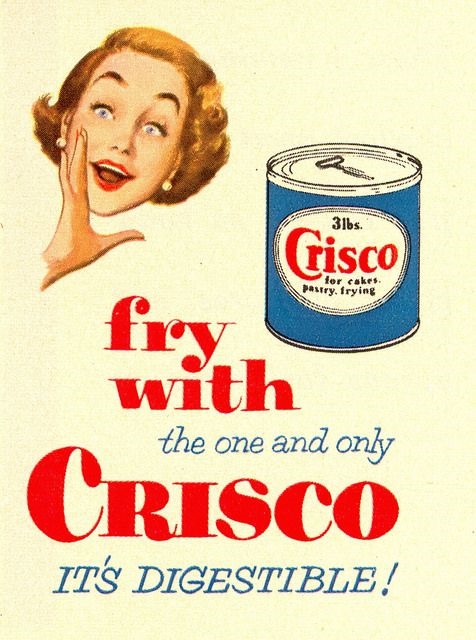
The result: Crisco. Crystallised cottonseed oil. Industrial textile waste transformed through chemical processing into something white and solid that looks like lard. They patent it in 1907, launch commercially in 1911.
Now they have a problem. Nobody wants to eat industrial waste that's been chemically treated. Your grandmother cooks with lard and butter like humans have for thousands of years. Crisco needs to convince her that her traditional fats are deadly and this hydrogenated cotton-seed paste is better.
The marketing campaign is genius. They distribute free cookbooks with recipes specifically designed for Crisco. They sponsor cooking demonstrations. They target Jewish communities advertising Crisco as kosher: neither meat nor dairy. They run magazine adverts suggesting that modern, scientific families use Crisco while backwards rural people use lard.
But the real coup happens in 1948. The American Heart Association has $1,700 in their budget. They're a tiny organisation. Procter & Gamble donates $1.7 million. Suddenly the AHA has funding, influence, and a major corporate sponsor who manufactures vegetable oil.
1961: The AHA issues their first dietary guidelines. Avoid saturated fat from animals. Replace it with vegetable oils. Recommended oils: Crisco, Wesson, and other seed oils. The conflict is blatant. The organization issuing health advice is funded by the company that profits when people follow that advice.
Nobody seems troubled by this. Newspapers report the guidelines as objective science. Doctors repeat them to patients. Government agencies adopt them into policy. Industrial cotton-seed oil, chemically extracted and hydrogenated, becomes "heart-healthy" while butter becomes "artery-clogging poison."
1980s: Researchers discover that trans fats, created by hydrogenation, directly cause heart disease. They raise LDL, lower HDL, promote inflammation, and increase heart attack risk more than any other dietary fat. Crisco, as originally formulated, is catastrophically unhealthy. This takes 70 years to officially acknowledge.
Procter & Gamble's response: Quietly reformulate without admission of error. Remove hydrogenation, keep selling seed oils, never acknowledge that their "heart-healthy" product spent seven decades actively causing the disease it claimed to prevent.
Modern seed oils remain. Soybean, canola, corn, safflower oils everywhere. Same chemical extraction process. Same high-temperature refining. Same oxidation problems. Just without hydrogenation so trans fats stay below regulatory thresholds.
These oils oxidise rapidly when heated. They integrate into cell membranes where they create inflammatory signalling for months or years. They're rich in omega-6 fatty acids that promote inflammation. They've never existed in human diets at current consumption levels.
But they're cheap. Profitable. And the food industry has spent a century convincing everyone they're healthy. The alternative, admitting that industrial textile waste shouldn't have been turned into food, would require acknowledging the last 110 years of dietary advice was fundamentally corrupted from the start.
Your great-grandmother cooked with lard because that's what humans used for millennia. Then Procter & Gamble needed to sell soap alternatives and accidentally created the largest dietary change in human history.
We traded animal fats that built civilisations for factory waste that causes disease.
The soap company won. Your health lost.
🚨 Here is the full 42 minutes of my crew and I exposing Minnesota fraud, this might be my most important work yet. We uncovered over $110,000,000 in ONE day. Like it and share it around like wildfire! Its time to hold these corrupt politicians and fraudsters accountable
We ALL work way too hard and pay too much in taxes for this to be happening, the fraud must be stopped.
@GrumpyFox9@MNThinkTank The State “manages” the money collected from the employer, that will pay the employee. The State can not pay the employee money it hasn’t first collected from an employer.
How do you know the No Kings protest was a bust?
The Left is showing videos from 2017 trying to convince Americans they were from today.
It was that bad.
Statement from Andrea Baccarelli, M.D., Ph.D., Dean of the Faculty at Harvard T.H. Chan School of Public Health:
"We found evidence of an association between exposure to acetaminophen during pregnancy and increased incidence of neurodevelopmental disorders in children..."
@gatorgar Yes! Go online and learn what time mass is being held and just show up. Go a couple times to get the feel of the congregation. Go to as many churches as you need, until you find one that feels to you like home.