Satya Nadella just introduced a concept that's going to change how every company thinks about AI. He's calling it "token capital." And once you understand it, you can't unsee it.
His idea: every company now needs two types of capital.
Human capital : the knowledge, judgment, and pattern recognition of your people.
Token capital : the AI capability your company builds and owns.
Human capital doesn't become less valuable as AI grows. It becomes more valuable. Without human direction, AI just runs in circles.
The real opportunity isn't picking the best model. It's building a learning loop where your people and your AI compound together. That loop becomes your real IP.
But here's the warning nobody expected from a CEO pushing AI harder than anyone.
He compared what's happening now to globalization. GDP looked fine on the surface but entire economies were hollowed out by outsourcing.
He's saying don't let that happen with AI where a few models capture all the value while industries get their knowledge commoditized underneath them.
His line: "You can offload a task. You can offload a job. But you can never offload your learning."
The companies that build the learning loop early will have an advantage that's nearly impossible to replicate. Regardless of which model is on
If PENCOM is making an exception for Dangote Refineries, you should pay attention.
According to the latest data released by the National Pension Commission (PenCom), pension assets reached:
•₦29.52 trillion in March 2026
The majority of the funds are invested in:
•Nigerian federal government securities (about 60%+)
•Domestic equities
•Money market instruments
•Corporate debt
•Infrastructure and private equity funds
Dangote Petroleum Refinery falls under Domestic Equities
Krishna Rao is the CFO of Anthropic, and this is his first podcast appearance.
He joined the company two years ago when run-rate revenue was about $250M. Today it is $30B. He has helped raise ~$75B and is responsible for the procurement and allocation of compute.
I feel lucky we get to hear what it is like to sit inside a company this consequential at a moment this pivotal.
We discuss:
- The cone of uncertainty
- How he allocates compute across Trainium, TPUs, and GPUs
- What investors misunderstand about model companies
- Why the returns to frontier intelligence keep rising
- Platform vs application and where Anthropic builds its own products
- How Anthropic uses Claude internally
I have asked my closing question about the kindest thing more than 500 times. Krishna's answer is one I have never heard before.
Enjoy!
Timestamps:
0:00 Intro
2:38 The Compute Canvas
6:51 The "Cone of Uncertainty"
11:58 Why the Returns to Frontier Intelligence Are So High
16:45 Recursive Self-Improvement
20:20 Scaling Laws
23:30 Sourcing $100 Billion in Compute
28:05 Platform vs. Application Strategy
32:52 Pricing Dynamics
38:48 How Anthropic’s Finance Team Uses Claude
43:24 Raising Capital & Overcoming Investor Skepticism
52:32 Public Perception, Risks, and Government Regulation
57:25 Mythos Release
1:12:33 What Could Derail the AI Revolution?
1:13:47 Biotech and Healthcare
1:15:31 The Kindest Thing
People have asked me how I feel about Udemy’s sale to Coursera. Honestly, I’m kinda pissed about it.
I want to be clear - I’m grateful for the opportunity to start and benefit from Udemy’s success. It changed my life.
But there’s another side to Udemy. A story of what could have been.
After our Series B, founders owned less than 30% of the company. Our investors took over and installed their own CEO to run it. We all liked this new CEO and honestly, for years it looked like a brilliant move. The company kept growing and growing. They launched B2B and built a $500M ARR business. Eventually, the company IPO’ed for $3B.
Yet all along there were clear cracks under the surface. Over Udemy’s history, there have been 7 CEO’s. The board replaced the second CEO with dud after dud. I’d often try to meet with the board or the new CEO, and was completely ignored. Eren had influence as Chairman of the Board but Oktay and I were so ignored they didn’t even invite us to the IPO. LOL WTF. There are like 50+ people invited to these things and nobody thought: “oh maybe we should invite the people who fucking invented the thing we’re all celebrating.” It shows how little respect they had for founders and for product innovation as a discipline.
I think they wanted a CEO they could control, a buttoned-up suit instead of a brash founder/CEO that is risk-taking, visionary, but a bit of a pain. For awhile, it looked like it didn’t even matter who was CEO - the company was run by the incredibly talented team that reported to them anyways.
Well, it worked until it didn’t.
The company made no major product innovations for 15 years. Instead, they took the original idea (video-based courses) and sold it in every place imaginable. It got us to $800M run-rate. That’s no joke; that takes serious execution and a great team that hustled hard to win the market.
But eventually the consumer business stopped growing. The B2B business has now flattened out as well. Meanwhile, Coursera was catching up.
Original Coursera was a far worse product than Udemy, but it got a ton of press. Learning ivory tower bullshit from academics doesn’t get you a real education, but it does create prestige. They raised from better investors on better terms, and had better leadership.
Udemy to this day has more revenue than Coursera, but Coursera won the court of investor opinion. They got higher multiples from both private and public markets.
Coursera innovated heavily. They added corporate courses to their university catalog, built fully-online degree programs, and offered a B2B competitor that kept Udemy on its toes. Still, the Udemy B2B business (and team) out-performed and so the two companies were deadlocked. Coursera was better at B2C, Udemy at B2B.
A merger was inevitable.
But WHY IN GODS NAME did we sell to Coursera instead of the other way around? Why are the combined companies under $3B in market cap?
Three reasons:
First, edtech didn’t live up to its promise. While these two companies had solid revenue and cash positions, their growth slowed, and public markets balked. This meant compressed multiples and significantly lower valuations.
Second, the companies stopped innovating. They are selling a product to businesses that their customers don’t love. They were category leaders, but they lead the category into mediocrity. They captured a significant share of learning and development (L&D) spending, but L&D as a whole actually lost budget within their organizations. That’s Udemy’s fault, and it doesn’t even realize it.
That brings me to my final point: I personally believe Udemy traded upside opportunity for downside risk. Us founders were unproven and young. We made lots of mistakes, including fighting amongst ourselves. A good investor would have supported us through it because they believe founders drive the highest long-term returns. Instead, they brought in outside CEOs to replace us. I sometimes wonder if they recognize this error; everyone makes mistakes and maybe they learned from it.
Either way - the consequences are real. By ignoring the founders, Udemy failed to innovate, which led to slowing growth which led to mediocre public market results. Furthermore, they don’t have a good evangelist and public markets don’t like a headless horse.
I sold my Udemy stock awhile ago. I think the merger was critical for both companies’ survival. Now, though, the new combined entity needs to innovate again.
On B2B, Coursera needs to help L&D become the heroes of the AI era so the entire market starts growing again. On B2C, they need to build the most educational AI product on the planet. (I’d focus on the former, since the latter is a lot harder and riskier).
Coursera can still achieve our original vision and likely build a $10B+ company in the meantime. Even though I’ve got no stake in its future, I’m mission-driven and I REALLY hope they figure it out.
The current education system sucks and the world deserves something better.
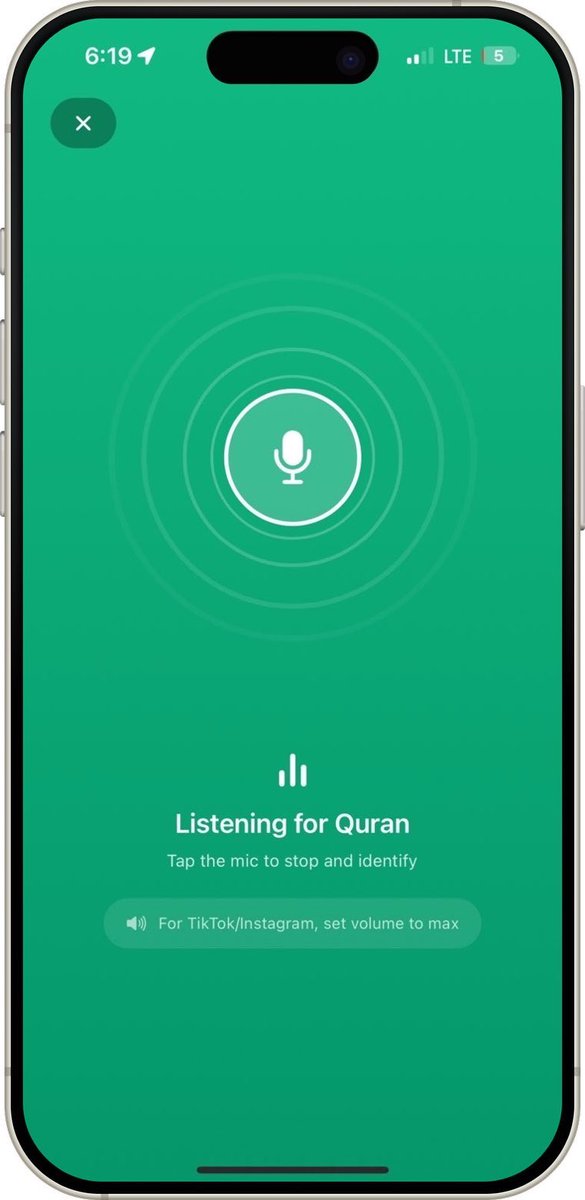
over the weekend... I built the Shazam for Quran 📖
ever hear a beautiful Quran recitation and wonder "what Surah is this?" or "what does this Ayah mean?"
It identifies:
- any Quran recitation (Surah & Ayah)
- complete tafsir & translation
- AI-powered insights
- historical context of revelation
- and much more
perfect for Taraweeh, TikTok, or anywhere you hear Quran
download for ios: https://t.co/SdKnI2Uqzx
Gaskiya dai I cannot attend any type of event for my wedding. Whoever I am marrying is free to throw whatever type of event she wants if she insists, she should just know I won’t be there, I will patiently wait for her pictures from the comfort of my room
Introducing Anything Max: Vibe Coding that's leaps above Lovable and Bolt
We've raised money at a $100M valuation and built what we believe is the future of vibe coding.
We asked 100 vibe coders to build their apps side by side on Lovable, Bolt, and Anything Max and they rated Anything Max the winner across all 3 categories - accuracy, design, and 'overall'.
Here's why:
• Full-stack control: Max can test backend hooks, branch database states, and debug issues, because Anything owns the full infrastructure.
• Max can load up your app in its own browser and click on all buttons like a human tester to find all edge case bugs, then trace the bug across the stack - could be a frontend, backend, or a database issue (only we can do this, read #1) and autonomously fix it with 97% accuracy.
Lovable and Bolt build prototypes, but Max users are building production-ready apps and already charging money for them.
Blake built a gut biome app to $10K run rate
Anthony built a referral tool to $20k in revenue
Yuri built a suite of apps doing $40K
Build your app with Max: https://t.co/haQw8s04mB
--------------------------------------------
We're hosting a $100K Hackathon to help people grow their app to $10K MRR.
- We'll teach you everything we know about growing to 1M users.
- You'll have 30 days to build a real product in public and get paying customers for it.
If you do it well, you can start the New Year with a functioning business.
Retweet and comment “LFG”, and we’ll send you a $100 discount code and the link to participate