Associate Prof. in Machine Learning at University of Glasgow. I research computer vision/graphics, deep generative models, ML for sciences & healthcare
Vesuvius Challenge has been quietly making a lot of progress; we read a full scroll, developed a new unwrapping algorithm with a global spiral prior, and we just launched a new $1M grand prize for reading one of the scrolls we've scanned.
There are also 10 $50k prizes available for finding text in a scroll we haven't found text in before, plus monthly progress prizes.
Join the discord!
A new phase BEGINS! 🚀
🏆 $1M Grand Prize
💰 $2M+ in open prizes
👑 $20K awarded every month to the best submission
https://t.co/P6VuhVYK1L
Will you read the next scroll? 👀
Spread the word and repost! 🔁
There are two new permanent posts available at @GlasgowCS in AI/ML especially with HCI/ML in Science/Active Inference focus. Deadline 17th Feb
https://t.co/m30arKeDIc
New preprint! TL;DR = latent diffusion over 3d gaussian splats enables fast scene generation (0.2s for 50 ddim steps) from 0/1/few images
https://t.co/SySb0xPiux
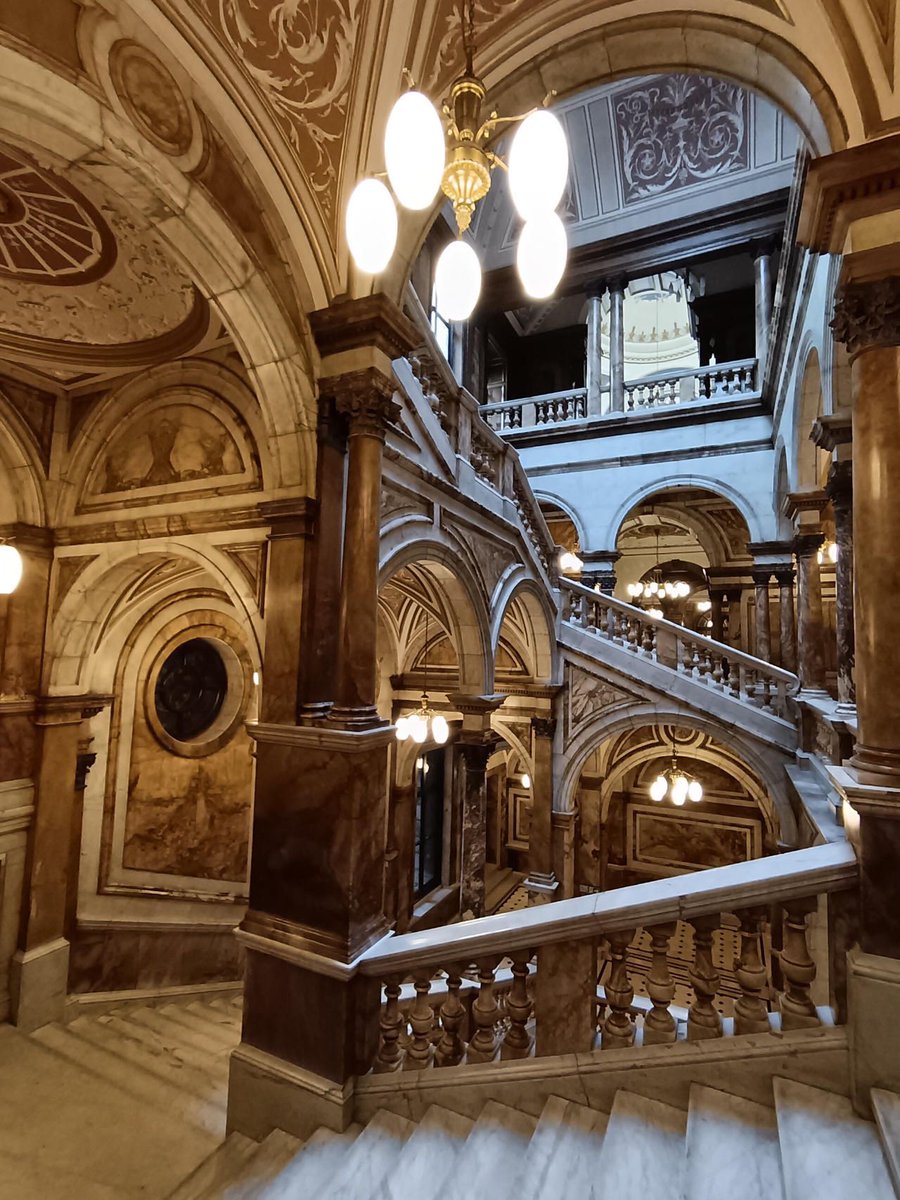
4 months to go for #BMVC2024! 🥳This is a sneak peak of the beautiful #Glasgow city chambers where we will be hosting the drink reception ! 🍻#VisitGlasgow Stay tuned for more updates!
Dr. Paul Henderson @pmh47_ml delivered a talk on "Structured Generative Models for Computer Vision" in the 27th BMVA Summer School in Durham University.
We design an autoencoder that maps multi-view images to 3D Gaussian splats, and simultaneously builds a compressed latent representation of these splats. Then, we train a multi-view diffusion model over the latent space to learn an efficient generative model
In Vienna? Interested in 3D generative models? Come chat at @anciukevicius's @iclr_conf#ICLR2024 poster later (Tuesday 16:30, #42) on Denoising Diffusion via Image-based Rendering
https://t.co/gVVmCv9rlf
Happy to announce our work on generative 3D reconstruction "Denoising Diffusion via Image-Based Rendering" is accepted at @iclr_conf.
Created by @Anciukevicius, partly during his Google-internship with @fedassa and Fabian Manhardt
A quick summary...
@CVAS_UofG@IDAglasgow
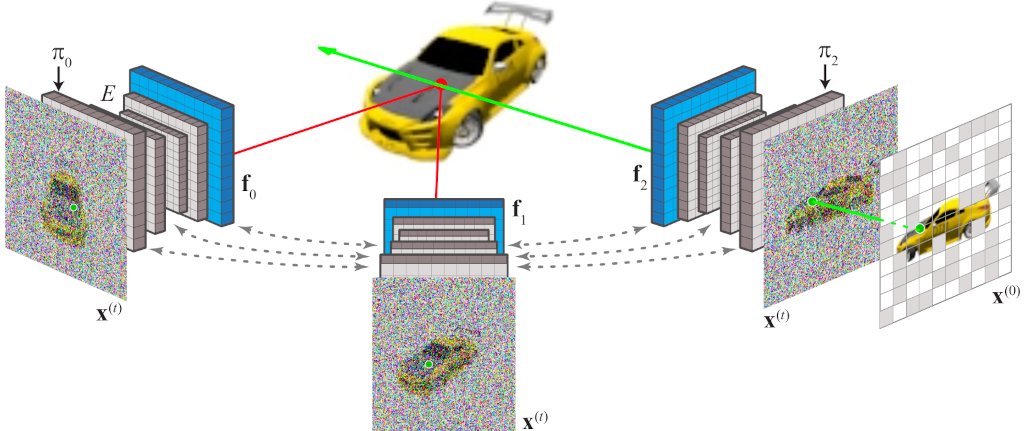
We show how to learn 3D diffusion models over large real-world scenes using only multiview images for training. It's standard diffusion training, BUT with a twist - the denoiser NN predicts a latent 3D scene representation before rendering to give clean pixels
It's similar in flavour to Viewset Diffusion (nice concurrent work from @StanSzymanowicz & @chrirupp) -- but ours avoids the bounded 3D feature volume. The image-based reprn enables generating 3D content anywhere that any camera sees, hence don't need to mask away background
Happy to announce our work on generative 3D reconstruction "Denoising Diffusion via Image-Based Rendering" is accepted at @iclr_conf.
Created by @Anciukevicius, partly during his Google-internship with @fedassa and Fabian Manhardt
A quick summary...
@CVAS_UofG@IDAglasgow
@iclr_conf@CVAS_UofG@InfAtEd@Anciukevicius See the project page https://t.co/BhnlZz8RBS for more examples rendered at much higher resolution (1024x1024 -- higher than any similar model)
...and here are the results on generative reconstruction from *one* input image, which I forgot before =)
This was trained end-to-end from images only, yet learns to create plausible details even in occluded areas
@iclr_conf@CVAS_UofG@InfAtEd@Anciukevicius
Happy to announce our work on generative 3D reconstruction "Denoising Diffusion via Image-Based Rendering" is accepted at @iclr_conf.
Created by @Anciukevicius, partly during his Google-internship with @fedassa and Fabian Manhardt
A quick summary...
@CVAS_UofG@IDAglasgow
Happy to announce our work on generative 3D reconstruction "Denoising Diffusion via Image-Based Rendering" is accepted at @iclr_conf.
Created by @Anciukevicius, partly during his Google-internship with @fedassa and Fabian Manhardt
A quick summary...
@CVAS_UofG@IDAglasgow
In this #ICLR2024 work, we use an image-based scene representation we call IB-planes, where features unprojected from each camera are fused to by an MLP to define local appearance/density (similar to PixelNeRF)