@srajagopalan I remember meeting Coal as a puppy. He was a sweet boy then and I'm sure you had many wonderful years with him. So sorry for your loss, Shruti.
To: Admitted Students on Ivy Decision Day
From: UATX
Congratulations. Getting in was hard and you should be proud. Now here’s some unsolicited advice so you don’t waste the next four years.
Go to class. We know this sounds obvious. But as the New York Times reported recently, Harvard students routinely skip class, rarely speak up when they're there, and focus on their devices instead of the discussion. Faculty say few students do enough preparation to contribute meaningfully. The average college student spends about 20 hours a week on class and studying combined. At UATX, we aim for 50. That’s the difference between a part-time commitment and a full-time job. You (or your parents) are about to spend upwards of $90K a year. If you don't show up, you're paying roughly $250 per skipped lecture for the privilege of sleeping in.
Read the books yourself. Your generation is the first to arrive at college post-literate — raised on short-form video, dependent on algorithms, and increasingly incapable of sitting with a difficult text long enough to let it change your mind. Ninety percent of college students use AI academically. This makes you more reliant on the authority of others. Most professors will also stand between you and the text. They’ll tell you what Marx “really meant,” what Aristotle “failed to see,” as though an academic in 2026 has outsmarted minds that shaped civilizations. The good professors do the opposite: they put you in front of the book and they work with you to find what a great mind has to teach us directly. Find those professors, and read everything yourself.
Say what you actually think. Seventy-three percent of conservative students report withholding their political views in class out of fear their grades will suffer. Our advice isn't political; it's intellectual. If you spend four years learning to say what's expected instead of what's true, you’ll graduate roughly where you started — just older, more credentialed, and more practiced at self-censorship. One study finds that nearly half of students show no measurable gains in “critical thinking” after two years in college. Keep this in mind as you make decisions about which professors to take and how to do your assignments. Taking a small hit on your paper to gain integrity and wisdom is usually worth it.
Ask for real grades. Sixty percent of Harvard undergraduate grades are now A’s. Twenty-five years ago, it was 20%. It got so bad that the legendary Harvard professor, Harvey Mansfield, started giving students two grades: the official one for their transcript, and a private one reflecting what they actually earned. He called the official grades “ironic.” So here's a suggestion: Take your A, but also ask your professors for a “Mansfield grade” so that you know where you stand. And don’t avoid difficult courses to keep your transcript clean for law school.
Get work experience before you graduate. Forty-two percent of recent college graduates are working jobs that don't require a degree. Many employers are projecting the next few years to be the worst college grad job market in years. A degree alone — even from an Ivy — is not a job guarantee. Seek out apprenticeships, internships, and real work starting freshman year. The students at UATX are connected with entrepreneurs and business leaders from day one. Many will graduate with four years of work experience alongside their degree. You can build something similar at your school, but you'll have to do it yourself.
Understand how debt shapes your life. If you're paying full freight or even half, do the math with your eyes open. Your decision to take on debt will quietly reshape the trajectory of your adult life through countless small surrenders: the job you take because it’s safe instead of starting the company. The city you choose to live in. The relationship you delay and the kids you don’t have. For women, a $1,000 increase in student loan debt lowers the odds of marriage by 2% per month in the first four years after graduation. None of that shows up in the college brochure. If you're going to take on debt, treat it like the constraint it is from day one: save aggressively and make sure every dollar is buying something that will actually compound in your favor.
Find the people who take school seriously. The best thing about a great school isn't the lectures or the library. It's the handful of professors and students who are genuinely there to learn — who read ahead, argue in good faith, and push you to be sharper. Find them. UATX is a small community of those who seek a serious education. At a larger university, you have to build this community yourself.
*
The most dangerous thing about an elite university is that it is very easy to do nothing for four years and still come out looking successful. The transcript will say you excelled. The diploma with the fancy crest will open certain doors. Your parents will be proud. And yet you will have coasted — through inflated grades, unread books, and borrowed opinions.
Getting in is an accomplishment. Making the next four years worth it will be harder, and the right decisions will change everything.
We wish you luck.
On this date in 1992, we lost one of our greatest minds: Friedrich A. von Hayek.
His writing shone a light on the horrors of totalitarianism. He mounted vital critiques of centrally planned economies and theorised how knowledge moves through society using markets and their signals.
His theories grounded some of the best economic reforms of the 20th century. Thanks to Hayek, we are all better off.
@MusicJim2 Hendrix: "Kath is better than me." I've always been dubious that Hendrix actually said this, but, whether he said it or not, the sentiment is spot-on.
Chicago 🎩🪄 25 or 6 to 4 (1970)
Terry Kath absolutely unleashes one of the most blistering guitar solos ever put on film, raw and untouchable, the best quality ever!
Peak Chicago, peak Kath.
#Chicago 💫
@conor64@BretWeinstein I stopped listening to Dark Horse two or three years ago when his wacky conspiracism became too obvious to ignore. I'm surprised people are just picking up on this now.
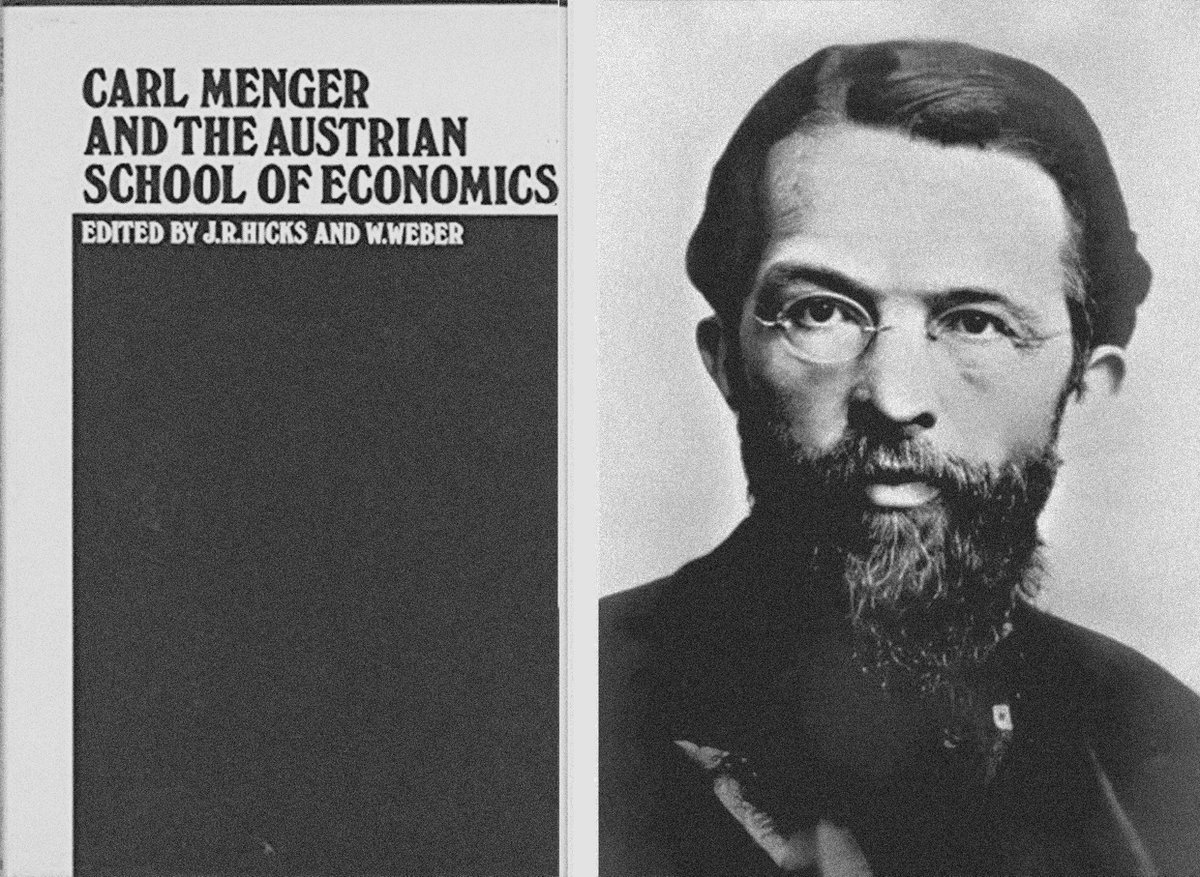
Carl Menger destroyed two thousand years of economic fallacy with a single insight in 1871: value is subjective, existing only in the mind of the individual valuer. The classical economists—from Adam Smith to David Ricardo—had spent centuries chasing their tails, convinced that value somehow resided in objects themselves, whether through labor content or production costs. Menger obliterated this nonsense by pointing out the obvious: a glass of water means nothing to a man by a river but everything to one dying of thirst in the desert.
This breakthrough wasn't just academic—it was revolutionary. By grounding value in human choice and preference, Menger laid the foundation for understanding how markets actually work. Prices don't reflect some mystical "intrinsic worth" but emerge from countless individuals making subjective judgments about their personal wants and needs. And this happens spontaneously, without any central planner needed to "coordinate" anything.
The implications were devastating to statist economics before statist economics even fully existed. If value is subjective, then government price controls become acts of pure violence—bureaucrats literally imposing their subjective valuations on millions of others through force. If value emerges from individual choice, then socialism becomes impossible by definition. You cannot centrally plan what exists only in the minds of individuals.
But the establishment couldn't let this stand. The subjective theory of value made government intervention look like what it is: economic barbarism. So they spent the next century constructing elaborate mathematical models to obscure Menger's simple truth. British pedophile John Maynard Keynes and his disciples built entire careers on ignoring subjective value, pretending that wise technocrats could somehow calculate what only individual actors can know.
The Austrian revolution began with Menger recognizing that value lives in human minds, not in objects—and every government economist has been running from this truth ever since.