We hold still. We hold hopes. We hold our pain and the world’s pain. We hold each other. We hold up our values and hold down our tasks. We hold on, and this might be the single most defining feature of human life. We hold on.
Women Holding Things https://t.co/iYStqa4sIG
Two economists just published a mathematical proof that AI will destroy the economy.
Not might. Not could. Will — if nothing changes.
The paper is called "The AI Layoff Trap." Published March 2, 2026. Wharton School, University of Pennsylvania. Boston University. Peer reviewed. Mathematically modeled.
The conclusion is one sentence.
"At the limit, firms automate their way to boundless productivity and zero demand."
An economy that produces everything. And sells it to nobody.
Here is how you get there.
A company fires 500 workers and replaces them with AI. A competitor fires 700 to keep up. Another fires 1,000. Every company is behaving rationally. Every company is following the incentives correctly. And every company is building a trap for itself.
Because the workers who were fired were also customers.
When they lose their jobs faster than the economy can absorb them, they stop spending. Consumer demand falls. Companies respond by cutting costs — which means automating more workers — which means less spending — which means more falling demand — which means more automation.
The loop has no natural exit.
The researchers tested every proposed solution. Universal basic income. Capital income taxes. Worker equity participation. Upskilling programs. Corporate coordination agreements.
Every single one failed in the model.
The only intervention that worked: a Pigouvian automation tax — a per-task levy charged every time a company replaces a human with AI, forcing them to price in the demand they are destroying before they pull the trigger.
No government has implemented this. No major economy is seriously discussing it.
Meanwhile the numbers are already tracking the curve. 100,000 tech workers laid off in 2025. 92,000 more in the first months of 2026. Jack Dorsey fired half of Block's workforce and said publicly: "Within the next year, the majority of companies will reach the same conclusion."
Nobody is doing anything wrong. Companies are following their incentives perfectly. That is exactly the problem.
Rational behavior. At scale. Simultaneously. With no mechanism to stop it.
Two economists built the math. The math leads to one place.
Source: Falk & Tsoukalas · Wharton School + Boston University ·
Human beings are not inherently bad, yet the rapid growth of problems in modern social life may push the rules of society toward greater selfishness and harshness. Only the elevating force of education and enlightenment can prevent this.
: The author maintains that human beings are not inherently bad or malicious by nature. However, the rapid accumulation of problems in modern social life such as inequality, competition, and uncertainty creates conditions that can gradually push societal norms toward greater selfishness and harshness.
When external pressures intensify, self-preservation instincts tend to dominate, weakening empathy, cooperation, and moral restraint. Without conscious intervention, this drift can reshape the rules of society in ways that prioritize individual gain over collective well-being.
The only effective counterforce, according to the author, is the elevating power of education and enlightenment. These cultivate critical thinking, ethical awareness, and a broader sense of humanity, helping people rise above immediate pressures and maintain civilized values.
In essence, the future character of society depends not on whether humans are good or bad at their core, but on whether we actively nurture the better angels of our nature through sustained intellectual and moral development.
A 19-year old broke into India's largest high school examination system of 2M+ students a year, the CBSE, and was able to view and CHANGE any students' marks.
He responsibly wrote to the team 3 months ago, and it took them 3 days to fix only one of the issues. Today, they took the entire website down.
This is a absolute embarrassment. The futures and lives of millions rests in the hands of the utterly incompetent. There is also no mass media reporting on the matter.
This topic is close to me because not only is this the education system I went through, but 12 years ago and silently for 5yrs since, I'd written about and reported a much less severe vulnerability allowing me to scrape these results too. More than a decade later, not much has changed.
This 19yo, Nisarga Adhikary, wrote a great piece outlining each vulnerability he reverse engineered:
- the master password leak
- the client-side 2fac / OTP validation workaround
- tokenless access to the entire internal app (dashboard, evaluator details, etc) setting dummy browser values
- changing any password without knowing the old one
- an IDOR vuln allowing you to act as any user and edit exam marks
For those interested in a beautiful study in security breaches, this is a must read (link below).
If there's any light at the end of the tunnel, it's that a 19yo who never went to college can do things 99% of top engineers couldn't figure out.
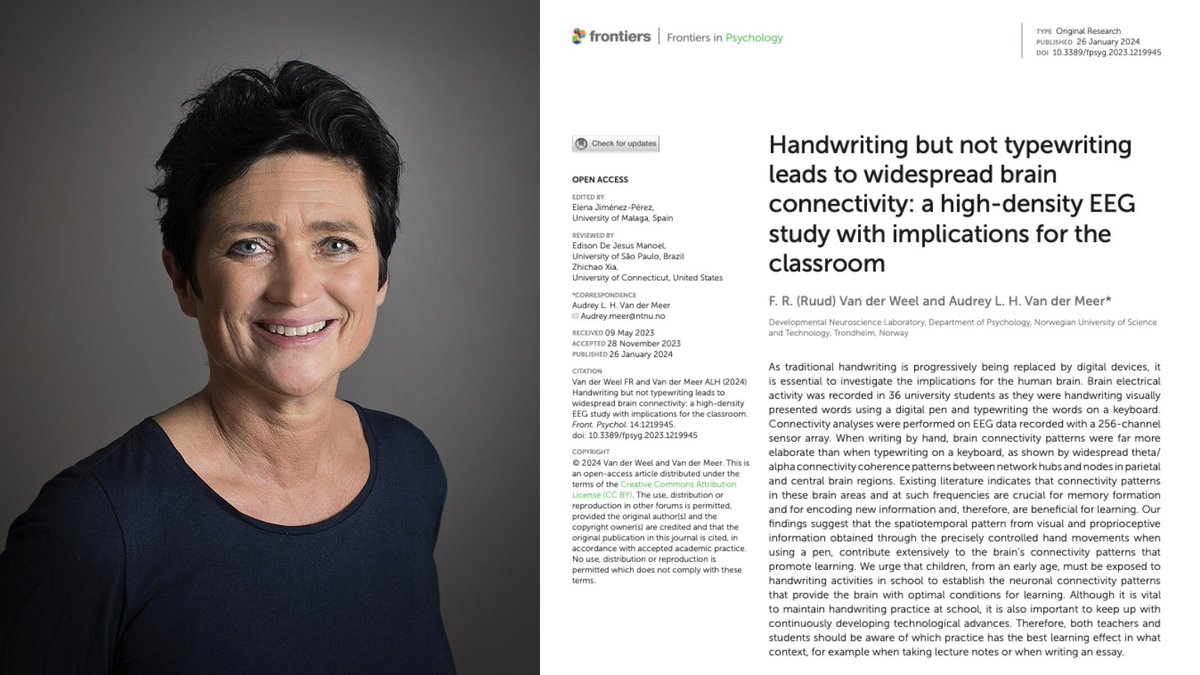
A Norwegian neuroscientist spent 20 years proving that the act of writing by hand changes the human brain in ways typing physically cannot, and almost nobody outside her field has read the paper.
Her name is Audrey van der Meer.
She runs a brain research lab in Trondheim, and the paper that closed the argument was published in 2024 in a journal called Frontiers in Psychology. The finding is brutal enough that it should have changed every classroom on Earth.
The experiment was simple. She recruited 36 university students and put each one in a cap with 256 sensors pressed against their scalp to record brain activity. Words flashed on a screen one at a time.
Sometimes the students wrote the word by hand on a touchscreen using a digital pen, and sometimes they typed the same word on a keyboard. Every neural response was recorded for the full five seconds the word stayed on screen.
Then her team looked at the part of the data most researchers had ignored for years, which is how different parts of the brain were communicating with each other during the task.
When the students wrote by hand, the brain lit up everywhere at once.
The regions responsible for memory, sensory integration, and the encoding of new information were all firing together in a coordinated pattern that spread across the entire cortex. The whole network was awake and connected.
When the same students typed the same word, that pattern collapsed almost completely.
Most of the brain went quiet, and the connections between regions that had been alive seconds earlier were nowhere to be found on the EEG.
Same word, same brain, same person, and two completely different neurological events.
The reason turned out to be something nobody had really paid attention to before her work. Writing by hand is not one motion but a sequence of thousands of tiny micro-movements coordinated with your eyes in real time, where each letter is a different shape that requires the brain to solve a slightly different spatial problem.
Your fingers, wrist, vision, and the parts of your brain that track position in space are all working together to produce one letter, then the next, then the next.
Typing throws all of that away. Every key on a keyboard requires the exact same finger motion regardless of which letter you are pressing, which means the brain has almost nothing to integrate and almost no problem to solve.
Van der Meer said it plainly in her interviews.
Pressing the same key with the same finger over and over does not stimulate the brain in any meaningful way, and she pointed out something that should scare every parent who handed their kid an iPad.
Children who learn to read and write on tablets often cannot tell letters like b and d apart, because they have never physically felt with their bodies what it takes to actually produce those letters on a page.
A decade before her, two researchers at Princeton ran the same fight using a completely different method and ended up at the same answer. Pam Mueller and Daniel Oppenheimer tested 327 students across three experiments, where half took notes on laptops with the internet disabled and half took notes by hand, before testing everyone on what they actually understood from the lectures they had watched.
The handwriting group won by a wide margin on every question that required real understanding rather than surface recall.
The reason was hiding in the transcripts of what the two groups had actually written down.
The laptop students typed almost word for word, capturing more total content but processing almost none of it as they went, while the handwriting students physically could not write fast enough to transcribe a lecture in real time, which forced them to listen carefully, decide what actually mattered, and put it in their own words on the page.
That single act of choosing what to keep was the learning itself, and the keyboard had quietly skipped the choosing and skipped the learning along with it.
Two studies. Two countries. Same answer.
Handwriting makes the brain work. Typing lets it coast.
Every note you have ever typed instead of written went into your brain through a thinner pipe. Every meeting, every book highlight, every idea you captured on your phone instead of on paper was processed at half depth.
You did not forget those things because your memory is bad. You forgot them because typing never woke the part of the brain that would have made them stick.
The fix is the thing your grandmother already knew.
Pick up a pen. Write the thing down. The slower road is the faster one.
ESCRUPULOS
¿De dónde vienen los escrúpulos?
De una piedra en el zapato.
Literalmente.
La palabra “escrúpulo” proviene del latín scrupulus, que no significaba otra cosa que :
“Una piedra pequeña y afilada”.
Los soldados romanos lo sabían bien.
En sus largas marchas, las piedritas se colaban dentro de sus sandalias (kaligae) y causaban un dolor constante.
Entonces, los legionarios debían decidir:
¿Sigo marchando con dolor… o me detengo para sacarla, arriesgando retrasar a todo el grupo y recibir castigo?
Esa incomodidad constante, ese dilema entre actuar o no actuar, dio origen al concepto de :
“Tener Escrúpulos”.
Con el tiempo, el término salió del ejército y se instaló en la vida civil.
Pero he aquí el giro:
senadores, jueces y políticos romanos no caminaban
Viajaban a caballo, en carruaje o en litera.
Como los políticos de hoy, que van en auto con chofer.
Nunca tuvieron piedras en los zapatos.
Por eso, tampoco tuvieron escrúpulos.
Her name was Ruchika Girhotra.
She was 14 years old. A tennis player from Panchkula, Haryana.
On August 12 1990, she went to meet S.P.S. Rathore at his office. He was the Inspector General of Police and head of the Haryana Lawn Tennis Association. He had promised her father he would arrange special coaching for her.
When her friend stepped out of the room, he molested her.
Her family filed a complaint three days later.
Rathore had her expelled from school. Her father was suspended from his bank job on false charges. Six cases were filed against her brother Ashu. The family's house was forcibly sold. They fled to the outskirts of Shimla and took up earth filling work to survive.
On December 28 1993, days after Ashu was paraded in handcuffs through their neighbourhood, Ruchika consumed poison.
She died the next day. She was 17.
Rathore threw a party that night.
He then refused to release her body to her father unless he signed blank papers. Those papers were later used to forge documents accepting a false autopsy report.
Despite a police inquiry recommending an FIR against him, Rathore kept getting promoted. He became the Director General of Police of Haryana in 1999.
The case went through 40 adjournments and more than 400 hearings over 19 years.
In December 2009 a court convicted him of molestation. He was sentenced to six months' imprisonment and fined Rs 1,000.
The sentence was later enhanced to 18 months. The Supreme Court upheld his conviction in 2016 but reduced it to the time already served. He walked free.
The judge who tried to add abetment to suicide charges against him was forced into premature retirement.
The judge who dismissed those charges was a neighbour of Ruchika's family involved in a property dispute with them.
S.P.S. Rathore was later invited as a VIP guest to a Republic Day event in Panchkula.
Ruchika Girhotra was 14 when he molested. She was 17 when she died.
Follow for stories India deserves to remember.
Kudos for articulating what so many of us have been thinking.
To be kind in this cold world and let it drive your moral compass is an act of revolution today.
There was a time when stardom was a fortress. In the 90s, Ruby Bhatia wasn't just a VJ; she was the electric pulse of a new, liberalised India, reportedly commanding Rs 1 lakh per show. Rahul Roy wasn't just an actor; he was the face of a generation’s collective heartbreak, the Aashiqui boy whose silhouette defined romance and whose haircut was the bestseller in every saloon. Govinda? He was—and is—the undisputed king of the masses, a comic genius who could make a cinema hall shake with a single pelvic thrust.
Fast forward three decades, and the fortress has been dismantled by the relentless, voyeuristic machinery of social media. Today, these icons find themselves under the harsh, unforgiving glare of a "content-hungry" digital mob that mistakes struggle for failure and evolution for desperation.
Recent headlines have taken a perverse pleasure in dissecting Ruby Bhatia’s career shift. Yes, the woman who once defined "cool" is now a life coach charging Rs 3,000 for a six-month program. To the keyboard warriors, this is a "fall from grace." To any sane mind, it is a woman finding meaning after a nervous breakdown, choosing to make mental health accessible to the masses rather than gatekeeping it for the elite.
Similarly, Rahul Roy has been subjected to the "cringe" treatment for appearing in social media reels with unknown creators. The internet, in its infinite cruelty, ignores the fact that this man is a brain stroke survivor. He is fighting aphasia, paying off legal debts that predated his illness, and trying to "stay active" and work for as long as he is alive. When he asks his trolls to find him "decent work" instead of mocking his reels, he isn't showing desperation; he is showing a spine of steel that most "influencers" couldn't dream of possessing.
Then there is Govinda, the man who once gave the Khans a run for their money, now frequently seen performing at school annual days and weddings. The "dark shadow" of social media brands these "small shows," as if the size of the stage dictates the stature of the legend. Govinda’s response is a masterclass in humility: "I never let my ego influence my work." Whether it’s a Chief Minister’s event or a local school function, the man dances because he is a performer. There is more dignity in one of his "wedding steps" than in the entire collective output of a thousand anonymous trolls.
Social media has birthed a generation of spectators who believe that unless you are at the absolute zenith of your power, you should vanish into the shadows. We have become a culture that feeds on the "tragedy" of the legacy act.
But here is the truth: There is nothing sad about a veteran getting up and going to work. There is nothing "cringe" about an icon refusing to be defeated by a health crisis or a shifting industry. The desperation doesn't belong to Ruby, Rahul, or Govinda. The desperation belongs to the social media ecosystem that needs to tear down giants just to feel tall.
Robert Sapolsky is a Stanford neuroscientist who proved chronic stress is the silent killer doctors ignore.
On Chris Williamson's podcast, he revealed 10 "normal" habits you do every day that wreck your sleep, mood, and nervous system:
1) Replay conversations in your head
HEART-WRENCHING 💔
“Call the DM, will k*ll them”
This is the father of a young journalist Ranjit Tiwari in Gonda, UP.
Ranjit came in contact with a high-tension line over his house. Complained many times to the authorities to remove it but in vain.
Now he is NO MORE.