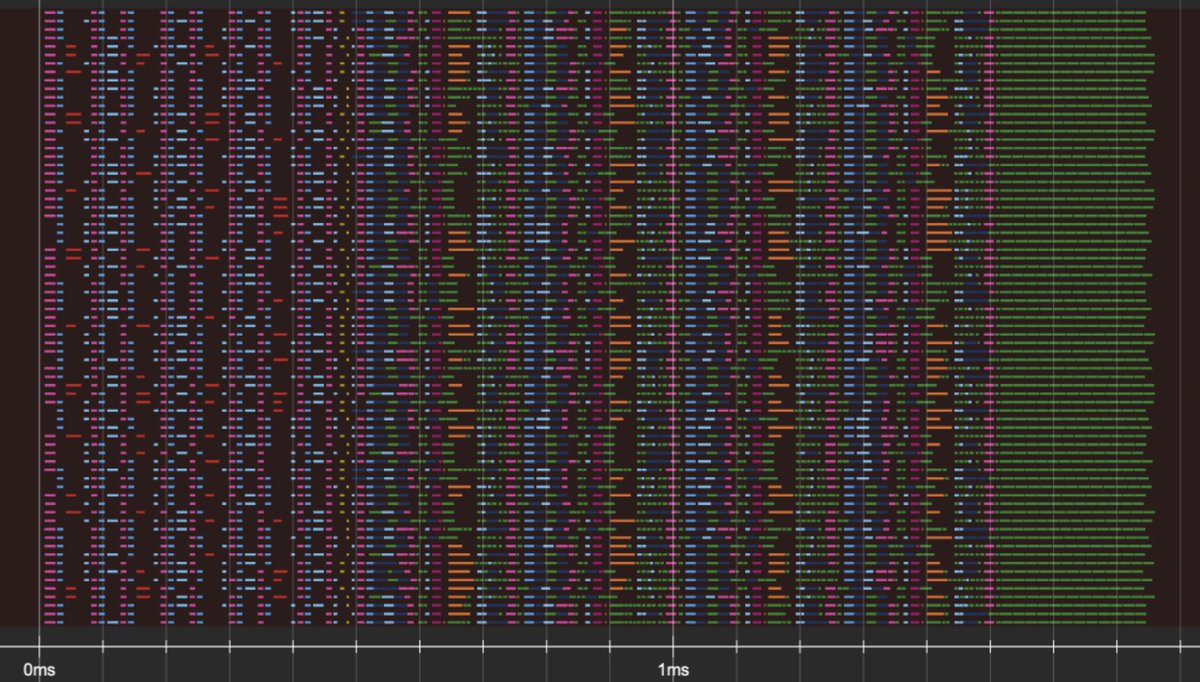
To express full training runs in a single kernel, we had to build general control-flow primitives. This lets us efficiently run weirder, more dynamic, fine-grained workloads than any other framework (we can run DOOM!).
Come join us if you want to build the future of GPU systems!
We’ve spent the past year developing new primitives for GPUs. We believe this enables new algorithms to change how machines learn, open new markets, and dramatically reshape AI’s cost structure.
We have raised a $1 billion Series A, co-led by Index and Lux.
Many take the inefficiencies in todays ML frameworks as a given. At flappy we have the audacity to build a replacement from the ground up, supplanting the traditional kernel model with a pipelined GPU-resident virtual machine.
(4/5) One thing we’ve built is a “kittens” virtual machine that takes over the whole GPU and allows new kinds of co-optimization. We can go past the traditional sequential kernel model – for example, fusing entire training runs into a single kernel and even weirder stuff.
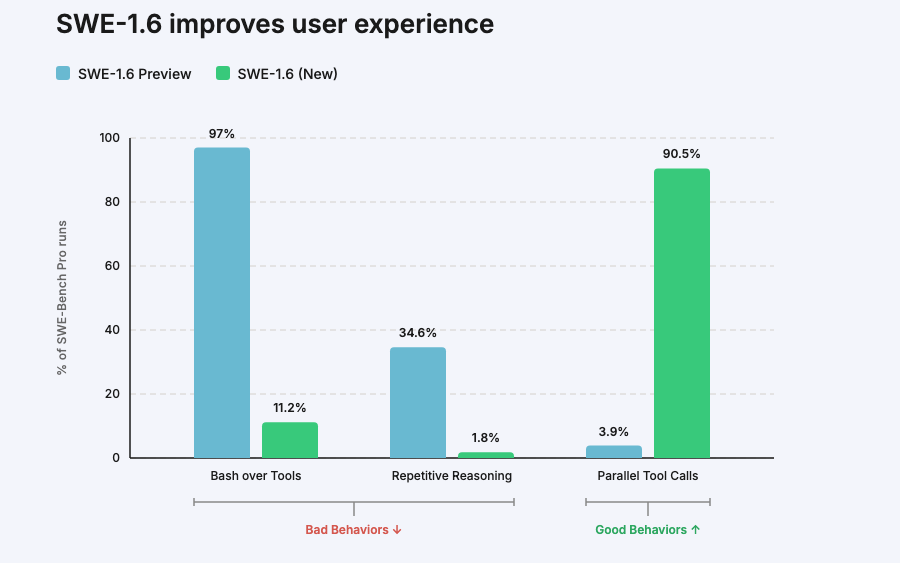
We’re releasing SWE-1.6, our best model in both intelligence & model UX. SWE-1.6 matches our Preview model on SWE-Bench Pro while dramatically improving on various behavioral axes.
It’s available today in Windsurf in two modes: free tier (200 tok/s) and fast tier (950 tok/s).
We’re releasing SWE-1.6, our best model in both intelligence & model UX. SWE-1.6 matches our Preview model on SWE-Bench Pro while dramatically improving on various behavioral axes.
It’s available today in Windsurf in two modes: free tier (200 tok/s) and fast tier (950 tok/s).
Introducing SWE-grep and SWE-grep-mini:
Cognition’s model family for fast agentic search at >2,800 TPS.
Surface the right files to your coding agent 20x faster.
Now rolling out gradually to Windsurf users via the Fast Context subagent – or try it in our new playground!
Wave 12 is here, and it’s a big one!
📚 DeepWiki-powered docs for every symbol in your codebase
🔍 Vibe and Replace
🐛 100+ bugs squashed
🎨 Brand new UI
… and more!
Everything that’s new 🧵
Cognition has signed a definitive agreement to acquire Windsurf.
The acquisition includes Windsurf’s IP, product, trademark and brand, and strong business. Above all, it includes Windsurf’s world-class people, whom we’re privileged to welcome to our team.
We are also honoring their talent and hard work in building Windsurf into the great business it is today. This transaction is structured so that 100% of Windsurf employees will participate financially. They will also have all vesting cliffs waived and will receive fully accelerated vesting for their work to date.
At Cognition we have focused on developing robust and secure autonomous agents, while Windsurf has pioneered the agentic IDE. Devin + Windsurf are a powerful combination for the developers we serve. Working side by side, we’ll soon enable you to plan tasks in an IDE powered by Devin’s codebase understanding, delegate chunks of work to multiple Devins in parallel, complete the highest-leverage parts yourself with the help of autocomplete, and stitch it all back together in the same IDE.
Cognition and Windsurf are united behind a shared vision for the future of software engineering, and there’s never been a better time to build. Welcome to our new colleagues from Windsurf!
Test-Time inference is cool! But also a a bit of a shoehorn: models are usually trained to generate a correct answer first try. This naturally steers them away from trying out riskier responses, even when allowed multiple attempts. Enter multi-turn training! See the 🧵for more.
Our research interns present:
Kevin-32B = K(ernel D)evin
It's the first open model trained using RL for writing CUDA kernels. We implemented multi-turn RL using GRPO (based on QwQ-32B) on the KernelBench dataset.
It outperforms top reasoning models (o3 & o4-mini)! 🧵
Syntactic constraints aren't enough. LLMs still make typing errors.
This paper adds type-aware decoding using prefix automata built from a language's type system.
Improves codegen, repair, and translation across multiple LLMs. Tested on TypeScript & HumanEval.
Generating *code* using a statistical prior about which token sequences are more likely is a fundamentally different task than generating *programs* by searching directly in the space of program dynamics