@FefeDemeny Lol. I have poor network connection and this looked like a photo. I was thinking "did Fefe really mean to post this"?? Please don't make it so easy for the haters 🙈
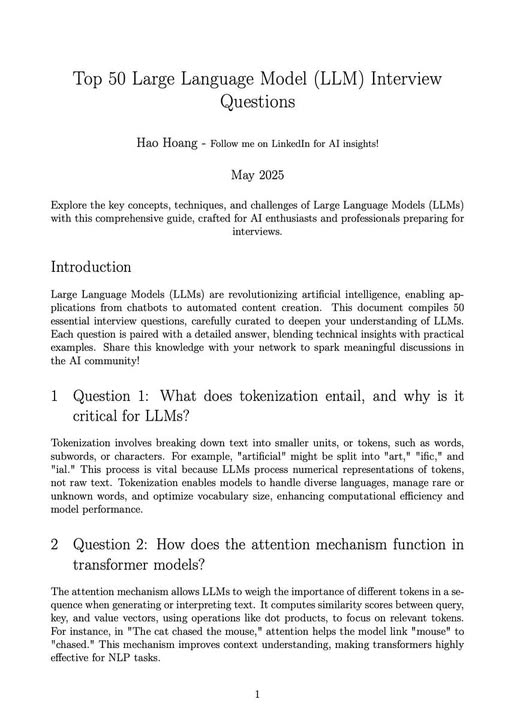
🚨 GOOGLE, META, OPENAI etc. BIG TECH are REJECTING JOB CANDIDATES BEFORE EVEN THEY FINISH TALKING.
50 LLM QUESTIONS. IF YOU CAN'T ANSWER THEM, THE INTERVIEW ENDS BEFORE IT STARTS.
The people passing these interviews are walking out with $200k+ offers.
Someone just LEAKED THE EXACT LLM INTERVIEW QUESTIONS these companies are asking right now.
And the gap between people who know these answers and people who do not is already costing careers.
Here is every category you need to know:
The Basics they always ask first:
↳ How does tokenization work and why does it matter
↳ How does attention actually work inside a transformer
↳ What is a context window and what breaks when it gets too big
↳ What are embeddings and how do they get initialized
↳ How does the model know word order without reading left to right
The fine-tuning questions that eliminate 80% of candidates:
↳ What is LoRA and why is it better than full fine-tuning
↳ What is QLoRA and when do you use it instead
↳ How do you fine-tune a model without making it forget everything it already knows
↳ What is model distillation and why do companies use it
↳ How do you handle vocabularies with millions of possible words
The generation questions most people guess on:
↳ Beam search vs greedy decoding, which one and when
↳ What temperature actually does to model output
↳ The difference between top-k and top-p sampling
↳ Why autoregressive models work differently from masked models
The advanced concepts that separate good from great:
↳ How RAG works and why it beats fine-tuning for factual accuracy
↳ Why Chain-of-Thought prompting makes models dramatically smarter
↳ What Mixture of Experts is and why every frontier model uses it now
↳ Zero-shot vs few-shot learning and when each one wins
The math questions that make people sweat:
↳ Why softmax is used inside attention and not something simpler
↳ What cross-entropy loss actually measures
↳ What KL divergence is and where it shows up in AI training
↳ Why vanishing gradients were destroying transformers and how they fixed it
If you are applying for any AI role in 2026 and you cannot answer at least 40 of these, you are not ready yet.
The full list of 50 questions is worth printing out and going through one by one.
Save this post. Your next interviewer has almost certainly pulled from this exact list.
🚨DID MORGAN STANLEY PULL OFF THE BIGGEST CRYPTO MANIPULATION?
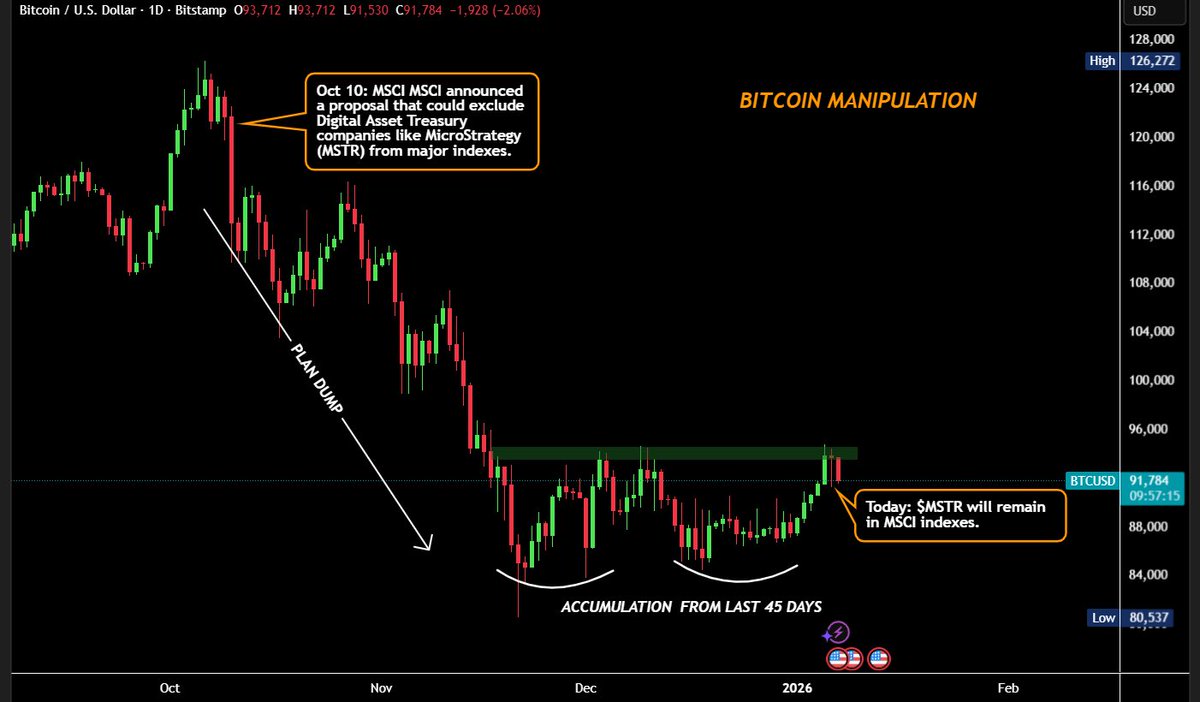
The sequence of Bitcoin’s October crash and January recovery looks like a planned setup, and the data supports it.
Let’s go through it 👇
1) OCTOBER 10: THE TRIGGER
On October 10, MSCI, originally a Morgan Stanley division, announced a proposal to remove Digital Asset Treasury Companies from its global indexes.
That included firms like MicroStrategy and Metaplanet, whose balance sheets hold billions worth of Bitcoin. This wasn’t a small change because MSCI indexes guide trillions of dollars in passive flows.
If those firms were removed:
• Pension funds and ETFs would be forced to sell
• Institutional exposure to Bitcoin would shrink
• Liquidity would tighten sharply
Minutes after the announcement, Bitcoin dropped nearly -$18,000, erasing more than $900 billion from crypto’s total market cap.
2) THEN THE 3-MONTH PRESSURE WINDOW.
The consultation stayed open until December 31, meaning three full months of uncertainty.
That overhang froze demand:
• Passive investors avoided exposure
• Index-linked funds risked forced selling
• Prices stayed weak
• Sentiment collapsed
During this period, Bitcoin dropped about 31%, altcoins even more.
It was the worst quarter for crypto since 2018.
3) JANUARY 1st: SUDDEN PUMP STARS
From Jan 1st, Bitcoin starts pumping without any bullish news, and in the first 5 days of 2026, Bitcoin jumped 8%, that’s a $7300 pump from $87,500 to $94,800.
No one knew why, but somehow the relentless selling stopped, and Bitcoin was printing back-to-back green candles.
These were probably insiders who knew what was coming in the next few days.
4) JANUARY 5th-6th: THE REVERSAL
Then, somehow, in 24 hours, everything flipped.
First, Morgan Stanley filed for its own spot Bitcoin, ETH, and Solana ETFs.
Then, in a few hours, MSCI announced that it would not remove the crypto-heavy companies after all.
The exact rule that caused three months of selling pressure was suddenly withdrawn the same day Morgan Stanley launched a product that benefits from a recovering market.
That’s not a coincidence.
Here’s the full sequence in order:
1. MSCI threatens index removals (October 10)
2. Crypto crashes, uncertainty lasts 3 months
3. Prices stay suppressed while institutions wait
4. Morgan Stanley files its ETF (January 5)
5. MSCI cancels the removal threat (January 6)
It’s a clear pattern:
Create pressure
accumulate at low prices
launch product
remove pressure
Make money
MSCI controls index inclusion.
Morgan Stanley controls capital distribution.
Together, they can influence how and when institutional money reaches Bitcoin.
The October crash wasn’t just market panic. It was a structural play.
Now that the overhang is gone, liquidity is returning, and the same players who engineered the pressure are positioned to profit from the rebound.
There is no official confirmation that this was coordinated, but the sequence, the timing, and who benefited raise real questions.
the digital product cheat sheet I wish I had when I started:
**finding your niche:**
don't pick what you're "passionate about"
pick the intersection of:
- what you know more than beginners
- what people actively pay to learn
- what you can talk about for 6+ months without getting bored
passion fades. profit sustains.
**product types ranked by speed to create:**
swipe file (copy-paste scripts): 2-3 hours
checklist/SOP: 2-4 hours
template pack: 3-5 hours
resource database: 4-6 hours
PDF guide: 5-8 hours
mini course: 15-25 hours
full course: 40-60 hours
start with the fast ones. upgrade later.
**pricing tiers that make sense:**
$19-$29: entry point, impulse buy, builds trust
$34-$50: sweet spot for most digital products
$67-$97: need social proof and testimonials
$150-$200: need established audience
$300+: need sales calls or serious credibility
most people price at $19 when they should price at $44.
**the content ratio:**
educational: 40%
stories/personal: 30%
engagement (questions, opinions): 20%
direct selling: 10%
flip this ratio and watch everyone unfollow.
**what to post when:**
morning: tutorials and how-to content
midday: personal stories and experiences
afternoon: hot takes and opinions
evening: longer breakdowns and threads
test your own audience but this is a solid starting framework.
**growth tactics ranked by effectiveness:**
1. valuable replies on bigger accounts (free exposure)
2. consistent daily posting (compounds over time)
3. engaging in first 30 mins after posting (algorithm boost)
4. collaborating with similar-sized accounts (cross-pollination)
5. threads that get bookmarked (high signal content)
most people skip #1. it's the fastest free growth.
**the tool stack:**
free tier:
- google docs (writing)
- canva free (design)
- gumroad (payments)
- convertkit free (email up to 1K subs)
paid tier worth it:
- canva pro: $13/month
- typefully or tweethunter: $12-49/month
- carrd: $19/year
total startup cost if broke: $0
total cost once profitable: under $100/month
**red flags your product won't sell:**
- you can't explain who it's for in one sentence
- you made it without asking anyone if they wanted it
- it solves a problem nobody's talking about
- the title is vague or clever instead of clear
- you're embarrassed to share the price
fix these before launching.
**green flags your product will sell:**
- people already ask you about this topic
- competitors exist and are making sales
- you can name the exact person who needs it
- the transformation is obvious from the title
- you'd buy it yourself at that price
**the customer journey:**
sees tweet → clicks profile → reads bio → checks pinned → follows → sees more content → builds trust → sees offer → clicks link → reads sales page → buys
every step has drop-off.
your job is making each step as smooth as possible.
**sales page structure:**
1. headline that calls out the reader
2. describe their problem (make them feel seen)
3. agitate (what happens if they don't fix it)
4. introduce your solution
5. what's included (stack the value)
6. testimonials or proof
7. price with comparison anchor
8. FAQ (handle objections)
9. final call to action
don't skip steps. each one matters.
**email metrics to aim for:**
open rate: 25-35% (good)
click rate: 3-5% (good)
unsubscribe rate: under 0.5% per email (healthy)
below these? your subject lines are weak or content isn't matching expectations.
**refund benchmarks:**
under 3%: excellent
3-5%: normal
5-8%: check your sales page for misleading promises
8%+: something's wrong with product or positioning
refunds aren't bad. they're data.
**the timeline most people don't survive:**
days 1-14: excited, posting a lot, no results
days 15-30: doubt creeping in, engagement still low
days 31-60: want to quit, maybe 1-2 small wins
days 61-90: starting to click, consistent small growth
days 90-180: real momentum, first real money
days 180+: compounding, everything easier
most quit between day 15-45.
the ones who make it just outlasted the doubt.
**one metric to focus on at each stage:**
0-1K followers: replies and engagement rate
1K-5K followers: profile clicks and follows
5K-10K followers: link clicks and email signups
10K+: conversion rate and revenue
don't track everything. track what matters for your stage.
**the 3 questions every post should answer:**
1. who is this for?
2. what will they learn or feel?
3. why should they care right now?
if you can't answer all three, rewrite it.
---
screenshot this. reference it monthly.
the basics never stop being the basics.
95% of people use ChatGPT like a Google search.
But I used it to build a 90-page eBook.
Now it's making $2,300/month.
Here's how to use AI to create and launch your first $5,000 eBook in 6 steps:
(Free system doc at the end)
1/ Don't write about what you like.
Skip fiction. Ask ChatGPT to list urgent problems people need help with right now.
Choose a hyper-specific topic.
Bad example: "How to sleep better"
Good example: "How to stop your husband's snoring in 7 days (without surgery)"
Specific = less competition, more buyers.
2/ Create a 10-chapter outline.
Ask ChatGPT to build a 10-chapter outline for your eBook.
Make each chapter title intriguing...people preview your table of contents on Amazon before buying.
Boring index = no sales.
Curiosity-driven index = instant clicks.
3/ Switch to Claude AI for writing.
ChatGPT is great for ideation and outlines.
But Claude is 10x better at writing long-form content that doesn't sound robotic.
Use Claude to write each chapter. Feed it your outline and let it expand.
4/ Polish your eBook for readability.
Step 1: Run your draft through Hemingway App
Make sure it reads at a 7th-grade level.
Easier to consume = more 5-star reviews.
Step 2: Run it through Grammarly
Catch any grammatical mistakes ChatGPT or Claude missed.
Clean copy = credibility.
5/ Design a cover that sells.
Turns out, people DO judge a book by its cover.
Your content could be gold, but if the cover looks amateur, no one clicks.
Use Canva + Ideogram to create professional-looking covers in 10 minutes.
6/ Publish on Amazon KDP.
Upload your eBook to Amazon KDP (Kindle Direct Publishing).
Amazon handles everything: delivery, payments, customer service.
You just collect royalties.
Total cost: $0 (if you use free tools)
Better approach: $200–$800 (hire freelancers for covers, editing, formatting. It's faster and higher quality)
I just created a detailed guide breaking down my 6-figure eBook business.
Inside:
• How to find topics people actually want to read
• AI prompts for perfect outlines + writing
• Tool stacks that made me $51,000 in a single month
Like this + Comment "DOC" and I'll send it to you for free.
(Must follow to receive)
In the last 30 days AI busted reality and if you're smart you can get the work done of 30 talented men.
I or a single smart employee at @hyros_official is getting shit done in days that used to take take a month by a team.
This is a gift from zeus for young people. 3 dudes with zesty energy can realistically build a 100 million $$ business with just a Claude (support, operations) , Cursor (engineering) , Figma (design) and Lovable (front end site) subscription (all powered by opus 4.5).
The world just changed faster than I've ever seen it change in my life. Move fast.
Comment where Bitcoin will be on 1.1.2026 00:00 EST on Coinbase and win $5,000
One comment per person.
Must follow, like and share.
Must comment before 25.12.25
I hired an OnlyFans girl to train my client's sales team
"yegor what the fuck"
best $500 I ever spent
she closed more in 3 days than his $8k/mo closer did in a month
prostitutes outsell your entire company. here's why:
The OF DM Playbook (stolen and adapted for B2B):
Step 1: Find prospects who just engaged with a competitor's content
These mfs are actively interested RIGHT NOW. Not cold. Actively engaging with the thing you sell
Step 2: Follow them. Don't DM immediately you desperate little shit
Wait 24-48 hours. Let them see your content. Let them click your profile
Step 3: DM something that's not a pitch
"Saw you commenting on [competitor]'s post. What are you working on rn?"
No pitch. No "I help businesses..." Just curiosity
Step 4: They respond. Send a 90-second Loom breaking down ONE thing they mentioned
Don't sell at first, just help
Step 5: End the Loom with "I actually have a full system for this if you want it"
Conversion rate: 15-25% to call booked
I have 3 VAs in Serbia running this. $1,200/mo total. 30-40 qualified calls per month
One client closed $180k in Q3 from this alone
100x better than cold DMing "Hey! I noticed your brand..." like a fucking robot
Hoes understood parasocial selling before any of you
Study how women extract money from desperate men.
Apply it to desperate business owners.
lesson.
BREAKING:
BITCOIN WASN’T DEFEATED IT WAS CAPTURED.
Wall Street just executed the most coordinated financial maneuver since 2008.
In just 288 hours, they absorbed the hardest asset on Earth.
Between Nov 24 and Dec 6, 2025:
- JPMorgan filed leveraged BTC notes (1.5× upside, 30% downside protection)
- Vanguard reversed its ban unlocking Bitcoin for 50 million clients
- Bank of America authorized 15,000 advisers to recommend BTC (up to 4%)
- Goldman Sachs acquired a Bitcoin-native firm for $2 billion same day
Four institutions. Twelve days.
Over $20 trillion in combined assets.
This wasn’t chance.
This was choreography.
But here’s what they don’t want you to see:
- Retail panic-sold $3.47B in November the largest monthly ETF outflow in history
- BlackRock’s IBIT lost $2.34B to redemptions
- Meanwhile, Abu Dhabi tripled its BTC holdings in Q4
- JPMorgan increased its IBIT position to $343M up 64% QoQ
At the same time:
- MSCI will vote Jan 15, 2026 to exclude BTC-heavy firms from global indices
- Strategy Inc. faces $11.6B in forced selling
- JPMorgan published the warning…
- JPMorgan is launching products to capture the redirected flows
This isn’t volatility.
It’s conquest.
- Nasdaq expanded IBIT options limits 40× up to 1 million contracts
- Volatility suppression is now structurally enabled
- Bitcoin is being domesticated into a portfolio allocation
The asset built to eliminate intermediaries
is now controlled by them.
The code remains untouched.
The supply cap holds.
The network doesn’t care.
But the economics now flow upstream to Wall Street.
The revolution wasn’t stopped.
It was monetized.
@FefeDemeny@crypto_banter@YouTube@YouTubeCreators@TeamYouTube@YouTube. Please sort this out and stop acting in such a disgraceful way. Fefe's opinions are respected by many of us and your treatment of his channel is not only unfair to him, but unfair to us who pay for YouTube premium to watch his content
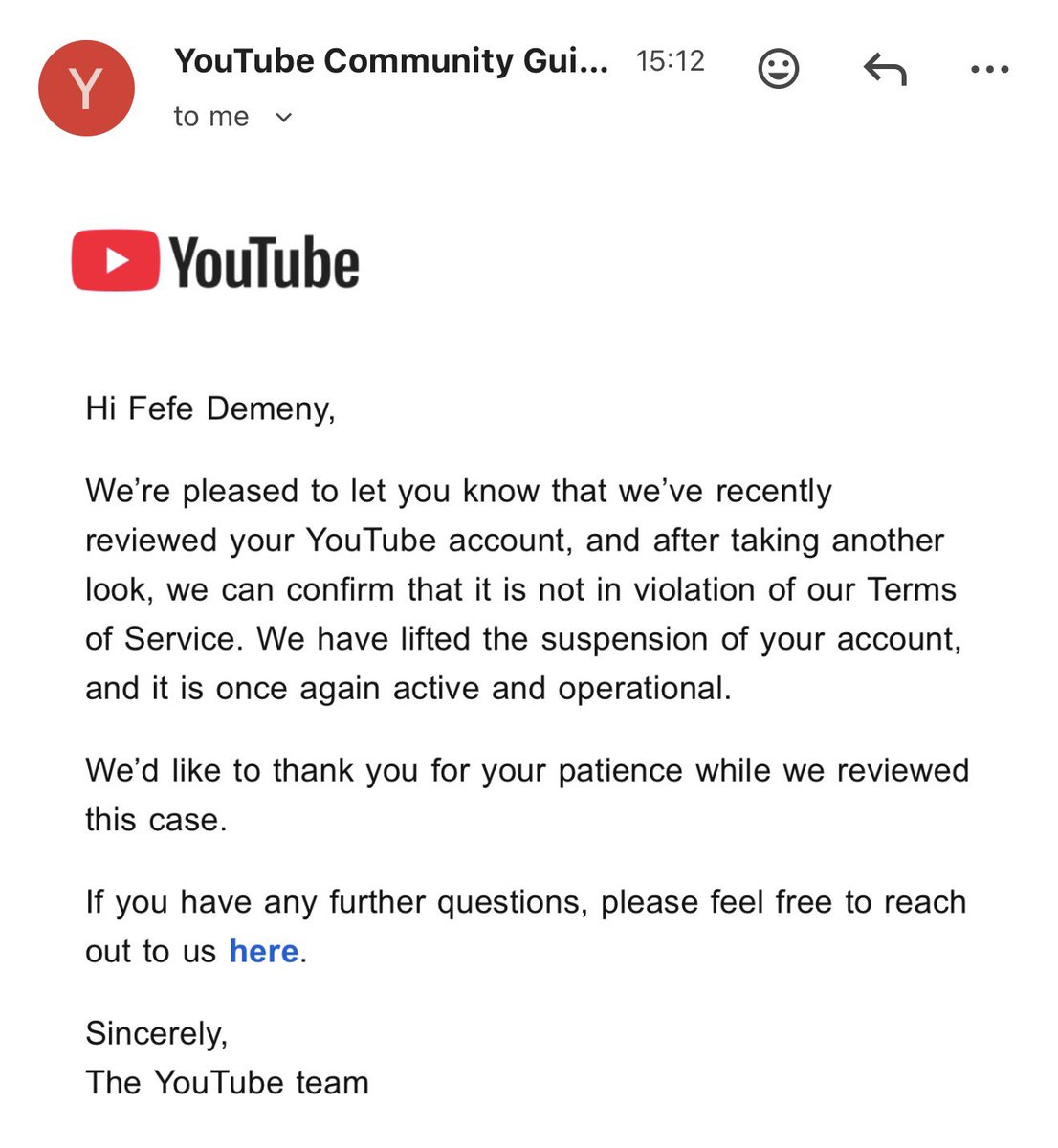
Got my channel back just now
It’s a victory for me, but it changes nothing
I know how it feels to lose everything I worked for years overnight
How it feels to lose my community
How it feels to lose my business
How it feels to be censored and treated unfairly
The stress I experienced today definitely shortened my lifespan.
I will continue this fight and find a solution for the sake of our industry and creators.
Thank you @YouTubeCreators@TeamYouTube@YouTube
Please now get in touch and let’s change this for once and for all
See my post below
@FefeDemeny@YouTube@SECGov@YouTube@YouTubeCreators - i don't want to support any organisation that intentionally avoid clarity to push arbitrary agendas. Please reinstate @FefeDemeny 100X Club channel and give clear guidelines on how to avoid issues in the future!