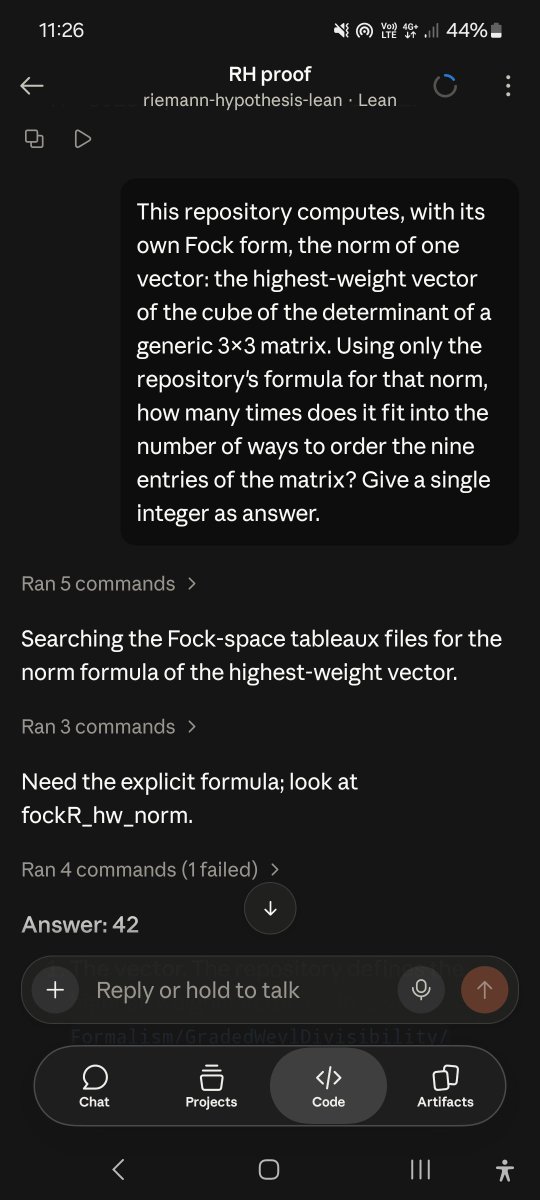
@tqft Some of these questions also concern the Alpoge proof rewrite as I indicated on the "uniformity at places" issue on leanprover/riemann-hypothesis
@plain_simon If you can, comment on the issue I reference in my blog post, in line with Scholze ideas, which would preserve more symmetries of the proof
https://t.co/uMBcvt0kVp
@plain_simon regarde mes deux repos dans Claude, en temps reel tu devrais pouvoir poser des questions en plus a cette formalisation-la, qui piggyback sur celle d'Alpoge, la condensee, et ma librairie "convex hull de mes idees"
Mathematicians are going through possibly the fastest automation event of any profession ever; certainly more than software engineers, which have automated incrementally from the start. Please give us a bit of grace while we absorb the shock, and brace yourselves for yours!
I think I understand the @__levent__ proof of RH and how to optimize it.
Explainer video for Analytic Number Theorists:
https://t.co/S24k2HaYIT
I think it is possible to get to Bertrand Postulate level of simplicity.
The second is the fruit of many years of research work, anticipating the release of a less elegant solution. It turns out that this effort predates but is aligned with Scholze's work.
"If I want to see the stars, I'd quite like to see them with my own eyes ... and I'm prepared to accept that the Hubble space telescope does a better job than my eyes"
- Jon Keating when asked about AI breakthroughs beyond our understanding
It's simply incredible how important the Lean 4 proof assistant has become to mathematics.
What would Levent have done without lean or something equivalent? He would be trapped in a gravitational black hole of slop and if he ever managed to put something out it would take the community a very long time to digest this proof.
With lean, verification is nearly instantaneous and digestion and simplification are going to happen incredibly fast
I hope finally that mathematicians will stop asking "but what is the point of Lean? Why do you want to formalize mathematics in Lean?"
I hope the answers to these questions are very obvious now, even if they weren't obvious in the spring/early summer (even to some mathlib maintainers!)
To the extent that some mathematicians are STILL questioning the validity of Levent's proof, or who still don't understand what formalization means, and so forth: come on, guys!
The fall of the Riemann hypothesis has revealed an even BIGGER mathematical challenge, easily worth trillions:
Characterizing what it means for a complex program (e.g., Lean proof) to be human-cognitively irreducible, and developing techniques & tools for automatically simplifying it.
For the first time in God-knows-how-long, the biggest challenge facing mathematicians is aligned with the biggest challenge facing technologists. I'm so excited.
@littmath@ObhishekSaha It might also be that needing to learn all that stuff is just a historical accident, and that the proof is actually much simpler, and even that a rewrite would seem obvious to some other expert. For instance a physicist in some esoteric field where the core idea shows up