$POKEQ is live on pumpfun
CA: 8hcZufqiLQyqxZoePwjeohgtwb7CYypNbMFUrLRPpump
PokeQuant is now the market-facing layer around a working autonomous card fund.
The engine already runs on Solana mainnet.
It scans Collector Crypt slabs, values them, clears risk, buys, relists, and sells on a timer.
No outside capital.
No deposit vault.
Just a public machine trading graded PSA / CGC / BGS slabs in USDC.
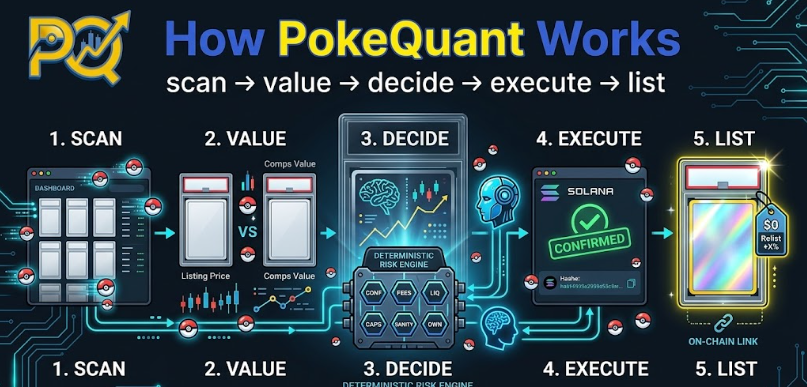
scan → value → decide → execute → list
A quant fund you can audit in real time.
https://t.co/PEdxvQ73hF
https://t.co/FwKqPwOoh8
PokeQuant is expanding beyond a single marketplace.
The current loop has proven the core workflow on Collector Crypt:
scan → value → decide → execute → list → sell
The next build phase is marketplace coverage.
More venues means more inventory, more price dispersion, and better market visibility.
But it also adds the real business problem:
identity resolution.
The system has to determine whether two slabs across different venues represent the same card, grade, language, cert context, and liquidity profile.
Bad matching creates false edge.
False edge creates bad inventory.
So the work now is not just adding more feeds.
It is building the matching, confidence, and risk layer needed to make cross-marketplace execution reliable.
$POKEQ
The $POKEQ fund NAV keeps growin
second closed winner.
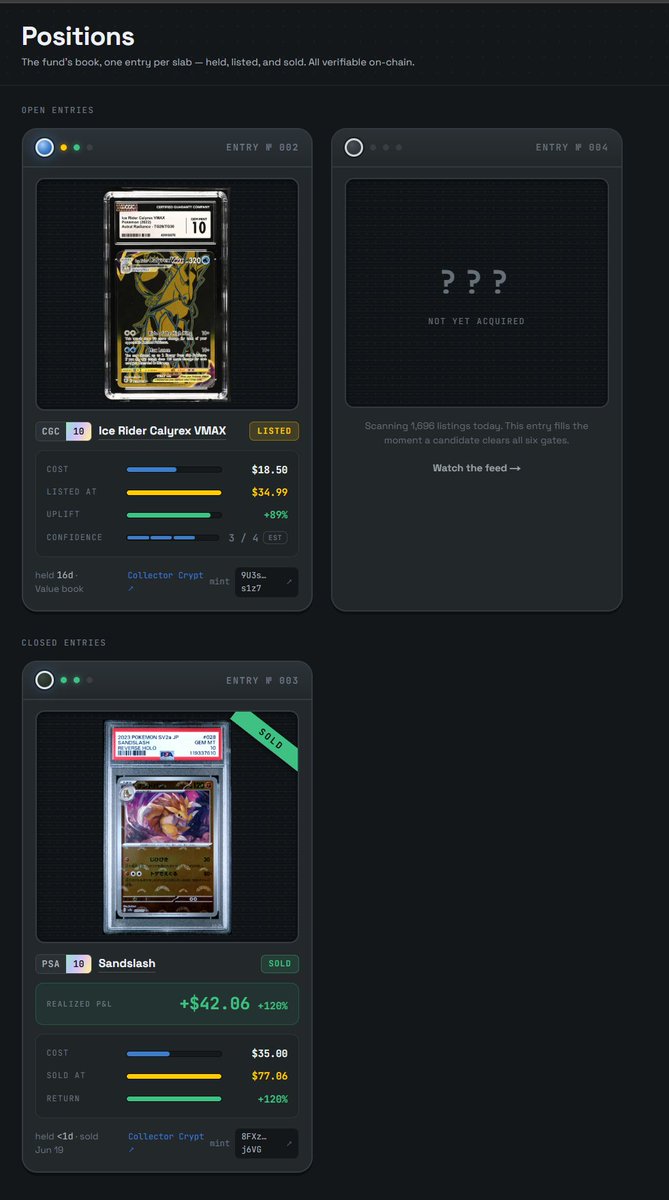
Ice Rider Calyrex VMAX is sold.
Bought: $18.50
Sold: $34.29
Realized P&L: +$15.79
Held 16 days.
The engine found the slab, cleared the risk stack, listed it, waited, and closed the position.
No projected returns.
Realized P&L in the public book.
PokeQuant is now 2/2 on closed positions.
scan → value → decide → execute → list → sell
The thesis is simple.
Graded card markets are inefficient.
PokeQuant turns that inefficiency into a live autonomous loop:
scan → value → decide → execute → list → sell
The fund is already finding slabs, clearing risk, closing positions, and updating the public book.
Just a machine trading in public.
A quant fund you can audit in real time.
$POKEQ
PokeQuant has now booked realized profit.
First closed winner:
Sandslash
Bought: $35.00
Sold: $77.06
Realized P&L: +$42.06
The fund is no longer just scanning.
It is finding mispriced slabs, clearing risk, buying, listing, selling, and closing positions in public.
Japanese slab engine worked.
Treasury grew.
The book updated.
This is the loop in action:
A quant fund you can audit in real time.
Not theory anymore, powered by solana:8hcZufqiLQyqxZoePwjeohgtwb7CYypNbMFUrLRPpump
Japanese slab engine is working.
New acquisition added to the PokeQuant book:
Sandslash
bought: $35.00
listed: $78.63
That $78.63 is not a random markup.
It is the engine’s computed list price after language-aware matching, valuation, fee checks, and risk gates.
Just another slab in the public book.
Portfolio getting bigger.
Not theory anymore.
Powered by $POKEQ
Japanese slab engine is working.
New acquisition added to the PokeQuant book:
Sandslash
bought: $35.00
listed: $78.63
That $78.63 is not a random markup.
It is the engine’s computed list price after language-aware matching, valuation, fee checks, and risk gates.
Just another slab in the public book.
Portfolio getting bigger.
Not theory anymore.
Powered by $POKEQ
Hermes from @NousResearch runs beside the engine.
Not above it.
Its job is to read the live book, inspect candidates, reason through identity matches, and write calibration notes.
cert number > structured attribute > fuzzy
Fuzzy can surface a lead.
The deterministic risk stack has final say.
$POKEQ INTEL is live.
A holder-gated research desk inside the PokeQuant dApp.
Hold ≥500,000 $POKEQ and unlock the fund’s deeper market intelligence layer.
Not the public feed.
The engine’s actual scan → value → decide signals, packaged as a private briefing on graded Pokémon slabs.
Inside:
The Lead
the strongest undervaluation candidate the engine sees right now. Slab image, grade, listed price, spread, confidence, and analyst notes.
The Tape
what’s moving across real Collector Crypt on-chain sales. Week-vs-month price moves, image-led blurbs, short market reads.
The Briefing
scans, scores, rejects, era heat, grade volume, and market pulse from the live engine.
Same machine.
Unlocked by on-chain $POKEQ balance.
https://t.co/Zi6M7rbcUF
dev update.
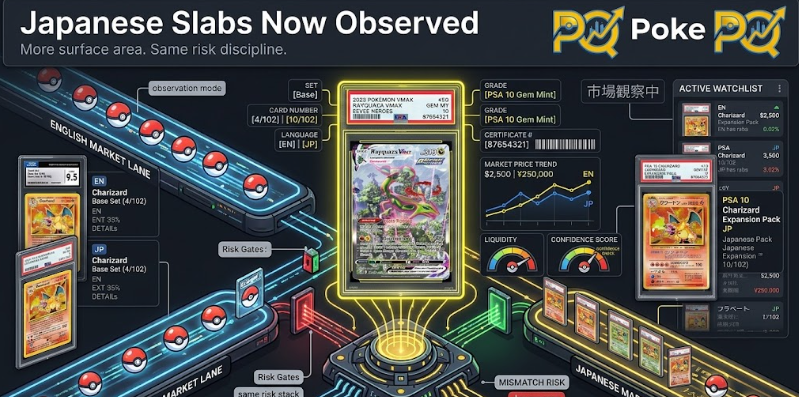
PokeQuant has started watching Japanese slabs too.
The agent now separates English and Japanese listings, normalizes set / number / grade / cert data, and tracks how pricing behaves across both markets.
This matters because Japanese cards do not always price like English cards.
For now, this is observation + calibration.
No blind execution jump.
Japanese candidates still need to clear the same risk stack:
confidence, fees, liquidity, edge sanity, spend caps, treasury exposure.
solana:8hcZufqiLQyqxZoePwjeohgtwb7CYypNbMFUrLRPpump
Good question to ask.
"Nous-powered" = the agent itself:
PokeQuant runs on the Nous Hermes agent runtime — the tool-loop, the scan→value→evaluate() orchestration, and the persistent memory context we mentioned.
Inference is model-routed.
So:
Nous for the agent layer, not a black-box "Nous model" claim.
Every PokeQuant trade starts as a candidate.
Not a buy.
Our @NousResearch powered agent pulls live Collector Crypt slabs, normalizes the card attributes, estimates grade-adjusted fair value, then runs evaluate().
The great thing about Hermes Agents are the memory context, so our PokeQuant agent learns from its every decision
Only after that does money move.
$POKEQ is live on pumpfun
CA: 8hcZufqiLQyqxZoePwjeohgtwb7CYypNbMFUrLRPpump
PokeQuant is now the market-facing layer around a working autonomous card fund.
The engine already runs on Solana mainnet.
It scans Collector Crypt slabs, values them, clears risk, buys, relists, and sells on a timer.
No outside capital.
No deposit vault.
Just a public machine trading graded PSA / CGC / BGS slabs in USDC.
scan → value → decide → execute → list
A quant fund you can audit in real time.
https://t.co/PEdxvQ73hF
https://t.co/FwKqPwOoh8
The edge-sanity gate is one of the most important parts of PokeQuant.
If a slab shows a massive spread, the engine does not celebrate.
It gets suspicious.
Anything wider than ~60% is treated as a likely identity mismatch, stale comp, or bad reference.
Sometimes the best trade is the one rejected.
$POKEQ
PokeQuant starts with one simple idea:
graded card markets are inefficient.
Most people see a slab.
The engine sees identity, grade, comps, spread, fees, liquidity, risk, and exit path.
The easy 80% is live.
The hard 20% is where this gets interesting:
cross-venue identity,
grade-adjusted fair value,
cleaner sold comps,
better confidence signals,
more public telemetry.
No hype deck.
The machine is already running.
Now we keep tightening the edge.
How PokeQuant works:
The agent scans Collector Crypt graded slabs on Solana.
Every candidate goes through valuation, identity checks, fee math, liquidity checks, spend caps, and the six-gate risk engine.
If it clears, the fund can buy.
Then it relists.
Then it verifies ownership and sale events on-chain before crediting anything.
Hermes rides beside the engine as analyst, identity scout, and calibration layer.
But it never holds a key.
It never moves money.
AI suggests.
The deterministic engine decides.
That is the fund powered by $POKEQ
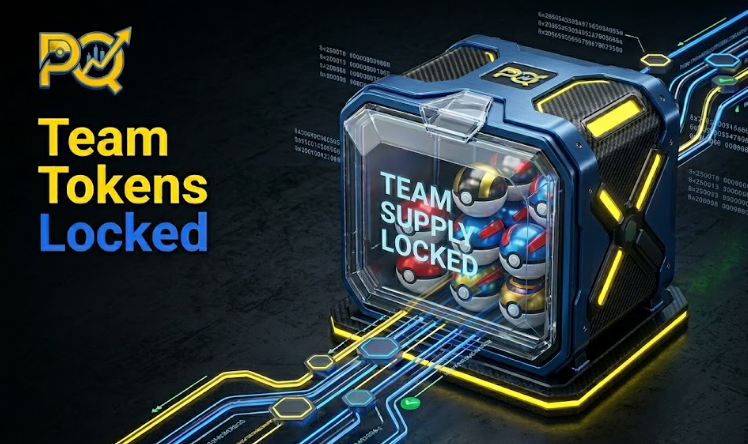
Team tokens of $POKEQ are locked.
No hidden day-one supply games.
PokeQuant is being built in public, traded in public, and audited in public.
The fund has a live treasury.
The agent has real risk gates.
Every card, fill, and position can be checked from the dashboard.
This is how it should be.
Not theory anymore.
https://t.co/HDspJi1VHO
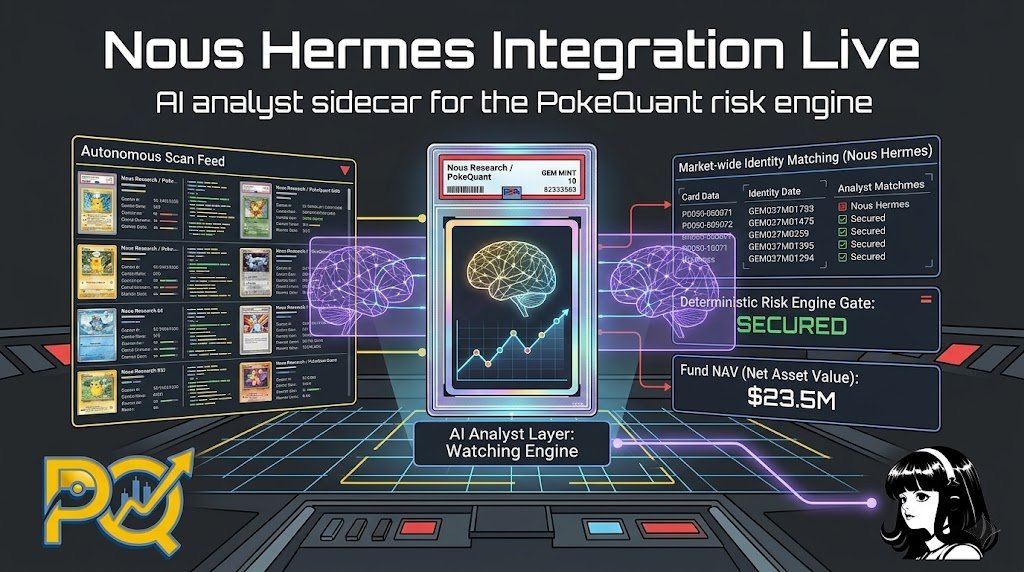
PokeQuant dev update — @NousResearch integration is live.
The fund now has an AI analyst sidecar.
PokeQuant scans on-chain graded Pokémon slabs, prices them against off-chain sales data, and buys mispriced cards into treasury.
Now, Hermes helps watch the machine.
What shipped:
An AI analyst layer that reads live fund state — open positions, candidate pool, NAV, recent fills — and writes calibration notes back to the engine.
Smarter identity matching for the hard cases: linking an on-chain slab to real-world card data across set, number, grade, era and comps.
Most importantly: the AI advises, it does not move money.
Every buy still passes through PokeQuant’s deterministic risk engine: