This is what celebration looks like in Paris today.
Notice something. No progressive politician would tell their daughter to walk alone into this crowd. No feminist would feel comfortable here. No Jewish person would feel particularly welcome. And yet we are constantly told that this is the future of diversity and inclusion.
While European cities become increasingly hostile to women, Jews, and gays, Western politicians like AOC put on the hijab and celebrate the very ideology driving much of this regression.
They chant "my body, my choice" while defending cultures that deny women the most basic freedoms.
These pseudo-feminists are among the dumbest people in modern politics. They condemn patriarchy in the West while making excuses for societies built upon it.
@ChathamHouse Ah yes, the same China that believes Taiwan is theirs, builds islands in the South China Sea and claims a fictional “nine dash line”, and is seeking to eradicate the Uyghur and Tibetan cultures. Such an upholder of the “rules-based order”. 🙄
Everyone who is up in arms about Trump "kissing Xi's ass" needs to understand that this is realpolitik and dealmaking.
Trump is, by a mile, the most aggressive president America has had against the CCP in modern history. No one else imposed sweeping tariffs on Chinese goods, banned Huawei from domestic networks, put the entire CCP military-linked ecosystem on the entity list, restricted semiconductor exports, strengthened the Quad, and publicly called out China's currency manipulation, IP theft, forced tech transfers, and South China Sea aggression the way he did.
Pre-presidency Trump was blunt. If you recall, as a candidate, he often complained about how "China was screwing us over." Literally in 2016 on the campaign trail, he said that "China is raping us."
You need to understand that this posture completely shattered what was bipartisan elite consensus at the time - which was that more engagement with China on economic terms would liberalize and democratize China (ethnocentric projection once again), and that as China became more integrated into the global system, they would act more and more like responsible stakeholders. Every President since Nixon pushed closer economic integration while ignoring the OBVIOUS signs. This was especially supercharged under Bush, Clinton and Obama (but not Biden).
And yet at the time, the mainstream media painted him as a xenophobe for this kind of rhetoric. It wasn't even a subtext - they directly alluded to how Trump was being racist against the Chinese for calling out their unfair trade practices.
Once in office, Trump refined it into a strategy that actually moved the needle while dialing back his strong rhetoric.
The personal flattery - calling Xi a "great leader," talking up respect for China, saying they'll have a "fantastic future together," is all Machiavellian Art of the Deal stuff. Flattery costs nothing and makes the other guy more willing to give ground without looking like he's folding domestically.
The CCP's entire system is built on the leader's prestige. Publicly humiliating Xi or treating him like a subordinate would make him dig in, rally nationalists, and push him to retaliate harder just to save face.
I don't actually think Trump knows about Chinese "honor culture" and the obsession with mianzi (face), but for whatever reason, Trump instinctively understands authoritarian psychology and how to work with it.
The problem is that intellectual types, especially those steeped in liberal internationalist frameworks, tend to struggle with parsing the difference between rhetoric vs. revealed preferences. They're hard-wired to overweight the former.
They treat diplomatic language as a window into the soul, as if it maps directly onto intent rather than as front-facing tool of statecraft. China weaponizes this brilliantly.
It's a lesson everyone should've learned by now. With Trump, ignore the optics and ignore what he says. Just look at his actions, and look at his results.
He accomplished two important things with this line of questioning: 1) He exposed abortion for what it really is, stripping away the euphemisms that hide its barbarity, and 2) he revealed that abortion's proponents are too embarrassed and uncomfortable to have the conversation without the euphemisms because it makes them look monstrous. In other words, they care more about how they're perceived than anything else, including the wellbeing of innocent, defenseless babies. So they are, in fact, monstrous — and terrible at hiding it.
Very well done.
Let me tell you why a Muslim would stab a random Jewish person on the streets of London.
I was raised Muslim, and I know exactly why this happens. It’s not a reaction to the war in Gaza. It’s not oppression. It’s not radicalization. It’s the logical outcome of Islam itself.
It doesn’t matter if you’re a Muslim or not, we as human beings carry guilt deep inside us. We know we are not good enough, and we spend our life trying to redeem ourself through good deeds, thinking it will make the suffocating guilt go away.
Christianity for example offers a way out of guilt, a solution not based on your works but on Christ’s.
Salvation isn’t earned, it’s given. You accept that you can’t redeem yourself, because Christ already did everything on your behalf. That means you’re free. Free to live, free to build, free to serve, free to love.
And when a Christian feels lost, broken, and in need of forgiveness, they can go to church, talk to a pastor or priest, and leave knowing they are forgiven.
Islam, on the other hand, doesn’t offer redemption, it weaponizes guilt.
Instead of providing salvation, Allah exposes you, holds your sins over your head, and threatens you with hellfire and torture in the grave.
The Quran isn’t a book of peace, it’s a book of threats. It bullies Muslims into obedience through fear, humiliation, and punishment.
So what happens when a Muslim seeks redemption? They try to be better Muslims.
They pray, fast, give to charity, go on Hajj, do everything Allah commands. But it never works. I know it. I did it.
And no matter how much you pray, no matter how much you try, the guilt never goes away. Because deep down, every Muslim knows it’s not enough. Allah always demands more.
Allah loves those who die fighting against the infidels. That’s not an opinion, it’s in the Quran, in Hadith, in every lesson taught to children.
This is why Muslims, even the so-called "moderates," always hesitate to condemn terrorism. Because they know jihad is required by Allah. They might not be willing to commit it themselves, but they can't say it’s wrong.
So when a Muslim fails to reach peace through religious rituals, they have two choices:
Give up, stop being devout, and learn to live with the guilt, or commit to jihad, because that’s the only way to be true to yourself.
The Quran spells it out clearly: “Kill those who do not worship Allah or obey the Prophet” (9:29).
So when a Muslim embraces this identity fully, killing infidels isn’t just justified, it’s joyful. It’s an act of:
Saving yourself, obeying Allah, securing your eternity, finally escaping the crushing weight of guilt
This is why a Muslim can stab a random jewish person on the streets and feel nothing but satisfaction.
Because for the first time in his life, he finally believes he has done something worthy of redemption.
Donald Trump may not fit anyone’s picture of a polished Christian leader, but that is exactly why he has been able to do things others could never touch. If Ted Cruz, Mike Huckabee, or J.D. Vance tried to openly call America back to God, the backlash would be immediate, but Trump moves differently because even his critics do not frame him that way.
Sometimes God uses an unexpected deliverer to create space for the church, and if you only look at appearances, you will miss the assignment.
If you’re wondering why he would make a statement this ridiculous, from a psychological point of view, this is what it does: it creates doubt where clarity already exists.
That is a classic political manipulation tactic. You don’t deny the evidence directly; you simply imply that the public should “wait for details,” which SLOWS moral judgment and protects the side whose ideology may be implicated.
He is not speaking to people who already know the facts. He is speaking to people who need permission not to process the facts. His language gives them a psychological escape hatch: “We don’t know yet,” “Don’t jump to conclusions,” “Maybe there are other motives” That protects them from cognitive dissonance.
The genius of this kind of framing is that it can manipulate the opposition too. It forces people to waste energy proving what is already visible, while his supporters accuse them of being partisan, MAGA, or inflammatory. That is how gaslighting affects opposition: it turns reality itself into the battlefield.
This is how propaganda and political indoctrination work: deny clarity, create doubt, then accuse anyone who names the truth of being partisan.
What should be the front-page headline on the NY Times and WSJ if we had a functioning media:
**How years of extreme rhetoric by Democrats and on university campuses led to the latest attempt on President Trump's life by a radical leftist**
Islam is a political system that has a religion department.
The split between Eastern Orthodoxy and Roman Catholicism was the product of centuries of theological and ecclesiological debate.
Questions about the nature of the Trinity (the Filioque clause), the authority of the Pope, and the relationship between church and empire were argued through councils and formal theological disagreement.
The Great Schism of 1054 emerged from incompatible theological and institutional claims.
The Protestant Reformation followed the same pattern.
Luther, Calvin, and others challenged doctrines like indulgences, justification, the authority of tradition versus Scripture, the nature of salvation.
In all cases theology came first; institutional separation followed. Violence followed these divisions, but it did not create them.
Christianity fractured because people disagreed about what was true.
Islamic sects came into existence in an entirely different way.
Islam did not fracture through theological debate. It fractured through power struggles, wars of succession, and political violence, after which theology was constructed to justify the outcome.
The first and most consequential split in Islam, Sunni versus Shia, had nothing to do with doctrine at the outset. It revolved around a single question: who gets to rule after Muhammad?
Muhammad left no succession mechanism. No council. No institutional separation between religious authority and political power.
When he died, leadership meant control of the state, the army, the law, and divine legitimacy, all at once. The result was immediate conflict.
What followed was a chain of civil wars: the Ridda Wars, the assassination of Uthman, the battles of al-Jamal and Siffin, the rise of the Kharijites, the murder of Ali, and the massacre at Karbala. Hundreds of thousands died, not over doctrine, but over who had the right to rule in God’s name.
Only after this bloodshed did theology harden.
Sunni doctrine evolved to legitimize whoever held power and to preserve order at almost any cost.
Shia theology evolved to sacralize dispossession, martyrdom, and stolen authority.
Theology followed blood. It did not precede it.
This pattern repeats throughout Islamic history.
Umayyads, Abbasids, Fatimids, Ottomans, Safavids, each civil war produced a theological justification after victory or defeat. Belief adjusted to power, not the other way around.
Christianity fractured because people argued about God. Islam fractured because people fought over who gets to rule for God.
In Christianity, theology is primary, in Islam, politics is primary and theology is retrospective.
This is why Islamic sects, despite centuries of violence against one another, remain largely monolithic on the core elements: the Qur’an, Muhammad, and submission to divine law. The differences between them are marginal when compared to the scale of bloodshed that produced them.
This is why Islam behaves less like a religion in the and more like a political system that sanctifies power. Its internal divisions do not reflect competing visions of truth, but competing claims to authority.
If you’d told me a few years ago this is where we’d be on Iran, I’d have said you were high:
1. Nuke program set back years. Enrichment and reprocessing gutted, weaponization sites destroyed, Fordow inoperable, Natanz in ruins, a generation of senior nuclear scientists eliminated.
2. Ballistic missile program crippled. Monthly production down from 100 to near zero. Roughly half the regime’s missiles and launchers destroyed. The IRGC Aerospace Force commander who ran the missile enterprise dead.
3. Air defenses devastated. American and Israeli airpower dominating Iranian skies, with strike aircraft operating over the country with near impunity.
4. Full economic warfare. Not just OFAC sanctions anymore, but military pressure layered on top: naval blockade, near-zero oil exports, choked imports, wrecked steel and petrochemical sectors, triple-digit inflation, and a currency that is effectively worthless.
5. Regime decapitation. Khamenei dead. Larijani dead. Hundreds of senior IRGC, intelligence, military, and Basij commanders dead including the IRGC commander-in-chief, the armed forces chief of staff, and the Aerospace Force commander. Mojtaba Khamenei inheriting a hollowed-out regime with no supreme authority and a gutted command structure.
6. The region turning on Tehran. Gulf states shutting down the sanctions-busting, money-laundering, and financial escape routes the regime has relied on for years. No Arab capital willing to throw Iran a lifeline. China and Russia providing limited support.
7. Proxy network shattered. Hezbollah and Hamas heavily degraded. Houthi political leadership taking direct Israeli strikes. The “Axis of Resistance” and “ring of fire” are now more slogans than real threats.
8. Syrian corridor severed. Assad is gone. The new government in Damascus is actively blocking Iranian arms transfers to Hezbollah: arresting smugglers and publicly declaring Syria will no longer serve as a transit corridor for Tehran’s terrorists. The land bridge to the Mediterranean that took decades to build is effectively closed.
9. Lebanon pivoting west. With Hezbollah battered and resupply choked, Israel and Lebanon have opened direct peace talks for the first time since 1983, aimed at a permanent agreement and Hezbollah’s disarmament. Beirut now asserting that the Lebanese armed forces alone are responsible for national defense. This is a direct repudiation of Hezbollah’s “resistance” claim. TBD.
10. Deterrence exposed as a bluff. Four direct attacks on Israel — April 2024, October 2024, June 2025, March 2026 — failed to impose strategic cost and instead triggered heavy retaliation. Iran couldn’t even use Syria as a launchpad.
11.Economy hollowed out from within. Power shortages, water crises, factory shutdowns, pension unrest, and mass protests. Nationwide demonstrations erupted in December 2025 after a year of economic freefall, with bazaaris, oil workers, and truckers, the regime’s traditional support base, joining strikes across all 31 provinces. Running out of oil storage space. Fuel shortages. The worst crisis since 1979.
12. Scientific and technical brain drain. Beyond the nuclear experts, Iran has lost a generation of irreplaceable expertise in missile design, centrifuge engineering, and weapons development. The survivors are harder to recruit and easier to deter.
13. Naval power decimated. The regular navy shattered, IRGC navy taking growing losses as CENTCOM moves to reopen Hormuz.
And against all of this: the regime forced to play its Hormuz card at its weakest possible moment when the U.S. has options instead of when we didn’t: namely, Tehran with nuclear-armed ICBMs, 10,000 ballistic missiles, a Chinese- and Russian-built military, hundreds of thousands of attack drones, a fully operational terror network, and hundreds of billions of dollars to harden its economy.
That’s the strategic picture. It’s extraordinary. Much more to do but I can’t comprehend how much has been achieved.
The Strait of Hormuz Reverse Uno Card
When Raji Khabbaz and I were running Silver Arrow Investment Management, whenever we were trying to figure out why something happened, he was unsatisfied the explanation that people are sometimes stupid and institutions are often stupid. He correctly thought that people usually have a good reason (at least to them) for doing something even if it appears to make little sense to an outsider. More importantly, he thought that “sometimes people are stupid” was a lazy answer that was dismissive. As investors, it was our goal to understand what was happening, not to ignore it.
Recently, I’ve written that many of President Trump’s critics are making the same error. When Iran closed the Strait of Hormuz, the narrow waterway that previously transported 20% of the world’s oil supply, the price of oil rose. Gas prices in the US have risen in response. Many screamed that this was an obvious move by the Iranian regime and insisted President Trump should have known it was something they’d do. How could he not know?!
In 2002, the US Navy conducted war games they called the Millennium Challenge. One side represented Iran. The other represented the technologically superior US Navy and included an aircraft carrier, warships, and cruisers. The US Navy side had a substantial advantage in firepower. Retired Marine Corps Lieutenant General Paul K. Van Riper used asymmetric warfare tactics to wipe out the US side in one day. Had this been a real fight, the US would have lost 20,000 servicemen. The result was such an embarrassment that the Navy re-floated the sunk ships, changed the rules of engagement to ensure a US victory, and started the challenge again.
These games were not a secret. They have been widely covered in the mainstream media and have been the subject of a New York Times documentary. Over the past two decades, I have seen the Millennium Challenge discussed in my daily financial news reading at least a dozen times. The event has its own Wikipedia page. Regardless of your opinion of President Trump, do you really believe that neither he, nor anyone in the White House, nor any of his military advisors, nor Secretary of War, Hegseth knew about this? I realize that many of you reading this have strong negative emotions regarding President Trump. I’m not asking you to like or respect him. I’m just suggesting that “he’s stupid and has no idea what he’s doing” is not good analysis. This is a point I’ve made in this space in the past.
Early in the war, Iran closed the Strait which placed economic pressure on the rest of the world. Despite the fact that it was Iran mining the Strait and shooting at the ships that attempted to navigate it, many countries expressed anger at the US and Israel. This was the outcome Iran wanted. Then, the regime decided to allow friendly ships to pass if they paid a fee. The fees were about $1/barrel of oil, or about $2MM per large container vessel. (Many of these fees were paid in Bitcoin, something macro analyst, @peruvian_bull, explained in an excellent post within the past week.)
This looked like worst-case scenario for the US. Iran succeeded in closing the Strait and causing economic problems all over the world, then found a way to profit from their own actions. Then, President Trump played his “reverse uno” card. He correctly realized that it wasn’t just the rest of the world that depended on free passage through the Strait of Hormuz, and that it was Iran that had the most exposure. Iran is a big oil producer, and oil exports account for 80% of Iran’s exports, 60% of government revenue, and 25% of its GDP. It turns out that Iran has more economic exposure to this narrow waterway than anyone else. President Trump sent the US Navy to form a blockade. He closed the Strait himself ensuring no more $2MM/vessel charges and an inability for Iran to export oil.
Iran is close to filling its own storage. Once its oil tanks are full, the regime has two choices, either capitulate and come to an agreement with the US, or to stop producing from its own wells. The problem with the second choice is that it’s difficult to reverse. Stopping production on an active oil well tends to damage it and it’s hard to re-start later. Iran now has a limited amount of time to find a course of action before 25% of its GDP becomes permanently(ish) impaired.
While no one in the US likes paying more for gas, prices were much higher just four years ago in 2022 and around $4/gallon in 2008, 2011, and 2012 when $4 had more purchasing power than it does now. The US is a net energy exporter with an economy that has survived higher prices in the past. Foreign ships are turning away from the Strait of Hormuz and sailing to Texas and other southern US ports to fill up at premium prices. I’m not suggesting that this is great for the US; but rather, that the US is well-suited to manage the situation while Iran is about to be faced with a massive long-term problem.
Finally, Iran maintains control of the country using extensive human infrastructure. There are police everywhere monitoring protests, internet usage, the attire of citizens, and the hair of Iranian women. That level of control is expensive and the government just lost 60% of its revenue. I’m wondering how long they’ll keep doing their jobs without paychecks.
I don’t know how this conflict will end. What I do know is that President Trump and the US Navy have turned Iran’s biggest strategic strength into a giant weakness. Sometimes people do stupid things. And sometimes, we just aren’t seeing the reasoning behind those actions. Last week, one of DKI’s interns wrote, ”The bottom line is that (financial analysis) can tell you what the market’s pricing in, but it’s your job to figure out why”. Right now, the mullahs are facing a difficult decision. It will be interesting to see what comes next.
Food for thought.
Welcome to the New Great Game: the closure of the Strait of Hormuz is not an outburst, it is a long‑planned move on a board Washington has been studying for decades.
Donald Trump’s Iran gamble is being judged against the wrong baseline. Nobody serious expected regime change by airstrike; the bet of Operation Epic Fury was narrow but brutal, halt Iran’s march to a bomb, break the infrastructure that threatens Americans and allies, restore deterrence and, by closing Hormuz, demonstrate that even in a “multipolar” age the United States can still reach for the world’s most strategic chokepoint.
The question is not whether Iran looks worse than in peacetime, but whether it is weaker than the Iran we were otherwise on track to face: near‑weapons‑grade enrichment, hardened sites, ICBMs a tested weapon within a year, and implicitly backed by China. Against that counterfactual, a regime that has lost senior commanders, core nuclear facilities and major war‑making capacity has not “emerged stronger”.
Nor did this war suddenly hand power to the IRGC. The Guards have run Iran for years; the conflict stripped away the clerical façade and killed many of their most capable officers. They are not true religious believers but calculating military men, interested in power, money and survival more than theology. Such men can be negotiated with, if the terms strip away their most dangerous options. A discredited IRGC with degraded capabilities and no viable nuclear path is weaker than the old clerical‑IRGC hybrid with a bomb option. This looks less like a revolutionary vanguard and more like a brittle military dictatorship.
Venezuela shows why this is not neo‑conservatism in disguise. There, Washington helped force Nicolás Maduro from power with sanctions, isolation and support for the opposition, but it did not send Marines into Caracas or attempt to remake the country in America’s image. The objective was pressure and transition, not permanent US stewardship. The same bounded playbook now applies to Iran: maximum economic and military pressure to fracture the regime from within, not an occupation or bayonet‑installed government.
Seen from that perspective, Hormuz is not a shocking improvisation but the central artery in a strategy that has been war gamed out : use control of sea‑lanes and finance to punish Iran first, but also to remind China and Europe that their growth models still depend on flows Washington can disrupt. What cannot be allowed is for this world to turn Iran into a Chinese staging point on the Gulf.
The endgame in this first round of the New Great Game is narrow and knowable: no enrichment, real caps on missile reconstitution, no Chinese forward base, no open chequebook for terror, and enough sustained pressure that when the Iranian people finally move, they are pushing against a weakened security state rather than a confident nuclear one.
The world has changed; Iran has lost the war, Pax Americana is dead. Trump’s national security doctrine, coercion without occupation, leverage without crusades, is the planned successor, and the Strait of Hormuz is its chosen proving ground. Is the Strait of Malacca next?
Why should investors care? Because if this strategy succeeds, it removes a looming nuclear breakout risk, curtails state‑sponsored terrorism, re‑establishes a credible fear of US hard power and, for a time, compresses the geopolitical risk premium that has hung over energy, shipping and global equities for a generation. It offers the possibility, however briefly, of a peace dividend: lower volatility, higher investment and a world that, for a moment, rhymes with the fall of the Berlin Wall and the end of the Cold War.
In that window, capital will scramble to reprice assets that assumed perpetual Middle Eastern and Nuclear escalation. The New Great Game is not just about guns and chokepoints; it is about who captures that re‑rating.
Food for thought.
Iran Is Not Winning. It Is Unraveling.
The prevailing narrative on Iran has it almost perfectly reversed. We are told that Tehran is winning a war of wills in the Gulf and that Donald Trump is gambling recklessly with the world’s most sensitive chokepoint. In reality, Iran is not consolidating strength; it is managing decline. And Trump’s play on the Strait of Hormuz has quietly forced energy markets to reprice security—tilting the balance decisively toward the Americas, and away from Europe, Asia and China.
The Islamic Republic no longer resembles a confident revolutionary project.
With the old clerical core leadership shattered, power has splintered between a camp that recognises a deal with the outside world as the only path to survival and the Islamic Revolutionary Guard Corps, a class of military dictators with guns, patronage networks and a rational fear that any genuine settlement will ultimately throw them overboard. This is not a unified strategy at work; it’s infighting, paranoia, a fragmented system in late-stage decay, crumbling under pressure.
Into this fragmentation, the White House has introduced a form of calibrated coercion too often caricatured as impulsive.
Around the Strait of Hormuz, Washington has threatened disruption without fully triggering it, forcing shipowners, insurers and policymakers to absorb a hard truth: dependence on vulnerable, seaborne Middle Eastern barrels is not a passing inconvenience but a structural risk. Iran can harass tankers and jolt day-to-day sentiment; it cannot rebuild a broken economy on sporadic shocks to global shipping. And the world must deal with the end of Pax Americana!
The underlying playbook is anything but novel. Sun Tzu’s insistence that “all warfare is based on deception”, Machiavelli’s counsel that a ruler must manipulate appearances and exploit factionalism, and Alfred Thayer Mahan’s argument that sea power and control of chokepoints shape the fate of nations are not museum pieces. They are, in this case, the operating code. Trump’s opaque signalling, deliberate use of disinformation and visible but limited naval posture in and around Hormuz amount to a modern, Mahanian use of sea power as economic statecraft.
Energy markets are already adjusting. Tankers are head to the Gulf of America. In a world where a single strait can a risk to economies is Europe and Asia, without ever being fully closed, assets tied to secure basins and diversified export routes deserve a premium.
The Americas sit in an enviable position: vast, politically stable hydrocarbon resources, multiple pipelines and ports, and no dependence on a distant maritime chokepoint controlled by adversaries. By contrast, Europe, much of Asia and China find themselves downstream of vulnerabilities they do not control and regimes they cannot stabilise, exposed to shipping routes that can be threatened faster than alternative supply can be mobilised.
All of this plays out against a domestic backdrop in Iran that looks less like revolutionary vigour and more like fear. A state that cannot safely keep its internet on, that must rely on public brutality to deter dissent, is not projecting confidence. It is signalling weakness, to its own citizens as much as to its rivals.
Winston Churchill once remarked that “in war, resolution; in defeat, defiance; in victory, magnanimity; in peace, goodwill.” Iran’s leadership offers only defiance, without realistic prospects of victory or peace.
The uncomfortable conclusion for those still insisting that Tehran is “winning” is that what they are observing is not the rise of a regional hegemon, but the protracted, strategically exploited unwinding of a brittle regime at the centre of an overexposed energy system.
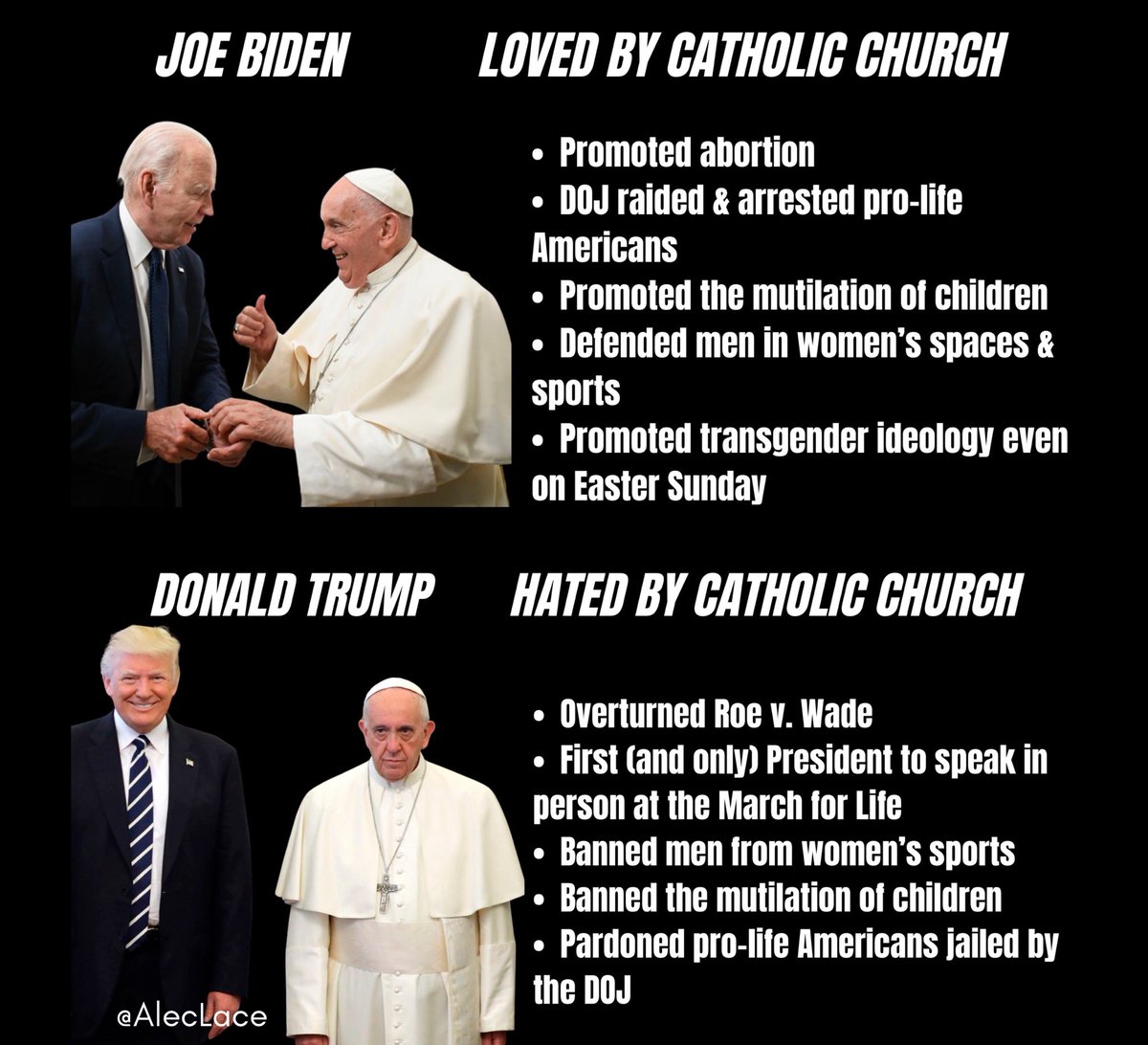
🚨 SPOT THE DIFFERENCE?
Biden:
Pushed abortion
Jailed pro-lifers
Promoted child mutilation
Men in women’s spaces/sports
Trans ideology on Easter
Trump:
Overturned Roe v Wade
Spoke at March for Life
Banned men in women’s sports
Banned child mutilation
Pardoned pro-life activists
@amjadt25 Some people like this Brit Muslim MP are so filled with TDS that they could truly convince themselves that Iran won this war, against every single piece of evidence. Sad!
The US completely won.
Shattered the Iranian military industrial complex, shattered their missile and nuclear capabilities, decapitated their leadership - Obama said this would have required apocalyptic boots on the ground war involving tens of thousands of deaths but it was accomplished with naval and air power.
Completely broke their attempt to close the Strait of Hormuz by blockading their ports.
Killed their top generals, nuclear scientists, guys like Soleimani that can never be replaced.
No endless US military occupation, no boots on the ground, very few civilian casualties by historic standards - aside from the tragic disaster at Minab it was overall one of the most targeted campaigns in military history, more than 21,000 strikes with about 1500 civilian casualties in total.
People will say that they won simply by surviving but their economy is in ruins, they are going into hyperinflation, the regime has never been less popular. Still a strong chance that the regime disintegrates Soviet style over the next year or two.
THE POPE IS WRONG
The pope is wrong.
I'm not talking about the pissing match between him and Trump, an embarrassment arising from two men with problem egos.
I'm talking about the gospel. He's wrong about that.
On Palm Sunday, presiding at the altar, dressed in his vestments and regalia, standing above the body and blood of Christ, proclaiming as the bishop of Rome the gospel, he said, "Jesus does not listen to the prayers of those who wage war -- but rejects them."
Let that sink in.
"Jesus does not listen to the prayers of those who wage war -- but rejects them."
That is preposterous, and conflicts directly with the Bible, the teachings and history of his own Roman Catholic Church, and the very nature of the Lord Jesus Christ.
In the Bible, there are six separates Psalms written as prayers by David while he was waging war. In these prayers he asked God to bless his efforts and defeat his enemies.
Does the pope want us to believe that the Lord ignored those prayers and rejected David as he offered them? Should those Psalms be removed from the Bible canonized by his own church four times over more than a thousand years?
What about Jehoshaphat, Elisha, Joshua and Hezekiah -- as well as the entire tribes of Reuben, Gad and Manasseh -- who all while waging war prayed fervently to God to deliver them and subdue their enemies?
God ignored them, too, and rejected them?
That's a little hard to swallow given that each one of them was blessed with success in battle and rejoicingly thanked the Lord for it.
That's what the Bible says.
As far as the doctrinally authoritative Catechism of the Catholic Church, the church declares the principle of "just war" -- based on the teachings of saints Augustine and Thomas Aquinas -- and Catholic tradition specifically calls on those waging war to ask for victory in justice and protection for Catholic troops.
And what of the Catholic chaplains in our Armed Forces? Should they tell young men and women waging war in their country's service that their prayers are pointless, as they will be ignored and rejected by their Savior? Isn't that what the Holy Father said?
Finally, there is the matter of Constantine as he prepared for the Battle of the Milvian Bridge. A pagan who was about to wage war, he asked God to bless him with victory. At that point, he saw a cross in the sky and words that told him to march under its banner. That led to his conversion, the embrace of Christianity by the Roman Empire, the Nicaean Creed, and the official governmental sponsorship that made the Catholic Church one of the most powerful and wealthy institutions in the western world.
Is the pope saying that the Lord turned a deaf ear to Constantine? Was that all a mistake or misunderstanding? Should we still be worshipping the sun god?
Of course not.
But this isn't about history or doctrine, soldiers or even the Bible.
It's about Jesus Christ.
"Jesus does not listen to the prayers of those who wage war -- but rejects them."
Nothing could be further from the truth. Jesus listens to everyone's prayers, and Jesus rejects no one.
The Lord loves us all, no matter who we are, no matter what we have done, no matter how far we have fallen. God loves us all, and waits like the adoring Heavenly Father he is for us to reach out to him. He rejoices when we pray, he embraces us when we pray, he pours out his blessings upon us when we pray.
Even if we are waging war.
Even if we are in the depths of sin. Maybe especially if we are in the depths of sin.
"The Lord is near to all who call upon him," David said. And that is true, no matter what Leo said.
God always loves us, God is always there for us, God will always hear our prayers.
It's unfortunate the vicar of Christ seems confused on that point.
This is the best FB response I have seen so far on Trump’s “healer picture” post: “All of you know full well Trump doesn’t truly see himself as a savior nor healer. It’s quite shocking how easily that image rattled some of you and prompted a need to call him out of his ‘blasphemous ways.’
Few presidents in the history of mankind have done more for the advancement of the Judeo-Christian faith than President Donald Trump.
1. Appointed three Supreme Court justices who overturned Roe v. Wade, delivering a major pro-life victory.
2. Established the White House Faith Office in the West Wing to prioritize faith-based initiatives and religious liberty.
3. Created the Task Force to Eradicate Anti-Christian Bias to combat federal discrimination against Christians.
4. Launched the Religious Liberty Commission to protect and promote Christian expression nationwide.
5. Pardoned pro-life activists and Christians targeted for peaceful prayer and faith-based actions.
6. Moved the U.S. Embassy to Jerusalem, honoring biblical ties and evangelical priorities.
7. Issued protections for voluntary prayer and religious speech in public schools and federal workplaces.
8. Expanded conscience rights for Christian healthcare workers, chaplains, and adoption agencies.
9. Allowed churches to endorse candidates from the pulpit without losing tax-exempt status.
10. Affirmed America’s Judeo-Christian heritage through proclamations, faith events, and anti-Semitism efforts.
The list goes on.
Have you praised God for that? Or are we busy savoring for every opportunity to shout how ‘unlike Christ’ he is.
Imagine how much more orderly the world would be if we all scrutinized and corrected ourselves as harshly as we do the President.
God have mercy on us.
Grace for America.”
Note Leo's absolute statements: "God does not bless *any* conflict. *Anyone* who is a disciple of Christ is *never* on the side of those" who use military weapons of war. "Peace ... comes *only* from ... dialogue among peoples." Taken at face value, Leo appears to be denying all "just war" criteria.
Taking his statements at face value, he apparently believes that after the Japanese attacked us in Pearl Harbor and Hitler declared war on us we should have done nothing; and that Jesus was opposed to us defeating these two evil empires. We should have continued to engage in "dialogue" with Nazi Germany and Imperial Japan while they were committing murder on an unprecedented scale. That is a morally irresponsible verdict on Leo's part.
Jesus did not require the state to be pacifistic. He did not believe that Israel erred every time or even most of the time that it engaged in warfare as reported by his Scriptures (the Conquest, the period of the judges and tribal confederacy, David's reign). "Turn the other cheek" is not a model for the state (obviously), nor is it for internal policing and criminal punishment.
Granted, Jesus did not side with the violent revolutionaries of his day, just as Jeremiah did not side with those wanting to throw off Babylon's yoke in his day, but that is because they both viewed God as using the great empire of their day to punish Israel. Their approach was not a carte blanche rejection of military force in all circumstances.
Leo's level of moral understanding regarding conflict is shocking for someone who is supposed to be a moral leader for 1.5 billion Catholics worldwide.