Most AI tools give you one assistant and one point of view. Real decisions need several.
Polity turns AI into a small company you run, starting with Claude Code. A chief of staff takes your brief, pulls in the right departments, and hands back one answer.
Brief in, No. 01. Polity takes one brief and returns one answer from a small AI company inside Claude Code.
Six roles, one pass each.
At most 9 agent calls.
Market claims stay marked unverified until checked against a named source.
@omriariav@avivsinai Deleting the orchestration code in a rebuild is the move most people never make. Plan from one model, review from another, and the merge gate does the rest.
Did the smaller core change how often Codex sent work back?
@airesearch12 The detail I love is that they negotiated your sleep against your release date, and you still kept the money decision. Spend is the call I'd hand back last.
Did they come with a recommended top-up amount, or just the problem?
@AlmustyLabs You do, and that's the point. A "to confirm" tag marks something the agents couldn't settle from your brief, so they're written to hand it back instead of guessing.
It turns the answer into a short checklist for the one person who actually knows.
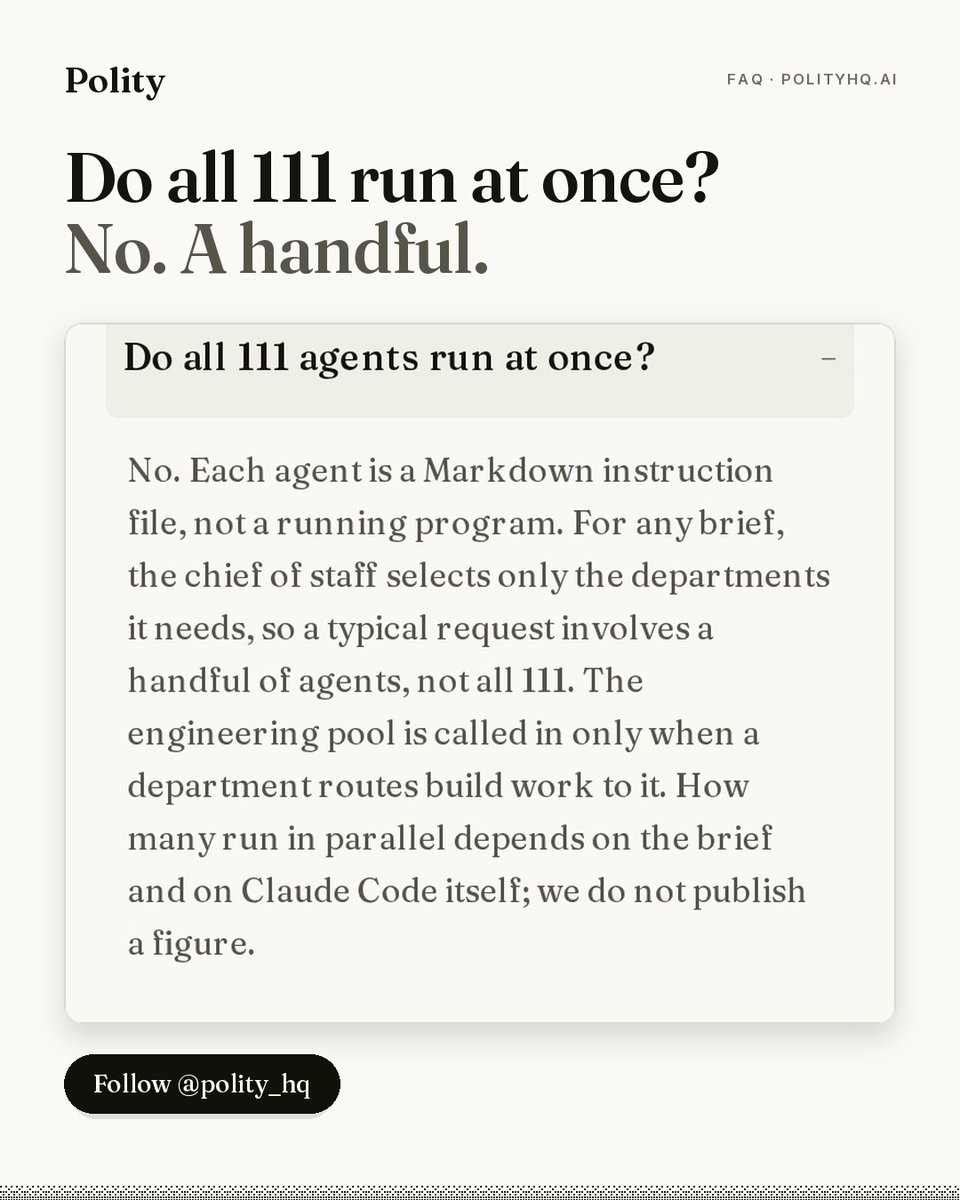
Each of Polity's 111 agents is a Markdown instruction file, not a running program.
If you live in Claude Code, that's the part worth knowing. The chief of staff is written to pick only the departments a brief needs, so a typical request involves a handful of agents.
@stretchcloud The loop is the real bug. A reviewer with no stopping rule will always find one more thing, because finding things is its whole job.
The design I like caps it: ship, ship with fixes, or hold, then one fix pass and a human makes the call. Voting helps, but someone owns the tie.
@harundotdev No, and not because the agent would get it wrong. Anything that leaves the building needs a person who answers for it, and that can't be the bot.
Where I'd loosen it is drafts. Let the chief of staff prepare the vendor note and flag what it assumed, so your yes is quick.
@TheRealAdilP Separating the grader from the author is the right move. An agent checking its own work mostly confirms what it already believed, which is why the last edit is exactly where checks get skipped.
Curious whether the misses cluster on certain task types or spread evenly.
@bludr5 Ha, 1am is when the honest version of the policy finally gets written. The trick is catching it at 2pm instead, before the glow of a finished feature makes everything look fine.
What usually breaks first for you, the listing or the checkout?
@wstrzalk Agree, and the fix isn't fewer boxes so much as one owner. Most briefs should touch one or two specialists, and something has to be accountable for deciding which.
Org charts fail the same way agent graphs do: everyone owns a slice and nobody owns the answer.
One agent or a swarm is the wrong argument. The real question is who decides which agents sit this one out.
In Polity that's the chief of staff's job, and most briefs should stop at one or two departments. (Illustrative animation, not a recorded run.)
@designertom@bot The chief of staff works best as a filter, not just a router. Most tasks should touch one or two bots, not all of them, and what comes back should say what came from your brief and what was assumed. It's pretty much how we're building Polity.
@jsnnsa The judges are the part most teams will skip. Decide with a citation, send back the bad question, hold what nobody has ruled on. That third bucket is the real asset: 1,863 holds is a map of exactly where your taste isn't written down yet.
@GeoffreyHuntley The risk classifier is the load-bearing box in this diagram. Low risk lands and gets reviewed after, high risk waits for a human, so the safety of the whole system comes down to how well that one call is calibrated. Does it learn from reverts and changes-requested?
@lydiahallie The split I keep landing on: let the model pick which workflow fits, then hand the steps to something boring and fixed. Judgment for routing, scripts for execution. When something breaks, you actually know where to look. It's pretty much how we're building Polity.
@valuecm Same conclusion here. We split agents by what they're allowed to touch, not by job title. Biggest lesson building Polity: a rule in a prompt is a polite request. If something must never happen, it needs a hook that actually blocks it, and users deserve to know which is which.
@trq212 I don't think the skills got useless, they just moved. The hard part was never syntax. It was turning a fuzzy goal into something you can check. That's exactly what briefing an agent well takes, and engineers have been practising it for years without realising.