Has Brexit done more good or harm?
All voters: 47% more harm, 14% more good
2016 Remain voters: 76% harm, 6% good
2016 Leave voters: 20% harm, 25% good, 39% about the same
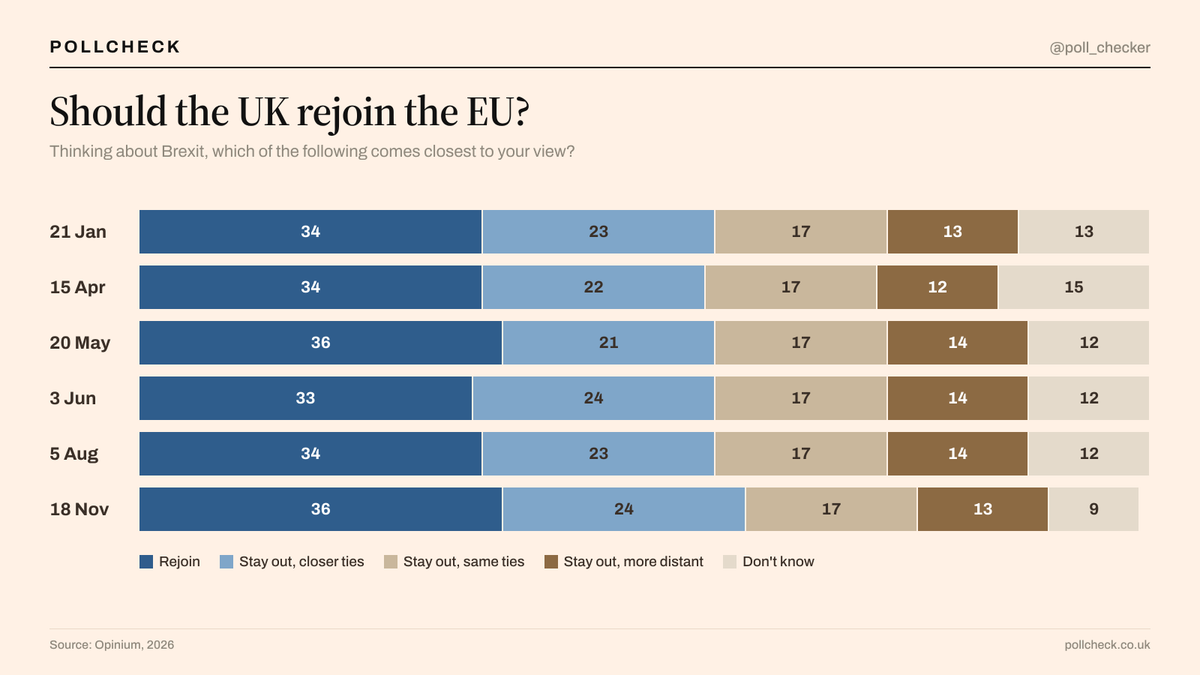
Opinium's Brexit tracker, 18-20 Nov:
Rejoin the EU 36%
Stay out, closer ties 24%
Stay out, same ties 17%
Stay out, more distant 13%
Don't know 9%
Rejoin has been between 33% and 36% in every Opinium poll this year
New Fortius Global polling (more than 7,000 GB adults, November), as reported in the Guardian, has support for rejoining the EU at:
Scotland 68.9%
England 58.3%
Wales 57.9%
Their seat model has 512 of 632 GB seats in favour of rejoining, including 274 of the 394 seats that voted Leave in 2016
With rejoining the EU in the news, could Andy Burnham's Northern credentials help Labour in Red Wall and Leave-voting seats? 🧵
Since he became PM on 20 July, among 2016 Leave voters:
Labour 11% → 15%
Conservatives 25% → 29%
Reform 45% → 39%
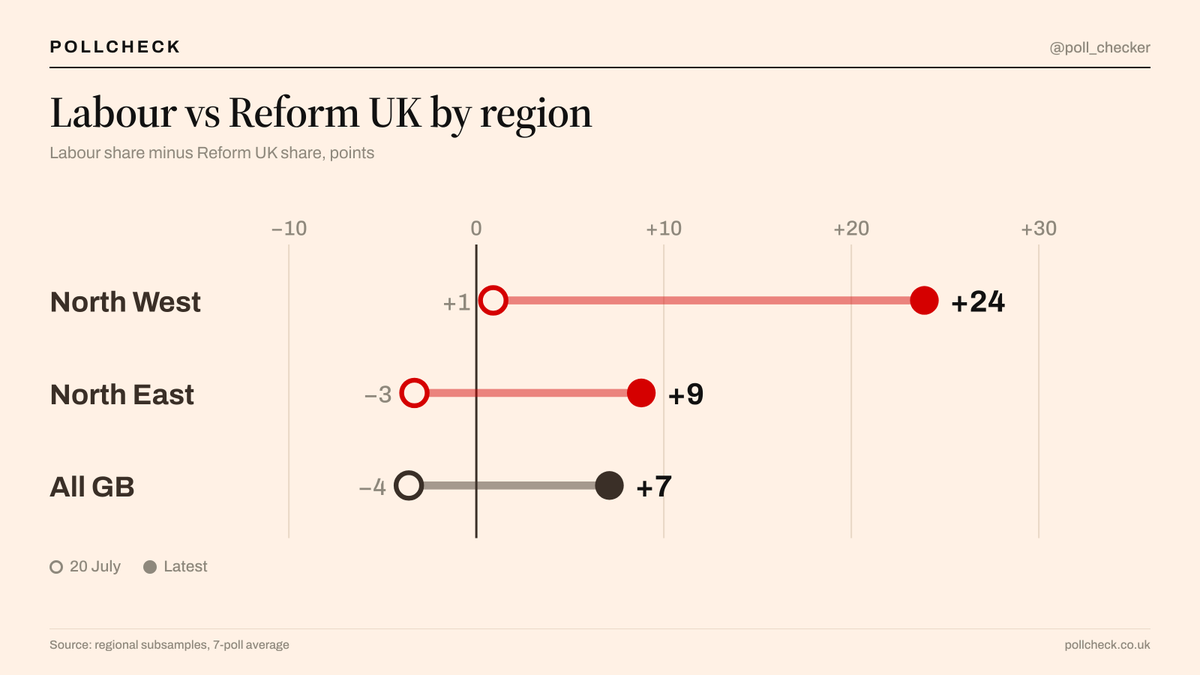
In North West regional polling, Labour have gone from 1 point ahead of Reform to 24 ahead
In the North East it's 3 behind to 9 ahead, close to the national change (4 behind to 7 ahead)
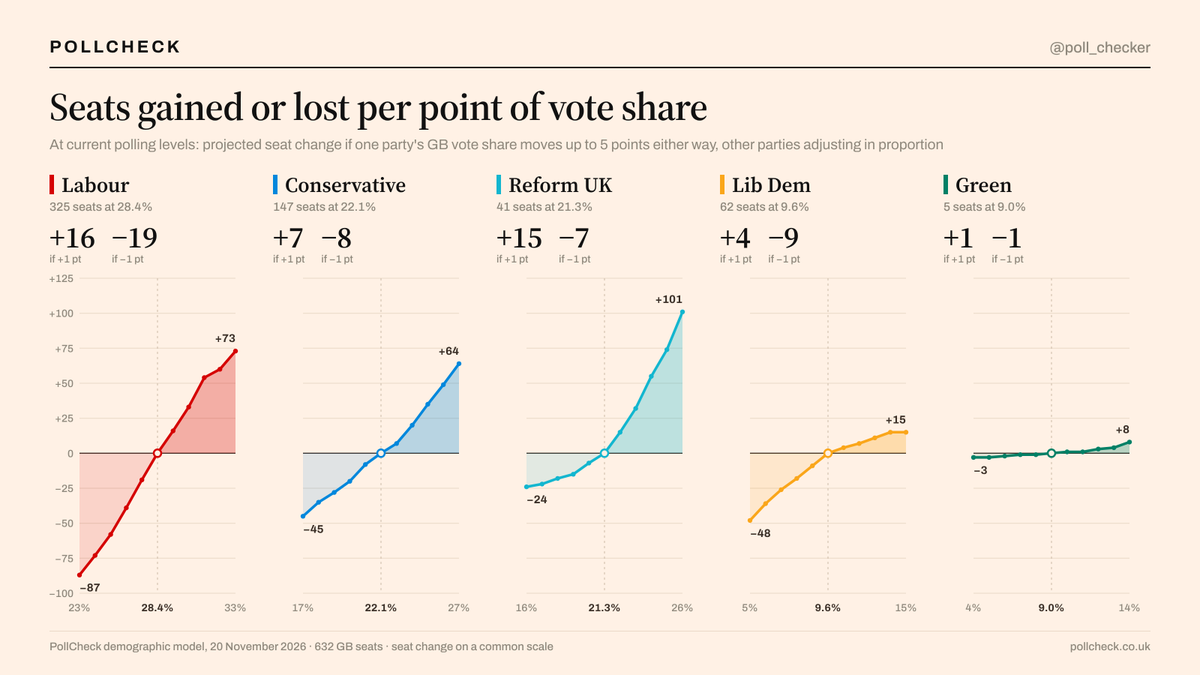
As the parties continue to battle under FPTP, how many seats does 1 point of vote share give each party at current levels, according to our model?
Labour gain 16 seats per extra point, and lose 19 per point dropped
Reform gain 15, but lose just 7 if they fall a point
The Conservatives gain 7 and lose 8
The Lib Dems gain 4, but lose 9 per point dropped
Greens gain just 1 seat at current levels
Leader net approval, smoothed trend across all pollsters 📊
Change over the last month (21 Oct to 18 Nov):
Burnham: +12 (+4)
Badenoch: +2 (+1)
Davey: -10 (-1)
Lowe: -22 (-4)
Farage: -27 (no change)
Polanski: -36 (-5)
Full tracker: https://t.co/a0JxApLouw
A big by-election to watch next week - all seats in Castle Bromwich (Solihull) will be up after all three Reform councillors resigned following ITV's documentary Undercover: A Year in Reform
May 2026 results (all three seats): Reform 57%, Conservative 28%, Labour 9%, Green 5%, Lib Dem 2%
Conservatives need to win one seat to take control of the council
There are 21 candidates (voters can vote three times):
🔵Conservative: Georgina Hartland, Martin McCarthy, Ethan Potter
🟢Green: Dee Boyce, Shesh Sheshabhatter, Mark Wilson
Labour: Kashif Ahmed, Hazel Dawkins, Tom Gilmore
🟡Lib Dem: Bob Carleton, Christopher Johnson, Matt Purssell
➡️Reform UK: Mark Evans, Jacqueline Howse, Garry Taylor
⚫️Restore Britain: Michael John Craven
🏠Independent: Qasim Ali, Elliott Astley, Michael Gough, Bhavan Pemmaiah, Paul David Thompson
🗳️ Here's the latest map of all local by-elections in England & Wales to take place since May. I've included the same map for by-elections held between LE2025 and LE2026 for comparison.
This year has been far more mixed and far less polarised between Reform and the Lib Dems
We can also see how certain by-elections favour Reform much less, mostly on amount of degree holders in a ward.
Reform UK's council by-election vote share, by the share of adults in the ward with a degree:
Fewest graduates (14-26%): 35%
26-31%: 29%
32-40%: 22%
Most graduates (40-71%): 13%
So some wards will always favour certain parties, while national polling however can only go off nationally representative numbers
Many people are saying national polls aren't accurate as Reform is outperforming these in by-elections
National polls are firstly, of course, designed to be nationally representative, while a by-election will usually favour a certain party based on voting history, demographics etc
Reform have averaged 24.4% across the 165 council by-elections since 8 May 2026, standing in every one, while their current national poll average is 21.1%.
These wards have on average been older and whiter than national averages, and Reform did slightly better in these wards at GE2024 than nationally.
In these wards, Reform now get 1.47 times their 2024 general election vote. Across Great Britain, 1.47 x 14.7% = 21.6%, against 21.1% in the polls.
Reform showing continuing strength in a series of by elections last night, particularly pattern in places still feeling effects of closures of traditional industry. Despite national poll dip areas of country that have felt those impacts still turning to Reform for something new.
@charliemansell Definitely, would be interesting to do a few variations. As you say, measuring anything pre 2024/2025 even generally has no Reform data so swing looks much bigger. If you were to look at these same seats since 2021 it looks much different, but not a like for like
Looking at wards that have had by-elections since May 2026 - Labour have increased an average of 7% in the same wards
Average share across parties:
Labour: 29.0% (May 2026 21.9%, +7.1)
Reform UK: 22.1% (May 2026 27.4%, -5.4)
Green: 17.7% (May 2026 23.6%, -5.9)
Conservative: 12.7% (May 2026 12.5%, +0.2)
Lib Dem: 11.2% (May 2026 9.6%, +1.6)
Restore Britain: 1.9% (new)