American media does not cover the world.
It covers the world's relationship to America.
There is a difference, and the difference is everything.
When a country's political situation is covered through the framework of what it means for American interests, American elections, American strategic positioning, the people living in that country become supporting characters in someone else's story.
Their elections are covered as tests of American influence.
Their economies are covered as variables in American trade policy.
Their conflicts are covered in terms of which side America supports and why.
The internal logic of their political lives, the history, the grievances, the class dynamics, the colonial inheritances, is either compressed into a paragraph of background or omitted entirely.
This is not deliberate distortion in most cases.
It is structural.
American journalists were trained in American institutions with American assumptions about what constitutes a story and who the relevant actors are.
They produce journalism that reflects those assumptions.
That journalism circulates globally, because American outlets have the distribution infrastructure that most national outlets cannot match.
So the world gets covered through an American lens, at American scale, with American categories determining what is a "crisis" and what is "normal," who is a "leader" and who is a "militant," what is "democracy" and what is "instability."
And local journalists, who want international reach, learn to write in that framework.
The lens is not neutral.
The lens exported globally is not neutral.
And a world that sees itself through someone else's eyes eventually starts to lose its own.
Here's what they could not bomb.
They could bomb the roads. They bombed the roads.
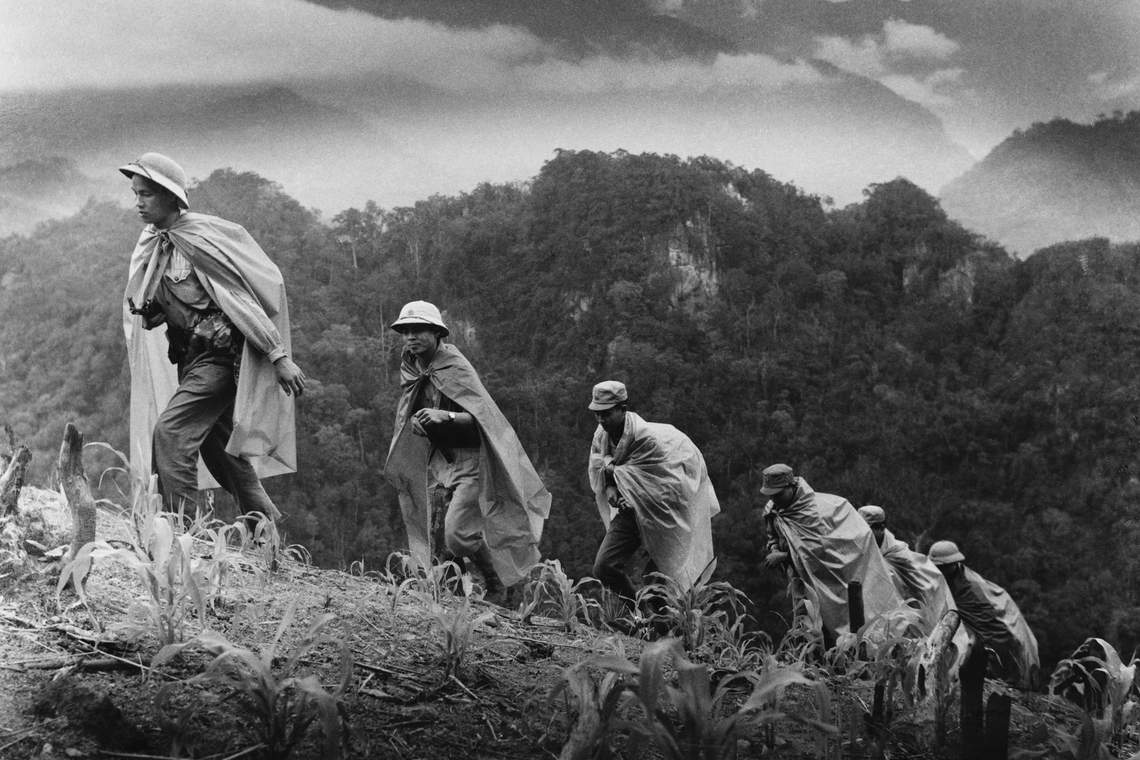
Vietnam moved supplies at night, on bicycles, through jungle paths, through routes so dispersed and adaptive that no bombing campaign could cut them.
They could bomb the cities. They bombed the cities.
Vietnam moved the cities underground. Entire hospitals. Entire schools. Entire command structures, built into tunnels, kept operational through years of bombardment.
They could bomb the supply lines from the north. They bombed them constantly.
Vietnam repaired them faster than they could be destroyed.
Tens of thousands of people, many of them women, many of them teenagers, worked around the clock to fill bomb craters and rebuild bridges and keep the lines open.
They could not bomb the reason.
The reason the Vietnamese were fighting.
The reason they were willing to live in tunnels and eat whatever they could find and watch their villages burn and keep fighting.
The reason, which was simply:
This is our country and we will determine what happens in it.
That reason lives in a place no bomb reaches.
It lives in the decision.
The collective, generational, absolute decision of a people that their dignity is not for sale and their submission is not available at any price.
When a people reach that decision, when enough of them reach it, deeply enough, the military calculus stops working.
All the tons of bombs and all the chemical weapons and all the counterinsurgency manuals become irrelevant.
Because the war is no longer being fought over territory.
It's being fought over whether the people will break.
And Vietnam did not break.
After everything.
After Agent Orange and carpet bombing and Phoenix Program assassinations and "free fire zones" and napalm and the systematic destruction of every physical thing that could be destroyed:
The people did not break.
The people won.
There is no more powerful demonstration in modern history of what human will can do against imperial force than what Vietnam did.
And they know it.
Which is why their military academies study it.
Which is why their strategists are still writing about it.
Which is why the word "Vietnam" is still the word their politicians reach for when they want to describe something that went wrong beyond recovery.
They study it because it frightens them.
It should.
It should frighten every empire that thinks enough firepower can substitute for the right to be where you are.
Vietnam proved it can't.
Filipino family culture is very toxic.
"Utang na loob" is just the legal bare minimum your parents should do to not get arrested for child neglect.
"Pakikisama" is the fear of conflict, it is better to have people step on you than say something.
"Hiya" is the worst.
America dropped nuclear bombs on civilian cities.
It is the only country in history to have done this.
It then spent eighty years telling every other country they couldn't be trusted with nuclear weapons.
Sit with the geometry of that sentence.
Sit with it until it becomes uncomfortable.
I cittadini cinesi continuano a vivere oppressi e costretti a viaggiare in treni ad alta velocita', sicuri e puntuali senza quell'emozione dei ritardi continui e imprevedibili che permeano le vite dei cittadini italiani, tedeschi ed altri.
Sono anche costretti ad attendere i loro treni in queste mega strutture pulite, moderne ed efficienti, che noi non avremo mai, senza quel brivido e senso di paura, a noi noto, di imbattersi in drogati, criminali, scippatori e clandestini ed altri personaggi che infestano le nostre stazioni, impuniti.
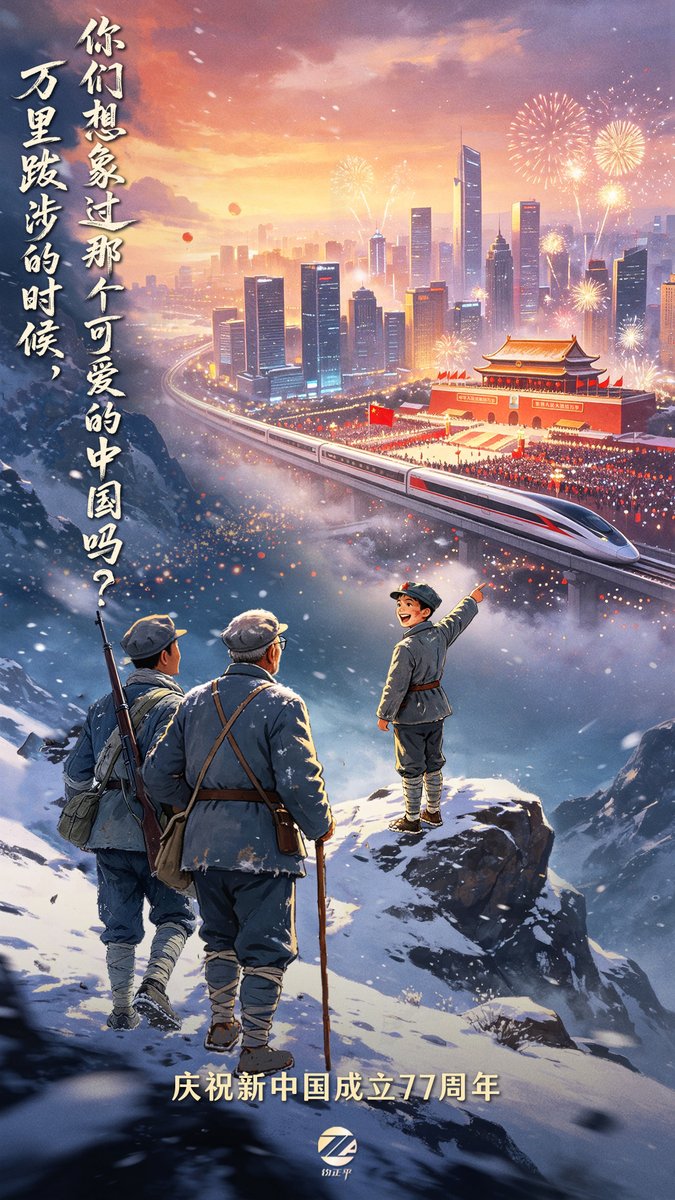
Today we mark the 77th anniversary of the founding of the People's Republic of China.
In less than three generations, under the leadership of the Party, our nation has risen from a war-torn country to a global superpower.
We began with nothing. By 1949, China had been at war, on and off, for over a century. The 1911 Revolution overthrew feudalism and established our first republic, but it brought us neither prosperity nor dignity. Yet it was the last snowflake that set off the avalanche; the people's revolution.
Western historicism sees history in segmented eras; it likes to pinpoint Copernican turning points and paradigm shifts. We Chinese, however, view history as more continuous. That is why our communist revolution did not begin in 1949, or 1921, or 1911: its roots reach back long before Marx. For us, ideology is a tool for the people's liberation and national awakening. Our goal has always been people-centered, not blind faith in doctrine.
We still view previous revolutions, regardless of ideological leaning, as part of our struggle, the fight for a better life for our people. They are not foreign chapters in someone else's story; they are chapters in our own. Every uprising, every reform, every sacrifice that sought to lift our people and advance the awakening of our nation belongs to that same long march. We honor them not because they were perfect, but because they were ours steps, however uneven, toward the same horizon.
That is the continuity we carry, not a chain of isolated revolutions, but one unbroken struggle, generation after generation, to build a China worthy of its people.
"National interest" is the most durable escape hatch in the history of power.
It works because it sounds like an argument when it is actually a deflection.
When an American official says "we acted in the national interest," they mean: "the justification for this action exists at a level of abstraction that insulates it from ordinary moral scrutiny."
Not: these specific people are better off.
Not: this specific outcome produced more justice in the world.
The national interest.
Abstract, unverifiable, self-defined by the people invoking it, and conveniently coterminous with whatever decision they had already made.
The national interest required Guantánamo.
The national interest required the intervention in Libya.
The national interest required the bombing of Yemen.
The national interest required the coup in Venezuela.
The national interest required war with Iran.
The national interest required continuing military support for Israel through the genocide in Gaza.
At some point the honest question becomes: whose nation? Whose interest?
Because from where much of the world stands, what gets called "national interest" looks a great deal like the specific financial and strategic interests of a specific class of people, wrapped in a flag large enough to obscure the accounting.
The American ruling class will never say "we are the terrorists."
They will say "we are the indispensable nation."
They will bomb a country into dust, then claim they saved it from something worse.
They will cry over their own dead and shrug at everyone else’s.
They will not stop until someone takes away their permission.
That someone is not another government.
It is the people they pretend to represent.
The genius of the two-party system is not that it gives you a choice.
It is that it gives you someone to blame who is not the system.
Every failure becomes the other party's fault.
Every continuity, the wars that continued, the surveillance that expanded, the wealth that concentrated, the policies that persisted across administrations with striking fidelity, gets explained as the other side's influence.
The holdovers. The bureaucracy. The structural constraints.
The system never fails.
One side or the other always fails.
And the solution is always to try the other one.
And then the other one does what the other one always does.
And the solution is to go back.
The pendulum swings.
The machine runs.
And the people most committed to the ritual, the ones who canvas and donate and argue fiercely about which face to put on the office, are also the ones least able to see that the office itself is the question they're not asking.
You keep waiting for the "good ones" in power.
There are no good ones in an office that exists to manage global violence.
The system is not broken.
It is faithful.
It does what it was built to do.
The only variable is not who rules.
It is how long the ruled accept the deal.
"life isn't fair." then make it fair?????? like???? it is your job as authority figures to do so actually. why are we treating the pursuit of fairness and justice like its a juvenile and naive thing to want
That's why the US government is blockading Cuba and not allowing us access to Chinese technologies.
That's why China looks like a science fiction movie while my city, Cleveland, Ohio, is a big pile of rust and dirt and homeless people and drug addicts.
That's why social media is completely controlled by the Epstein class.
That's why everyone knows money buys elections and policy, and the people have no real say over our daily lives.
Because COMMUNISM can't survive these things...
Is anyone else sick of these scumbag politicians gaslighting us, telling us the sky ain't blue and water ain't wet?