Did you know tiny models are capable of out-planning a database?
I trained a 4B model to produce 81% faster query plans than Postgres. Write-up below 👇
We are releasing Ultramarine 1 Flash, a frontier-class model built for knowledge work. It is open-source and achieves similar performance to Fable 5, while being 60x cheaper.
It was post-trained by a team of 5 for ~$300k all-in. Available on API now, with weights releasing in 2 weeks.
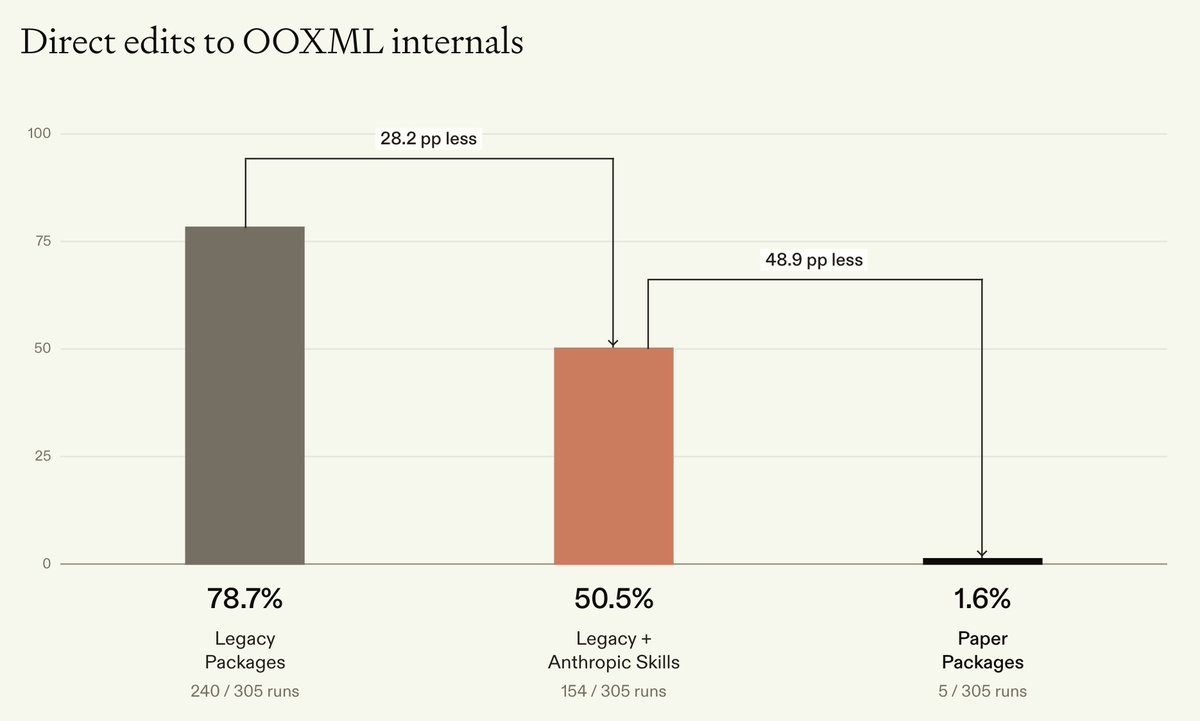
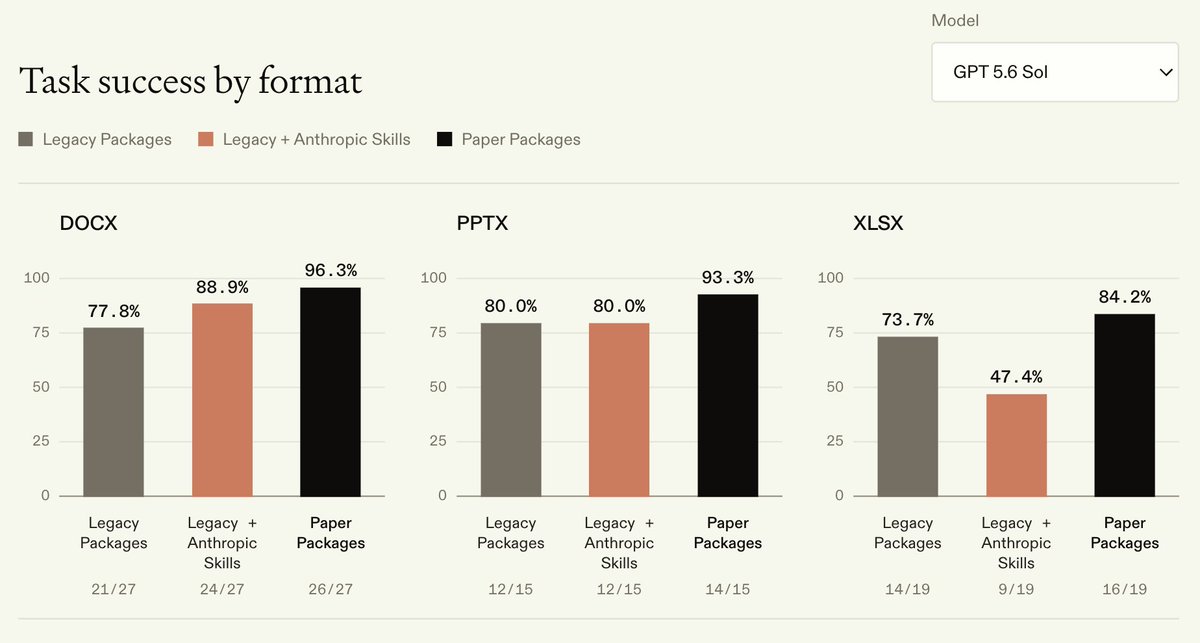
Agents are using legacy Python packages to edit Word, Excel, and PowerPoint files, hitting API gaps, dropping into raw OOXML, and creating silent corruptions.
We fix that today with OSS Paper Office:
Did you know tiny models are capable of out-planning a database?
I trained a 4B model to produce 81% faster query plans than Postgres. Write-up below 👇
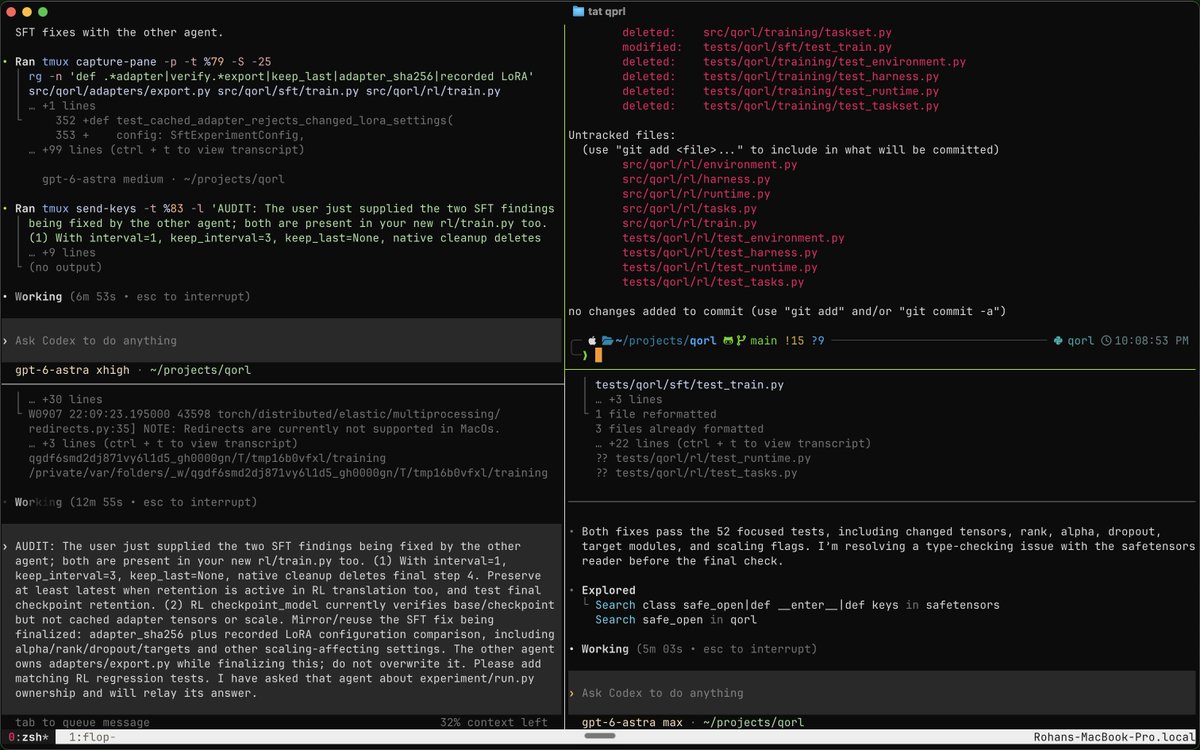
can confirm this works shockingly well, xhigh astra (top left) steering a fast but dummy medium astra (bottom left), it's like a poor man's version of mostik
I’m seeing lots of tweet replies asking basically “but how do I get two models to talk to each other? Without me manually copy/pasting results between apps?”
And I’ve heard this same question repeatedly from friends who use AIs mainly through GUI apps.
Yes, there are various apps starting to be released for just this problem. But it’s worth knowing that in a pinch you can already do all this yourself, on the command line, just by using tmux.
Here’s how.
On the command line start a named tmux session with the command “tmux new -s chat”.
Create a second window within that session. (The default keystroke for this is doing “ctrl-b c”. You can switch between windows by doing “ctrl-b n” for the next window.)
Launch the codex CLI in one window, and the claude CLI in the other.
Then you can literally say to the AI in window 1, “please read the analysis of the AI in window 2 of the tmux session ‘chat’. Wdyt?” And vice versa. Now you have cross-harness review.
Or you can instruct one AI to delegate and manage the other AI over multiple turns, or monitor it over time, or whatever. This works because each AI can use the tmux CLI to read and write to the other’s window.
This does not on its own solve coordination problems like deciding who is in charge, or who talks first, or who waits for whom, but it establishes the basic communication primitives of “read the other AI’s output” and “write to the other AI”. You can build more complex workflows on top of that mostly by prompting.
The fundamental reason this all works is that the Unix-era command line environment is more interoperable than the modern GUI environment, so a decades-old tool like tmux is still one of the best ways to compose modern AIs. Obviously the command line tools are a PITA in other ways. But it’s great that they are so flexible, they already exist, and they work right now, so you don’t need to wait for the vendors to get their apps to play nicely with each other (which might never happen) or for someone else to catch up and write a new app just to connect things.