You can manufacture “traction” with tons of incentives
The playbook is always the same:
• Use product / help us out = "big airdrop”
• PUA with endless points/SBTs/quests to juice “user traction + volume”
• “Grind S1, we’ll reward real users”
• Endless screenshots of peaks and high volume
• Muh “community + traction” → endless quests
• “Meet CEO / reply with proof” type of tasks
... all looks like momentum, hard to tell what’s real demand vs reward chasing behaviour
Can they actually show unique users, repeat buyers, net spend per user, and what volume looks like without rewards?
Also, do some math around SBTs before you get excited over a potential airdrop:
• Most projects can only allocate like maximum 5% of token supply to airdrops (to prevent huge token dump)
• Then you divide that by the number of SBTs circulating + continuously minted weekly/monthly
• If SBT issuance is basically unlimited (weekly criteria, constant new badges), your expected value per SBT gets diluted to dust...
Then TGE arrives and people who put in time/capital get a tiny unlock + vested airdrop
After enough examples, if you still believe the hype and fomo… that’s on you
If the main growth loop is quests + SBTs + constant FOMO… you ARE the product. (Insert @DegenSpartan's if you don't know where the yield comes from, you are the yield)
p.s. this tweet may or may not be referring to recent TGEs/ new projects
Every crypto founder thinks they need to time their token launch around bull markets. I always tell them they're wrong, launch timing doesn't matter. They never believe me.
Well, I built a tool with Claude Code to analyze every token listing announced on the Binance blog to settle this once and for all.
Here's what I found:
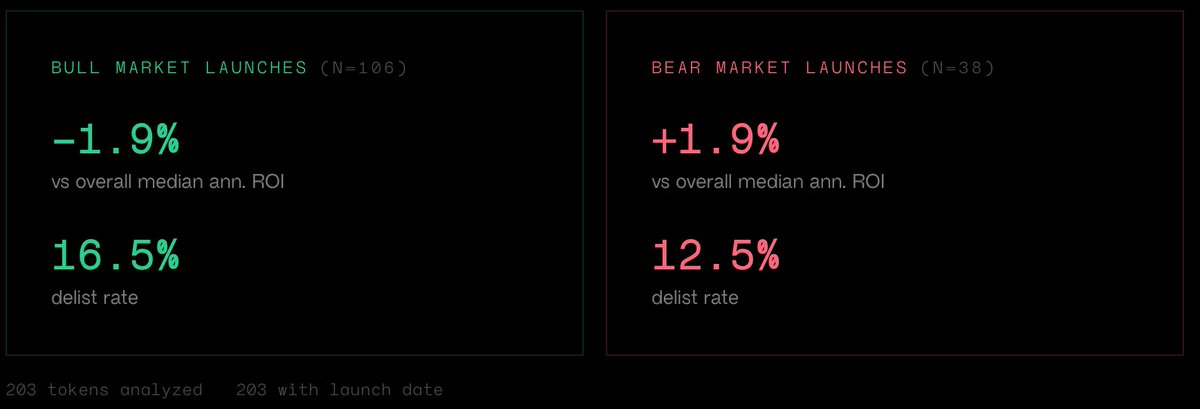
Headline result: there is no statistically significant difference between tokens launched in bull vs bear markets (Mann-Whitney p = 0.81), meaning differences between bull and bear market tokens are indistinguishable from noise.
It doesn't matter when you launch your token.
How can I be sure of that?
First, you have to be careful how you answer this question: people believe that it's better to launch tokens in bull markets, and there's more funding in bull markets, so there are many more tokens launched in bull markets. Because of this sample bias, you can't naively look at the proportion of top 100 tokens that were launched in bull markets.
To correct for this, you need a clean selection criterion to compare the populations. The best dataset I found was looking at the Binance listings blog. Take every announced listing, tag them as during bull markets, bear markets, or neutral markets, and benchmark the relative performance of the bull vs bear populations. Filter out tokens that aren't independently priced (RWAs, stablecoins, LSTs etc.), and this gets you a total of ~200 tokens to benchmark.
See the website below to explore the data & methodology in more detail. This finding is robust to almost any way you slice and dice the data.
Now, if you're a founder, this analysis might not be the end of the story. Even if launching in a bear market doesn't predict long-term token performance, there are other advantages to launching in a bear market: less competition for talent, service providers are cheaper, exchange listings are less competitive. On the flipside, if you're doing a simultaneous token sale, you're likely to get more demand in a bull market.
But on the whole, these things are probably a wash. The main thing is to just get your product out there and build something valuable.
The example I always bring up to founders is that Solana launched 4 days after the COVID crash in 2020, when Bitcoin wicked down to $4K.
It doesn't matter that much when you launch. Just launch.
The hard part isn’t putting assets onchain anymore, that part is basically solved. The hard part is everything around it. Because tokenization on its own doesn’t magically fix anything. it just moves the potential mess onto new rails.
you can tokenize a loan, a building, a bond, whatever, but then what?
How do i know it’s still performing? who’s checking the data? what happens if something breaks? can i actually exit?
do i understand the risk or am i just staring at a % number?
This is where most RWA chats tend to fall apart. People keep building “the asset”
but barely anyone is building the boring stuff that makes the asset usable & trustable.
The data, the reporting, the verification.
the risk logic & before anyone says anything, yes I know there are a few projects out there doing said things but there aren’t enough.
RWAs make or break on whether the information is real, live, and provable. If a loan is late, i should know. If collateral moves, i should see it. If something defaults, it shouldn’t be a surprise six months later.
Then there’s liquidity and this is where people really lie to themselves. We all truly know real assets aren’t liquid by default. pretending they are just creates fake TVL and broken/unachievable exits.
The opportunity here isn’t “make everything trade 24/7”. It’s building sane secondary markets, redemptions that actually work, and liquidity that shows up after structure is aligned.
and risk… this is the elephant in the room.
most people don’t actually understand why something yields what it yields. They just compare numbers. 8% vs 15% - boring vs exciting.
The teams that help investors understand risk & not hide it are going to matter way more than the teams chasing the highest APY. If teams are open & transparent about the downside of their products I’ll trust them 10x more than the ones who hide it and show off a higher APY.
and lastly, UX. most people don’t care that something is “onchain”. They care if it makes sense & that it’s simple to consume & use.
can i see what’s happening? can i trust it?
can i explain it to someone else without sounding too much?
they’ll win because they’re boring, understandable, and reliable. Maybe the opportunity isn’t another asset. maybe it’s the stuff that makes assets finally behave the way they should and that to me is where i think PMF actually lives in this current moment.
As price moves up, new sellers show up. Early buyers take profit. Long term holders start distributing.
For a rally from $0.13 → $2 to sustain, buy pressure has to be continuous and increasing, strong enough to clear each level faster than new sell orders appear.
At low prices, this is easy.
Most are long term holders and not willing to sell at a loss. Thin order books mean buyers can clear each level fast, so price jumps.
That’s why POL popped on the announcement.
But selling pressure increases as price goes up.
@aditya_sharma getting hired in crypto IS about networking harder:
-with the right people
-making sure those people know your track record
the space is relationship based. hiring process is about, “do you know anyone who does xyz?”, “saw you’re connected to A, what do you think of him/her?”
@molusol I have a small position in Loopscale. Didn't dare to add more since the platform was previously exploited. Will check their latest audit update. Thanks for the tip!
By the way, do you know when their planned TGE is?
@StarPlatinum_ Good take, but applies more to people who’ve been farming these products already, since retro snapshots go back years (MM, Base). New users can't compete
Jupiter, Farcaster make sense. Jupiter resets its snapshot every Feb, Farcaster doesn’t have much competition (+farming Base)
2025 token launches have mostly been a bloodbath
Tracked 118 TGE launches this year and compared today’s FDV vs opening:
• 84.7% (100/118) are below TGE valuation
• This means ~4 out of 5 launches are below their opening valuation
• Median token is -71% FDV (-67% MC) from launch
• Only 15% are green vs TGE
TGE isn’t early anymore reee
Full data: https://t.co/QyRR3UJd04
🚨 Breaking:
@RateX_Dex TGE probably this month
Team confirmed in the discord that S2 will start right after S1
RTX token utility will be closely tied to new @mooncake_fi protocol