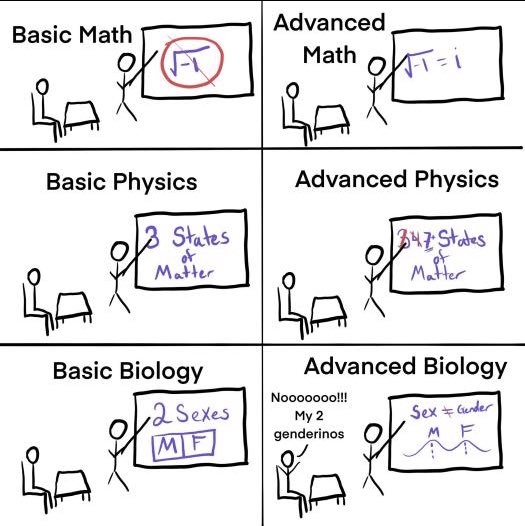
@NoAguacatito@tussifresh_@alina0 Para nada estoy llorando. Entiendo el enojo y que usen insultos transfobicos hacia un abusador, pero de ahí q negar que es transfobia se me hace un poco raro.
@NoAguacatito@tussifresh_@alina0 Una cosa no quita la otra. A mi parecer ambas son obvias, esa persona cometió un abuso. Pero el grado de odio a su identidad es demasiado y si bien lo puedo entender por el caso, negar que esa transfobia se me hace algo feo. Igual horrible lo que hizo.
@cleste2828@tussifresh_@alina0 Es que entiendo que no está mal hablar mal de un abusador, es una persona hdp. Pero ese discurso se está generalizando a la población trans.
@ManueI_99999@mpxwlin11052@alina0 Nadie le está comparando. Pero justificar también el negar la identidad de una persona, no está muy cool. Está claro que esa mujer trans cometió un tipo de abuso, sin embargo no justifica el misgenering. Son cosas separadas.
@nacheldon@tussifresh_@alina0 Llamar a alguien por su sexo es misgender y eso es una falta de respeto a la identidad. SOMOS SERES SOCIALES Y LA CIENCIA TAMBIÉN RESPALDA ESO.
@JessLinuxera Creo que debe ser una etapa más en el proceso de selección. Y bien puede ser una skill usada en el reto técnico, o ser evaluada en plena entrevista, para ver cómo se usa la herramienta ✨
I was not expecting things to go this way, but I think MCPs are better than CLIs for most integrations.
The models have gotten much better at tool calling, we can defer tools & MCP is now stateless.
If you need to compose/filter data, add params like query to your MCP tools.
He's right. The last codebase I worked on that you had a chance to understand was MS-DOS.
By the time Windows NT came along, you could be an expert on the scheduler or an expert on the allocator, but you weren't going to know fibers and OLE embeddings at the same level.
Plus, I'm wired to remember what code looks like in the editor, so I've got to see it, and you just can't see it all.
There's too much code for my context window. And in talking to people on the team much smarter than me, I'm not the only one.
Eventually, your brain (or mine, at least) sorts them into specifics and generals. So I might know specifically how fork() works but only have a general sense of how printf() actually formats floats. It still FEELS like you know, but you don't.