Ponminer : Verifiable Work. Transparent Distribution. 🀄️
Connects local computation to onchain reward allocation. Participants run a mining worker directly in their browser, generate qualifying proofs and earn a share of epoch rewards according to the work they prove.
The process starts with Keccak-256. A browser worker searches for nonces that satisfy the selected mining seam’s difficulty target. Qualifying proofs are submitted onchain, where the contract recomputes the hash before accepting the contribution. Each proof is bound to its chain, contract, epoch, seam and miner address, giving submissions an explicit verification context.
Three mining seams structure participation, with distinct difficulty levels and fixed allocations of 20%, 30% and 50% of the epoch reward. Within each seam, allocation follows each miner’s share of the proven work. Rewards therefore depend on contribution relative to other participants.
The architecture brings together three components: the Rig performs local computation, the Ledger records mining parameters and proofs, and the Vault handles reward allocation and claims. During an open epoch, the dashboard tracks work and estimated payouts. Once the epoch seals, settled $PONM rewards become claimable through a pull-based mechanism.
0xcbe8ad52afaeb03d31ff3095f28e43d91ac3900f
Enter the mine: https://t.co/y1Reoah89O
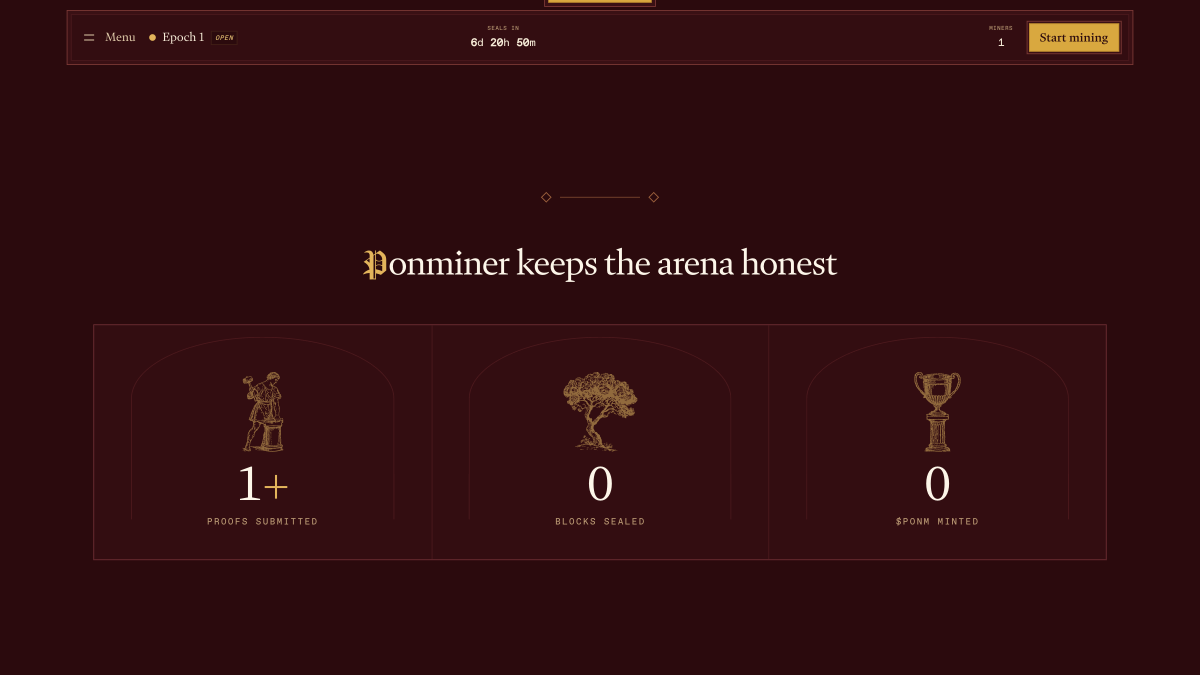
Zero blocks sealed. Zero PONM paid out. Epoch 1 is still wide open.
It seals on September 28 at 05:01 UTC. Mining is live now, and every proof accepted before the seal counts as work on its seam, toward that seam's slice of epoch 1's block of 1,000,000 PONM. Nothing submitted after the seal counts toward it.
$PONM is live on https://t.co/TFhfBfWZ3Z. Claims open once the mine is pointed at it and holds enough to pay. Nothing expires, so a share settled in epoch 1 waits until you come to claim it.
Every submission costs gas, work guarantees nothing, and $PONM may never be worth anything. Mine knowing that, and mine before the seal.
https://t.co/j4Hjo7ocXh
Build it where anyone can check it.
Everything the mine does is in one contract on Robinhood Chain, and its source is verified, so what you read is what runs. The Forge page writes down what that contract can and cannot do before anyone has to ask: what was fixed at deployment, what the owner can still change, and the curve every block follows.
No private dashboard, no off-chain ledger. The chain is the record.
https://t.co/3aTnofpHLL
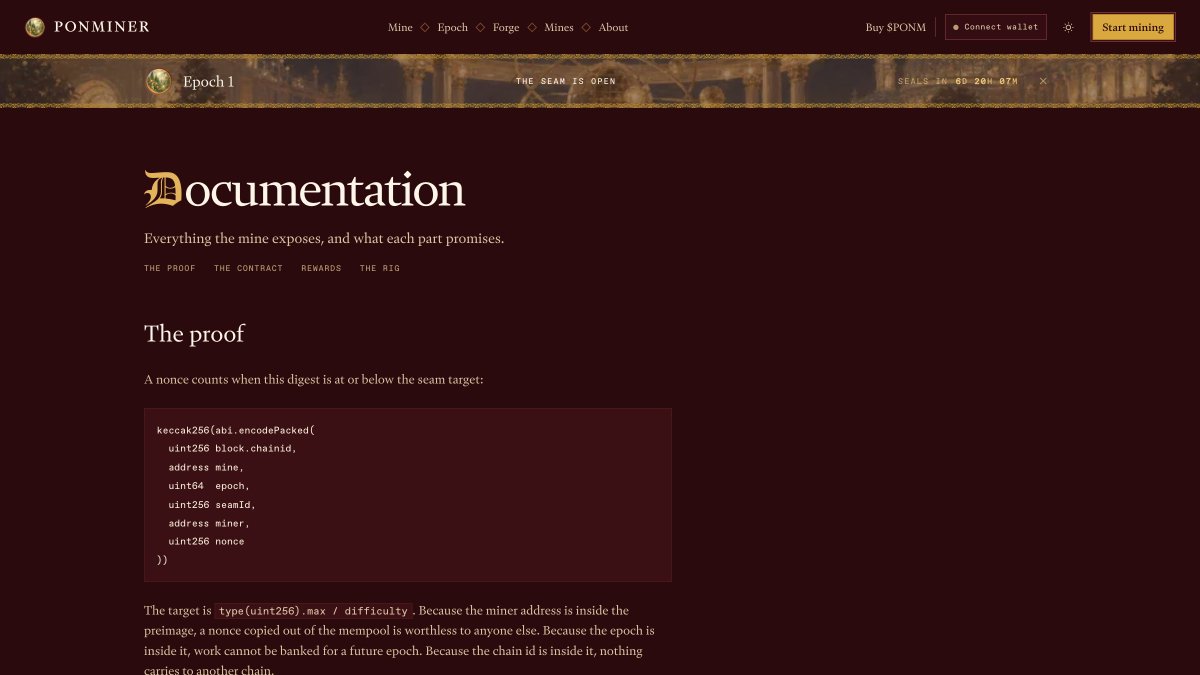
Everything the mine exposes is documented, and every call can be checked against the chain.
submit records a proof and credits the sender with that seam's difficulty as work. pending shows what an address can claim right now. projected shows what it would take from the open epoch if it sealed now. digest returns the same hash submit computes, so any rig can be checked against the contract.
The proof format, the contract, the rewards and the rig are all on one page, written before anyone had to ask.
https://t.co/A5EBR6Hl1U
Cheap proofs are the whole trick.
Every accepted proof on PONMINER is one transaction. On a chain with real fees the gas would swallow the reward, and mining from a browser tab would collapse into theatre.
Robinhood Chain settles a block in about a tenth of a second at around 0.13 gwei, so recording a proof costs a fraction of a cent. That is what lets a laptop or a phone take part at all.
That is why the arena lives here.
https://t.co/Rk0mRcZeta
The arena fits in a pocket. You can mine $PONM from your phone.
The countdown, the seam list and the epoch card all have a phone layout. No wallet in your phone browser? Connect wallet offers to reopen the page inside MetaMask, Coinbase Wallet or Trust Wallet. Once you are connected on Robinhood Chain, pick a seam and start the rig.
It is the same Keccak-256 worker thread on a smaller machine. A slower device finds proofs less often, and every accepted proof still credits its seam's full difficulty as work. Seam 01 is the lightest, at about 1M hashes per proof on average.
Lock the screen or switch apps and the grind waits, so keep the page in front while it works.
https://t.co/VBijmIJaJb
$PONM is live on https://t.co/TFhfBfWZ3Z.
The buy link and the contract address now live on https://t.co/VBijmIJaJb. Buy $PONM sits in the menu and the footer, and Copy CA puts the address on your clipboard in one click. Take it from the site, not from a reply.
The mine runs on its own clock. Epoch 1 is still open, proofs are landing on Robinhood Chain, and claims open once the mine is pointed at $PONM and funded.
https://t.co/VBijmIJaJb
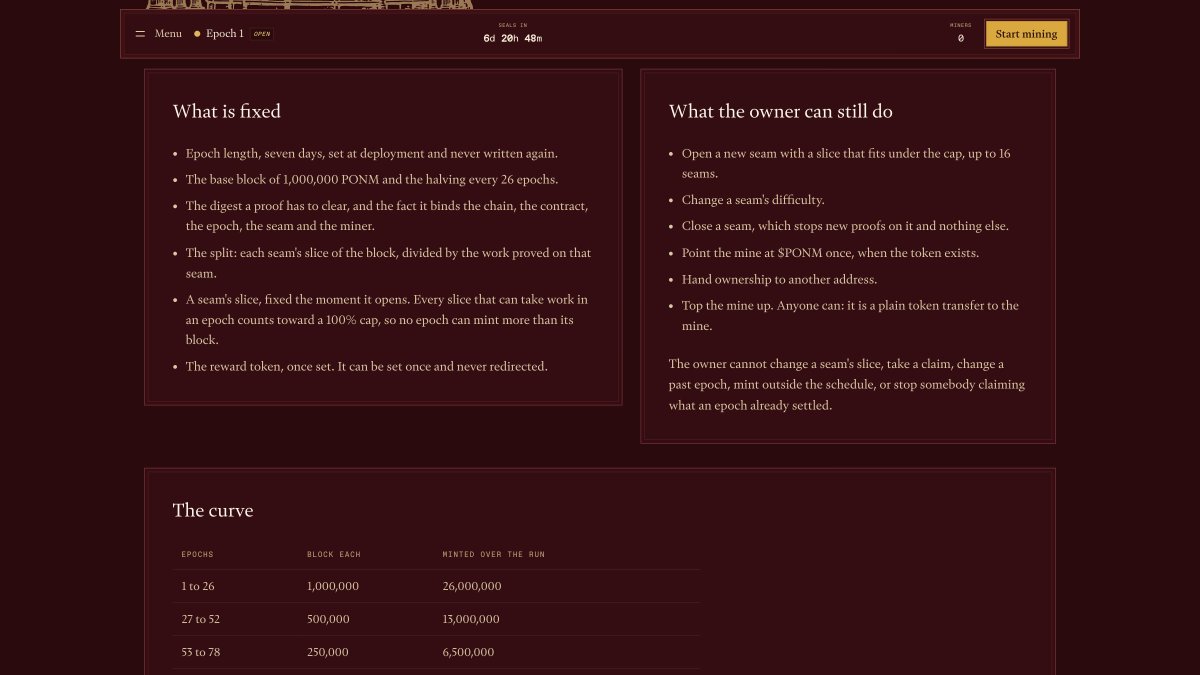
Admin powers usually hide in bytecode nobody reads. Ours are written out on the Forge page, next to the powers the owner does not have.
The owner can open a seam, up to 16, but only while all the slices together stay at or under 100% of the block. Change a seam's difficulty. Close a seam, which stops new proofs on it and nothing else, and reopen it if the cap allows. Point the mine at $PONM once. Hand ownership on.
The owner cannot change a seam's slice, take a claim, change a past epoch, or mint outside the schedule.
Fixed for good: seven day epochs, the 1,000,000 PONM base block, the halving every 26 epochs, and a reward token that can be set once and never redirected. The source is verified.
https://t.co/3aTnofqfBj
Paying per proof sounds fair right up until the hash rate arrives.
Fix a reward per proof and the mint rate follows the hash rate. A mine that gets popular over-issues, and the supply curve becomes whatever the crowd makes it.
So we split a fixed block instead. The seam opens. Miners work it. The epoch seals. The block is split by work. Four steps, then it repeats.
The ceiling is known in advance, and hash rate decides who takes what.
Nobody is promised a number. What you work for is a share of a block whose size was fixed before anyone started.
https://t.co/EhM6eSWb4X
52,000,000 PONM is a ceiling, not a promise. Time alone mints none of it.
An epoch is seven days open, then it seals. That length was set at deployment and can never be changed. Nothing pays out while an epoch runs, and nothing settled in it ever expires.
Epoch 1 carries a block of 1,000,000 PONM. The block halves every 26 epochs, roughly every six months: 500,000, then 250,000, and on down. Added up, the blocks approach 52,000,000.
An epoch nobody works mints nothing at all, so the schedule can never run ahead of the mining.
https://t.co/EhM6eSWb4X
Three pieces do the work, and nothing hides between them.
The Rig hashes in a worker thread at whatever rate your machine can spare, and pauses when the tab sleeps, so nothing runs behind your back.
The Ledger is one contract on Robinhood Chain that holds every seam, every difficulty and every proof. It answers to anyone who reads it.
The Vault is the split. Each seam carries a fixed slice of every block, divided by the work proved on it, and every miner claims their own share, so nothing can be stranded.
Your tab, one contract, a fixed block.
https://t.co/VBijmIJIyJ
Every miner who joins a seam spreads the same slice thinner. The slice itself never grows.
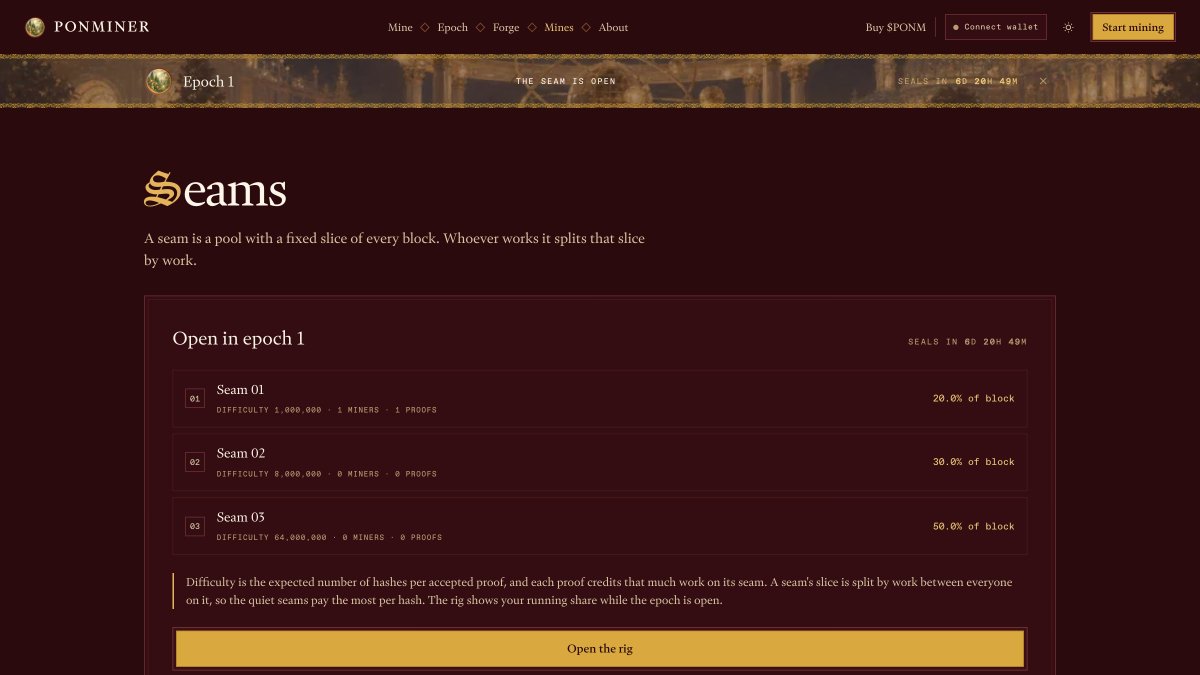
Each seam carries a fixed slice of every block.
Seam 01. Difficulty 1,000,000. 20% of the block.
Seam 02. Difficulty 8,000,000. 30%.
Seam 03. Difficulty 64,000,000. 50%.
Difficulty is the expected number of hashes per accepted proof, and each proof credits that much work on its seam. The slice is divided by work between everyone on that seam, and a slice nobody works is never minted.
Seam 01's slice in epoch 1 is 200,000 PONM, however many show up for it. The seams page shows how many are on each one right now.
Choose the seam, not the crowd.
https://t.co/U4jKkksBiG
A proof lifted from the mempool pays whoever lifted it nothing. The reason is in what gets hashed.
Every guess is one Keccak-256 hash of the same 144 bytes: chain id, the mine, the epoch, the seam, the miner and a nonce. Only the nonce moves.
Each field closes a door. Chain id 4663 makes a proof worthless on any other chain. The mine ties it to this one contract. The seam keeps it from counting on any other seam. The epoch stops an old proof being replayed later. Your address sits inside the hash, so the proof only counts for you. And each digest can be spent once.
The contract recomputes the hash and rejects anything that does not clear. The only way to hold a proof is to have found it.
https://t.co/VBijmIJaJb
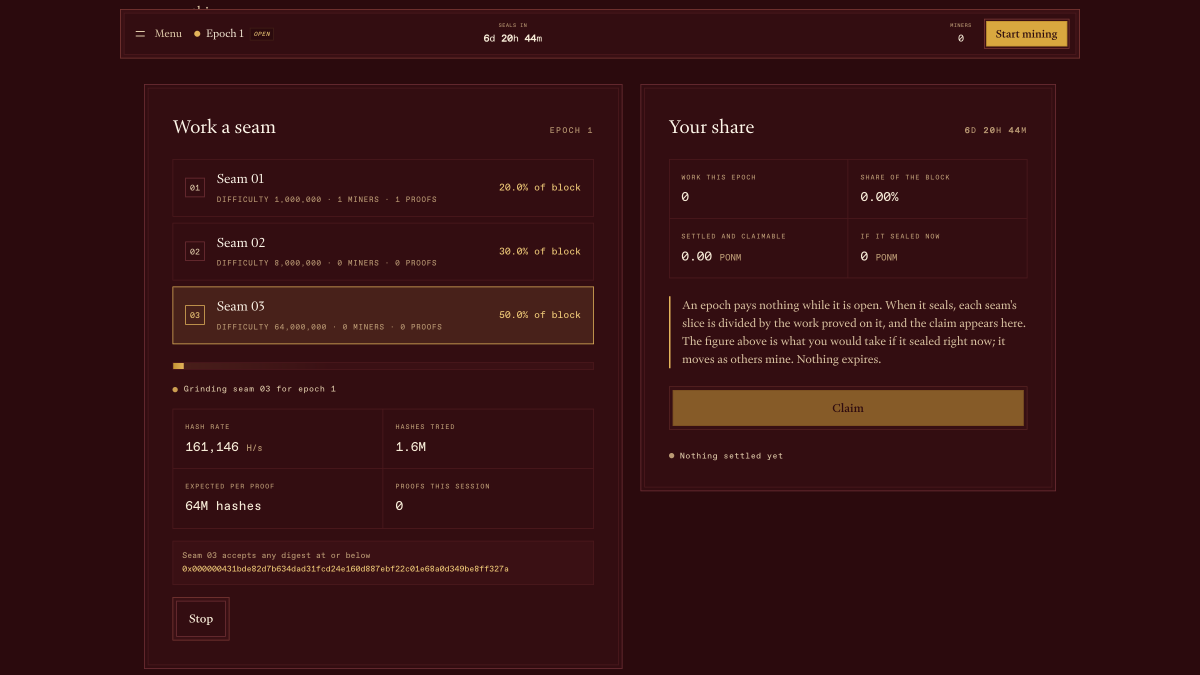
161,146 hashes a second. No GPU, no install, no driver. That is one browser tab.
The rig is a worker thread hashing Keccak-256 at whatever rate the machine can spare, so yours will read differently. Here it is grinding Seam 03 for epoch 1: 1.6M hashes tried, about 64M expected per proof, so roughly six and a half minutes per proof at this rate. That is an average. Chance decides when a proof lands. Difficulty decides how often.
The right panel shows your share if the epoch sealed right now. It moves as others mine.
Hide the tab and the rig pauses. Close it and the rig stops. Nothing runs behind your back.
https://t.co/VBijmIJaJb
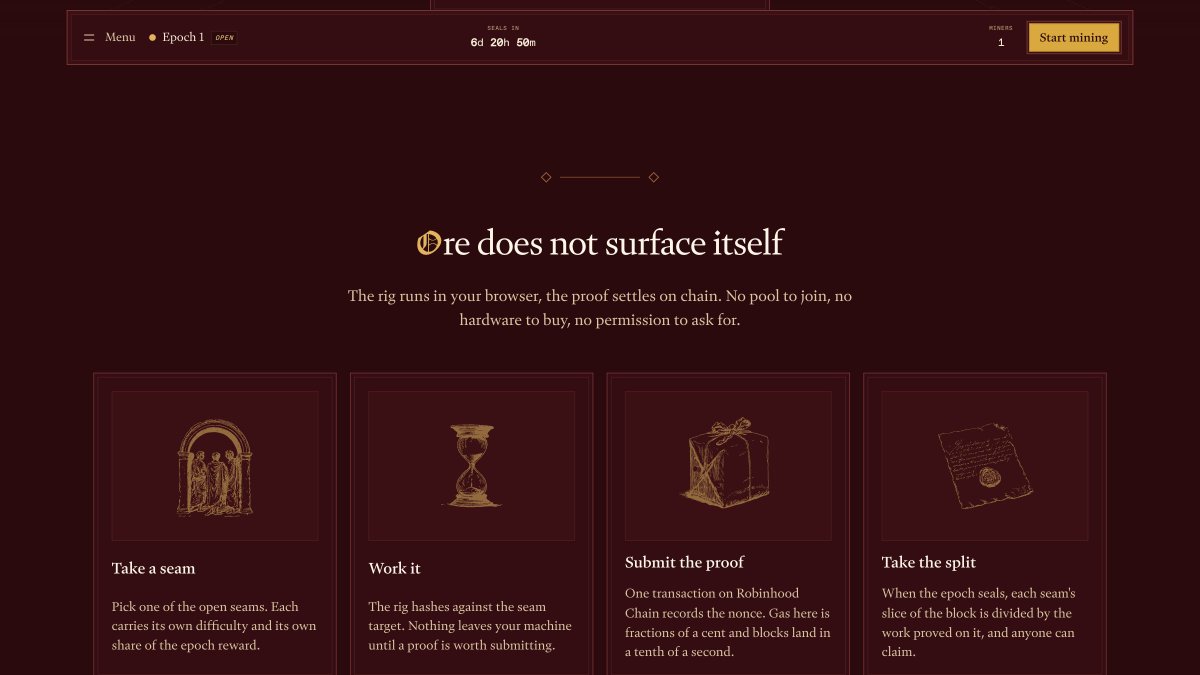
Ore does not surface itself. Mining $PONM takes four moves, all from one browser tab.
Take a seam. Each open seam carries its own difficulty and its own share of the epoch's block.
Work it. The rig hashes against the seam target in your browser. Nothing leaves your machine until a proof is worth submitting.
Submit the proof. One transaction on Robinhood Chain records the nonce. Blocks land in about a tenth of a second, and gas is fractions of a cent.
Take the split. When the epoch seals, each seam's slice is divided by the work proved on it, and you claim your share once the mine is paying out $PONM.
https://t.co/VBijmIJIyJ
Proof of work ended up in warehouses full of ASICs. PONMINER puts it back in a browser tab.
It is a proof of work mine for $PONM on Robinhood Chain. The rig hashes Keccak-256 in a worker thread on your own machine, and one contract checks every proof. No pool to join, no hardware to buy, no sign-up. A wallet is the whole identity.
Every seven days an epoch seals a block of $PONM, and the arena splits that block between the miners who showed up for it.
Epoch 1 is open, with 1,000,000 PONM in its block. The countdown under the painting is already running.
https://t.co/VBijmIJIyJ
Epoch 1 is underway. ⛏️
Three mining seams. Different difficulty targets. Reward allocations of 20%, 30% and 50%, each distributed according to verified work.
The position shown holds a 2.86% reward share, an estimated 28,571 $PONM if the epoch sealed now. That estimate adjusts as more proofs arrive; rewards become claimable after settlement.
0xcbe8ad52afaeb03d31ff3095f28e43d91ac3900f
Choose your seam. Prove your work. Build your share.
https://t.co/y1ReoagAkg
Thanks to @orbiodotso
The Robinhood Colosseum is an AI project as much as a mine, and every AI project leans on something it does not own: model access. Ours now runs through orbio.
orbio is a marketplace for LLM API credits. Holders with credits they will not use list them at a discount, and buyers spend them through one OpenAI compatible key. Same models, less spend, and prompts are never stored.
The two fit because they are built on the same idea. PONMINER opens proof of work to anyone with a browser tab: no pool, no hardware, a fixed block split by the work proved. orbio opens the models the same way: spare capacity, priced in the open, one key for all of it.
Hash rate mines $PONM. orbio keeps the intelligence affordable. Same arena.
https://t.co/VBijmIJaJb · https://t.co/2KT4Pq1yTA
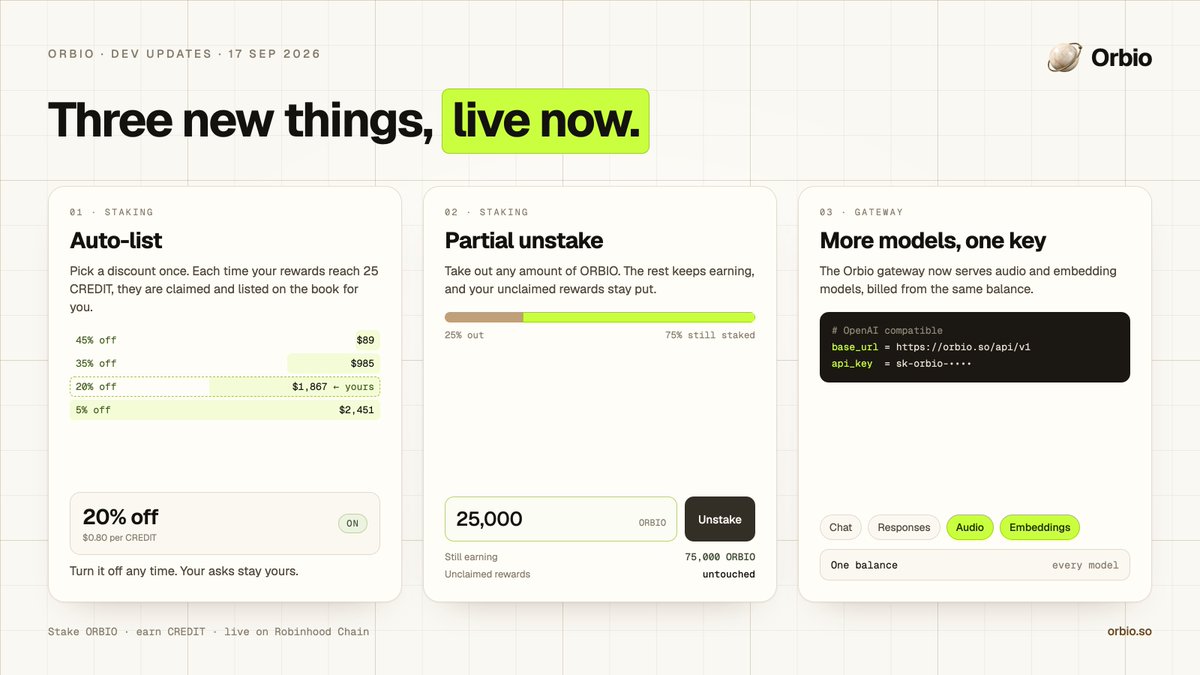
Updates:
Auto-list: pick a discount once, your staking rewards list themselves on the book
Partial unstake: take out any amount, the rest keeps earning
More models, one key: audio and embeddings on the gateway
🔒 100% of our team’s $PONM holdings are locked through PinkLock.
Committed to building PONMINER for the long term. The work continues.
https://t.co/7g22jMcWvi