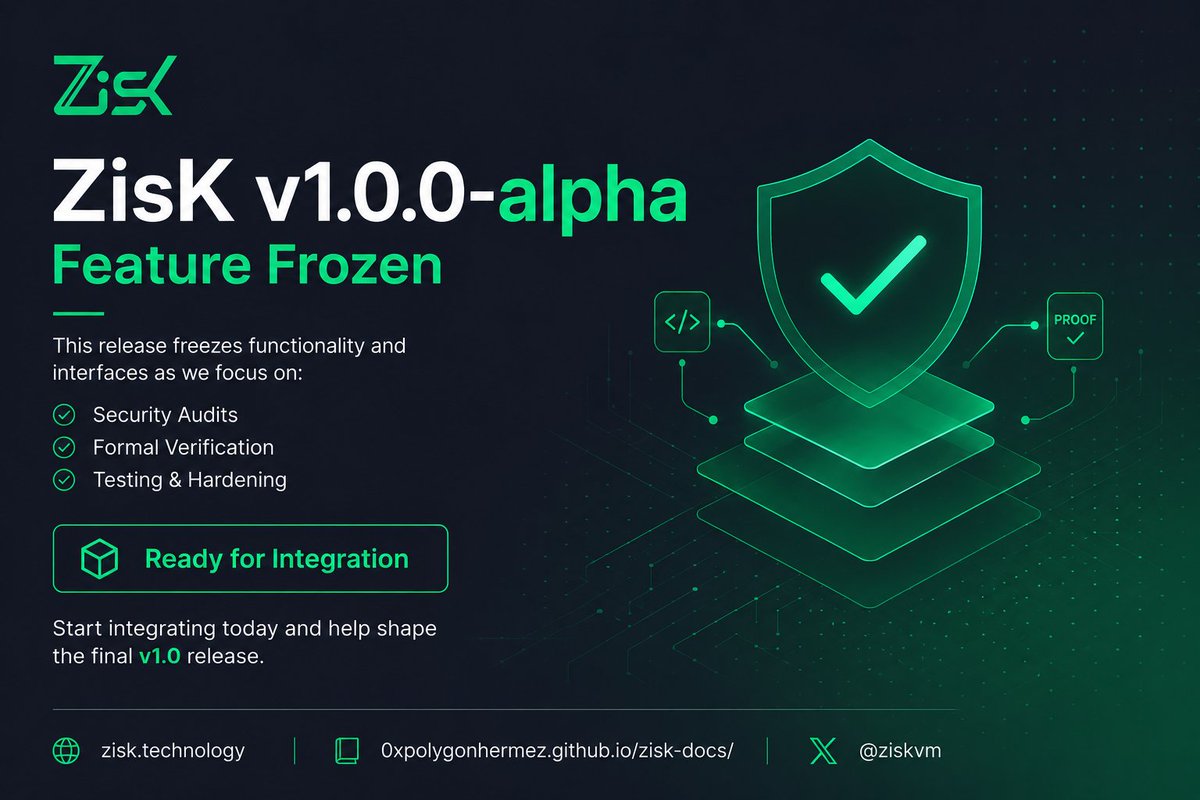
We just launched ZisK v1.0.0-alpha.
From here, our focus shifts to security: audits, formal verification, and hardening every component of the stack.
Huge thanks to the team and the community for making this possible.
ZK is a fundamental technology for decentralized and trustless systems
ZisK v1.0.0-alpha is out.
https://t.co/chagP2ML85
This release marks the beginning of the stabilization phase for ZisK.
The codebase is now feature frozen, and our focus shifts to security audits, formal verification, testing, and hardening.
We call it alpha because we take security seriously.
If you're interested in integrating ZisK, building on top of it, or evaluating it for production use, now is the time to start.
#ZisK #zkVM #ZKProofs @eth_proofs #Ethereum
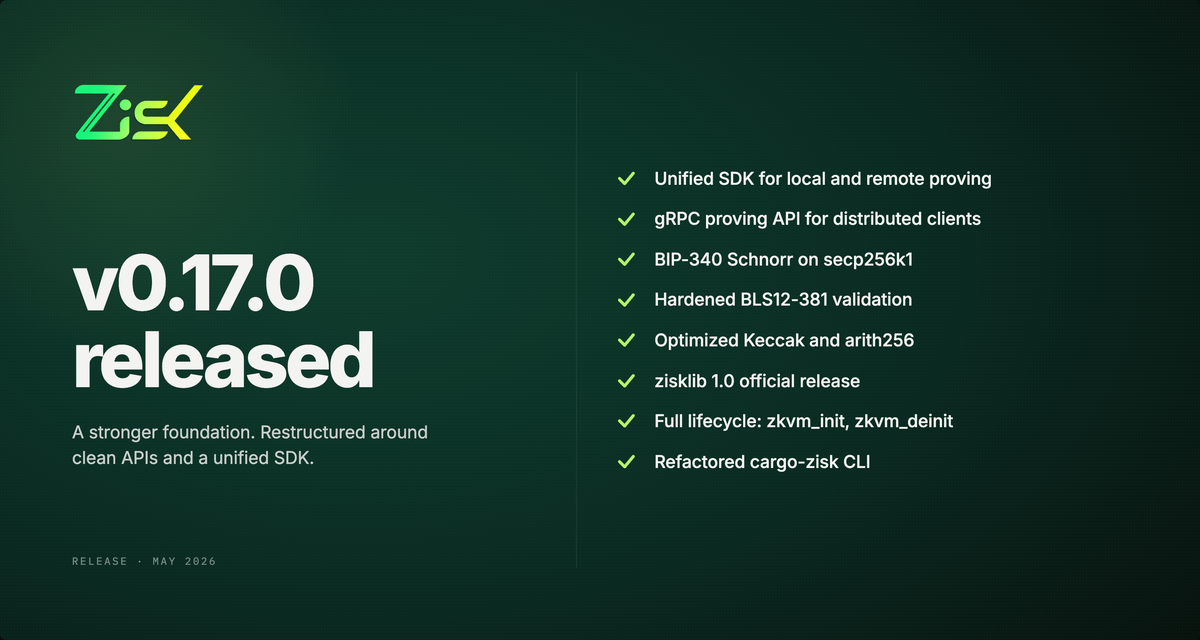
ZisK v0.17.0 is now released.
This release restructures the entire system around clean, well-defined APIs and a unified SDK making local and remote proving seamless and consistent.
Thread with details below:
https://t.co/e622dx4tus
This one is packed! The velocity at which we ship things is honestly incredible. Each bullet point here probably warrants a separate blog post (and some should be full-blown papers) - we'll get to these in time.
For now, one more such release, and then mainnet 🚀
We've been working on this for some time, and I'm really excited to finally start sharing the details publicly.
In many ways, this is the missing piece for crypto adoption as it provides answers to several critical questions simultaneously:
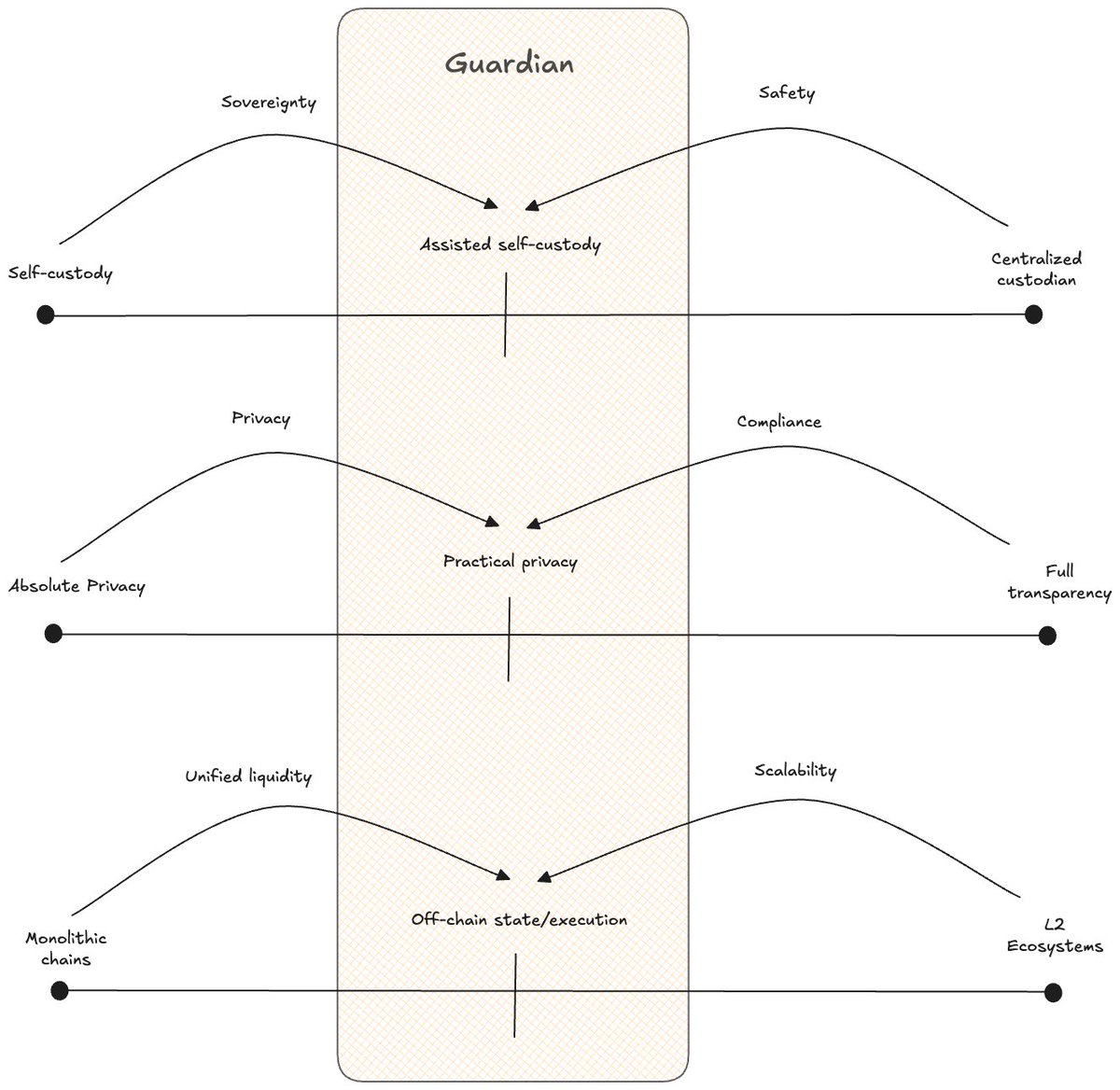
1. This makes crypto safe and accessible for 99% of people w/o compromising its core value prop. The "not your keys, not your coins" is just too risky for most people, but the alternative, up to now, has been to give up control of your coins to a third party. The Guardian introduces a new point on the spectrum where users retain custody but get the same guardrails as in the traditional financial system (e.g., account balances are fully private, a stolen key does not mean loss of life savings etc.).
2. This provides a clear way to resolve privacy vs. compliance tension. Guardians provide a powerful way to enforce any ruleset on a subset of the users. In many ways, it is like creating a set of economic zones with different compliance rules and different privacy guarantees. For example, we could have a Guardian that manages accounts only for US-based users and are able to impose the required compliance rules that are specific to the US.
3. Importantly, Guardians do not fragment the liquidity of the chain – all accounts managed by Guardians still live on the base chain. This again, is a different point on the spectrum between deploying smart contracts or app chains. Users/institutions don’t want to run a separate chain for every single application – and Guardians provides a way to deploy an application that plugs in directly into the liquidity of the base chain but scales independently. This is made possible by Miden’s architecture of local state and local transaction execution.
The above is just scratching the surface – there are many more interesting properties and benefits that Guardians unlock and we’ll share these over the coming weeks. We think of Guardians as a new category of network participants. They are kind of like validators but instead of helping with the consensus, Guardians help secure the network in different ways.
We’re excited that our CEO Slobodan Lukovic will be presenting CryptoCPU at the major community event EthCC [9] in Cannes.
CryptoCPU is Ponos’ RISC-V platform accelerating ZK protocols and post-quantum cryptography end-to-end, supporting Ethereum’s evolution toward more secure, scalable infrastructure.
If you're at EthCC, make sure to stop by the session.
🎤 Excited to speak at EthCC [9] this year.
I’ll be introducing:
CryptoCPU — a solution for Ethereum’s cost-effective, post-quantum-secure ZK future.
🗓 April 2, 10:20 AM
Burton Stage#EthCC
#Ethereum#ZK#PostQuantum#RiscV#CryptoHardware#Web3
🚀 ZisK v0.16 is live!
This release brings major performance improvements and new architectural capabilities as we move closer to ZisK v1.0.
🔗 Release notes: https://t.co/0KIvRZAclD
Highlights 👇
There are 3 ways to put state onchain:
1. Cleartext.
2. Encrypted.
3. State commitments.
Cleartext is what almost all chains do today. The state is fully transparent and visible to everyone - but it is also very useful for shared state (especially among a large number of participants).
Encrypted state is what most privacy chains do today. The state is onchain but only those with viewing keys can see it.
State commitments is when we put only hashes of the state onchain. This makes the state fully private and has a couple of other benefits:
- Even if the encryption keys are compromised (or leak somehow) the state still remain fully private.
- Harvest now / decrypt later attacks are not possible (because it is impossible to drive the full state form its hash).
- This greatly reduces state bloat issues because regardless of the underlying state size, each commitment contributes only ~32 bytes to onchain data.
Episode 3 of CypherTalk is live 🎙️
Zero-Knowledge Technology with @jbaylina, founder of @ziskvm.
We dive into:
• What privacy really means
• Selective disclosure & compliance
• ZK proofs beyond blockchain
• The future of privacy tech
Just posted a new proposal on EthResearch about synchronous composability between rollups via realtime proving.
The idea explores how based rollups with realtime validity proofs could enable atomic L1↔L2 and L2↔L2 interactions in a single transaction, bringing back true cross-rollup composability.
Comments are very welcome.
https://t.co/dL5ARGwVK3
#ethereum @VitalikButerin@koeppelmann
Our CEO summed up Davos 2026 perfectly: AI, quantum breakthroughs, and global leadership shaping what comes next. Here’s hoping innovation leads us toward a more thoughtful, responsible future.
#WEF2026#Davos#Leadership#Innovation#AI#Quantum
In "A Peer-to-Peer Electronic Cash System" - the "cash" part is important in more ways than one. Our goal with Miden is to make it work much more like cash.
Recent zkGas profiling benchmarks (1M gas, 4 GPUs) show very strong performance for ZisK.
Across most EVM opcode categories, ZisK delivers the fastest proving times, often by a wide margin, especially on heavy workloads.
Full results: https://t.co/n5CcqwDMmE
#zkVM#ZK #Ethereum









![lukovics's tweet photo. 🎤 Excited to speak at EthCC [9] this year.
I’ll be introducing:
CryptoCPU — a solution for Ethereum’s cost-effective, post-quantum-secure ZK future.
🗓 April 2, 10:20 AM
Burton Stage#EthCC
#Ethereum #ZK #PostQuantum #RiscV #CryptoHardware #Web3 https://t.co/JEFMxJxggT](https://pbs.twimg.com/media/HDj70UkWsAACnGE.jpg)


