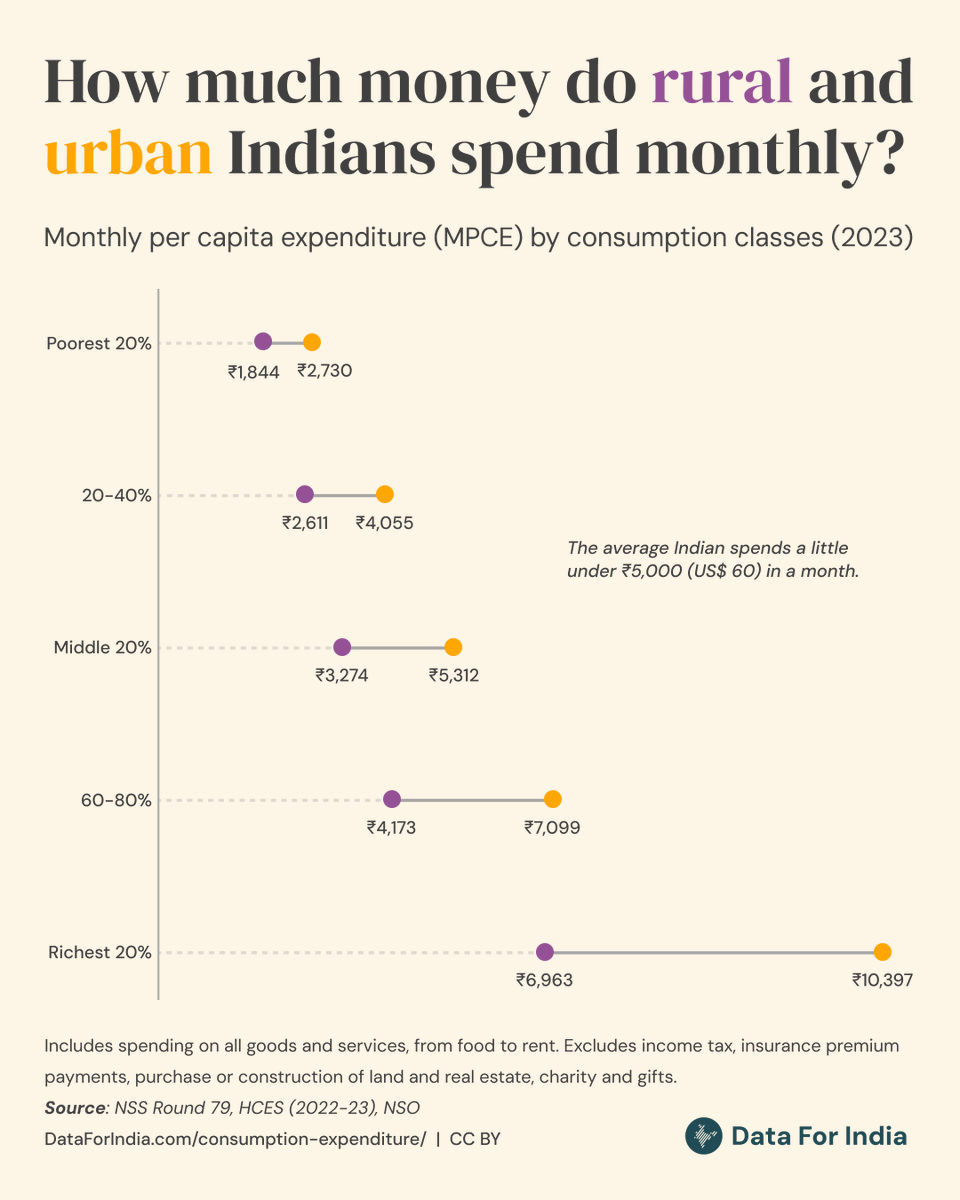
One of the most effective ways to understand how Indians live is by looking at how much they spend in a month. This is particularly significant in India where the economy is largely informal and significantly agricultural, making income measurement a challenge.
An average Indian’s Monthly Per Capita Consumption Expenditure (MPCE) on everything except investments is a little under ₹5,000 or USD 60, according to the 2023 Household Consumption Expenditure Survey.
However, there is a considerable gap between urban and rural spending. The average person in urban India spends around 70% more every month than the average rural Indian.
Urban expenditure is higher than rural expenditure at every step of the distribution, but the gap is most pronounced among those at the highest consumption level. In the lowest quintile (fifth of the population), the average urban MPCE is 50% higher than the average rural MPCE. In the highest quintile, however, urban MPCE is 90% more than rural MPCE.
What do Indians spend their money on, and how much money do the richest 5% of Indians spend? Read @akwaghmare’s piece to find out: https://t.co/yBSuDRe1SH
#ConsumptionExpenditure #HouseholdSpending #LivingStandards #India #DataForIndia
Deeply saddened by the passing of friend Radheshyam Bishnoi.
Those who knew his work understand what a tremendous loss this is not just to his loved ones, but to the nation. The Thar has lost one of its bravest and most committed wildlife warriors. Hard to believe.. Rest in peace, brother. Your life was an inspiration!
If youre buying a house in BLR, its very important to consider the water flow levels, sewage drain maps etc
The reason why Manyata Tech Park & near by areas flood every yr is because its built on wetlands of Nagawara lake
Nature will find a way to reclaim what belongs to it
With all due respect and a lot of love for India, a country in which I extensively travelled, I think a lot of it comes from India's geopolitical positioning in recent years.
Its strategy of multi-alignment, both with the Global South and the West, is meant to court people on both "sides" but the result - illustrated by the global reaction to the altercation with Pakistan - is much the contrary: everyone sees India as hedging its bets rather than standing on principle, ultimately breeding distrust from all quarters rather than the support it seeks to cultivate.
Let's be real: in the Global South people almost universally see India as the weak link in the BRICS, the country trying to undermine collective South-South cooperation whenever it conflicts with its parallel ambitions of being embraced by Western powers.
India's strong Islamophobia also obviously doesn't help when such a huge proportion of the Global South is Muslim...
And in the West it's much the same story: people look at things like Modi's record at home, its strong ties with Russia, and view India as a player that they don't really identify with.
And on top of that, when it comes to the West there's the fact that India is a) at a very different stage of economic development than they are and b) has a very different culture and historical context.
All this means that there's bound to be a persistent undercurrent of othering in how the West approaches its relationship with India: they tend to see India with a mix of colonial condescension and strategic necessity. And the gap in respective conditions and development status would anyhow prevent India from being fully embraced as a "natural ally" despite superficial diplomatic overtures.
Layered on top of this is the corrosive media environment in India itself and the experience most people have when they interact with many nationalist Indians on social media: to remain polite, one gets the impression that there's an insurmountable gap between how India sees itself on the world stage and how others perceive it.
I'm not going to be paternalistic myself and tell India what it ought to do but one thing is clear: when someone claims 'International Media has turned viciously against Bharat,' they should maybe reflect on whether it isn't the inevitable result of a multi-alignment strategy that has ultimately aligned India with nobody's true interests but its own. And whether the knee-jerk defensive victimhood narrative prevents honest self-reflection about precisely that.
The unspoken untouchability against meat and eggs practised by non-Brahmins through their illogical “fasting” is just a way for them to aspire to be Brahmin in a casteist Brahminical society that rewards proximity to Brahminness
The classist disdain against rural areas/people in this post is quite disturbing – this is what ultimately leads to an urban bias in our policies, perceptions, and resource allocation. There’s nothing wrong with anyone expressing pride in their hometowns.
My dear sisters and brothers from other states,
Ever wondered how many Indian languages Hindi has swallowed? Bhojpuri, Maithili, Awadhi, Braj, Bundeli, Garhwali, Kumaoni, Magahi, Marwari, Malvi, Chhattisgarhi, Santhali, Angika, Ho, Kharia, Khortha, Kurmali, Kurukh, Mundari and many more are now gasping for survival.
The push for a monolithic Hindi identity is what kills ancient mother tongues. UP and Bihar were never just "Hindi heartlands." Their real languages are now relics of the past.
Tamil Nadu resists because we know where this ends. தமிழ் விழித்தது; தமிழினத்தின் பண்பாடு பிழைத்தது! சில மொழிகள் இந்திக்கு இடம் கொடுத்தன; இருந்த இடம் தெரியாமல் தொலைந்தன!
#தமிழ்_வாழ்க #LetterToBrethren
#StopHindiImposition #SaveIndianLanguages
The Asia Land Forum 2025 was a unique space, where members and partners of the International Land Coalition exchanged knowledge, built collaborations, and strengthened their solidarity toward advancing people-centered land governance in the Asian region.
My budget article in the Economic Times. Was chuffed that it was flanked by the usual brown nosing pieces by corporate honchos.
https://t.co/EiqmLscxDh
100.000 took to the streets in Berlin today to stand up to Fascism.
This is the direct answer to the attempt to normalise Far Right forces in Germany and all across Europe.
We resist.
The SC's latest directives to recognise Raj's orans as #forests is a big step for #conservation. But will formal legal recognition safeguard traditional governance? In this piece for @down2earthindia , I explore the opportunities and concerns arising from this landmark decision.
The City of Saints
Delhi gets a bad reputation amongst travellers, who tend to see it as a grotty urban jungle.
But Delhi is also one of those handful of cities, along with Rome, Cairo and Istanbul, that is just infinite in the layers of architecture, history and culture.
"Am I just an anniversary event to the people? Why don't they wake up with the thought of my persecution and sleep with it? Why are they not troubled with the fact that anybody can be put behind bars for years without trial?" Umar Khalid asked me today. Do we have the answers?