Too many of us are too comfortable with pushing people to apostasy. "Leave Islam if you do this", "take your hijab off if you do that". And when people actually do leave Islam as they were told, what do you say?
To the Pakistani FemBints who amplified the story that Afghan women are being called “goats” and “cows”:
You helped make the story go viral. Now make the correction go viral.
HERE’S HOW YOU REDEEM YOURSELVES.
Tag @el_pais . Demand evidence, a correction and a public apology.
Email their Ombudsperson: [email protected]@el_pais 's own cited source has disputed how her words were reported. @DailyMail has since deleted its article and tweet.
You demanded accountability for Afghan women.
Now demand accountability from those reporting about them.
@GhostXHassan@kx49nv When did I accuse you of using qiyas? I'm accusing you, and all scholars who applied the verse broadly, misapplying the verse. At best, it's mistaken. At worst, it's ghuluw. Even among scholars of 4 madhabs, this is not "without disagreement".
@GhostXHassan@kx49nv Why should I? The disagreement doesn't come from qiyas.
Rejecting to apply [33:32-33] broadly is not even rejecting qiyas. A lot of scholars who use qiyas also don't apply the verses broadly.
@alamghiry Piracy itu ga bisa dihukumi mencuri. Mencuri itu pemiliknya harus kehilangan barangnya. Piracy kan engga. Miw mengkategorikan piracy sebagai zalim itu udah bener. Sesuai dengan 4:29.
@GhostXHassan@kx49nv When did I say that? Are you accusing me of saying ummahatul mu'minun are not mu'minat???
I'm saying 33:32-33 don't apply to all believing women because not all believing women are ummahatul mu'minun.
Lu pada konyol, ntar ada pejabat korupsi langsung muncul narasi "Giliran yang ngerugiin banyak orang pada diem". Ada orang pacaran "Yang haram bagi mereka cuma babi".
Giliran diingetin masalah lain malah ga terima. Halal haram kok cuma berlaku buat ego pribadi? kocak
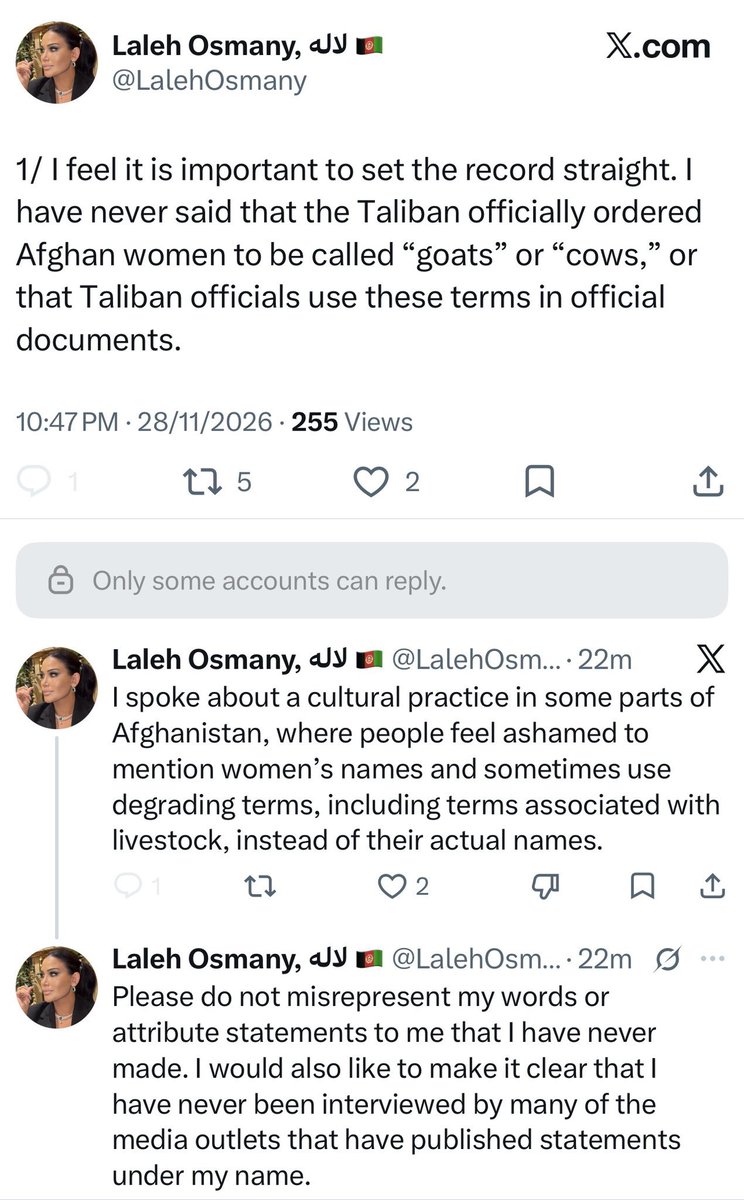
Where did the Taliban officially bans women’s names come from?!
The story first appeared in the Spanish newspaper @el_pais in an article by @TDeiros, quoting an Afghan expat woman, Lalah Osmany, who lives in Germany.
The story was then picked up by British media outlets @DailyMail and @MetroUK.
After the story collapsed, Lalah posted saying she didn’t say the Taliban issued an official ban on women’s names, but that she was talking about cultural practices. (Photo 1)
In other words, this Afghan woman living in Germany has a problem not with the Taliban alone, but with Afghan men in general, whether Taliban or not.
Yet @el_pais and @TDeiros presented the allegations as an official Taliban ban and fabricated a story.
@DailyMail has deleted both its article and the post Elon musk quoted about this story.
However, are the allegations true?
There is no evidence or truth that the Taliban Afghan government issued an official ban on women’s names.
However, every society has its own social and cultural practices.
In Western countries, wives traditionally take their husbands last names and drop their own family names, a practice dating back to when women were treated as property under European marriage laws.
In the Muslim world, women traditionally retain their own family names rather than adopting their husbands last names.
In many parts of the Muslim world, societies use traditional terms of respect, and affection when addressing women, especially when they are not related.
In the Arab world, women are often addressed as Hajjah, Ukhti (my sister), Sayyida (lady), Umm Fulan (mother of so and so), Tant and Tata (auntie), Teta , and Lalla (lady).
In Afghanistan, they use Bibi (lady) and Jaan (my dear). In Afghanistan and Iran, they use Khanum (madam), while in Turkey, they use Hanım and Hanımefendi (madam).
These are traditional terms of respect, not because Muslims hate women and don’t want them to have names!!! Quite the opposite.