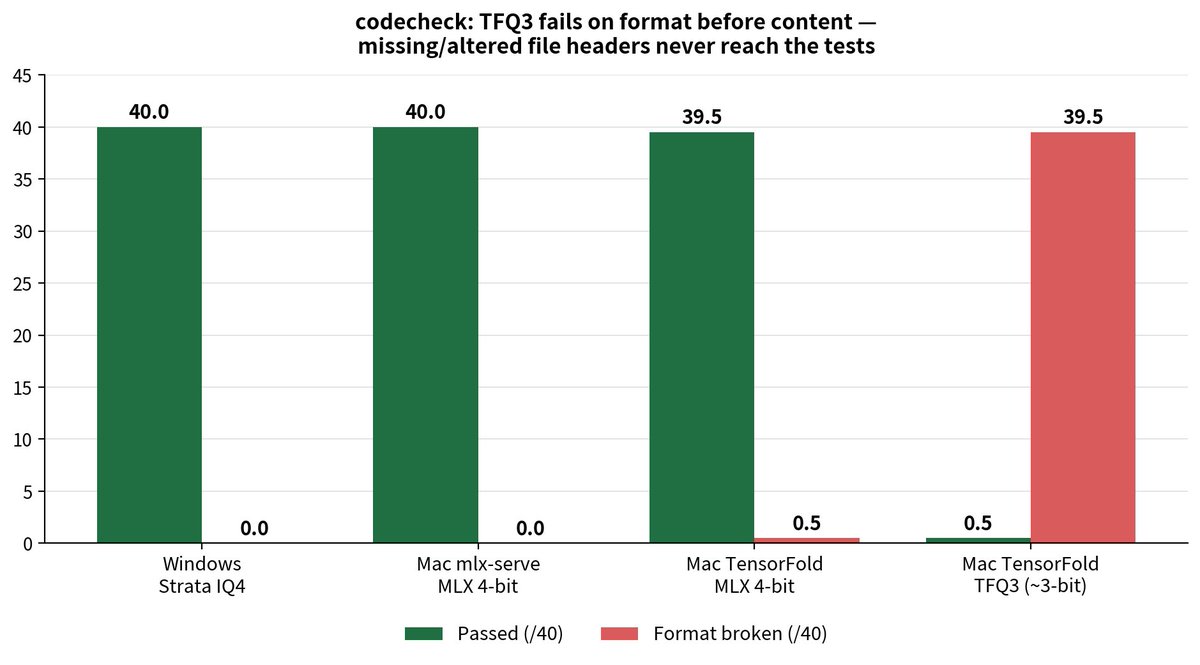
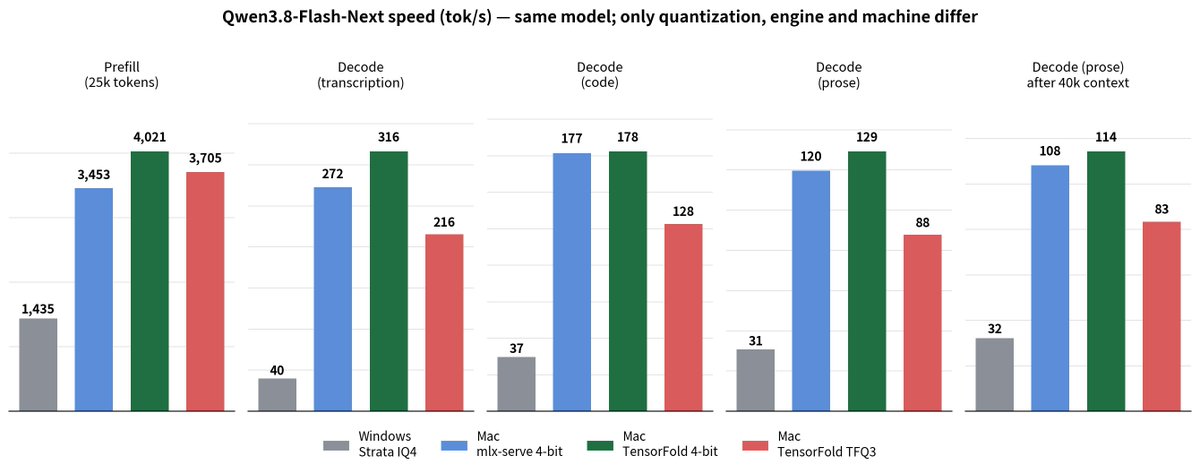
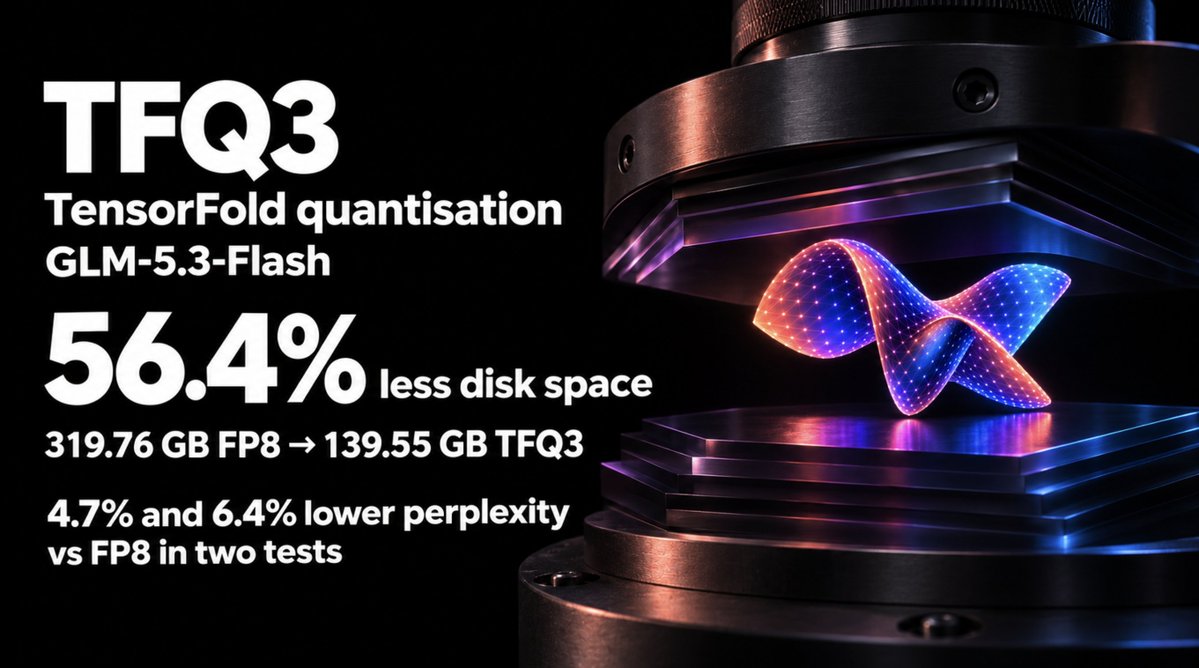
I’ve been working on TFQ, my own quantisation format for TensorFold.
Currently, this is for Metal but will be for CUDA and Vulkan too.
On GLM-5.3-Flash, TFQ3 took the FP8 checkpoint from 319.76 GB to 139.55 GB on disk, a 56.4% reduction.
Perplexity was ~5.5% lower than FP8 in tests 🫶🏼
I am working on expanding this to other model families such as Qwen at the moment.
https://t.co/8W9HBrN17C
https://t.co/SVBOiYekJ8
🚨ÚLTIMA HORA: Nuevo fármaco contra el síndrome de Guillain-Barré permitió que el 67 % de los pacientes recuperara la marcha independiente en ocho semanas.
Se trata de imlifidasa, una enzima derivada de Streptococcus pyogenes capaz de escindir rápidamente las inmunoglobulinas G (IgG).
Escinde directamente las IgG, interrumpiendo los mecanismos de daño inmunológico mediados por su región Fc.
Prometedor el fúturo de tratamientos contra esta enfermedad.
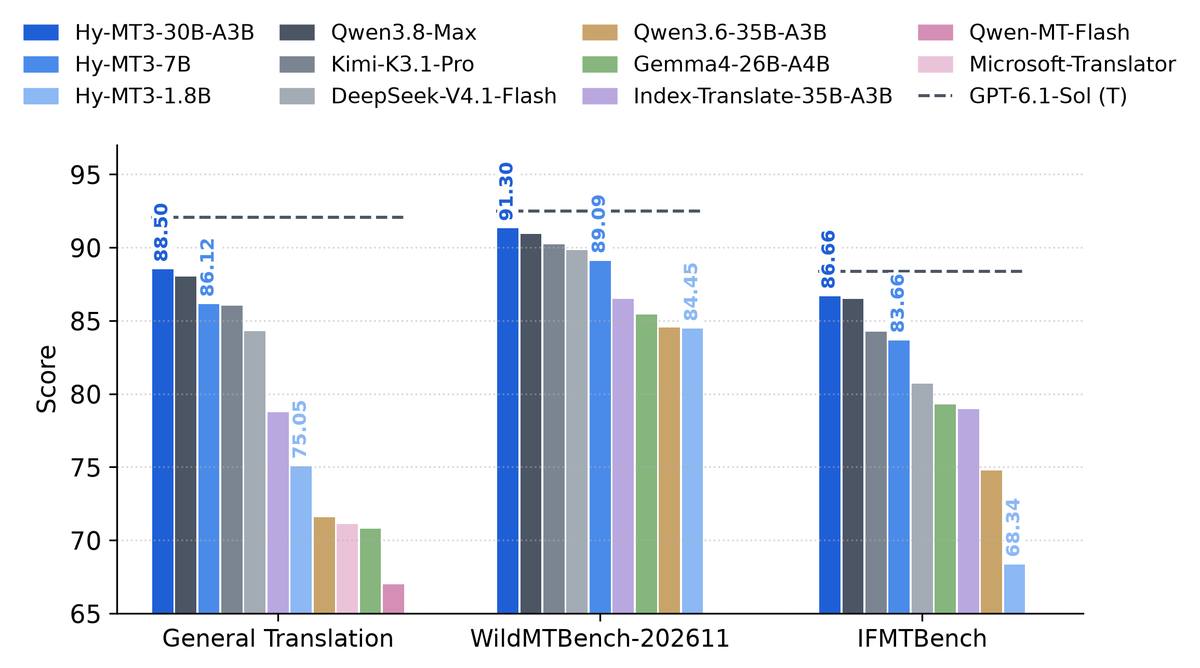
We open-sourced a 3B-active translation model that beats models using over 30x its compute. Hy MT3 comes in 1.8B, 7B, and 30B-A3B sizes under Apache 2.0.
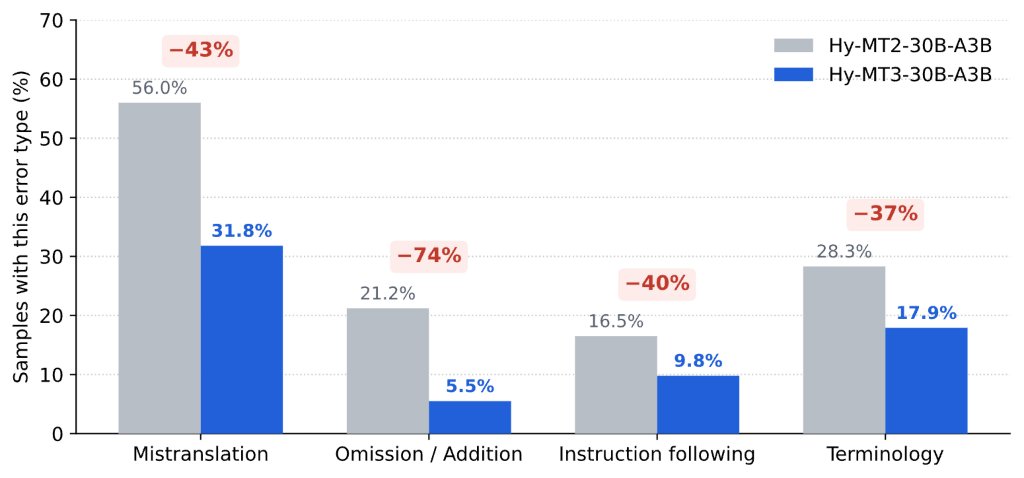
We keep refining our models with community feedback, expanding coverage from 38 languages in Hy MT2 to 102 in Hy MT3. On real-world data, the 30B-A3B model cuts omissions and additions by 74%, mistranslations by 43%, and instruction errors by 40%. It also keeps formatting, tags, and terminology intact, and handles OCR errors better in image translation.
All three sizes come with quantized builds for local and on-device use, alongside full weights for server deployment. Hy MT3 is also coming soon to our Chrome and Edge browser extension, which supports one-click local models for offline translation.
Repo: https://t.co/KwTSyclC0l
Weights: https://t.co/PSry0SwjCs
Paper: https://t.co/e8854T1f06
Good point — a cap only tells you when to stop, not where the money went. Logging cost per successful task, retries included, is the part most people skip, and in agent loops retries are usually the silent budget killer. The degrade-to-cache step at 70% is a nice touch too: graceful degradation instead of a hard wall. In my own local pipelines I log the estimated cost before every run, but cost per successful task is a better unit. I may borrow that.
🚀 That didn't take long! Another Strata update!
Niko Veit has already released Strata 0.2.20, following yesterday's massive 0.2.19 update.
And this time the big news is older and smaller GPUs.
Look at the developer-reported Inkling 2 Mini speedup on 12GB GPUs:
🐌 Before → 6.5 tps
🚀 After → 61.9 tps
That's 9.5× faster! 🔥
The improvement comes from fixes to Strata's speculative decoding implementation.
and there's even more in this update ...
✅ Expanded direct support for Unsloth's Inkling 2 Mini GGUF quants
✅ GPU + RAM + CPU + SSD hybrid MoE execution
✅ Automatic splitting across 2–4 GPUs
✅ Optimized NVIDIA, AMD, Intel Arc and Apple Silicon kernels
✅ Better handling of long contexts and KV-cache offloading
✅ Fixes for garbled NVFP4 output and startup issues
But another number caught my attention.
Tencent HY-4 Flash, RTX 5090 + 128GB DDR5:
🐌 Before → 30 tps
🚀 After → 128.25 tps 👈 4.27× faster
This guy really doesn't sleep. 😂
Anyone running 0.2.20 yet? I'd love to see benchmarks on older 8GB and 12GB GPUs.
Link in ALT.
SSD is about to become the only limiting factor for local AI
Most frontier open models are ultra sparse MoEs
Qwen 3.8 Flash Next = 180B total, ~6B active per token (~3%)
GLM 5.3 Flash = 321B total, ~18B active per token (~6%)
DeepSeek V4.1 Flash = 552B total, ~16B active per token (~3%)
GLM 5.3 = 753B total, ~40B active per token (~5%)
Kimi K3.1 Pro = 2.8T total, ~104B active per token (~4%)
When ~95% of a model sits idle on every token, keeping all of it in VRAM makes no sense
Local AI has been evolving toward this for years:
2023-2025 - Layer offloading (Ollama, classic llama.cpp)
This chopped whole layers across GPU and CPU, leaving the GPU waiting on CPU once VRAM filled up
Oct 2026 - RAM expert cache (llama.cpp --moe-cache)
This shifted from whole layers to individual experts, caching hot ones in VRAM and pulling misses from RAM. Huge leap for decode, but still capped at the size of your RAM
Now - SSD expert streaming
Early tools like Colibri and Strata proved direct NVMe streaming actually works on consumer hardware. Instead of hitting a VRAM or RAM wall, your SSD becomes an active part of the engine
However most people hear "run from SSD" and assume 2 tok/s, which isn't entirely wrong. A few problems still exist:
- Basic caching kicks out experts you're about to need again
- Waiting on disk reads one layer at a time leaves the GPU and SSD sitting idle
- Getting speculative decoding to work well with SSD streaming is hard
- Long prompts are tough to keep fast without wiping out your hot cache
- Most early tools are experimental engines built for only a couple models
Making expert streaming feel fast takes solving all of those together
At Magnitude, we've been working on this for the past 2 months. Here's how we solved it:
- Smarter caching that keeps your session's most-reused experts in GPU memory
- Speculative lookahead that pulls upcoming experts off SSD before the GPU needs them
- Direct NVMe reads scheduled across layers so your SSD never sits idle
- Streaming prefill that reads each cold expert once without wiping your hot cache
- Built into a full engine that tunes itself to your chip across Macs and GPUs
All of this together means DeepSeek V4.1 Flash on a single gaming GPU at ~40+ tok/s...
We're excited to release it on Monday
GitHub here: https://t.co/5SjPQWkmrF