SCOOP:
Source tells me that in addition to a possible story coming out about Communist Maine Senate candidate Graham Platner allegedly raping a woman in Iraq, another story is also dropping about how he was allegedly messaging underage girls on Kik.
He has canceled all of his campaign events for today and tomorrow.
Looks like he is about to drop out… or go to prison. Hopefully both! 🤞
@TheRabbitHole Elizabeth Warren making a video in the back of a chauffeur-driven limo about how rich Elon is was astonishingly out of touch... even for her...
When Secretariat died in 1989, the legend seemed complete, until the necropsy revealed the secret behind his impossible power.
Inside his chest was a heart that stunned veterinarians: an estimated 22 pounds, nearly two and a half times the size of a normal Thoroughbred’s.
It wasn’t diseased.
It wasn’t abnormal.
It was perfect.
Every chamber balanced, every wall strong, the anatomical masterpiece of nature’s own design.
That massive heart pumped oxygen-rich blood with unmatched efficiency, feeding muscles that never seemed to tire.
It was, quite literally, the tremendous machine that carried him beyond limits.
When he ran, his stride measured at nearly 25 feet, became an extension of that engine.
At full speed, his heart could circulate his entire blood volume twice in a single minute.
It’s why he didn’t just win, he expanded, accelerating when others faltered, as if time itself bent to his rhythm.
But what makes the discovery so moving isn’t the science, it’s the poetry.
That colossal heart wasn’t just muscle.
It was metaphor.
It explained what fans had always felt watching him: that there was something greater inside him, something immeasurable.
As one vet whispered after the necropsy:
“We finally know what powered him, but we’ll never understand how much heart he truly had.”
In life, Secretariat’s heart carried him 31 lengths past history.
In death, it reminded the world that greatness isn’t always about what’s seen
but about the size of the heart that beats behind it.
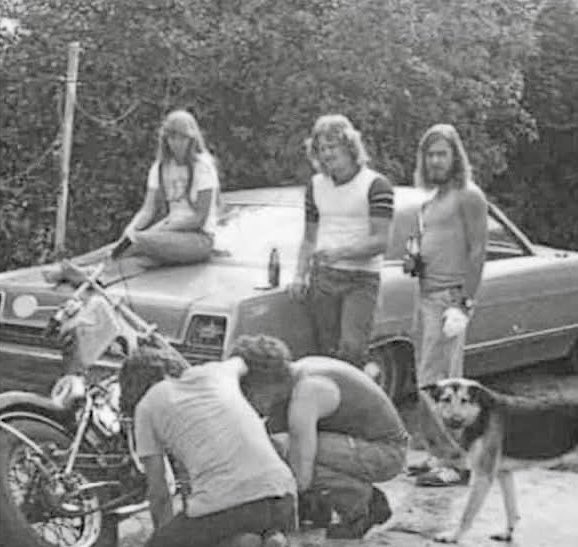
There’s a generation a lot of people forget exists. We were born at the tail end of the Boomers, but we are not culturally the same as people born in the 40s and early 50s. We are Generation Jones.
And honestly, it explains a lot.
We grew up in a world that still felt fundamentally analog, but we were young enough to be dragged headfirst into the digital revolution. We are the bridge generation between rotary phones and smartphones, between slide rules and AI, between Walter Cronkite and algorithm driven media.
We remember when there were only a few television channels and the entire country watched the same thing at the same time. We also adapted to the internet, email, forums, social media, streaming and now artificial intelligence. We lived before and after the technological singularity hit everyday life.
That is not a small thing.
People born in the 40s came of age in a post World War II America that was still industrial, deeply hierarchical and institutionally stable. Their formative years were shaped by the Cold War, Vietnam, the civil rights era and a society where information moved slowly.
Generation Jones came later. We inherited the aftermath of all of that.
We were the kids who watched Watergate destroy blind trust in government. We watched manufacturing begin to collapse. We saw divorce rates explode. We were the first truly latchkey generation in massive numbers. We learned independence early because many of us had to.
We grew up with one foot in old America and one foot in whatever this new thing was becoming.
We played outside until the streetlights came on but we also learned DOS commands. We learned cursive and keyboarding. We had card catalogs and Google searches. We went from vinyl records to cassette tapes to CDs to MP3s to streaming in one lifetime.
We remember maps. We remember memorizing phone numbers. We remember life before GPS and before every human interaction became filtered through a screen.
And because of that, I think Generation Jones developed a very unique perspective. We are adaptable because we had no choice but to adapt. We learned technology as adults instead of being born into it. We remember a slower world but were forced to survive in a rapidly accelerating one.
That creates a very different mindset than either older Boomers or younger Gen X and Millennials.
A lot of us also reject the caricature people now associate with “Boomers.” We were not buying houses for the cost of a sandwich in 1965. The interest rate on my first house was over 14% and that was after buying down a point. Many of us got hit by recessions, outsourcing, pension collapses and economic instability just like younger generations did. We watched promises evaporate in real time.
We understand older generations because we were raised by them. We understand younger generations because we had to evolve alongside them.
That’s why the Jones generation often feels culturally homeless. We are rarely discussed, rarely defined and usually lumped into categories that don’t actually fit us.
But we exist.
We are the human transition point between the industrial age and the digital age.
And frankly, there will probably never be another generation quite like us again.
Breaking the man who stopped the shooter at the DC WH Correspondence dinner was a cook named Casey Ryback.
Casey was cooking meals when he heard the commotion and tackled the gunman and saved everyone.
@elonmusk That’s admirable, but what about the Coast Guard, Secret Service and other DHS employees that are not being paid or mentioned on the news? The media and Democrats are only talking about TSA but none of them are being paid. Congress needs to do their job instead of grandstanding
Mike Rowe: “We’ve been telling kids for 15 years to learn to code.”
“Well, AI is coming for the coders.”
“It’s not coming for the welders, the plumbers, the steamfitters, the pipefitters, the HVAC, or the electricians.”
“In Aspen, I sat and listened to Larry Fink say we need 500,000 electricians in the next couple of years—not hyperbole.”
“The BlueForge Alliance, who oversees our maritime industrial base—that’s 15,000 individual companies who are collectively charged with building and delivering nuclear-powered subs to the Navy … calls and says, we’re having a hell of a time finding tradespeople. Can you help?”
“I said, I don’t know, man … how many do you need? He says, 140,000.”
“These are our submarines. Things go hypersonic, a little sideways with China, Taiwan, our aircraft carriers are no longer the point of the spear. They’re vulnerable.”
“Our submarines matter, and these guys have a pinch point because they can’t find welders and electricians to get them built.”
“The automotive industry needs 80,000 collision repair and technicians.”
“Energy, I don’t even know what the number is, I hear 300,000, I hear 500,000.”
“There is a clear and present freakout going on right now. I’ve heard from six governors in the last six months. I’ve heard from the heads of major companies.”
Bowl season used to be so fun. The college football I grew up with is dead now, and it honestly crushes my soul. I still love the sport, but damn it used to be so much better than this. 💔
#TexasTech HC Joey McGuire's thoughts on the current CFP calendar, head coaching changes overtaking the headlines & how he thinks college football can fix it
It's long but worth the listen.