INSTEAD OF WATCHING AN HOUR OF NETFLIX TONIGHT.
This 60-minute Cambridge lecture by Demis Hassabis will teach you more about the future of AI than most people will learn in the next 5 years.
Bookmark it and give it an hour, no matter what.
Young Stalin – The Hipster Who Became a Monster
At seventeen he was a published poet. He was handsome, brooding, magnetic, and absolutely certain the world was wrong and he was the man to fix it. You would have found him fascinating at a party in 1905 – and spent the rest of your life trying to avoid him.
The interesting part is not that the poet became a monster. It is that nothing had to change.
1. Born Ioseb Jughashvili in Gori, Georgia, 1878. Provincial boy, clever, going places. His mother wanted him to be a priest. He went to the Tiflis Theological Seminary, read forbidden books under the desk, organized a secret study circle, and was expelled for revolutionary activity. The original dropout with a cause. He had found something the seminary could not compete with: the complete certainty that the existing order was wrong and that he was the man to fix it. That feeling never left him. Neither did the habits the seminary taught him – the surveillance, the informing, the management of loyalty through fear. He just changed the institution.
2. He wrote poetry. Actually good poetry – published in Georgian journals under the name Soselo, praised by the leading Georgian poet of the day, romantic in register, nationalist in spirit. One poem ended up in a schoolbook, still being taught to Georgian children long after. He was handsome too, before the smallpox scars, and charismatic in the way provincial boys who have read more than everyone around them sometimes are – the intensity mistaken for depth, the certainty for wisdom. Women found him compelling. He cultivated the look: the cape, the hair, the revolutionary aesthetic, the name. Koba first – after a Georgian Robin Hood, the noble outlaw of a novel he loved. Then Stalin. Man of Steel. The least subtle personal branding in political history, from someone who understood early that the myth matters more than the man.
3. He robbed banks. Tiflis, Yerevan Square, 1907 – bombs thrown into a crowd on an ordinary morning to take a bank shipment for the party. Around forty people dead in the street, most of them ordinary Georgians. He organized it and stayed away from the action, then took credit for the result. Already the pattern: the man who inspires others to take the risks while he manages the outcome from a safe distance. This is the moment the aesthetic acquired a body count – and nobody in the scene objected, because the cause was beautiful and the dead were abstract. Lenin called him "the wonderful Georgian." He meant it as a compliment. It was a description of utility.
4. He was exiled to Siberia repeatedly and escaped every time. This was considered dashing. What it actually demonstrated was complete indifference to everyone left behind – fellow exiles, comrades, inconvenient witnesses. In one of those exiles he took up with a thirteen-year-old girl in the house where he lodged, fathered a child, and left them there. Another son had already been abandoned earlier. Rousseau gave his five children to the orphanage. Marx denied his. Stalin left his in Siberia. This keeps happening and it is not a coincidence – a man who loves humanity in the abstract has found a way to be excused from loving anyone in particular.
5. His first wife Kato died of typhus in 1907. He was twenty-eight. At her funeral he reportedly said: "This creature softened my heart of stone. She is dead and with her have died my last warm feelings for humanity." He said that out loud. At the funeral. The second wife would eventually shoot herself. Stalin was informed by telephone. He did not attend the funeral.
6. Lenin wrote in his Testament that Stalin had accumulated too much power and should be removed. "I propose to the comrades that they find a way to remove Stalin." The comrades did not act on it. Stalin had been building his network for years. You didn’t remove Stalin. Stalin removed you.
7. Which is precisely what happened. The Great Purge of 1936–38 eliminated virtually the entire original revolutionary generation – the old Bolsheviks, the people who had known him before power and therefore knew too much. Show trials, confessions extracted by methods that made the confession meaningless, executions. And when the Terror turned to nations, the largest single group by far were the Poles. NKVD Order 00485, August 1937: over 111,000 Poles shot in eleven months. Not for anything they had done. For being Polish – for belonging to a nation that had beaten the Red Army in 1920, that sat between Russia and the West, and that had a habit of not disappearing when told to. Every system built on systematic falsehood has understood, instinctively, that Poland is the problem. Because Poland is where the lie meets the truth, and the truth refuses to move.
8. And here is what everyone gets wrong: nothing was added. No transformation, no idealist corrupted, no moment where the good man broke. Power did not install the monster – it removed the obstacles. He never stopped being the sensitive one either. He read enormously, annotated his books carefully, telephoned writers, had opinions about films, wept at music, edited Georgian poetry translations while the death lists sat on the same desk. The tenderness was real. It simply had no connection to what he did to living people, and it never occurred to him that it should.
9. Tens of millions dead. The monster was always there – in the seminary surveillance, in the bank robbery he didn’t attend, in the funeral he left early, in the comrades he let be arrested. You have met a version of him. He reads the right books, has the correct politics, is magnetic at the party, performs solidarity fluently. And in every organization he joins, gradually, the people who challenge him stop showing up to meetings. He doesn’t argue with them. They simply cease to be present.
We have been trained to think the monster and the aesthete are opposites – that anyone who cares about poetry, justice, the oppressed, the beauty of the cause, is thereby safe. He was not the exception. He was the type.
Look around the movements of your own time. The sensitivity is genuine. The care for humanity in the abstract is genuine. The contempt for the specific human being who disagrees is also genuine, and it is sitting on the same desk. All that is missing is the removal of the obstacles.
The hipster was always the tell. The intensity was never about the cause. It was about the man.
It always is.
If I were in my 30s or 40s right now and wanted to leverage AI to retire within 10 years, here's what I'd do:
1. Immediately form an LLC company. Not next month. Not once you're 'ready.' This week.
I resigned from Anthropic today. I spent the last three years doing pretraining research at both OpenAI and Anthropic. Neither company is acting responsibly. They are racing straight to self-improving superintelligence and gambling with our lives. More thoughts below.
The more nonsensical and obviously absurd a belief is, the more people who hold it (or pretend to) will resist recanting. The potential for humiliation rises in direct proportion to the ridiculousness of what they've publicly swallowed. They see no choice but to double down.
Peruvians don’t lose rights because they move away. Peru has an electoral constituency specifically reserved for its 3.5 million people diaspora. “People who don’t vote the way I like them to should not have the right to vote” is frankly reactionary thinking
Excluding them from voting would silence millions of citizens whose experiences can help inform the country's future. Calls to restrict expatriate voting often serve to narrow, rather than strengthen, democratic participation.
@pozzi_escot La respuesta es muy sencilla : Más vale diablo conocido que bueno por conocer. Si hay que explicarlo, entonces no lo entenderías. Sugiero que leas las historia del Perú en los 80’s sobre todo en Ayacucho donde el MRTA y Sendero Luminoso causaron tanto daño.
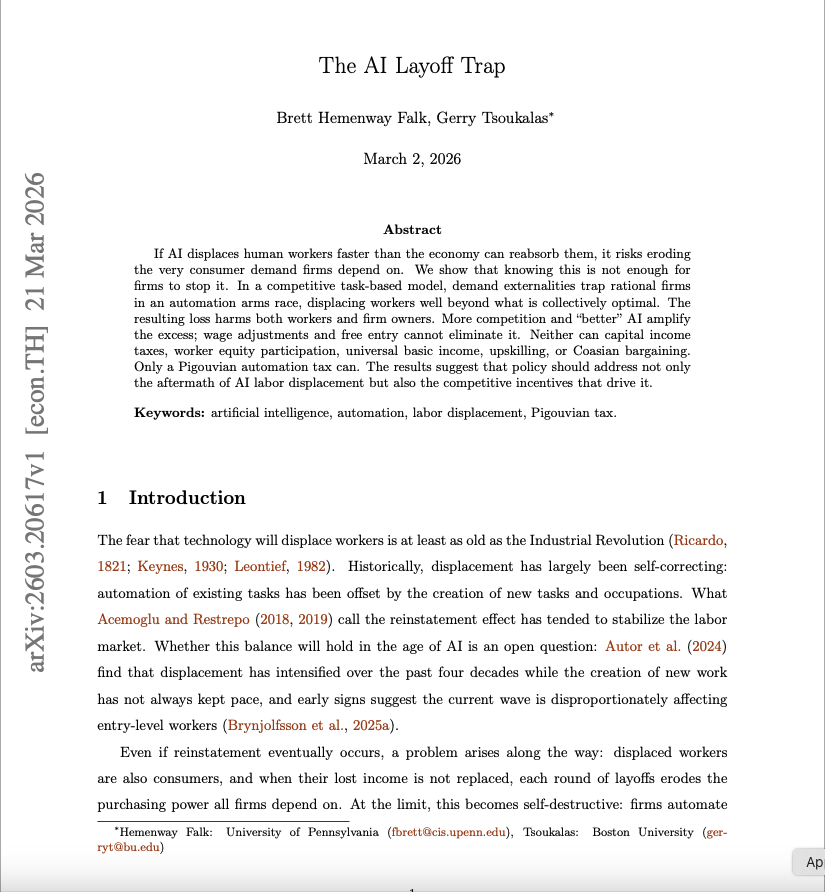
Two economists just published a mathematical proof that AI will destroy the economy.
Not might. Not could. Will — if nothing changes.
The paper is called "The AI Layoff Trap." Published March 2, 2026. Wharton School, University of Pennsylvania. Boston University. Peer reviewed. Mathematically modeled.
The conclusion is one sentence.
"At the limit, firms automate their way to boundless productivity and zero demand."
An economy that produces everything. And sells it to nobody.
Here is how you get there.
A company fires 500 workers and replaces them with AI. A competitor fires 700 to keep up. Another fires 1,000. Every company is behaving rationally. Every company is following the incentives correctly. And every company is building a trap for itself.
Because the workers who were fired were also customers.
When they lose their jobs faster than the economy can absorb them, they stop spending. Consumer demand falls. Companies respond by cutting costs — which means automating more workers — which means less spending — which means more falling demand — which means more automation.
The loop has no natural exit.
The researchers tested every proposed solution. Universal basic income. Capital income taxes. Worker equity participation. Upskilling programs. Corporate coordination agreements.
Every single one failed in the model.
The only intervention that worked: a Pigouvian automation tax — a per-task levy charged every time a company replaces a human with AI, forcing them to price in the demand they are destroying before they pull the trigger.
No government has implemented this. No major economy is seriously discussing it.
Meanwhile the numbers are already tracking the curve. 100,000 tech workers laid off in 2025. 92,000 more in the first months of 2026. Jack Dorsey fired half of Block's workforce and said publicly: "Within the next year, the majority of companies will reach the same conclusion."
Nobody is doing anything wrong. Companies are following their incentives perfectly. That is exactly the problem.
Rational behavior. At scale. Simultaneously. With no mechanism to stop it.
Two economists built the math. The math leads to one place.
Source: Falk & Tsoukalas · Wharton School + Boston University ·
https://t.co/4m8E9jQNYm
GOODBYE ASTROLOGERS⚠️
GROK JUST MADE IT EASY AND FREE.
JUST ENTER YOUR BIRTHDATE, TIME, AND PLACE.
NO HOROSCOPES, NO TAROT.
Copy these 6 prompts for results that will blow your mind:
GOODBYE ASTROLOGERS
GROK just replaced your $300 reading… for free.
No horoscopes. No tarot cards.
Just scary-accurate self-discovery using your birth date.
Here are 9 mind-blowing prompts to unlock your soul, destiny, genius, and future: