Listen to one of the last surviving members of Shraddha Walkar’s family — her aunt, who travels to Delhi for every court hearing. 💔
Only to be told it has been postponed thanks to Aftab’s dental/mental appointments/college exams.
Honest feedback for the GoI to consider, offered as a well-wisher:
1. E20 is a massive issue. Just because people aren't protesting in the streets doesn't mean it isn't. There is a simmering anger everywhere.
2. The root cause of this mess is singular: someone decided it was acceptable to ignore the National Policy on Biofuels 2018's plan to introduce E20 in 2030, which would have allowed older, non-compliant vehicles to phase out naturally. Instead, E20 was rolled out despite the fact that most vehicles on the road are not calibrated to run on it.
3. There is no "lobby" behind this public frustration. If the govt believes there is, they should expose the nexus and let citizens decide for themselves. Otherwise, ministers and spokespersons are only making things worse by using "lobbies" and "deep states" as defensive arguments.
4. Vehicle performance is suffering. Drivers are experiencing a drop in mileage and damage to parts. After months of denial, even Nitin Gadkari and Hardeep Puri have acknowledged "some issues" with Ethanol.
5. If the goal is true energy security, the focus and push must shift toward EVs, alongside exploring nuclear energy as a primary power source. The govt should encourage and incentivize EV adoption through subsidies and a robust infrastructure network. Ethanol, in the way it is currently being implemented, is doing more harm than good.
6. The solution is to provide a choice between E0 and E20. If the current fuel infrastructure cannot support both, E20 should be rolled back to E10 until 2030. This will allow older cars and bikes to be phased out naturally before moving forward. And also, do not introduce E27 or whatever is next till the new fleet is E27 compliant and all E20 cars are phased out, unless there is an infrastructure in place to dispense both in future.
Ethanol will hurt the BJP electorally, not because of car owners, the are just 8% of the population, but because of bike owners, who make up 60%.
Every issue with a bike, irrespective of whether it's due to ethanol or not, is being blamed on ethanol. Remember that the overwhelming majority of car and bike mechanics are not your voters and, in fact, they hate you and you know why. They are actively telling anyone with any bike issue that it is due to ethanol. Not only does it serve a political purpose, but it is also easy and convincing.
Car and bike dealers are equally happy to lean into this excuse because it completely deflects blame away from the manufacturers and their own service centers. If a part fails prematurely or a vehicle suffers from a chronic engineering defect, blaming ethanol allows dealers to shift the responsibility onto government policy rather than admitting to poor build quality or honoring warranty claims. It gives them a convenient, politically charged scapegoat that customers readily accept, shielding the automotive brands from reputational damage.
It's up to the BJP to smell the coffee. The issue is no longer on Twitter and no longer raised just by English-speaking metro car owners. It has gone to the ground. There is still time to wake up and make corrections.
P.S. I'm not defending ethanol here. It does damage engines and parts. I've been strongly opposing it and will keep doing so. I'm only saying what's happening on the ground. The BJP should do a course correction on ethanol solely because its implementation was wrong and correcting it is only logical. However, since politicians see every controversy from the standpoint of electoral gains and losses, I'm telling them that it will hurt them electorally too.
@amitmalviya Please stop justifying your mistake saying UPA also wanted to do so. You are elected to correct earlier mistakes not hide your hastily taken decisions behind UPA decision. For god sake your in power for 12 years. You had enough time to analyse, publish results in public.
India is the absolute first to achieve this and every Indian should be extremely proud of how clever this is.
Let me explain what you are even looking at.
That video shows a freight train carrying shipping containers stacked two high, one box on top of another, running under live overhead electric wires.
Sounds simple. But it is not. No other country in the world has pulled this off. India is the only one.
Here is why it is so hard.
When you stack two containers on a wagon, the train becomes very tall. Around 7 metres. Normal electric train wires in India sit much lower, around 5.5 metres. So the two cannot share the same track. The train would smash straight into the wire.
That leaves you with a choice. Go electric and stack only one container. Or stack two containers and pull the train with a diesel engine.
The US, China, Canada and Australia all run double-stack trains. But they mostly do it with diesel, or on routes that were never electrified in the first place. Nobody bothered raising electric wires that high on old tracks.
India did both electric and double-stack together. That is the world first.
The reason India could do this is a decision from the early 2000s.
So, Indian Railways had a basic problem. Goods trains and passenger trains shared the same tracks. Passenger trains always get priority.
So freight trains crawled at 25 to 30 km/h. For a growing economy, moving goods that slowly is a major problem.
So we built separate tracks only for freight. No passenger trains allowed. These are the Dedicated Freight Corridors.
The government approved the project around 2006 and set up a company called DFCCIL to build two corridors.
The Western one runs from near Delhi to the port near Mumbai, around 1,500 km. The Eastern one runs from Punjab down to West Bengal, around 1,875 km.
Because they were building from zero, the engineers were not stuck with old bridges, old tunnels or old wire heights. They could decide the clearances themselves.
So they made a deliberate call to build the whole corridor tall enough for two stacked containers. And electrify it.
Then they had to solve two hard problems.
First, the wire. On a normal Indian line the wire hangs around 5.5 metres. On the freight corridor they raised it to about 7.5 metres. This is called high-rise OHE.
No railway in the world had run a regular freight wire that high before.
Second, the engine. If the wire is way up high, a normal loco cannot reach it. The arm on the roof that touches the wire, called the pantograph, would be too short.
So India needed a new locomotive. A taller reach. And enough power to drag thousands of tonnes.
This is why we built a new loco called the WAG-12.
It is a beast.
12,000 horsepower. Double the power of the old WAG-9 it replaced. It can haul trains over 6,000 tonnes, and up to 15,000 tonnes in some setups, at 100 km/h. That is roughly three times the old freight speed.
The WAG-12 has its own backstory. In November 2015, Indian Railways signed a deal worth about ₹19,604 crore, around 3.4 billion dollars, with the French company Alstom.
They built a new factory in Madhepura, Bihar. Indian Railways holds 26 percent, Alstom holds 74 percent. It was the largest foreign investment ever in Indian Railways.
Over time the factory reached close to 90 percent local manufacturing. So most of each loco is now made in India.
So, the government approved an infrastructure decision in the mid 2000s, then it got built over almost two decades by DFCCIL, Indian Railways and RDSO. The locomotive came through the Alstom joint venture.
The first double-stack train ran under high-rise wires in June 2020, from Palanpur and Botad in Gujarat. The corridor sections were opened in stages after that.
And finally, why only India can do this.
Three things stack up together.
One, broad gauge.
India runs on a wider track than most of the world, 1,676 mm. A wider track gives a bigger loading box. So India can run plain flat wagons with two containers on top. Many countries need special low well-cars to manage height, and those still do not fix the wire problem.
Two, the fresh corridor.
India built new track with no height limits baked in. Old networks in Europe and the US are full of low tunnels and bridges never meant for 7 metre trains. Rebuilding all of that is close to impossible and crazy expensive.
Three, the system.
The tall wire, the high-reach pantograph and the powerful WAG-12 were all designed to work together as one package. You cannot copy just one piece. You need the whole thing.
Put those three together and other railways simply cannot recreate it without rebuilding from scratch.
But the part I keep thinking about is that India approved this in 2006 and ran the first train in 2020.
Fourteen years. :)
Let me trace the timeline here because nobody's connecting it.
Step 1: Scrape the entire internet. Every book, every article, every conversation, every piece of art, every forum post. Do it without asking. Do it without paying.
Step 2: Train a model on all of it. Call it "artificial intelligence."
Step 3: Go to BlackRock's Infrastructure Summit and announce: "We see a future where intelligence is a utility, like electricity or water, and people buy it from us on a meter."
Step 3 is where you sell people's own knowledge back to them. On a meter.
They took the collective output of human thought, compressed it into a model, and now they want to charge you by the token to access a version of what you and everyone you know already created.
One Reddit user put it perfectly: "They stole all this data from us, the people, our life's work, creativity, art, by devouring the internet and blowing through all copyright laws. Now they want to sell it back to us in the form of a utility."
Imagine if someone photocopied every book in the public library, burned the library down, and then opened a subscription service for the copies.
That's the metered intelligence business model.
And they're pitching it to infrastructure investors as though they invented water.
🚨 ANNOUNCEMENT 🚨
We’re glad to welcome Rajat Patidar back into the RCB camp for the remainder of #IPL2022. He replaces the injured Luvnith Sisodia, who will continue to be in the RCB bio bubble to complete his rehab.
#PlayBold#WeAreChallengers#IPL2022#RCB#ನಮ್ಮRCB
When two Jih@dis meet to make a movie on India Pakistan friendship on cricket field!!
That is what is still wrong with these URDUWOOD morons that they don’t understand the pulse of the nation..
No one wants to watch your sh*tty appeasement movies.
Then they keep on banning actors as if UNKE BAAP ka audience hai !!
PM is traveling abroad to secure investments and ensure energy security in this period of economic gloom due to various global wars. It is one thing to know that, as a contender of PM post over the last 16 years, you don't have the intellectual capacity to understand this. However, I am intrigued to see your irritation towards promoting a reputed Indian brand (Parle). Is it because you don't want Indian brands to be showcased on the global stage? Or are you disgruntled by your intelligence (or lack of it), which has kept you puzzled over why melody is chocolaty?
Tears in the eyes of every nationalist today! 🥺
Amit Shah ji dedicates the historic Bengal victory to the 321 BJP Karyakartas who were brutally murdered by the ruling ecosystem since 2014.
We will never forget their sacrifice. The Lotus blooms on their unmatched bravery!
Bengal voted for the BJP for Hindutva, nothing else. Not caste arithmetic, not appeasement, not freebies. The Hindutva that unifies and protects. Its ripple effects are now visible across India.
A perfect chance for the BJP to return to unadulterated Hindutva at the Centre. The ideological clarity that powered 2014 and delivered a larger mandate in 2019 should not be blurred by transactional politics or competing grievance frameworks.
End neo-Ambedkarite appeasement. Stop allowing policies that support oppressor–victim narratives on castes. Dismantle the cultural Marxist influence in colleges and universities that manufacture and propagate grievance-driven “atrocity literature,” and do more for unconditional voters, and nobody can stop your juggernaut in 2029.
The ‘Liberal’ meltdown over Bengal is particularly satisfying. Their principles end at Bengal’s borders. Corruption, state power, sexual violence matter everywhere else. In Bengal it becomes “culture”.
And those fake feminist netas can’t hide.
My piece: https://t.co/7UIxeoPKO3
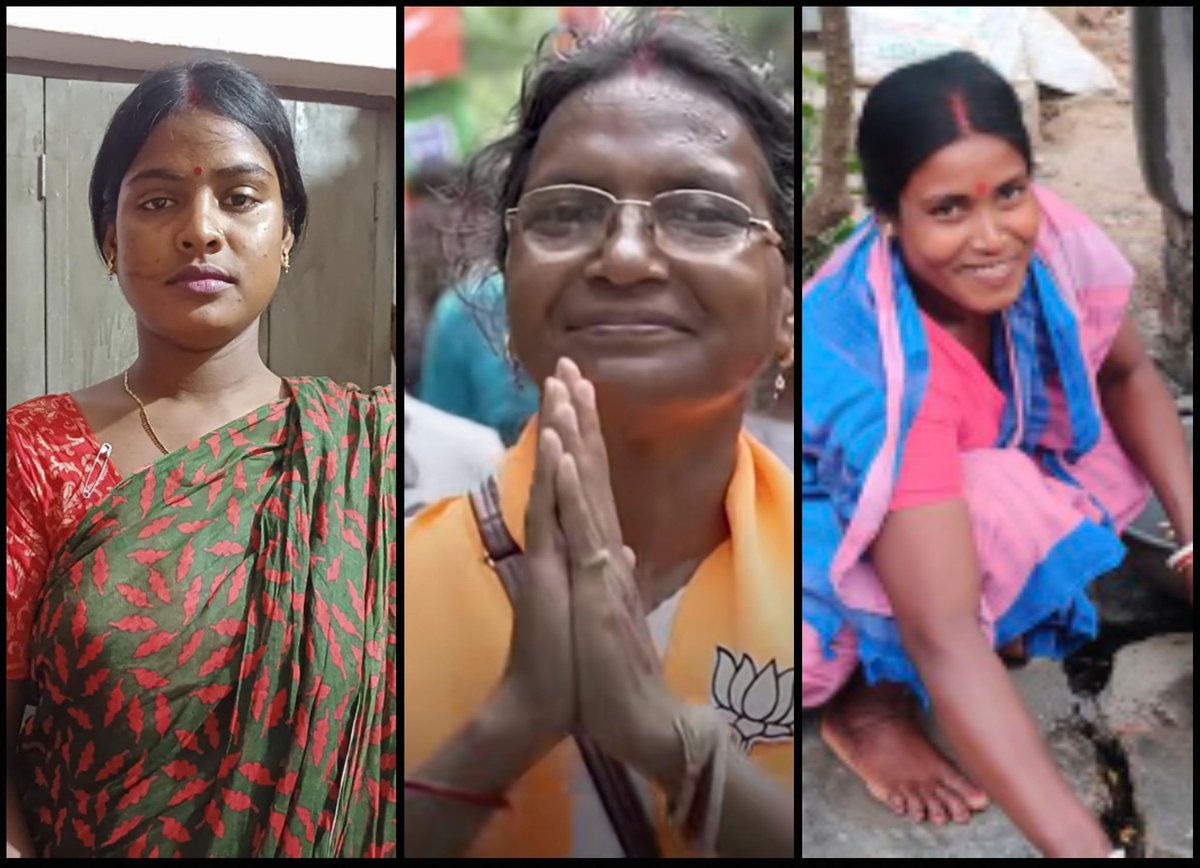
- Rekha Patra was victim of Sandeshkhali mass gang rape by TMC men. She defeated TMC candidate by 5000+ votes.
- Ratna Debnath is mother of RG Kar hospital rape & murder victim. TMC attempted shield the culprits. Ratna defeated TMC candidate by 28,000+ votes
- Kalita Maji is a maid who worked at four different houses to sustain her life. She was harassed by TMC workers regularly for supporting BJP. She defeated TMC candidate by 12,000+ votes.
Democracy is alive and kicking in India. Anyone who disagrees is just a chatukar of politicians who lost today.