🚨 Google Gemini can now build an entire website in a single afternoon.
No coding. No design experience. No hiring developers.
Here are 10 prompts to create a site that looks like it cost $/5,000+ 👇
This is the best partnership ad account structure for most brands
And is often the most profitable in the account
The structure itself is simple.
One CBO campaign on highest volume, with a single ad set for every partner you work with.
So if you're running ten creators, you've got ten ad sets, and every ad a given creator makes for you lives inside their own ad set.
We've run ABO and CBO side by side in the same accounts and the CBO almost always wins, so start there.
Run it on max conversions with whatever attribution window you normally use.
We run 7-day click and incremental.
The ads should run as real Partnership Ads with the official identity and dynamic identity on.
Pull in the existing post, connect your Shopify catalog, set each ad's schedule to match the creator's usage rights, and kill the heavy creative enhancements.
Here's what makes them work:
We set a minimum spend on every ad set.
Partnership ads carry a sunk cost, so you force Meta to actually test each creator.
The rule of thumb is being willing to spend up to 3x your account CPA on a partner in a week.
A $10 CPA is $30 over seven days, so the floor lands around $4.30 a day.
That floor gets every creator a fair shot across different days of the week, even the ones Meta wouldn't naturally pick up.
If a creator is egregiously underperforming, we'll cut it.
But if it's picking up spend and bringing in results, we're usually pretty generous about letting it keep running.
At the ad set level, exclude your purchasers and add-to-carts for most brands, then keep targeting broad and just adjust age and gender.
A couple of variations:
→ Chasing net new reach because of a TAM or penetration problem?
Layer on more exclusions: view content, site visitors, and 90-day page engagers.
Switch your attribution to 7-day click, 1-day view, 1-day engaged view to push new reach hard, and move the conversion event upper funnel (like view content or reach) to get even more aggressive.
→ Working with brand ambassadors running 30 to 50 ads around drops and collabs?
Give them their own campaign, usually on ABO so you control the demand per event.
Important note:
Partnership ads gather totally different data than the rest of your account and are usually very top of funnel, so your CPA can run high for a stretch.
Judge them on add-to-carts, net new customers, and blended account impact.
after generating $10M+ for clients' service based businesses with meta ads funnels...
i've realized that the #1 thing that kills scaling attempts isn't:
> the targeting
> the offer
> the media buyer
it's not testing ENOUGH ad formats
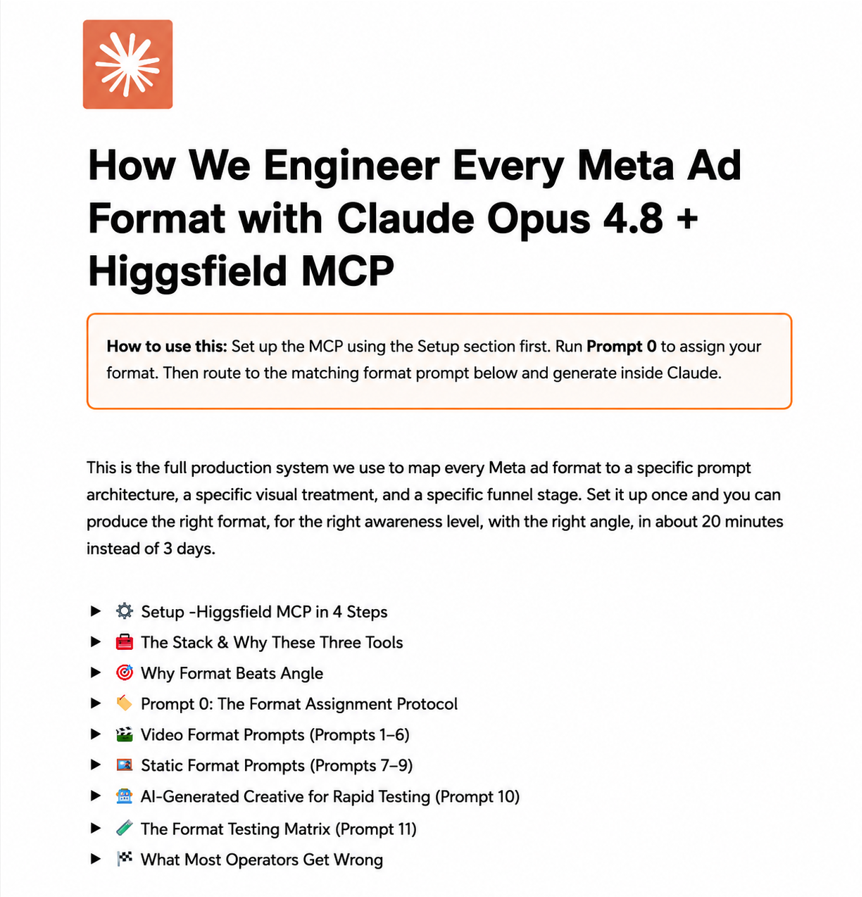
so i built an entire AI production engine that maps every Meta ad format to a specific prompt architecture (with opus 4.8), a specific visual model (inside Higgsfield MCP), and a specific funnel stage (inside the meta ads API)
here's everything that this system includes:
> the Higgsfield MCP setup
(the exact JSON config block, the file paths for mac and windows, and the one-line command to confirm it's actually connected before you generate a thing)
> the format assignment protocol
(one prompt that tags every brief across 4 points: awareness stage, placement, format family, angle, then routes it to the right format before a word of copy gets written)
> 10 format prompts, one per ad type
(founder selfie, talking head, B-roll w/ voiceover, split-screen, green screen, UGC, data viz, story-native, carousel, AI creative, each with its own word count, structure, and pacing rules baked in)
> the paired visual prompts for every format
(what to feed chatgpt images 2.0 for statics, what to feed seedance 2.0 for motion, exact dimensions per placement, all passed in through the MCP so you never leave Claude)
> which model runs which layer
(opus 4.8 for the script and reasoning, chatgpt images 2.0 for statics, seedance 2.0 for anything that moves, and what breaks when you mix them up)
> the 3-format testing matrix
(how we test every new angle across 3 formats and the exact CTR threshold at 200-300 impressions that decides what scales and what gets cut)
like + comment "FORMATS" and i'll send it over
(must be following + RT for priority access)
Before launching any product this is our process:
Step 1 - Master research document
We basically have a massive prompt we give to Claude, it assesses market sophistication, competitors, reviews on Amazon, Reddit, Trustpilot etc, common complaints, possible ad angles, estimated market size, pricing strategy etc
Once we have the output from this prompt we put it in a claude project along with a summary of breakthrough advertising and a document on maximising hook and hold rates for video ads. This project will be used in the next steps
Step 2
We ask the Claude project to select what are top 5 audiences to go after first in priority order
We ask it to give us a description of that audience, their main pain points and their core desires
Once you have those move onto the next step
Step 3
For each of our top 5 audiences we ask the Claude project to analyse the market sophistication for them and then give us in priority order which awareness levels we should target first to last
For some audiences it may be product awareness is the best thing to target first, for other audiences it may be problem aware etc
Step 4
Now that we have the awareness stages for each audience mapped out in priority order we ask the Claude project to give us the best ad angles to go after first for each awareness level of each audience
So basically what you have at this stage is:
- Top 5 audiences to target
- awareness stages for each audience mapped out in priority order
- Ad angles for each awareness stage of each audience
Step 5
This is where we start making ads
Will usually start with the top 2 audiences and top 2 awareness levels for each of those audiences
Will usually be static ads to start, using as many different formats as we can. Based on what we know already works for our other products and having a look around at how competitors are positioning themselves. We’ll try to kick off competitors based on common complaints we know people have about them
Step 6
This is where we’ll put the ads live. Will usually be just at $100 day
Goal here isn’t to be profitable, it’s just to see what is picking up spend and sales and take things from there
The stuff we see Meta favouring we will double down on. As well as making changes to the landing page based on this data.
If a certain ad angle is clearly performing best we may alter the landing page copy and images to be more aligned to this
If we have stuff that is working and we’re happy with the CPA we will then start taking those angles to UGC and video production
If we can’t get anything working, we’ll go pick more angles and audiences from our research and basically just work through it systematically until something sticks
This methodology has never failed us to this day
R.I.P. Fable 5.
Perplexity + Reddit + Opus 4.8 = AI SDR that still booked a $20B hedge fund.
(38% reply rate. 30 qualified meetings a month. 0 SDRs hired.)
This system reads 1,000+ companies every morning and only writes to the ones already in buying motion...
→ No more $200K/year SDR payroll for manual account research
→ No more 10,000 cold emails for a 1% reply
→ No more bought lists going stale in weeks
→ No more guessing who's actually ready to buy
→ No more openers that read like templates
Just 1 morning run → the 30 accounts worth calling today.
I built it around one rule: never depend on a single model to run.
Opus 4.8, GPT 5.5, Mythos, Fable 5 — there will always be a new LLM.
Today the US government proved why. The system didn't notice.
Here's how it works:
→ ICP Intelligence (Perplexity does a month of buyer research in 15 minutes)
→ Account Radar (reads 1,000+ companies every morning, keeps only the matches)
→ Buying Window (3 live triggers per account: a raise, a key hire, a launch)
→ Buyer Language (lifts your buyer's exact 5 phrases off Reddit, nothing reads like a template)
→ Voice Match (drafts a 3-line opener off that signal, in your voice)
→ Orchestration (Fable runs the whole pass and hands you the 30 to call today)
Built on real outbound infrastructure.
Model-agnostic. Runs every morning without supervision.
Government bans included.
Results from my own pipeline:
- Reply rate from 1% to 38%
- 30 qualified meetings a month, 0 SDRs hired
- A $20B hedge fund and a $15B fund booked
- $340K in new pipeline last quarter
Want the complete build?
Like + comment "RECON" + repost, and I'll DM it to you.
(must be following)
ChatGPT’s Deep Research mode is seriously underrated.
It doesn’t just answer questions — it thinks, compares, and breaks things down like an expert.
Turn a simple idea into real insights in minutes.
Infographic credit:@AndrewBolis
Follow @ayzha_ai for more prompts.
Here are 10 powerful ways to use it (with prompts you can copy )
Save this — you’ll need it later.
One of the most common attribution mistakes e-commerce brands make is overvaluing the channel closest to the conversion.
Google often looks incredible because it captures intent at the exact moment someone is ready to buy.
But that intent usually didn’t appear out of nowhere.
In many cases, Facebook was the reason the customer became aware of the product or brand in the first place.
By the time someone searches on Google, the product has often already been seen multiple times.
The awareness already exists, and the customer is already considering the product.
Google gets the credit because it captured the conversion, but that doesn’t automatically mean it was the channel driving the lift in performance.
The truth is, Google often just harvests awareness that Facebook created earlier.
This is why looking at attribution in isolation can completely distort where growth is actually coming from.
Brands overthink international expansion on Meta
Wether it's US to EU or EU to APAC it's almost always the same structure.
First, what you don't need:
- New pixel
- New ad account
- Custom purchase events
- Third-party attribution
Every variable you add at launch is another thing to second-guess.
Everything runs from your existing account, geo'd to the new country.
Campaign one is your purchase campaign.
CBO, highest volume, geo'd to the new market only.
New creative enters in weekly batches, every ad on a minimum spend so it gets a fair read before Meta can cut it.
Partnership ads get one dedicated ad set inside the campaign.
Attribution goes to 7-day click with 1-day view and 1-day engaged view on, the most generous window Meta will give you.
At launch the algorithm needs conversion volume before it needs accuracy.
Campaign two is your upper funnel campaign, and it exists because of the CPM tax.
Most new accounts entering a new market get hit with inflated CPMs for the first stretch.
You cannot outspend it, it settles as Meta registers conversions and learns to trust you in the market.
This campaign is the relief valve, cheap net new reach while costs come down.
Pick the objective by customer journey.
Reach, view content, add to cart, depending on AOV and how aggressive you want to be on net new audiences.
Fill it with your most organic, soft-sell creative and keep exclusions light.
Partnership ads get their own ad set here too.
Launching partners on an upper funnel objective is one of the most effective expansion plays there is.
Creators have to come from the market you're entering.
Local creators making soft-sell organic content outperform everything else at launch.
US creators can translate to Europe. European creators almost never translate to the US.
A few more best practices worth knowing:
Across the EU you can run English-language campaigns EU-wide and skip per-country translation.
Regional-accent talent is a booster, but full localization usually isn't worth the drag at the start.
Once the market has scale, break partnership ads into their own campaign, split by product and angle, and tighten attribution to 7-day click or incremental.
Consolidate at launch, separate at scale. Data volume first, precision later.
All of this assumes localized site copy and imagery, local fulfillment, and local currency.
If those are missing, no account structure saves you.
Most brands that stall in a new market had a patience problem.
Build the two campaigns, loosen the attribution, and let the market settle.