Tony's manager told the team that their chat logs were training an AI that would replace whoever sold the least
Tony is 31, in the Philippines, top biller on that team. His quota went up 25% the same month. He cleared $10,000 against an $8,000 target
He's a chatter. When you pay a creator on OnlyFans and she writes back, there's a good chance you're talking to an agency worker in the Philippines running several personas at once. The BBC found one doing it for under $2 an hour
The software these agencies buy analyses their existing chats - writing style, common phrases, tone - and then writes in that voice. One vendor sells it as replacing a team of chatters at up to 90% lower cost. Its page says: "Fans feel like they're talking to you, not software." And: "Your fans won't be able to tell the difference"
The difference they can't tell is Tony. It sounds human because it read what he wrote
Later two men in Illinois sued OnlyFans. They'd worked out they were messaging agency staff, not the creator. One noticed the replies contradicted each other. The other asked how one woman could be writing directly to 700,000 fans
Did the men who sued want the creator, or did they just want to not know? Both answers are worse than the lawsuit.
She was furious that the kids kept interrupting her work
She didn't send that message
She asked ChatGPT to write a calm version - no blame, "maybe we can chat later" - and sent it word for word
He melted
That night she told him a bot wrote it
He just nodded
Here's the part nobody agrees on: if the AI version got the outcome the honest version never would, was it still honest
And do you owe someone the truth about who wrote it?
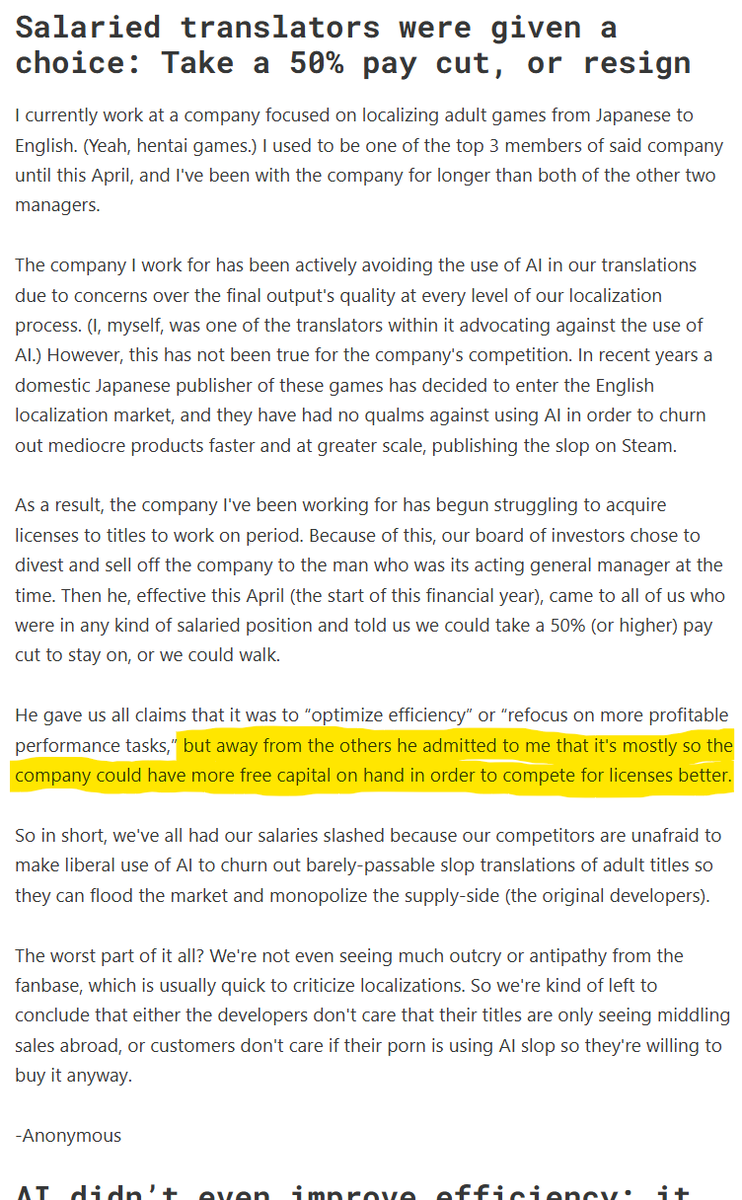
Boss gave every salaried translator at the company the same choice this April: take a 50% pay cut, or resign
Longer tenure than anyone else in management. Took the cut
The company localizes Japanese adult games (aka hentai) into English. For years it refused to touch AI, because at every stage of the process the output came back worse. The competition made the opposite call - a Japanese publisher started handling its own English releases, ran the scripts through a model, and shipped fast and cheap
That publisher started winning licenses. The company started losing them. Investors divested, sold to the acting general manager, and he halved everyone salaried
Publicly he called it "optimizing efficiency"
Privately, he admitted the actual reason: he needed free capital on hand to outbid a machine for the right to do the work by hand
There's been almost no backlash. Isn't it a fanbase that will argue for a week about one mistranslated honorific? And it's buying the AI versions in silence
So which is it? Did people stop being able to tell the difference, or did they never care in the first place?
Is India the Next AI Superpower? 🇮🇳
While everyone watches the US vs China AI race, a third giant is quietly rewriting the game — India.
Here’s why the world is paying attention 👇
The talent engine India already holds a huge slice of the world’s AI brainpower. India is the fastest-growing hub for AI developers and ranks second globally in public generative AI projects on GitHub, with 16 percent of the world’s AI talent. That’s not a future promise — it’s happening now.
The money is moving in In February 2026, India hosted its own AI Impact Summit, and the big players showed up. Leading global tech firms committed investment and entered strategic partnerships with Indian groups, including OpenAI and the Tata Group. When OpenAI plants a flag in your country, that’s a signal.
A sovereign AI strategy India isn’t just importing tech — it’s building its own. Through the IndiaAI Mission, the country is investing in shared GPU access and multilingual AI platforms to create secure, reliable sovereign AI. AI in dozens of local languages, built for 1.4 billion people.
The economic bet This isn’t hype. AI deployed systematically across India’s economy could add 1.0 to 1.5 percentage points to annual GDP growth — a massive lever for one of the world’s largest economies. The market itself? Valued at about USD 9.8 billion in 2025 and projected to reach roughly USD 195 billion by 2035.
The catch It’s not all smooth. India still has to solve talent shortages, infrastructure gaps in rural areas, and the need for agile regulatory frameworks. Scale is a superpower — and a challenge.
Bottom line India has the talent, the population, the government backing, and now the global capital. The US builds the models. China races for scale. But India might just build AI for the rest of the world.
Watch this space. 🚀
Is India the dark horse of the AI race — or the future leader? 👇
@opg_001 That’s exactly the point 👀 India isn’t loud about it — it’s building quietly. 2nd in the world for generative AI projects on GitHub, 16% of global AI talent, and OpenAI just partnered with Tata. The dark horse is always the one nobody’s talking about. 🐎
Is India the Next AI Superpower? 🇮🇳
While everyone watches the US vs China AI race, a third giant is quietly rewriting the game — India.
Here’s why the world is paying attention 👇
The talent engine India already holds a huge slice of the world’s AI brainpower. India is the fastest-growing hub for AI developers and ranks second globally in public generative AI projects on GitHub, with 16 percent of the world’s AI talent. That’s not a future promise — it’s happening now.
The money is moving in In February 2026, India hosted its own AI Impact Summit, and the big players showed up. Leading global tech firms committed investment and entered strategic partnerships with Indian groups, including OpenAI and the Tata Group. When OpenAI plants a flag in your country, that’s a signal.
A sovereign AI strategy India isn’t just importing tech — it’s building its own. Through the IndiaAI Mission, the country is investing in shared GPU access and multilingual AI platforms to create secure, reliable sovereign AI. AI in dozens of local languages, built for 1.4 billion people.
The economic bet This isn’t hype. AI deployed systematically across India’s economy could add 1.0 to 1.5 percentage points to annual GDP growth — a massive lever for one of the world’s largest economies. The market itself? Valued at about USD 9.8 billion in 2025 and projected to reach roughly USD 195 billion by 2035.
The catch It’s not all smooth. India still has to solve talent shortages, infrastructure gaps in rural areas, and the need for agile regulatory frameworks. Scale is a superpower — and a challenge.
Bottom line India has the talent, the population, the government backing, and now the global capital. The US builds the models. China races for scale. But India might just build AI for the rest of the world.
Watch this space. 🚀
Is India the dark horse of the AI race — or the future leader? 👇
Stack AI zpřístupnil rozsáhlou knihovnu 500 agentů umělé inteligence – zcela zdarma.
Uvnitř:
— Šablony pro finance, analýzy, výpočty, odpovědi a další úkoly.
— Možnost vytvořit si vlastního agenta od nuly.
— Jeden milion tokenů každý den.
— Podpora pro GPT-5.5, Gemini 3.5 Flash, Grok 4.3 a další modely.
Stack AI zpřístupnil rozsáhlou knihovnu 500 agentů umělé inteligence – zcela zdarma.
Uvnitř:
— Šablony pro finance, analýzy, výpočty, odpovědi a další úkoly.
— Možnost vytvořit si vlastního agenta od nuly.
— Jeden milion tokenů každý den.
— Podpora pro GPT-5.5, Gemini 3.5 Flash, Grok 4.3 a další modely.
How beginners enter AI and immediately drown
A lot of people don’t “start learning AI.”
They open a door and fall into an ocean of noise.
One week they’re curious. The next week they have 47 tabs open:
•“Top 10 LLMs you MUST know”
•“Best prompt frameworks of 2026”
•“Why RAG is dead / why RAG is back”
•“Fine-tune this, agent that, multimodal everything”
•19 newsletters
•8 courses
•3 Discord servers
•a Notion page that already looks like a graveyard
They haven’t built one small thing yet. But they already feel late.
That’s the trap.
AI content is optimized for attention, not for beginners. So newcomers get:
•tools before problems
•jargon before intuition
•hype before fundamentals
•“roadmap” before a single working example
They confuse consumption with progress. Watching another explainer feels like learning. Saving another resource feels like preparing. It isn’t.
What actually helps is embarrassingly simple:
1Pick one use case that matters to you.
2Use one model.
3Build one ugly little workflow.
4Break it.
5Fix it.
6Repeat.
You don’t need the whole map. You need a first mile.
The people who get good at this stuff are rarely the ones who collected the most information. They’re the ones who ignored 90% of it and shipped something messy.
If you’re new to AI and already overwhelmed: that feeling is not a sign you’re behind. It’s a sign the feed is too loud.
Close the tabs. Make one thing work. The ocean can wait.
How beginners enter AI and immediately drown
A lot of people don’t “start learning AI.”
They open a door and fall into an ocean of noise.
One week they’re curious. The next week they have 47 tabs open:
•“Top 10 LLMs you MUST know”
•“Best prompt frameworks of 2026”
•“Why RAG is dead / why RAG is back”
•“Fine-tune this, agent that, multimodal everything”
•19 newsletters
•8 courses
•3 Discord servers
•a Notion page that already looks like a graveyard
They haven’t built one small thing yet. But they already feel late.
That’s the trap.
AI content is optimized for attention, not for beginners. So newcomers get:
•tools before problems
•jargon before intuition
•hype before fundamentals
•“roadmap” before a single working example
They confuse consumption with progress. Watching another explainer feels like learning. Saving another resource feels like preparing. It isn’t.
What actually helps is embarrassingly simple:
1Pick one use case that matters to you.
2Use one model.
3Build one ugly little workflow.
4Break it.
5Fix it.
6Repeat.
You don’t need the whole map. You need a first mile.
The people who get good at this stuff are rarely the ones who collected the most information. They’re the ones who ignored 90% of it and shipped something messy.
If you’re new to AI and already overwhelmed: that feeling is not a sign you’re behind. It’s a sign the feed is too loud.
Close the tabs. Make one thing work. The ocean can wait.