The secret history of US germ warfare testing hiding in a Smithsonian rodent collection.
Read all about it: Inside Job: Secret Histories In The National Museum.
https://t.co/QcN4poPjte
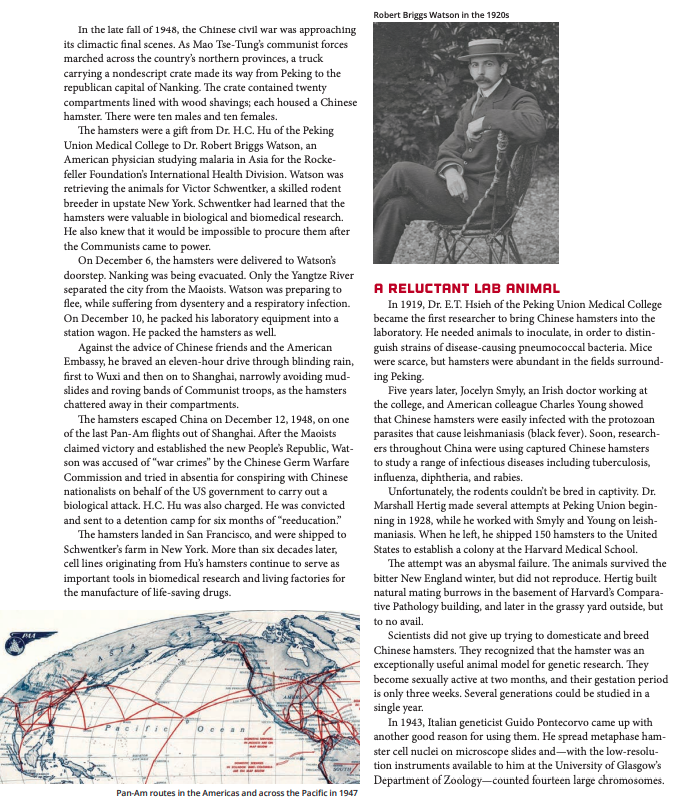
Chinese Hamster Ovary, or CHO, cells are widely used in the pharmaceutical industry. And, incredibly, these cells can be traced back to just twenty hamsters that were packed into a crate and smuggled out of China in the 1940s.
Chinese scientists had been using these hamsters — native to northern China and Mongolia — to study pathogens since at least 1919. The hamsters were unusually well-suited to scientific research because they have short gestation periods (18-21 days), a natural resistance to human viruses and radiation, and it was thought, early on, that they possessed just 14 chromosomes, making them easy to work with for mutation studies. (They actually have 22 chromosomes.)
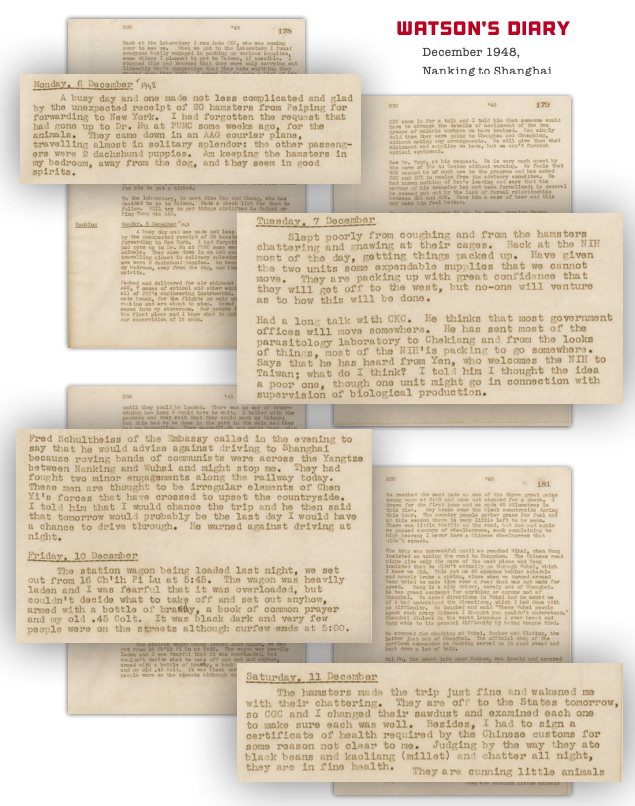
During the Chinese civil war, a rodent breeder in New York named Victor Schwentker worried that, if the Communists won the war, he’d never be able to get his hands on these special rodents. So in 1948, Schwentker sent a letter to Robert Briggs Watson, a Rockefeller Foundation field staff member, and asked him to “acquire” some hamsters so he could begin breeding them.
Watson collected ten males and ten females and packed them into a wooden crate with help from a Chinese physician (who was later imprisoned for this act). Watson slipped the crate out of the country on a Pan-Am flight from Shanghai, just before the Communists took control.
In New York, Schwentker received the hamsters and then began breeding and selling them to other researchers.
In 1957, a geneticist named Theodore Puck, intent on creating a new mammalian “model system” for in vitro experiments, learned about the Chinese hamster and contacted George Yerganian, a researcher at the Dana-Farber Cancer Institute, to obtain a specimen. Yerganian shipped Puck one female hamster.
Puck took a small piece from this hamster’s ovary, plated the cells onto a dish, and passaged them repeatedly. He eventually isolated a clone that could divide again and again; an “immortalized” CHO cell with a genetic mutation that rendered it immune to normal senescence.
Today, descendants of these immortalized CHO cells make about 70 percent of all therapeutic proteins sold on the market, including Humira ($21 billion in sales in 2021) and Keytruda ($17 billion). Many of these drugs are monoclonal antibodies, or Y-shaped proteins that lock onto, and neutralize, foreign objects inside the body.
CHO cells are well suited to biotherapeutics because they can perform a biochemical reaction called glycosylation. Many human proteins, including antibodies, are decorated with chains of sugars that control how they fold or interact with other molecules in the body. Only a few organisms, mostly mammalian cells and certain yeasts, can do this chemical reaction.
I first learned about this history from a really spectacular article in LSF Magazine, called "Vital Tools: A Brief History of CHO Cells." I recommend it. (You can find it with a quick search.)
Big news from us: "For over 3 billion years, life on Earth has lived on the light of a single star, but all that could soon change." https://t.co/WHaShuEhx7
@capitolsheila@AlexandraBalwit holy smokes, I can't wait to read this! I did all that research 14 years ago and did not have much to work with other than what was in the archives and in a few FOIAs at the time.
The Slovenian landscape architecture journal @Landezine published an interview with me today. Touched on some stuff I don't usually talk about. https://t.co/zMmSGevVi7
Whereas the anti-nuclear movement catalyzed around the terrifying imagery of atmospheric atomic explosions, the chemical & biological weapons program kept a much lower profile. Was this by design? Or, because a cloud of bacteria is visually less spectacular than a mushroom cloud?
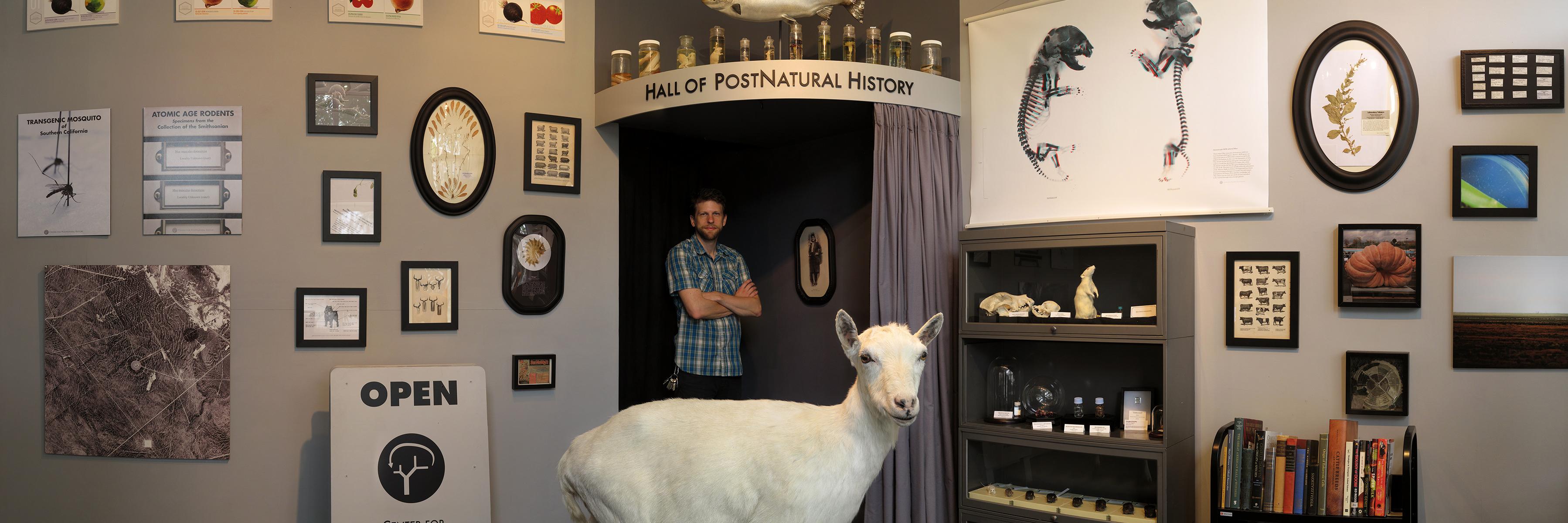
Rich Pell at @postnatural is such an adept archivist, that he has, on occasion, stumbled across government secrets.
In this piece adapted from his book, Rich discusses a fellowship, the discovery of visual records, and greater questions that arise in "America's Attic."
@baym Thank you for the correction. I obviously got my notes crossed. Would it be correct to say that the LTEE strain was sourced from Lederberg "strain B"? This is particularly embarassing as I handed a signed copy of this book to Richard Lenski just a few months ago 😬
Only 100 copies left!!!
This Is NOT An Artifact: Selections from the Center for PostNatural History. K-Verlag. Hardcover. 3D glasses. Order yours before they are gone!!!
https://t.co/ZBb40FDdvw
From Woolly Mammoth to smallpox blankets, turnspit dog to bird flu vaccine egg, the @postnatural book asks, “What do living artifacts tell us about the cultures who create them?” https://t.co/b3aZVUtwL7
@deepcryptodive@Aella_Girl That would be included under "research lab". If a researcher goes out out in search of viruses in usual places, brings it back to a lab in a major city, cultures it in captivity, contaminates themself, and carries it home, that's a lab leak.