If you’re noticing uneven shoulders, hip shifts, jaw tension, or bite issues, this video will help you understand how the jaw may be influencing your posture. Watch until the end to check if any of these signs apply to you.
https://t.co/GRo51fztnU
The nervous system will keep muscles locked, breathing shallow, and posture collapsed until it feels safe enough to release. Inside Supercharge Your Health, learn the four posture types and how they affect body function 👇
The body does not only remember trauma in thoughts.
It remembers through muscle tone, breathing, posture, and movement.
That is why stretching and strengthening are not always enough.
The nervous system has to feel safe before the body can let go.
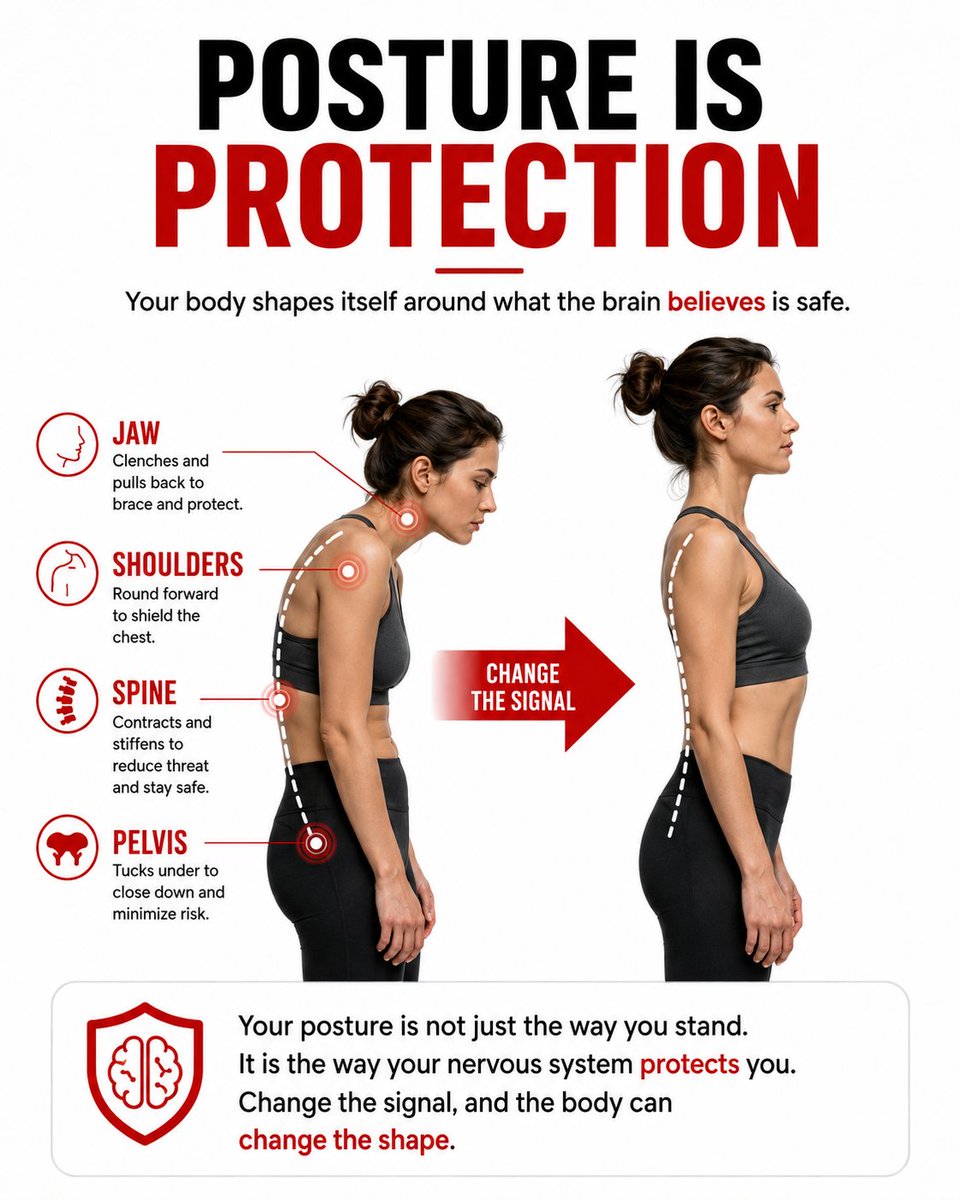
Your posture is not just the way you stand.
It is the way your nervous system protects you when stress has nowhere else to go.
The shoulders, jaw, pelvis, and spine all respond to what the brain believes is safe.
Change the signal, and the body can finally change the shape.
The position of your lower jaw affects the position of your upper body.
When the lower jaw sits too far back, as seen in Class II occlusion, the head and upper body tend to compensate forward.
When the lower jaw sits too far forward, as seen in Class III occlusion, the body may compensate in the opposite direction.
This is why occlusion is not only a dental issue. It is a postural input.
Research published in Frontiers in Physiology found that mandibular position can influence upper body posture, balance, and muscle tone.
The jaw gives the brain information about where the head is in space. When that information changes, the neck, spine, pelvis, and feet must adapt to keep the body upright.
That is why posture correction often fails when the jaw and feet are ignored.
The Fix My Posture Bundle retrains posture from both ends: tongue posture from the top down and foot posture from the bottom up, so the body receives better input without constant conscious correction.
https://t.co/1ffq2paacE
Study: https://t.co/2jLb36aOba
Poor posture is not just a back problem. It can show up as neck tension, headaches, shallow breathing, jaw tightness, uneven hips, knee pressure, foot collapse, and constant muscle tightness.
Why? Because posture is controlled by the brain.
Your brain is constantly reading sensory feedback from the body to decide how to hold you against gravity. When that feedback is poor, the body compensates. Muscles tighten, joints shift, breathing changes, and pain can appear in places that seem unrelated.
This is why stretching and strengthening alone often do not create lasting posture change.
You have to improve the communication between the brain and body. Better input creates better output.
FIX your Posture : https://t.co/G0VJBDPH64
Your vagus nerve is one of the main communication pathways between your gut and your brain.
It works in a two way loop: your gut, heart, lungs, and organs send information up to the brain, and the brain sends commands back down to regulate the body.
This matters for memory because the vagus nerve can influence stress, inflammation, heart rate, digestion, and brain areas involved in learning and recall.
When this loop is calm and regulated, the brain is often better able to focus, learn, store information, and retrieve it later.
Memory is created in the brain, but it is shaped by the condition of the body.
In addition to this, a Functional Activator is a great tool that can be used to address tongue position, so the vagus stays stimulated overnight, when no amount of conscious effort can hold it in place 👇
📷https://t.co/rTRwStyKQ7
@verpillot