GPT-6 and Intelligent UI, now rolling out in ChatGPT for everyone.
Intelligent UI in ChatGPT delivers fast, interactive answers that make everyday questions more visual, complex topics easier to grasp, and interactive tools for your task available on the spot.
Introducing Claude Opus 5.5, the first model in our new Claude 5.5 family.
It performs at the level of Claude Fable 5.1 for most tasks, and costs 40% less to run than Opus 5.
Please welcome GPT-6 Sol and GPT-6 Luna to the GPT-6 universe.
GPT-6 Sol and Luna build on the advances behind GPT-6 Astra, bringing much of its strengths into faster and more affordable models to support work at scale.
We’ve also made caching and inference more efficient, and we’re passing the savings directly to you: 50% lower API prices for Sol and Luna compared with GPT‑5.6 promotional pricing.
Introducing Xiaomi MiMo-V2.6 — Pro & Flash.
Frontier intelligence, all the modalities, built in public.
🔹 Two omnimodal models, advancing through scaled reinforcement learning
🔹 Pro performs on par with Claude Opus 5 and GPT-5.6 Sol across most agent benchmarks
🔹 Pro scores 46 on the Artificial Analysis Intelligence Index — the highest among open-source models
🔹 Stronger coding, computer use, 3D reasoning and creative capabilities
🔹 Open model weights, technical report, RL environments and training code
Blog:https://t.co/JGdwC9Ymvj
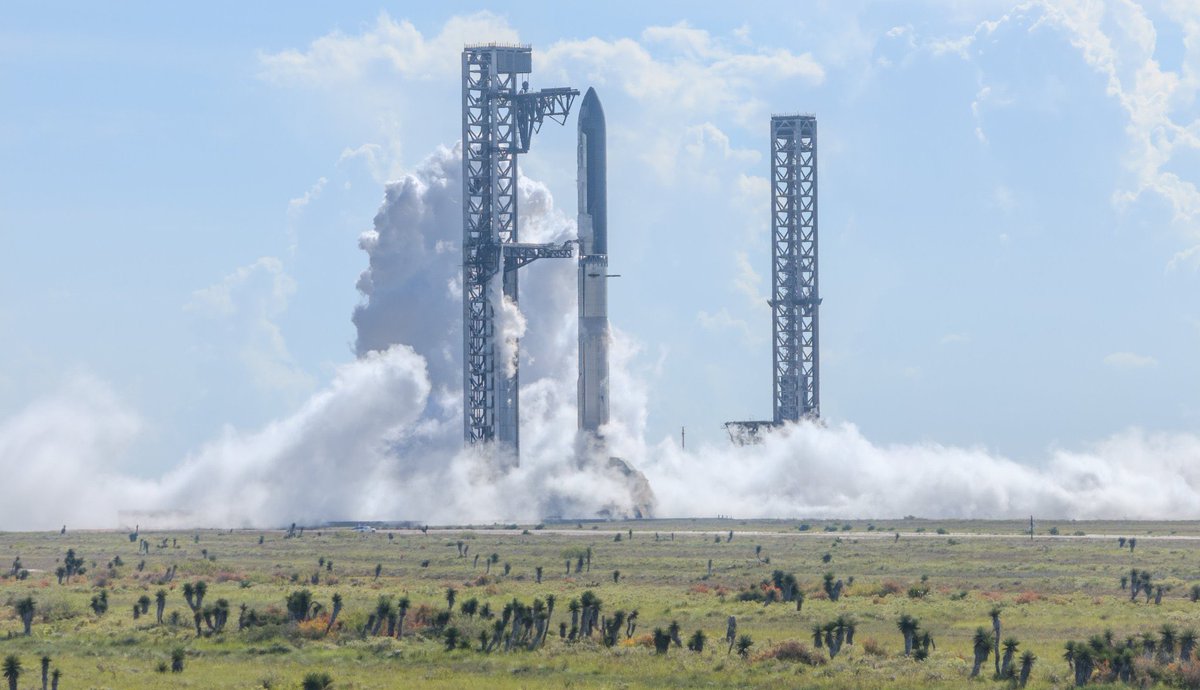
Grok 4.7 has landed. 🚀
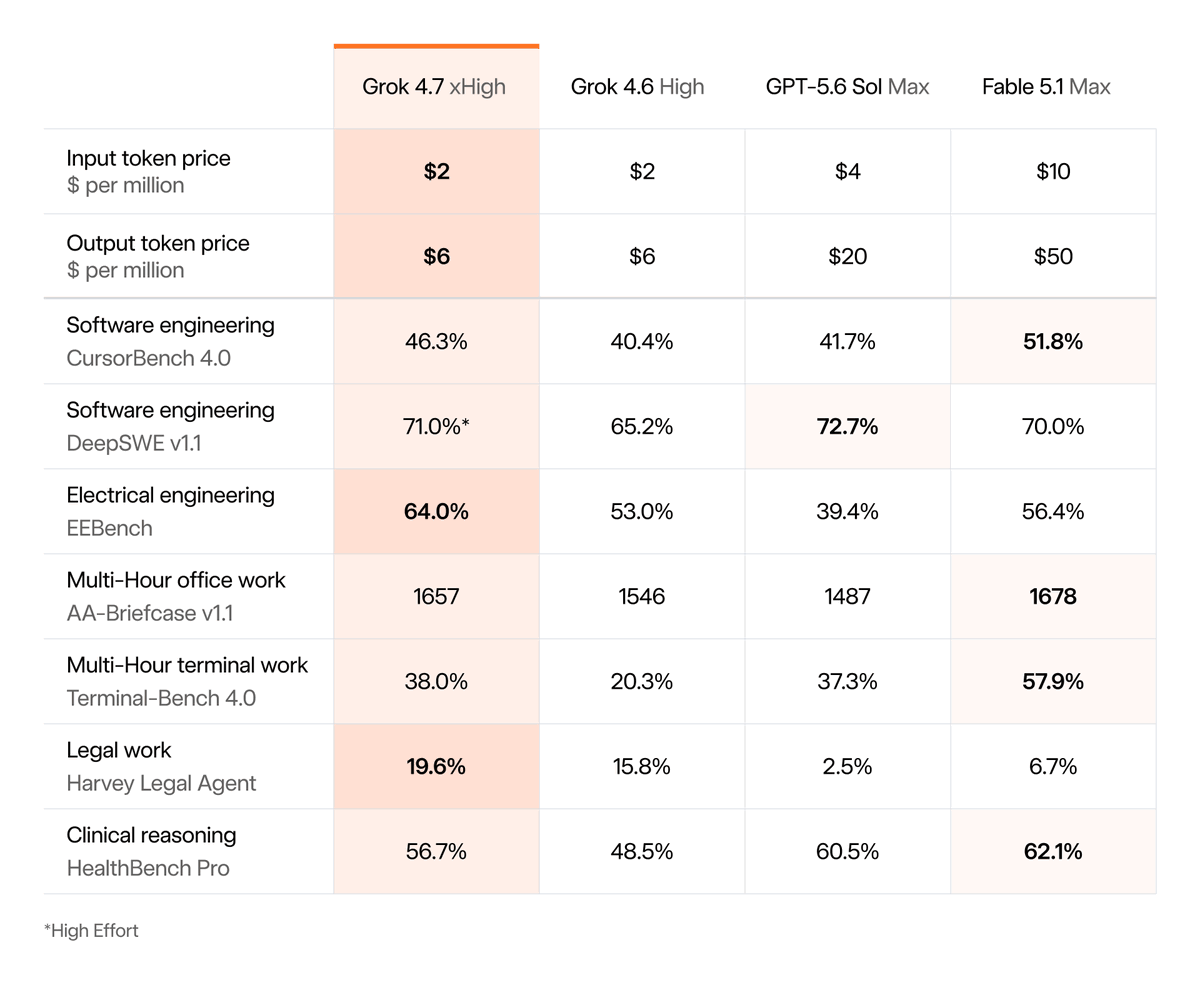
Congrats to @SpaceXAI on its most capable model yet for coding and knowledge work.
Proud to support the team with NVIDIA accelerated computing.
MiMo-V2.6: The Hard Road to Scaling Up RL
MiMo-V2.6 is very likely one of the largest single RL runs, by compute, that any open-source model team has undertaken to date. In an era when compute is brutally scarce, we still chose to dedicate a team of several dozen people to one goal over an extended period: scaling up RL. That takes more than research conviction. It takes a vision for AGI, respect for the unknown, and the nerve to walk straight into the hardest problems.
The result is a model whose potential was built through mid-training and unlocked through heavy RL. Today, it is the number one open-source model. I strongly recommend reading the technical report. I believe it will become one of those papers that Agent RL practitioners keep reopening and discovering something new in each time. In my view, the research innovations and engineering challenges behind it surpass those of DeepSeek R1, which I was partly involved in.
Some will ask: why MixRL instead of MOPD? First, they are not competing choices. We ran MixRL on verifiable tasks of moderate difficulty, including code and related agentic tasks, and found that the resulting models generalize remarkably well. Second, tasks that are difficult to verify, extremely long-horizon, or simply too challenging to include in a joint RL run are trained separately. Including them would substantially reduce rollout efficiency or introduce significant rollout staleness. We then merge the resulting capabilities through MOPD. Games, 3D tasks, and tasks with subjective evaluation signals all fall into this category.
There is also a third, slightly cheeky answer. Our team is flat enough and free enough of organizational silos that MixRL simply is not difficult for us. More importantly, everyone enjoys working this way. People from different domains come together every day, driven by the pursuit of AGI and intelligence that can continuously improve itself, to confront and resolve the RL bottlenecks in each field. I will always remember the RL daily update meetings from this period. They were intense and dense, with intelligence emerging in real time.
To help the open-source community focus on solving real Agentic RL problems, we have released a Qwen model distilled from MiMo RL trajectories as a stronger starting point for RL, along with 7K diverse environments and a complete RL training framework. We hope these resources will help move Agentic RL research forward.
MiMo-V2.6 is only the beginning. In an era when intelligence is easy to replicate, we still choose the hard road toward self-improvement and AGI. Much of what lies ahead remains unknown. But we are willing to keep investing the time, compute, and passion required to take on one hard problem after another and work each of them all the way through, until intelligence crosses into a new regime.
Grok 4.7 places @SpaceXAI as third, after Anthropic & OpenAI, for agentic coding.
When factoring in that Grok is significantly faster & lower cost, it’s a great choice for your everyday workhorse.
A new species of cat has been identified for the first time in a century—and experts think that there may be even more to discover around the world: https://t.co/woOXXxJOXB
After co-inventing ChatGPT, I kept asking myself: why have superhuman chat models not led to AGI?
I’ve spent the last 2 years in stealth building a new way to train models (RLCD), and a new type of frontier AI model that we are releasing today: Jev
• 20-200x faster
• 40-400x cheaper (w/ output tokens free)
• Frontier composable intelligence optimized for decisions
AFAICT the shortest path to AI-based economic revolution
happy Grok 4.7 day to those who celebrate it 🥳
> 2.1T params.
> new pretrain, not a 4.6 refresh.
> better than 4.6 in every way except slightly slower to serve.
> even better token efficiency.
> massive SpaceX / Starlink engineering data.
> ~Opus 5.0 class, not 5.1
> multimodal still needs work.
> delayed for RL, bro was giving up on hard tasks too early.
a few moments and it’ll be ready.