@DoctorCatX You're bullishness gives me a lot of hope, and mostly because you are very skillful in what you do.
Really appreciate your dedication and TA !
@DoctorCatX I got shaken badly lately, getting stuck in a " we're going lower " bias, so I am looking to build slowly my capital back up, so I can go with a relatively bigger position, with a max 10X laverage, preferably less thou.
Appreciate you TA, it's GOLD !
If we talk only about single trades, being early matters only as an investor.
If you invest in $BTC you want to buy 15-16K and at 100K you are 6-7X up.
But for single trades, the entry price does not matter, what matters is the RR which comes from small SL and big TP (whether fixed TP or eventually locked by trailing).
For example, at 90K there may not be good conditions which allow you a SL smaller than 10%.
But, at 110K there might be conditions which allow you to set a super tight SL based on LTF, say, 50X leverage.
Then, even if with a much smaller price move to the upside you will win more as your RR is way better than the trade which allowed you only 10X leverage.
"Allow" obviously means SL that makes sense based on current conditions.
With that being said, if you add to your winnings trades and build "pyramid" positions things are different.
Adding to your winners is the only way to extract as much money as possible from the market and the mandatory technique which one of the best traders ever have always performed: Dr David Paul, Richard Dennis who has turned 200$ into $400 million, to name a few.
Most traders don't do that, in fact if they add, they add to losers which obviously has the opposite effect.
But to add to your winners and build monster swing positions bigger not only in TP distance but also in terms of size, while not mandatory, it's still recommended and much easier to be relatively early, or at least to start building the position on a deep retrace.
Simply because if you scale 2-3 entries one over another you must put your SL at BE multiple times. This way your position can be 3X bigger than your max risk multiplied by the leverage, but you never exceed your max risk.
And if you do that, you need to be early enough so if the market retraces it's not deep enough to take your stops, even if they are already risk free, so your monster position survives.
That probably deserves an entire detailed thread in the future but these are some general thoughts for now.
We are also entering an era where biology and technology are no longer separate domains but they are merging into a single, programmable framework that redefines what it means to be human.
This is not speculation or something that I like to randomly say, it’s happening now, backed by billion-dollar investments, regulatory shifts, and institutional ambition.
The biotech revolution is not just about treating disease or enhancing life, but it’s about encoding humanity into a system where biology is data, and life itself is a product.
Gene-editing technologies like CRISPR have moved from the margins of scientific research into mainstream applications.
Once considered ethically untouchable, we now see live human trials underway, not only to treat rare diseases but to potentially reshape inheritable traits.
What started as an effort to eliminate genetic disorders is rapidly evolving into a race to design enhanced offspring: babies optimized for intelligence, strength, or disease resistance.
This isn’t "the future", It’s already in motion, and countries like China have taken the lead in real-world human trials.
As patents are filed on edited genes and synthetic biological sequences, the genetic code is becoming proprietary.
Your DNA and biological identity is no longer solely yours.
It is being cataloged, modified, and commodified.
At the same time, neural interfaces are being developed to connect the human brain directly to machines.
Projects like Neuralink, and others backed by DARPA and global tech firms, aim to decode brain signals in real-time, enabling thought to digital communication.
Medical support for paralysis or memory loss?
It quickly becomes a tool for augmented cognition, remote control, and even mental surveillance.
With the brain plugged into the cloud, the potential for cognitive intrusion (reading or even writing thoughts) becomes a new legal and ethical battleground.
Privacy, in its deepest sense, may cease to exist.
In parallel, synthetic biology is reengineering the body itself.
Organs can now be printed using 3D bioprinters, while lab-grown meat is preparing to scale into commercial markets under the banner of sustainability.
What we consume, and even what we are composed of, may soon be sourced from bioreactors rather than nature.
These innovations are protected not by open science, but by corporate patents and trade secrets.
Your future food supply, medical care, or organ replacement may not come from the earth or your body, but from a lab controlled by private interests with little accountability.
Perhaps, most dystopian of all is the development of synthetic embryosstructures created without sperm or eggs, which can grow rudimentary organs and even begin brain development.
Researchers have demonstrated this already in animal models and are rapidly moving toward full synthetic gestation.
Combined with artificial womb technology, reproduction itself may soon be removed from the domain of humans and placed under clinical, institutional control.
The implications are staggering: birth could become a licensed process, access to parenthood could be restricted, and eugenics (long a taboo) may return through the backdoor of innovation and “choice.”
Meanwhile, the physical body is being wired for constant surveillance through bio-monitoring devices.
Wearable tech already tracks our steps, heart rate, and sleep.
The next generation goes deeper: under-skin implants that measure hormone levels, blood glucose, fertility windows, and stress responses.
These devices connect to apps, databases, and now even payment systems.
Health becomes data, compliance becomes currency.
If you want to participate in the financial system or maintain access to insurance, you may soon have to prove not just your identity but your biological status: live, verifiable, and real-time.
All of this is unfolding under the polished marketing of “innovation,” “efficiency,” and “wellness,” but the true architecture being built is something far more profound and far more dangerous.
It’s a bio-digital economic system where human beings are no longer sovereign.
The merging of data and DNA repositions individuals as assets within a platform economy: your body, mind, and choices becoming programmable endpoints in a network managed by entities you’ll never see.
Not citizens, but nodes.
Not people, but participants in a behavioral market.
You will not be forced into this system and likely incentivized.
Rewarded.
Nudged.
Offered safety, speed, and convenience in exchange for your biological autonomy and for many, especially the next generation born into this infrastructure, there will be no memory of anything different.
The post-human economy is not science fiction or about killer robots or apocalyptic AI.
It’s about a quiet transition, one that recodes human life into a compliant, trackable, and monetizable format.
You won’t be replaced by machines.
You’ll be merged with them.
And the cost of opting out won’t be death, It will be disconnection.
And in a world where every system is digital, disconnection is the new exile.
After some careful thought, I’ve decided to make a change that will better support my personal journey and the integrity of my work.
Starting today, I will no longer be sharing my setups publicly.
This decision stems from a recurring issue I’ve observed: many people misinterpret my analyses, and some even criticize my positions ("you were bullish" or "you were bearish") without considering the full context, especially the conditional nature of my setups (ex., “If X happens, then I’ll look for Y”).
I acknowledge that part of the problem might lie in how I explain things.
Perhaps I haven’t been clear enough in conveying my logic, or maybe my posts didn’t do justice to the complexity of the scenarios I was analyzing.
I always aim to emphasize when I’m wrong, those who truly follow my work know that I don’t shy away from my mistakes.
Still, misunderstandings can arise, particularly when explanations are either too simplified or not thoroughly studied by the reader.
This is especially risky when people don't understand technical analysis mechanisms and just skim through TL,DR summaries.
Going forward, my setups and takes will be shared privately on Telegram, where we have a more engaged and respectful community.
There, members can refer to the detailed Notion resources and study my strategies in depth, fully grasping the reasoning behind each position.
Here on X I will share more general takes, some educational and psychological content or some targets.
Shoutout to @Moneytaur_ , who was absolutely right in saying:
“Free things often attract the wrong crowd.”
That said, I’m not disappearing.
In fact, I’m stepping up the quality.
For those truly interested in following my thought process and understanding the "why" behind every take, I’ll be uploading in-depth YouTube videos.
These will provide full voice explanations, walking through the logic step-by-step.
This ensures nothing is left ambiguous, and the content will be clear, complete, and structured.
What to expect on YouTube:
- Detailed market breakdowns
- Conditional setups with real reasoning
- Teaching moments to improve your TA comprehension
- High-quality visuals, structured flow, and no fluff
This shift is about quality over quantity.
If you’re serious about learning, you’ll still have access to all the tools I use, just in a better environment, with better delivery.
Thank you to everyone who’s been supportive so far.
I’m doing this to protect the integrity of the work, the energy of the community, and my own focus as a trader and analyst.
Pay attention to the increase in arrogance levels on X for assessing the next macro top.
Alongside the classic “retail top indicators” like positive news and mass media attention, a boost in negative replies and arrogant statements is by far one of the best warning signals that could be provided.
Newcomers have a very high tendency to become conceited when things go extremely well as their minds aren't open to considering potential downsides on their “favorite assets”.
Scan through the replies, look at the price action and you'll have a perfect cocktail to drink..not in company, but alone.
It will initially taste bad, but the sweet notes it will leave on your palate will be exquisite. 🍸
$BTC
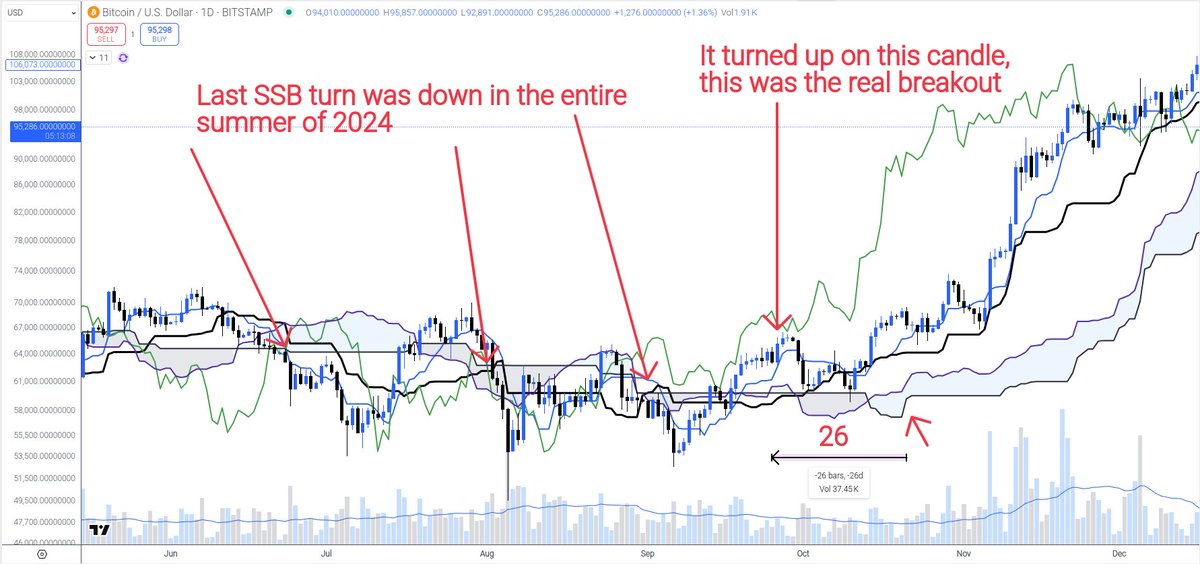
This daily bullish breakout is as real as the last one in 2024 which led us from the 60s to 109K.
Why?
Because SSB turned up which indicates that bulls are in control of the long term trend.
What was the common thing between all three other bull traps in earlier 2024?
That the last SSB turn was down. This is not the case now.
Reminder: we look for the SSB slope 26 candles in the future.
The SSB slope of the current kumo is completely irrelevant to the current price action, it has already taken action 26 candles back. Only the width of the current kumo matters as a measurement of its support/resistance strength.
More about SSB here: https://t.co/NABpsmuM9e
20 life lessons that will improve your existence (as they did/doing with mine):
1. You won’t find peace by forcing people to understand you.
Half of them only hear through their wounds.
You’ll contort, shrink, reword your truth and they’ll still twist it.
Say it once and If they don’t get it, let the silence speak. Some people need to misunderstand you to stay comfortable in their version of the story.
2. You can’t outwork a feeling you refuse to feel.
All the hustle, the distractions, the “I’m just staying busy”, it’s anesthesia.
You’re trying to outrun grief, abandonment, rage but emotions don’t disappear.
They wait, and when they come back, they come back louder.
Sit with it now, or break down later.
3. Sometimes your body keeps screaming what your mouth won’t say.
The headaches, the fatigue, the tight chest..it’s not just stress, it’s repressed truth.
It’s the tension of carrying things you were never meant to hold alone. The body remembers everything the mind tries to bury.
4. You only chase people when you don’t believe you’re worth being chosen.
Read that again.
If you believed your presence was enough, you’d stop begging for breadcrumbs.
Let them go.
The ones who see your worth won’t need a reminder.
5. Becoming “hard to read” is not a flex, it’s a trauma response.
If no one can get close, no one can hurt you. Right?
But isolation disguised as independence will rot your spirit from the inside. Let yourself be seen. Even if it’s messy.
6. Stop explaining your boundaries to people committed to crossing them.
If they keep testing your limits, they’re not confused, they’re entitled.
And you don’t need to be polite to disrespect.
“No” is a full sentence.
Use it without a smile.
7. Love that feels like proving yourself is just unhealed rejection in disguise.
You’re not in love, you’re trying to earn a parent’s affection you never got.
That’s not chemistry.
That’s a childhood wound in a grown body, still begging for validation.
8. You didn’t ruin anything by walking away from what was destroying you.
Let them call it quitting. Let them rewrite the narrative. You’re not obligated to burn just because someone else likes the light.
Survival isn’t betrayal, It’s the beginning of freedom.
9. You are grieving a version of yourself that tolerated things you now know were never okay.
That version of you wasn't stupid. They were surviving. But now you’re awakening and awakening always costs comfort.
10. Your intuition didn’t lie, you just didn’t want it to be true.
The red flags weren’t confusing, you just wanted it to work. You saw the signs. You felt the shift. You just weren’t ready to choose yourself over the fantasy.
11. Sometimes loneliness is safer than fake company.
Being around people who don’t see you is lonelier than being alone. Choose solitude with self-respect over a crowd that makes your soul ache.
12. The world respects a man who doesn’t beg, doesn’t complain, and doesn’t break.
Because stillness in chaos is power.
Silence in rejection is dignity.
Resilience in solitude is strength.
The man who moves on instead of lashing out, who rebuilds in private, who keeps his spine straight when everything around him folds..he doesn’t need to scream to be feared.
He becomes the storm they never saw coming.
13. They’re not mad at you, they’re mad they can’t control you anymore.
When you stop being available to their dysfunction, the tantrum comes. Let it. A boundary is only tested by those who benefited from your lack of one.
14. You heal when you stop pretending it didn’t happen.
Denial is protection, but it’s temporary.
True healing starts when you stop minimizing what broke you and start honoring how hard it was to survive.
15. Your softness is not a weakness.
This world will try to harden you, mock your empathy, punish your vulnerability, but don’t let pain steal your gentleness.
That softness?
That’s where your power lives. Keep it sacred.
16. There are no parents who want a broke son. No woman dreaming of marrying a broke man. No child proud of a broke father. No sister who wants to lean on a broke brother.
It’s not about greed, it’s about survival.
In this world, your value as a man is too often tied to your ability to provide, protect, and produce. You may be kind, wise, and full of potential, but without money, you’re background noise in a room full of noise.
A man without money is a man without voice.
Fix your finances before you try to fix the world. Because without leverage, your wisdom becomes whispers no one hears.
17. Men often get hooked on the feeling of being at their peak: running at 100%.
When they experience this, it shows them what they are capable of. This taste of greatness makes it hard to accept when they’re not performing at that level. They know what they could achieve, and falling short of that can feel frustrating and disappointing.
This drive to reach that potential leads them to relentlessly chase greatness. The key to unlocking it isn’t perfection, but consistency. Potential may tease and flirt, always out of reach, but steady, consistent effort will eventually bring it into focus. The real challenge lies in maintaining momentum even when results aren’t immediate, and that’s where success lies.
18. Test commitment before marrying
Before you commit to marriage, ask yourself this: Would this person still stand by you if you lost everything like your status, lifestyle, career, wealth, and health?
If the answer is no, then reconsider.
19. Respect is earned through improvement
People respect you more when you're physically fit, mentally calm, and focused on meaningful goals. Physical fitness shows discipline and confidence, while mental calmness demonstrates your ability to handle stress with composure.
Focusing on purposeful goals gives you direction and determination, which naturally inspires respect from others.
20. Your timeline Is tours alone
Your life doesn’t need to follow anyone else’s script. You might not be married by 30, land your dream job by 35, or have a family by 40 and that doesn’t mean your life isn’t full, meaningful, or successful.
Everyone moves at their own pace. Society pushes timelines that make you feel like you're behind, but there is no “behind” when you're living a life that’s true to you. What matters most is that you're growing, learning, and becoming more aligned with who you really are.
Don’t let pressure. whether from others or yourself, rob you of the joy in your current season.
Life isn’t a checklist; it’s a journey. Embrace your path, celebrate your progress, and trust that you're exactly where you need to be.
There’s only one major level I’m monitoring on BTC D: 67% dominance.
This is the line in the sand for me: the only level that, from a macro-technical perspective, truly makes sense to be taken out before any meaningful HTF bearish reversal can begin.
Why is this so crucial?
Because this level represents the "apex" of BTC D compression, a point where market participants are either fully rotated into BTC or preparing for the shift.
Once this liquidity is swept, it should mark the exhaustion of capital concentration into Bitcoin, and that’s when altcoins could begin their most aggressive and extended upside moves.
If BTC dominance cleanly takes the 67% level and fails to sustain above, especially if in "tandem" with ETH/BTC reaching the 0.014–0.013 zone, which coincides with a major HTF demand zone from February 2017, we could witness the start of a full-scale altcoin reversal.
Ideally, we might even see ETH/BTC wick below to 0.012 to sweep residual liquidity and trigger a strong reaction from long-term buyers sitting in that historical block.
Such a move would create the perfect storm: BTC dominance showing signs of macro rejection, ETH reclaiming strength against BTC from a high-confluence zone, and altcoins across the board finding relief from suppression.
We’re talking about multi-week, potentially multi-month (less probability) upside swings with significant return potential, in my opinion.
This is a very interesting question that I will try to elaborate.
In a multi-week altcoin uptrend, the smartest trades aren’t made by buying strength or fading weakness, they’re made by following the trail of inefficiencies left behind as price tears through levels, rebalancing selectively while hunting liquidity.
The market’s movement is rarely clean, and that chaos leaves clues.
If you know how to read imbalances, understand displacement, and track what wasn’t traded, you can build a system that positions you inside continuation, not after it.
When price expands violently, it rarely leaves a clean footprint.
We're talking about FVGs, mainly.
These are areas where price moved too fast to efficiently transact, meaning there was more aggressive buying than willing sellers.
These inefficiencies act like magnets on the way back down: in an uptrend, they become your primary zones to look for long entries.
Logically, you have to start with context: price has broken structure to the upside, likely through a prior SH that held significance (multiple touches, clean horizontal level, or liquidity pocket).
That displacement confirms aggressive demand.
What matters now is where price pauses, and where it left inefficiencies behind.
Use multi TFs to spot the candle bodies that left voids between them as price ran up.
These gaps are rarely random..they’re where you want to bid.
As price retraces, maybe on a small pullback, or after running a local high, you’re watching for it to come into the upper part of the FVG.
Not necessarily to fill it entirely, but to show that buyers are still active inside it.
You want to see a slowdown in bearish momentum: wicks rejecting lower prices, bullish engulfing on MTFs or closures within the level, ideally within the top 50% of that imbalance.
That’s your trigger.
The invalidation is below the imbalance.
Is like saying: “if this gap doesn’t hold, the move wasn’t strong enough.”
Now here’s the "juiciest" part: your take-profits aren’t blind highs or fibs, they’re set at the next imbalance above.
Because just like inefficiencies below get filled on pullbacks, the market is constantly seeking to rebalance inefficiencies on the way up.
The next major target is often the midpoint or origin of the next unfilled FVG above and once that gets filled, you look for reaction.
If price blasts through, you keep a runner. If it stalls, you scale out and wait for the next entry.
Add another layer: if price returns to an old imbalance zone that also lines up with a prior range high or a BB from the last leg down, that’s double confluence.
You’re now dealing with a zone where price has memory, and the inefficiency is your edge within that structure.
You’re not chasing green candles.
You’re trading what the market left behind, clean inefficiencies that act as footprints of intent.
The market tells you what it wants, not in words, but in voids.
If you let it come back to fill what it missed, and you’re patient enough to wait for that reaction, you enter at precision and exit at imbalance completion. (partial or full)
Clean, mechanical, and rooted in how price actually behaves, not how people want it to.
This is how you stay composed in a trend.
You don’t need to predict tops or chase breakouts.
You just track the imbalance, let price come back, and trade from value to value.
Liquidity leaves clues, imbalances define the path.
The rest is just execution.
"And if I'm not good at trading?"
If you get nice entries at discount in the next couple of weeks, you "just" need to identify the levels where the prices will be attracted, marking them down as HTF TP and respecting them.
That's a fool-proof strategy for those who want to hear.
Usually, before BTC dumps, the market doesn’t panic but goes into "align mode".
Price may look "stable", sentiment may tilt bullish, but beneath the surface, the architecture is already shifting.
One of the most telling signals comes in the form of isolated altcoin rallies.
Seemingly spontaneous, fundamentally unjustified moves with illiquid tokens ripping 100%+ while BTC chops sideways.
To the untrained eye, it looks like early altseason or a hidden gem finally getting its due but in reality, these rallies are manufactured.
They are localized liquidity events: short-term, high-intensity demand spikes engineered to serve a specific purpose: distribution.
When smart money position for a downturn, they know that exiting size through BTC can trigger slippage, spread widening, and signal panic to the overall market so instead, they rotate capital into thin altcoin markets where they can construct liquidity "windows" with precision.
Through weeks of quiet accumulation, they corner the supply.
I don't have to tell you that these tokens are chosen not for their fundamentals, but for their manipulability because they have tight order books, small communities and minimal oversight.
Once the position is built, demand is synthetically injected: exchange listings timed with press releases, Twitter hype, influencer callouts and bot-driven engagement. (Check LunarCrush)
Each piece is part of a short-term narrative scaffolded just long enough to justify a rapid price expansion.
Thin liquidity means price can be walked up with relatively small capital, and once it starts moving, the retail reflex kicks in.
Volume pours in, volatility spikes, and the bid side increases offering the liquidity that didn’t exist during accumulation.
That’s when the handoff occurs, capital extraction.
The timing is never random.
These events often cluster before significant BTC volatility and the surge of these random altcoins occur not because something is starting, but usually because something is ending.
Then BTC breaks.
Once the major leg down begins, those same alts retrace violently, liquidity disappears and retail is left exposed, holding assets that were never meant to be held but only used.
What looked like opportunity was just microstructure in motion, a constructed liquidity trap deployed before broader market contraction.
This is how smart money exit, not through panic selling, but through engineered relief rallies in the corners of the market no one is watching closely enough.
So when altcoins start to explode without reason while BTC is flat and wicking through HTF supply areas, zoom out.
It's usually a warning sign.
One of the biggest challenges in trading isn’t spotting the "perfect" level, nor it's finding a good setup, it's having the courage to take it.
You’ve done the work, your levels are clean, the environment is moving into your favor.. It’s all there.
Technically speaking, this is the moment you’ve been waiting for.
But then something strange happens.
Your logic starts to blur.
Confidence gives way to doubt.
Your finger hovers over the entry button, but you can’t click.
You hesitate… and the moment slips away.
Despite a perfect setup, your mind begins its usual "business":
"What if I’m not correct?"
"What if this level doesn’t hold?"
"What if I’m walking into a trap?"
"What if I just lose, again?"
You’re no longer trading the chart, you’re trading your own emotions: fear of being wrong, of losing again, of confirming that voice in your head that says maybe you're not as good as you thought.
This is paralysis, and it’s a silent killer in trading.
It doesn’t make noise like a blown account or a huge red day.
It whispers, it delays, it erodes confidence trade by trade.
And the most frustrating part? The setup was there.
But doubt took over, disguised as “caution.”
You convince yourself you're being smart by waiting when really, you're just afraid to be wrong.
You forget that trading is never about being right.
It's about executing your edge, regardless of outcome.
No setup, no matter how perfect, can override a mind that’s terrified of uncertainty, and in trading, uncertainty is part of the job.
You cannot eliminate it, you can only train yourself to move despite it.
This paralysis doesn’t mean your strategy is broken.
It means your relationship with risk, loss, and identity needs work because behind that hesitation is a deeper fear, that being wrong somehow means you’re not good enough, that another loss is a reflection of your worth.
But you have to remember: your job is not to predict the future.
Your job is to execute what your plan tells you to do, over and over again, regardless of fear.
Sometimes, the hardest part of trading isn’t building the setup, it’s trusting yourself enough to take it.
And that trust… it isn’t built through wins.
It’s built through presence, through showing up, through taking the trade even when it terrifies you, because that’s how you teach your nervous system that discomfort isn’t danger.
That fear isn’t a signal to freeze, but an invitation to act with intention.
You don’t become a confident trader by waiting for the fear to go away, you become one by learning how to trade alongside it.
Every time you flinch and don’t enter, you reinforce the idea that fear is in control.
And every time you step in, even when your stomach’s tight and your mind’s loud, you start shifting that power back into your own hands.
But this takes honesty.
You have to get real about what you’re actually afraid of.
Because often, it’s not the trade itself. It’s the story you’ve attached to it.
The meaning you’ve loaded onto it.
“If I lose this trade, it proves I don’t know what I’m doing.”
“If I miss this move, I’m failing myself again.”
“If I keep getting it wrong, maybe I was never cut out for this.”
These are not trading thoughts, these are self-worth wounds disguised as market analysis.
The more you internalize outcomes, the more personal every tick becomes.
Instead of being a participant in a probabilistic game, you become emotionally entangled in every candle and when your identity is on the line with every trade, how could you possibly feel calm enough to act?
This is why some traders spend years “studying” without progress, not because they lack knowledge, but because they never healed the emotional baggage that sits between knowing and doing.
Trading is not just technical.
It’s deeply psychological.
And the deeper you go into this game, the more you realize that the real work isn’t in the charts but It’s in the mirror.
You have to rebuild your relationship with uncertainty with failure and with yourself.
You have to learn to see losses as part of the equation, not punishments.
You have to forgive your past mistakes, or you’ll keep replaying them.
And maybe hardest of all:
You have to stop trying to prove something every time you trade.
You don’t need to win to validate your worth.
You don’t need to be perfect to be consistent.
You just need to be aligned with your process and courageous enough to honor it.
So next time you feel that hesitation rising or thenext time your hands get shaky and your brain starts spinning, pause, take a breath and come back to your plan reminding yourself that:
You are not here to be perfect, you are here to execute.
Win or lose, confidence is built through aligned action, not flawless outcomes.
And the more you choose courage over comfort, the quieter those doubts become.
Not because they disappear, but because you’ve stopped letting them decide for you.
That’s when you become dangerous, not because you can’t lose, but because you no longer fear it.
The biggest clue?
It’s not in the charts, It’s in the silence.
Notice how major financial institutions have gone dark on forward guidance.
Executives are suddenly unavailable for comment, earnings calls are filled with vague language, repeated phrases like “challenging macro environment” and “we’re remaining flexible.”
This is not caution, it’s coded language.
They’re circling the wagons.
And then there’s the political angle.
In the background, central banks are coordinating in ways they’ve never admitted publicly.
“Independent” monetary authorities are suddenly echoing the same policy language, hinting at synchronized rate cuts, just months after insisting inflation wasn’t tamed.
Why the pivot?
Because they know what's coming and they’re trying to get ahead of the collapse they helped create.
They’re not trying to prevent it, they’re trying to control it.
And when the house of cards comes down?
Expect emergency policies.
Expect “temporary” capital controls that quietly become permanent.
Expect the rollout of a programmable currency under the guise of stability, one that can expire, be frozen, or rerouted based on your behavior.
Sound paranoid?
They already tested it in pilot programs.
China. Nigeria..even the EU’s digital euro is quietly being structured with compliance features that track every transaction in real time.
Innovation is the fancy word to attract, total control is the flowing poison.
Meanwhile, the narrative machine is being fine-tuned.
Social media algorithms are shadowbanning dissenting voices, while blue-check talking heads mock anyone who questions the system.
The playbook is classic: discredit the skeptics, confuse the masses, and let the storm hit when no one's looking.
And while the average investor thinks it’s business as usual?
Smart money are executing an exit strategy.
Quietly, methodically, and with surgical precision.
They’re buying more than assets, they’re buying autonomy, freedom, safety.
How?
Remote lands for example, which are not just properties, they are think self-sustaining plots in low-regulation countries, often near natural resources or fresh water.
Places where the rule of law still functions, but where privacy is preserved.
Second passports, because dual citizenship is the new offshore bank account.
Not for luxury, but as a contingency plan.
When capital controls are enacted or borders tighten, they’ll already have legal exits.
Nations like Portugal, St. Kitts, and Vanuatu are favorites, offering swift paths to citizenship for those who can pay.
And what about off-grid infrastructures?
Solar power systems, water purification, private communications networks..even underground storage for essentials.
They’re not waiting for FEMA.
They’re building parallel systems in case the grid fails or gets weaponized.
As said before, beyond gold and silver, smart money are also loading up on rare earth metals, strategic commodities, and unregistered bearer instruments.
Assets that are hard to seize, easy to move, and immune to digital tracking.
Art, collectibles, intellectual property, rare commodities, foreign bank accounts, private equities, real estate in remote locations.
To conclude, the aspect linked to private security.
We’re talking about ex-military operatives, elite cyber-surveillance teams, and top-tier geopolitical risk consultants in order to protect wealth with the same level of intensity as a national secret.
This is what true hedging looks like, a complete restructuring of life itself, designed to minimize reliance on collapsing systems.
And while they prepare…
The masses are being pacified.
Hooked on TikTok, distracted by culture wars, killing each other for the next football game, chasing the next meme while real wealth migrates into shadow zones.
They’re told inflation is “transitory,” that the system is “resilient,” that the future is “green and inclusive.”
But when the next seismic shock hits, whether it’s financial, geopolitical, or technological, the trapdoor will swing open.
Those without a plan will be trapped in the blast radius, forced to accept whatever terms the new system demands.
Central bank digital currencies with programmable restrictions, digital ID systems that gate access to services or social credit mechanisms disguised as “trust and safety?
👁️
USDT D. update:✅
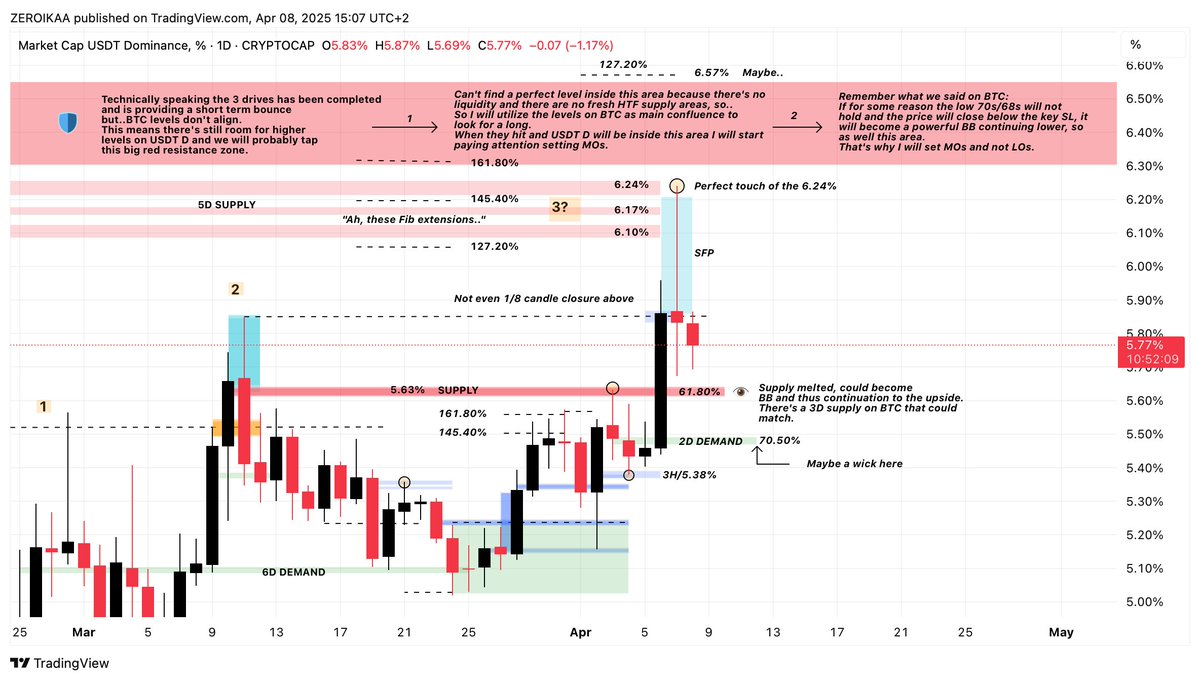
As you can see, a good dose of patience has brought to the (almost) full development of the plan.
The initial blue levels were fully taken and that's why I suggested to not rely on them for a second touch given their violent and quick sweeps.
In fact, with the 1st impulse we firstly perfectly touched the 5.63% supply seeing a rejection and therefore a pullback that "coincidentally" happened together with Trump's tariffs momentarily sending BTC up for a short live pump and the, and then with the 2nd one we broke the supply heading for the completion of the 3rd drive.
We caught all of the 3 levels mentioned, stopping exactly at 6.24% with a clear SFP, which is providing the current local bounce.
It's important to notice that the previous supply at 5.63% has been melted and now constitutes a valid BB with potential extension till the 5.48% which should match a fresh HTF supply area formed on BTC on the 3D TF.
The BOS to validate this retest ain't powerful considering that the weekly candle hasn't even closed with 1/8 of the body above the last SH at 5.85% but technically speaking is still valid.
What's the overall problem here?
That despite having reached one of the most important targets for the USDT D, BTC didn't yet and with a weak structure (no reclaim of any key swing) there's still room for catching higher targets on this metric.
As mentioned in the last update, we have an historical resistance area between 5.30%/5.50% and that could be the final target before a more pronounced reversal.
The 127.20% at 6.57% could be a target in case we wick hard, but again it's a matter of probabilities and the big red area should do the work.
However, remember what we said on BTC: If for some reason the low 70s/68s will not hold and the price will close below the key SL, it will become a powerful BB continuing lower, so as well this area.
That's why I will operate with market orders and not limits, personally speaking.
Still a bit of patience needed.
One of the things I’m most proud of, one I truly believe in, is the incredible value my Notion workspace is building.
What started as a personal hub has become something far greater.
It’s the result of nearly two years of deep work, meticulously crafted content that has helped people not just improve technically, but grow mentally, emotionally, and even transform their lives from the ground up.
This isn’t fast-food knowledge.
It’s not for those chasing shortcuts or quick wins.
It’s for the ones willing to show up, stay consistent, and do the work.
And that’s exactly why it’s making such a real, measurable impact.
I could’ve written a book but the truth is, a book would’ve never kept up with the evolution of my thoughts, research, and ideas.
I needed something alive, flexible, expansive, limitless.
That’s why I chose Notion.
It’s not a workaround, It’s a canvas..a powerhouse of evolving insights.
While the core remains rooted in market analysis and trading strategies, this is just the beginning.
I’m now expanding into topics like psychology, personal development, mental resilience, and physical well-being, foundations that can radically elevate a person’s entire life.
There are so many ideas buzzing in my mind that even I’m blown away thinking about what this will become in 2–3 years.
It won’t be just a book.
It’ll be a living, breathing best-seller.
Something the world hasn’t seen before.
And it’s only getting started.
"BTC updates series" continuation:
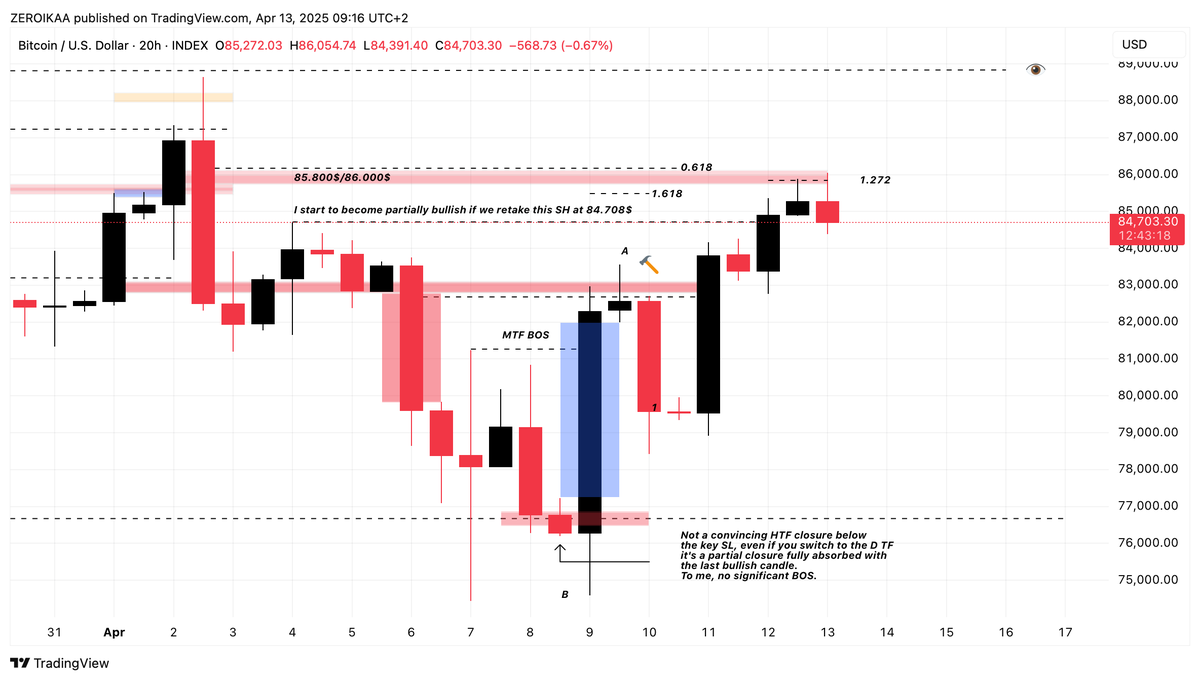
Respecting the plan mentioned in this post 10 days ago, we ultimately broke down since the PA was clearly showing SM collecting liquidity to the upside in order to fuel the next downward impulse, also "strengthened" by the fact that the classic OB had been tested several times, weakening the zone.
During the bearish impulse, an HTF supply at 83.000$ had been formed and considering that we didn't had a powerful closure below the key SL at 76.702$, the price had a higher probability of being attracted to that supply also due to the last imbalance formed on Sunday.
"Coincidentally", Trump had paused the Tariffs for 90 days (nice insider trading work Mr. President) pumping the market exactly from the SL till the HTF supply suggesting people to "buy the dip", something I mentioned live in this post https://t.co/Kgrn8dGHXv and constituting a fantastic short opportunity.
Now it's important to pay attention that the pump into HTF supply has created a MTF BOS and that's why despite the initial rejection we're seeing continuation to the upside, till..exactly, that MTF supply left behind before.
As you can see, another short opportunity is being presented with the price hitting the 1.272 Fib extension and facing a MTF correction.
I'll start to become more bullish only if we reclaim the 88.798$ high which is also the 3rd drive that led to the correction. (bullish entering longs, not macro and I'm gonna explain you why below..)
So, what I'm personally doing now?
I'm holding this short with the expectation that we might dump into the weekly closure or in the next 2/3 days, hopefully seeing a final breakdown preparatory to the next leg up.
As highlighted in this post https://t.co/ZUWENAoMhX this is the best scenario you can aspire, otherwise if we continue to rip higher from here the probabilities for seeing a powerful upside drastically decrease as there's no "fuel" in the reservoir.
It's also curious to notice that in this environment, several altcoins are approaching HTF supply/bearish imbalances so for this reason I remain in "short mode".
I'm personally not interested in buying anything spot (even if a lot of assets are trading at discount levels) until we break down on BTC otherwise, if not, I will enter on pullbacks exclusively with longs.
Time to observe at the moment.
Some uncomfortable, brutal and extended truths:
The more you dive into the financial markets, the more you begin to see the deep rot beneath the surface, a system engineered not for fairness or prosperity, but for control and exploitation.
It becomes apparent that the markets are not governed by natural laws of supply and demand, but rather by an intricate web of manipulation designed to benefit a select few.
What seems like an unpredictable, chaotic environment is, in fact, a well-orchestrated game where the rules are rigged and the outcomes are carefully determined by those with the power to influence every major move.
At the heart of this manipulation sits the central banks, the supposed “guardians” of economic stability.
But the truth is, these institutions are far more than mere regulators: they are the architects of the financial system’s manipulation.
The Federal Reserve, the European Central Bank, the Bank of Japan, and others have the power to control the global money supply.
They don’t just tweak interest rates: they print money out of thin air, injecting it into the system whenever they see fit.
But here’s where the "conspiracy" runs deep: this money isn’t meant to stabilize the economy, it’s meant to maintain control.
Central banks are the puppet masters, pulling the strings behind the scenes, dictating the ebb and flow of global liquidity.
They can inflate asset bubbles when they want to, and they can deflate them just as easily when it suits their agenda.
They don’t care about inflation or unemployment as much as they care about preserving their power over the financial system.
This isn’t just a matter of economic policy, it’s a system of engineered dependency.
The global financial system has been designed to ensure that the most powerful players remain in control, no matter the consequences for the general population.
This is why we see constant bailouts, massive injections of liquidity, and interventions when things start to unravel.
The system is built on the premise that the elites, the central banks, the major financial institutions are “too big to fail.”
And when they inevitably make disastrous decisions that cause economic collapse, they know that taxpayers will bear the brunt of the fallout.
The rest of the world pays the price for their mistakes, while the insiders continue to profit, as happened with the Libor scandal, proving that banks have access to hidden information taking heavy advantage.
But it’s not just about central banks, there’s a far darker force at play: the financial elites who operate behind closed doors.
These aren’t just the rich CEOs or the hedge fund managers you see on TV.
This goes much deeper, these are the hidden hands, the shadowy figures who control vast sums of money and can move entire markets without anyone ever knowing their names.
These players manipulate entire economies, not through public policy or popular decision-making, but through covert control of the financial markets.
They use insider knowledge, dark money flows, and vast networks of influence to orchestrate events that lead to market chaos, only to swoop in and profit when the dust settles.
When we see markets crash, when we hear about a "black swan event," or when a crisis unfolds with no warning, it’s often because these elites have engineered the situation.
Crashes don’t happen by accident.
Major financial institutions have the ability to create these crashes, deliberately engineering the circumstances that lead to widespread panic and chaos.
They use the media to manipulate public sentiment, spreading fear and misinformation to trigger the mass selling of assets and just as quickly as the panic spreads, they step in and scoop up assets at a discount.
The system is designed for them to profit off chaos, and every crash, every downturn, serves as an opportunity for the powerful to consolidate even more wealth and control.
This isn’t a free market, it’s a rigged one, and one of the most insidious aspects of this rigging is how the financial elites manipulate the very fabric of market psychology.
They don’t just react to news, they create news.
They control the timing of major economic announcements, geopolitical events, and market-moving reports.
They know exactly when to release a piece of information to cause maximum volatility, to set off a chain reaction of fear or greed that drives the masses into action.
"Ah, Mr. President.."
But these actions are rarely based on genuine market conditions or the health of the economy.
Instead, they are orchestrated to create the right conditions for the elite to profit.
When the market crashes, it’s not always because of a “natural” correction, it’s because the powers behind the curtain have decided it’s time to execute a plan.
They use their insider knowledge to manipulate the market at every turn, ensuring that they are always on the right side of the trade.
What’s even more disturbing is how these elites operate in complete secrecy.
Their wealth and power are hidden behind layers of shell companies, offshore accounts, and anonymous entities.
The media, which is often controlled by these same elites, keeps the public in the dark, painting a picture of “free markets” and “democracy” while the real decisions are made behind closed doors.
The economic system isn’t a democratic institution, it’s a tool used by a few to control the many.
They ensure that the average person is never able to break free from the system, keeping them trapped in a cycle of debt, consumerism, and financial dependency.
And let’s not forget about the role of governments in this conspiracy.
It’s no secret that governments are often in bed with the financial institutions.
Politicians pass laws and regulations that benefit the richest individuals and corporations, while the public is left to suffer.
Major corporations lobby governments to create favorable conditions for them to thrive, ensuring that they maintain their monopoly over the markets.
The entire political and economic system has become a closed-loop, with the powerful feeding off each other to preserve their wealth and influence.
In many ways, the financial system has become a form of modern slavery.
It keeps people in perpetual debt, reliant on the system for their survival.
It forces them to work longer hours, take on more debt, and consume more, all while the wealthy few continue to accumulate power.
The average person is trained to believe that they can “work hard” and achieve financial independence, but the system is rigged in such a way that this is virtually impossible.
The wealth gap grows ever wider, as the powerful continue to accumulate more, and the rest of the population remains stuck in a cycle of financial insecurity.
The more you look at the system, the more it becomes clear that it’s not a “glitch” or a series of unfortunate events, it’s by design.
The financial system is an intricate web of control, where every move is calculated, every piece of information carefully crafted to maintain the status quo.
The market crashes, the boom and bust cycles, the endless cycles of debt: these are all tools used by the powerful to manipulate and control the masses.
It’s a system built not on fairness, not on merit, but on deception and exploitation.
Ultimately, the deeper you go into the study of financial markets and technical analysis, the more you realize that the system isn’t just broken, it was never meant to be fair.
It was designed to concentrate wealth and power in the hands of the few, while the rest of the world fights over the scraps.
What we see as the “free market” is a carefully constructed illusion, a game rigged by those with the knowledge, the wealth, and the power to control it.
And as you uncover this truth, you start to understand just how rotten and corrupt the whole system truly is.
Corruptio optimi pessima.