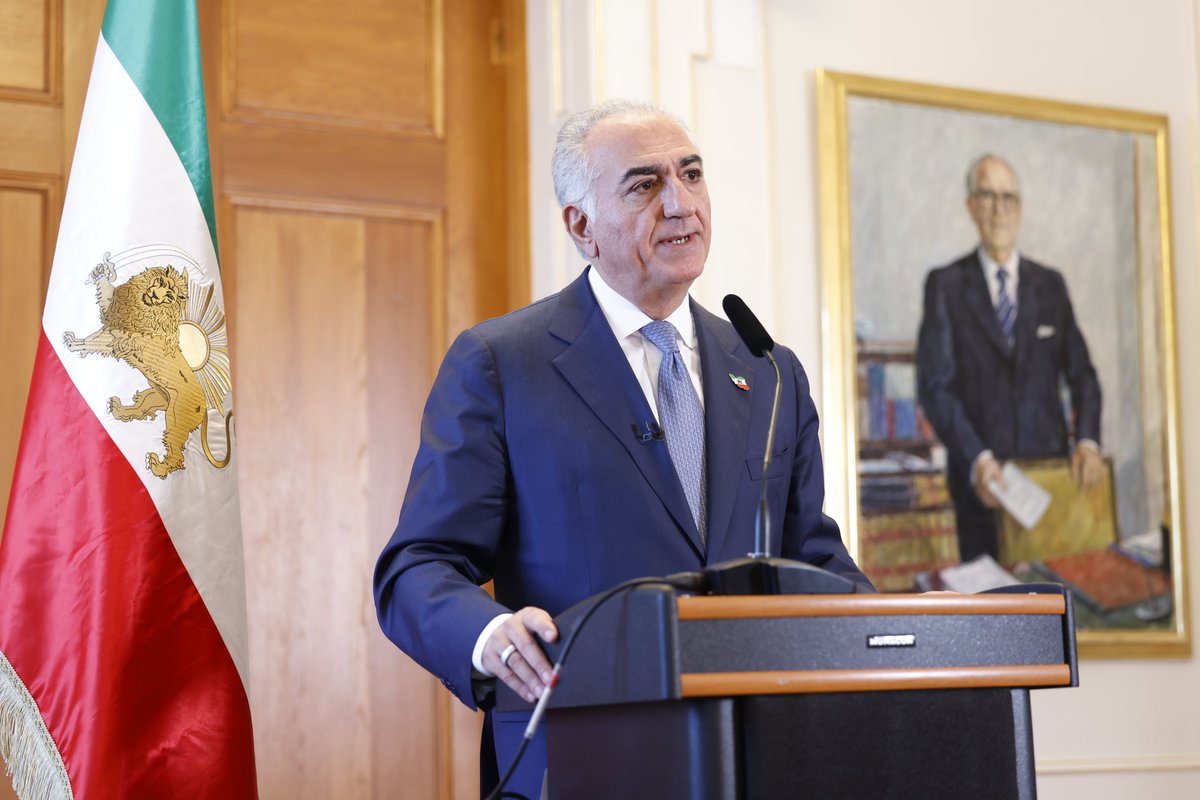
چهل و شش سال از درگذشت پدرم میگذرد، اما او امروز زندهترین چهره سیاسی در پیشگاه تاریخ و دل ایرانیان است.
شعله عشق ملت ایران به او روز به روز بلندتر و فروزانتر میشود. همانطور که جاویدنام مجیدرضا رهنورد به نیابت از میلیونها جوان ایرانی نوشت: «نسلی عاشقت شد، که تو را هرگز ندید».
پدرم با تمام وجود، عاشقِ ایران بود. قلب او با طبیعت این خاک میتپید و باریدن باران بر دشتهای ایران، برایش بهترین و زیباترین خبر بود.
او در ۲۲ سالگی، کشور را در شرایط دشوار اشغال متفقین تحویل گرفت و با تکیه بر میهنپرستی، ایران را به سوی دروازههای تمدن بزرگ هدایت کرد. اگر فاجعه ۵۷، مسیر تاریخ ما را منحرف نمیکرد، ایران امروز یکی از درخشانترین قطبهای رفاه و توسعه در جهان بود.
هممیهنانم، اگر به راه او باور داریم، مسئولیت بزرگی بر دوش ماست. برای وفاداری به نگاه او، ما باید ایران را از این فرقه تبهکار پس بگیریم و آن را دوباره بسازیم.
پاینده ایران
شش ماه پیش، در چنین شبی، تهران در تاریکی فرو رفت. سراسر ایران در تاریکی فرو رفت. اما حتی آن تاریکی نیز نتوانست میلیونها ایرانی را در خانههایشان نگه دارد.
۱۸ و ۱۹ دیماه تنها دو شب برای اعتراض نبود. شبهایی بودند که سکوت ایران شکست. میلیونها نفر به خیابانها آمدند، میدانها را پر کردند و بر بام خانههایشان ایستادند، اما رژیم با گلوله به آنان پاسخ داد. در آن چهلوهشت ساعت، دهها هزار تن از هممیهنانم جان خود را از دست دادند. از آن روز تا این لحظه نیز دهها هزار نفر دیگر بازداشت، شکنجه یا به مرگ محکوم شدهاند.
آنان مصمم و با شهامت به خیابان آمدند. من هر روز به آنان میاندیشم. در آن دو شب، هممیهنانی را از دست دادم که هرگز فرصت دیدارشان را نخواهم یافت. برای من عدد ۴۰ هزار هرگز یک آمار نیست. هر بار که آن را میشنوم پسری را میبینم که دیگر هرگز به آغوش مادرش بازنگشت. دختری را میبینم که همیشه جای او بر سر سفره خانوادهاش خالی خواهد ماند. هر یک از آنان را چون فرزند، برادر یا خواهر خود میدانم و سنگینی بار نام تکتک آنان را بر دوش خود احساس میکنم. اما هر هفته که با خانوادههای جانباختگان دیدار میکنم، اراده ملتم برای ادامه این راه استوارتر میشود. فرزندان آنان بیهوده جان ندادند. آنان برای آزادی جان دادند، و با سربلندی جان دادند.
تاریخ فداکاری این زنان و مردان را از یاد نخواهد برد، و من نیز نخواهم گذاشت نام و راه آنان فراموش شود. همانگونه که مقاومتگران اروپای اشغالشده در برابر استبداد ایستادند و همانگونه که انقلابیون آمریکا برای آزادی جنگیدند، فرزندان ایران نیز ایستادگی کردند. اما شجاعت آنان، ویژگی دیگری داشت. آنان نه ارتشی داشتند، نه پشتیبانی هوایی، و نه هیچ پشتوانهای جز باور به آرمانی که برای آن برخاسته بودند. با اینهمه، ایستادند. ملتی یکپارچه تصمیم گرفت در کنار یکدیگر در برابر گلولهها بایستد، نه آنکه حتی یک روز دیگر در ترس زندگی کند. مردان و زنان ۱۸ و ۱۹ دیماه در تاریخ ایران بهعنوان نسلی جاودانه خواهند ماند که مرگِ آزاد و سرافراز را بر زندگیِ در زنجیر و زانوزده ترجیح داد.
من تنها این را به جامعه جهانی میگویم: اجازه ندهید آنچه در اتاقهای مذاکره در ژنو یا اسلامآباد رقم میخورد، حقیقت آنچه را در خیابانهای تهران، مشهد و کرمانشاه رخ داد، به فراموشی بسپارد. آنان برای آزادی جان دادند و با آزادی ایران، تنگه هرمز گشوده خواهد شد، تهدید هستهای پایان خواهد یافت و ما به صلح واقعی دست خواهیم یافت.
به هممیهنانم گفتهام آنچه شما در ۱۸ و ۱۹ دیماه آغاز کردید، مسیری بازگشتناپذیر است. ما با هم جایگاه شایسته کشورمان در جهان را بازپس خواهیم گرفت، عزت ملی خود را احیا خواهیم کرد و یاد قهرمانانمان را با ساختن ایرانی آزاد زنده نگه خواهیم داشت. اکنون زمان آن است که درنگ کنیم، دوباره نیرو بگیریم، و بار دیگر خود را وقف پیروزی کنیم.
ما یاد جانباختگان را با به پایان رساندن راهی که آغاز کردند گرامی میداریم. ایران آزاد دیگر یک امید نیست. یک قطعیت است.
و جهان باید بداند که هممیهنان دلیر من تنها برای آزادی خود نمیجنگند، آنان برای صلح و ثبات جهان نیز مبارزه میکنند.
هممیهنان عزیزم،
در روزهایی که شما با شجاعت در برابر رژیم اشغالگر ایران ایستادهاید، این نظام منفور و منزوی، همچنان به تجاوز به جان و مال مردم ادامه میدهد تا سرنگونی حتمی خود را اندکی به تعویق اندازد. در چنین شرایطی، وظیفه خود میدانم که تصویر عدالت در فردای ایران را برای کسانی که با جنایتکاران همکاری کنند، روشنتر ترسیم کنم.
در این راستا، از «کمیته تدوین مقررات عدالت انتقالی ایران» خواستم درباره دو موضوع مهم، نظر مشورتی خود را ارائه کند: نخست، موضوع مسئولیت کیفری افرادی که با ساختارهای سرکوبگر جمهوری اسلامی همکاری میکنند؛ و دوم، موضوع مصادره اموال معترضان و خانوادههای آنان.
این کمیته اکنون نخستین نظر مشورتی خود را صادر کرده و پیام آن روشن است: این اقدامات، همکاریهای ساده یا بیاهمیت نیستند؛ بلکه «یاریرسانی به جنایت علیه بشریت» محسوب میشوند. هیچ مقام، هیچ دستور و هیچ بهانهای نمیتواند مسئولیت کیفری فردی را از میان ببرد. بنابراین، هر فردی که آگاهانه و داوطلبانه با ساختارهای سرکوبگر رژیم همکاری کند، چه در داخل و چه در خارج از ایران، باید بداند که در معرض مسئولیت کیفری قرار خواهد گرفت:
خواه این همکاری از نوع گزارشدهی یا خبرچینی باشد؛
خواه از نوع مشارکت در ایستهای بازرسی باشد؛
خواه از نوع بهکارگیری کودکان و نوجوانان در سرکوب معترضان باشد؛
و خواه از نوع تحصیل، انتقال یا خرید و فروش اموالی باشد که در جریان سرکوب از معترضان و خانوادههای آنان مصادره شده است.
از این رو، نهتنها افرادی که در صدور دستور، اجرای آن، یا تسهیل این مصادرهها نقش دارند در معرض مسئولیت قرار خواهند گرفت، بلکه کسانی که آگاهانه و داوطلبانه به خرید و فروش این اموال میپردازند نیز باید پاسخگو باشند. این مسئولیت، استفاده از اموال یا داراییهای آنان برای جبران خسارت واردشده به مالکان اصلی را نیز شامل میشود.
بنابراین، به همه کسانی که امروز در صدد همکاری با دستگاه سرکوب رژیم هستند هشدار میدهم: پیش از آنکه دست به اقدامی بزنید که به مردم ایران آسیب جانی، مالی و یا اجتماعی برساند، به آینده خود و خانوادهتان بیندیشید. به آن روز بیندیشید که ایران آزاد خواهد شد؛ روزی که حقیقت پنهان نخواهد ماند؛ روزی که اسامی آشکار خواهد شد؛ روزی که هیچ متجاوز و جنایتکاری از پاسخگویی در برابر قانون در امان نخواهد ماند.
آن روز، ملت ایران حکومتی خواهد داشت که حقوق ایرانیان را محترم میدارد و ایران را به سرزمینی آزاد و آباد بدل میکند.
پاینده ایران،
رضا پهلوی
شاهزاده رضا پهلوی روز جمعه ۱ خرداد (۲۲ مه)، در نشستی آنلاین با شماری از فعالان و چهرههای رسانهای و هنری گفتگو کردند. ایشان ضمن شنیدن دیدگاهها و نظرات حاضران، به برخی پرسشها نیز پاسخ دادند. بخشهای بیشتری از این گفتگو در روزهای آینده منتشر خواهد شد.
شاهزاده رضا پهلوی: «از تمام ظرفیت تاثیرگذاری خود در راه انقلاب شیر و خورشید استفاده کنید.»
بخشی دیگر از نشست آنلاین با شماری از فعالان و چهرههای رسانهای و هنری، ۱ خرداد ۲۵۸۵/۱۴۰۵
“This is the final battle — Pahlavi will return.”
Footage of the massive presence of brave, freedom-loving Iranians in the streets of Iran on January 8 and 9, recently released after weeks of nationwide internet shutdowns.
Iranians chant: “Reza, Reza Pahlavi.”
As internet access returns, more images of the extraordinary courage shown on January 8-9 are beginning to emerge.
Millions of Iranians flooded the streets. When the moment comes, they will return.
شاهزاده رضا پهلوی: «تیم من به من وفادار است و من هم متقابلا به آنها وفادارم.»
بخشی از نشست آنلاین با شماری از فعالان و چهرههای رسانهای و هنری، ۱ خرداد ۲۵۸۵/۱۴۰۵
شاهزاده رضا پهلوی: «با جهان یا بیجهان، با اروپا یا بیاروپا، با آلمان یا بیآلمان، مبارزه ما ادامه خواهد داشت. ما از پا نخواهیم نشست تا زمانی که کشورمان آزاد شود؛ تا زمانی که کرامت مردممان بازگردانده شود؛ تا زمانی که عدالت اجرا شود.»
برلین، ۳ اردیبهشت ۲۵۸۵/۱۴۰۵
We are relieved that President Trump and the First Lady, along with the Cabinet members in attendance at the White House Correspondents Dinner, are unharmed.
This attack on the American President and American democracy is appalling.
Whether or not Europe stands with us, whether or not your journalists do their jobs, whether or not your politicians demonstrate the courage to act, I will fight for my people and my country.
بهجای سرمایهگذاری روی این رژیمی که برای بقای خود هزاران ایرانی بیگناه را میکشد، روی ایرانیان سرمایهگذاری کنید. بگذارید آنها عامل تغییر باشند و برای شما صلح و ثبات بیاورند.
شاهزاده رضا پهلوی
برلین، ۳ اردیبهشت ۲۵۸۵/۱۴۰۵
ایرانیان هرگز مدل بزکشده با پوششی جدید از این رژیم را نخواهند پذیرفت.
آنچه مردم ایران میخواهند، زندانبانی مهربانتر نیست، بلکه آزادی است.
شاهزاده رضا پهلوی
پارلمان سوئد، ۲۴ فروردین ۲۵۸۵/۱۴۰۵
My remarks today at the Swedish Parliament:
"Esteemed Members of the Riksdag, Ladies and Gentlemen,
I stand before you today, not to speak of policy abstractions or diplomatic courtesies. I stand before you to speak of a people — a great, ancient, and proud people — who at mortal cost, are fighting for freedom.
What is unfolding across Iran is not simply a political dispute. It is not a contest between factions within a system. It is something far more elemental: a national reckoning between a civilization, and a ruthless regime that has occupied it for nearly half a century.
Since inception, the Islamic Republic has not behaved as a state among states. It has operated as a revolutionary enterprise — exporting instability through proxies, subverting its neighbors' sovereignty, fueling conflict from Baghdad to Beirut, from Sanaa to Damascus, and advancing its nuclear ambitions beneath a fog of denial. It has not sought a place in the community of nations. It has sought to overturn that community.
Yet something irreversible has now changed inside Iran. The battle in my country today is not between reformers and hardliners. It is between occupation and liberation. It is a battle for the soul of a nation.
What we are witnessing is not a fleeting protest movement. It is a generational revolt — the most profound uprising in Iran since 1979 — uniting workers and students, women and minorities, professionals and poets, and yes, even elements within the state apparatus itself. Together, they have rendered their verdict: this regime has forfeited all legitimacy. Indeed, it is a revolt against the 1979 revolution itself.
When legitimacy dies, power begins to crumble. The regime understands this — which is precisely why it silences voices, shuts down the internet, and turns weapons against unarmed citizens.
And the cost has been heartbreaking — a cost that demands this noble chamber bear witness.
Men and women are being slaughtered in the streets and in their homes. More than 40,000 Iranians were massacred in a single week. The regime's operatives hunted wounded protesters in hospitals and executed them in cold blood. Bodies were collected by dump trucks. Families were forced to search through rows of unmarked body bags.
40,000…
The number is almost too large to comprehend. Too abstract. It allows too many in the outside world to look at it like a mere statistic. So let me tell you some of their names and stories.
Consider Hamid Mahdavi, the 38-year-old firefighter from Mashhad, who spent his final moments carrying wounded protesters to safety—only to be shot dead by regime forces for the crime of saving lives.
Think of Sina Kazemi, 22 years old. He was in his final term of engineering school. He had a lifelong passion for music and technology. He chose to fight for his and his nation’s dignity. He was looking forward. Security forces shot him in the back of the head.
In Bushehr, nurse Mansoureh Heydari and her husband, teacher Behrouz Mansouri, were shot dead side by side while protesting peacefully. They left behind two young children, ages 8 and 10 — a family destroyed for daring to dream of freedom.
Twenty-eight-year-old biotechnology student Negin Ghadimi went out to protest despite her father’s pleas. Mortally wounded, she died in his arms whispering, ‘Dad, I’m burning’— a bright future stolen in a single night of terror.
But the terror is not over. It continues every day. Access to the Internet is still blocked. And while the people of Iran are disconnected from the world, the regime continues to kill. Today the media speak of a ceasefire. What ceasefire? There has been no ceasefire in the Islamic Republic’s war on the people of Iran. At check points that mark most every street, regime thugs and their imported terrorists harass, beat, and murder innocent Iranians.
For those who cry of war and its costs, this is the war you should be speaking of: the Islamic Republic’s war on my compatriots. That war that rages on everyday, far from the headlines of your Western newspapers, and the minds of your television producers.
But they are not far from my mind. My brave compatriots continue to resist. Many stand with broken bodies but unbreakable wills. They would rather die standing than live kneeling. So would I.
Churchill understood such a people when he said that nations do not die when their soldiers fall — they die only when their spirit surrenders. I am here to tell you, Iran’s spirit has not surrendered and it never will!
Despite its brutality, the Islamic Republic is closer to collapse today than at any point since 1979.
And one fact is now beyond dispute: the Iranian people will never accept a repackaged version of this regime. Too much blood has been spilled. Too many graves have been dug. The demand is not for a kinder jailer. The demand is for freedom.
There is a military dimension to these events that this chamber is watching closely, and I will not pretend otherwise. But I say to you: however the military operation currently on pause turns — whether it accelerates the Islamic Republic's fall or merely deepens the fractures within it — the outcome of Iran's revolution will not be determined by any force from the outside. It will be determined by the Iranian people themselves.
The Lion and Sun Revolution — the uprising that the people of Iran ignited in January with their own blood and their own courage — cannot be extinguished by any regime calculation, any diplomatic maneuver, or any military result. The people started it. The people will finish it.
If the military operation pushes the Islamic Republic into the historical abyss where it belongs, we will be there — ready, organized, and determined — to build what comes after. And if the regime survives the immediate storm, we will continue the revolution until it is complete. We began this journey. We will see it to its end. History has given us no other choice.
When I look at Europe, I see ambivalence and a continued inability to see the reality of the streets of Iran. I am disappointed, yet not surprised, at the rush to engage this criminal regime. The regime that has murdered tens of thousands of its own citizens. The regime is sponsoring terrorism on the streets of Europe, including in Sweden. The regime is threatening and blackmailing European Governments with hostages and violence.
The Europe I believe in is supposed to stand for human rights, democracy, and equality.
It has a proud record in previous struggles - fighting apartheid in South Africa, supporting the Solidarity movement in Poland, and now in backing Ukrainians in the fight for sovereignty.
So why should Iran be different? Are Iranians’ human rights less important? Are their lives worth less?
Perhaps to some, but not to us.
Sadly this is not new. For decades Europe has appeased and emboldened this terrorist regime. It has been a policy that has helped this Regime survive and kill its own people.
I hope the Swedish Government will press the European Union and other countries to stand with the people of Iran and their struggle for liberty. I am pleased and heartened that so many members of the Riksdag, across multiple parties, are here today to hear a message from the people of Iran. On behalf of my compatriots who are far too often silenced, thank you.
Esteemed members of this Riksdag, this is no longer distant geopolitics — it is a security emergency on Swedish soil.
The Swedish Security Service, SÄPO, together with the Swedish Police Authority, has confirmed that the Islamic Republic of Iran operates within Sweden through criminal proxy networks. These are not surveillance operations alone. They carry out acts of intimidation and violence — targeting Jewish communities, Iranian dissidents, and Swedish citizens at large.
On the third of March this year, shortly after the outbreak of the current conflict in the Middle East, SÄPO issued an urgent public warning of a heightened threat level.This is not speculation. This is a statement from your own security services.
And here is what makes this threat particularly corrosive: the criminal networks that Tehran employs do not cease to exist between assignments. They are embedded in Swedish society. They are the same networks already identified as a major internal threat to public safety.
Sweden has responded with resolve. You have restricted visas for Iranian embassy staff. You prosecuted Hamid Noury for crimes against humanity under universal jurisdiction — setting a historic precedent. But it did not last.
Sweden returned Noury to Tehran where he was given a hero's welcome by his fellow murderers. While he was allowed to return to boast of his crimes on state television, Dr. Ahmadreza Djalali was forced to continue to suffer in the regime’s torture chambers. It was ten years ago that he was taken. And he is still captive.
Decisions like this embolden the Islamic Republic to take more hostages, to commit more crimes, and to further defy the world. A French senator told me a few months ago: our governments have become hostages to our hostages.
But governments still have a choice whether to give in to blackmail or not.
Václav Havel once said that the only genuine security in the world is a security rooted in truth. The truth is, as long as this regime remains in power, Sweden and the free world will not be safe.
Why did Sweden join NATO? Because of Putin’s war of aggression against Ukraine. That decision was correct. And it was necessary.
Let us not forget that the Islamic Republic is not a bystander to Russia's war. Tehran has supplied drones and missile technology to Moscow. Iranian-manufactured weapons have struck Ukrainian cities. Regime technical cooperation has sustained Putin’s capacity to wage war against a democratic neighbor.
As President Zelenskyy and I have discussed and stated together: the Russian threat to Europe and the Islamic Republic’s threat to Europe are not two separate problems. They are two manifestations of a single challenge.
Sweden now stands inside NATO's collective defense. But collective defense is not only military. It is political, economic, and moral. It requires that democratic nations recognize threats in their totality — and treat the Islamic regime's support for Russian aggression as the direct security concern that it is.
Let me now speak, not of present dangers, but of future possibilities.
The relationship between Sweden and Iran has deep roots. In the early decades of the twentieth century, Swedish experts and businesses built strong ties in Iran. During the celebrations of 2,500 years of Iranian civilization at Persepolis, Sweden was represented by then-Crown Prince Carl Gustaf. His Majesty and I sat together and spoke of the future of our nations and people.
That future, with a democratic Iran, would change the security calculus of the entire region — and of Europe. It would immediately dismantle the proxy networks operating on Swedish soil. It would end the hostage diplomacy that has poisoned relations with Western nations for decades. It would cooperate on intelligence and the rule of law. It would cease its support for Russia's war machine. It would secure Europe’s energy needs for decades to come.
It would emerge as a natural partner — a nation of 90 million people with extraordinary human capital, a rich civilization, and a desire to rebuild after decades of misrule.
Sweden has every reason to be part of that future. Your excellence in information technology and digital infrastructure, your defense industry — Saab's world-class capabilities in aerospace and defense — your engineering heritage through Volvo and Scania, your commitment to culture, your tradition of precision manufacturing and industrial innovation: these are precisely what a rebuilding Iran will need. This is not charity. This is partnership between equals, between nations with complementary strengths and shared values.
At this historic moment, as Iranians call upon me to help provide leadership toward a democratic transition, I reaffirm the commitment I have made throughout my life: to serve as a unifying national figure — not a partisan one, not a claimant to power — but a facilitator of stability, of national unity, and of a peaceful transfer to democratic governance.
I am not alone in believing this is possible. Together with economists, legal experts, security professionals, and civil society leaders from across the Iranian political spectrum, we have developed detailed transition frameworks — the Iran Prosperity Project — to ensure institutional continuity, prevent instability, and allow rapid national recovery after the regime's end. There is a plan. There is a path. There is a responsible alternative.
Even within the state apparatus, the fractures are deepening. Reports indicate that members of the armed forces and security institutions are increasingly refusing orders to participate in violence against civilians. Many have quietly signaled where their true loyalties lie: with the nation, not with those who repress it. When the path emerges, I am confident they will act.
No government can survive once it loses the willingness of its own institutions to enforce repression. We are approaching that moment.
Let me conclude, esteemed members of this Riksdag, with what I believe is the simplest and most important truth of this address.
The Iranian people are not asking you to fight their revolution. They are already risking their lives doing that themselves — with a courage that should humble all of us.
They are asking something far more modest:
Do not legitimize those who oppress them.
Do not strengthen those who terrorize them.
Protect those who have sought refuge among you.
Prepare for the day when Iran stands free.
There are moments in history when neutrality is not a position — it is a decision. When caution is not prudence — it is complicity. When history quietly presents a question and waits, with terrible patience, for an answer.
Churchill faced such a moment in 1940. Havel faced it in 1989. Zelenskyy faces it today. And in their own way — with no aircraft, no armies, no diplomatic immunity — the people of Iran face it in every street, every prison cell, every unmarked grave.
The Iranian people have already answered. They have answered in the streets and in their prisons. They have answered with their lives. They have chosen freedom.
History now asks the democratic world a simpler question, and Europe in particular:
Will you stand with a free people? Or will you accommodate those who oppress them?
Future generations will not read your statements. They will assess your actions. They will not ask what you said. They will ask what you did — and what you refused to do when it mattered.
And one day soon — and I say this, not as sentiment but as strategic conviction — when Iran is free, when its people stand again among the free nations of the world, when its children inherit a country without fear, we will all know that this was the moment when history turned. The moment when a great people refused to kneel. The moment when free nations chose not to look away.
Let it be written that when that day came, Sweden was ready.
When the Iranian people stood for freedom, Sweden stood with them.
Thank you."
Stockholm, Sweden
April 13, 2026
I have arrived in Rome to meet Italian political and business leaders.
I will ensure the Iranian people’s voice is not silenced and will discuss the only true path to peace, security, and prosperity for the world— the liberation of Iran from the Islamic Republic.
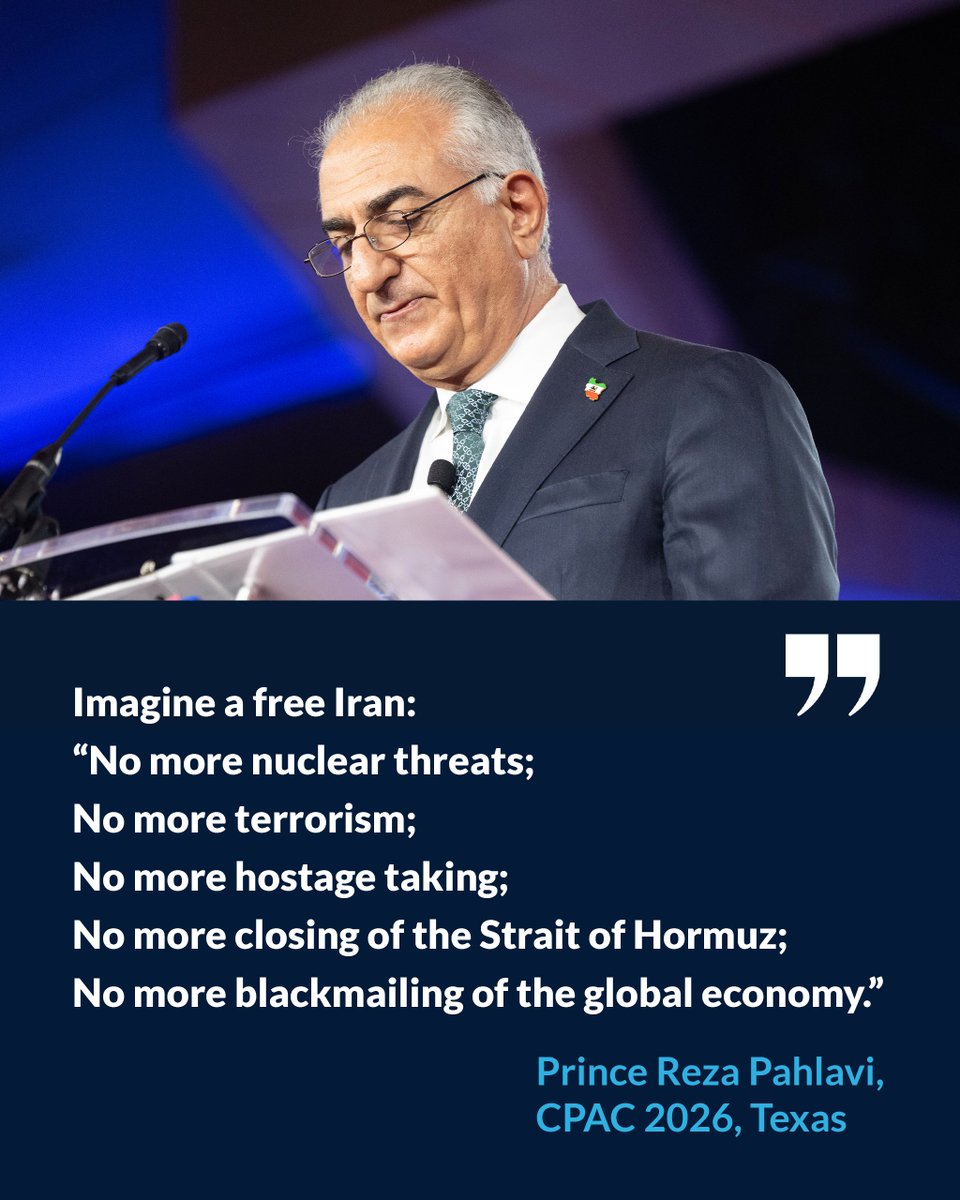
Imagine a free Iran:
No more nuclear threats;
No more terrorism;
No more hostage taking;
No more closing of the Strait of Hormuz;
No more blackmailing of the global economy.
Prince Reza Pahlavi,
CPAC 2026, Texas