Details of Proposed Constitutional Amendments for the Establishment of State Police and Federal Police
1. Establishment of Federal Police and State Police (New Section 214)
• Two distinct police bodies are constitutionally established:
• (a) the Federal Police
• (b) State Police (one per State, established by State law)
The National Assembly must pass an Act prescribing:
• Structure, organisation, administration, and powers of the Federal Police
• Framework and guidelines for the establishment of State Police
• State Police cannot commence operational policing until:
• Established by a Law of the State House of Assembly, and
• Certified as meeting national minimum standards (prescribed by an Act of the National Assembly)
• Transitional provision: Until a State Police becomes operational, the Federal Police continues all policing functions in that State. After commencement, the Federal Police handles federal policing functions and may provide assistance to the State Police.
2. Responsibilities and Non-Interference (Section 214)
Federal Police is responsible for:
• Maintenance of public security, public order, and security of persons/property throughout the Federation (to the extent provided by the Constitution or National Assembly Act).
• Similar functions within a State to the extent the State has legislative power under the Constitution.
Key safeguard against federal overreach (Section 214(6)):
The Federal Police shall not interfere with State Police operations or a State’s internal security affairs except in these limited cases:
• To contain serious threats where there is a complete breakdown of law and order and the State Police is unable to respond.
• When the Governor requests intervention.
• When a State Police is unable to function due to administrative, financial, or other problems.
Any such intervention requires prior approval by the National Police Council.
Federal Capital Territory (FCT): Fully under the jurisdiction and operational control of the Federal Police.
3. Leadership and Command (New Section 215)
• Federal Police: Headed by the Inspector-General of Police (IGP).
• Appointed by the President on the advice of the National Police Council, from serving members of the Federal Police.
• Subject to confirmation by the National Assembly.
• The IGP has command over the entire Federal Police, including contingents in States.
• The President (or authorised Minister) may give lawful directions on public safety and order; the IGP must comply.
• State Police: Headed by a Commissioner of Police (CP).
• Appointed by the Governor on the advice of the National Police Council, from serving members of the State Police.
• Subject to confirmation by the State House of Assembly.
• The Governor (or authorised Commissioner) may give lawful directions on public safety and order; the CP must comply.
• If the CP believes a direction is unlawful or contradicts general policing standards, the matter can be referred to the National Police Council (whose decision is final).
4. Removal of Top Officers (New Section 216)
• IGP: Removed only by the President on the recommendation of the National Police Council for specified grounds (grave misconduct, breach of Police Act/Regulations/Code of Conduct, conviction for fraud/dishonesty, bankruptcy, or mental incapacity). Requires two-thirds majority approval of the National Assembly.
• State Commissioner of Police: Removed only by the Governor on the recommendation of the National Police Council for similar grounds. Requires two-thirds majority approval of the State House of Assembly.
5. Funding Support (New Section 216A)
The Federal Government shall provide grants or aids to State Police on the recommendation of the National Police Council, subject to approval by the National Assembly.
6. Oversight Bodies
National Police Council (restructured and renamed from the old Nigeria Police Council; new composition and expanded functions in Third Schedule):
• Broad membership including: Chairman (Presidential appointee confirmed by NA), Attorney-General of the Federation, serving senior Federal Police officer, Attorneys-General of all States, retired Commissioners of Police (one per geo-political zone), representatives of NHRC, Public Complaints Commission, NLC, NBA, NUJ, and Traditional Rulers’ Councils.
• Key functions: Appointment and discipline of Federal Police officers (except IGP); recommending State top officers (CP, DCP, ACP) to Governors based on State PSC lists; supervising Federal and State Police activities (within constitutional limits); setting standards for training, intelligence, forensics; assisting State Police on request.
State Police Service Commission (new body established for each State in Third Schedule, Part II):
• Composition: Chairman (appointed by Governor, confirmed by State HA), representatives of NHRC, Public Complaints Commission, NLC, NBA, NUJ, retired Assistant Commissioners of Police (one per senatorial district), and Traditional Rulers’ Council.
• Functions: Recommending three qualified candidates for CP/DCP/ACP to the National Police Council; appointment, discipline, and removal of State Police officers below the rank of Assistant Commissioner of Police; other functions as prescribed by Constitution or National Assembly Act.
7. Legislative Framework (Second Schedule – Concurrent Legislative List)
• National Assembly may make laws on: establishment/organisation/administration/powers/duties of Federal Police; powers/duties of State Police; national minimum standards for both; policing standards, inspection, certification, complaints mechanisms, criminal information systems, inter-governmental cooperation, federal intervention, use of force, firearms, grants, and accountability.
• State Houses of Assembly may make laws for the establishment, organisation, administration, funding, and oversight of their State Police — but must comply with the Constitution and valid National Assembly Acts.
• States may set higher standards than national minimums but not lower.
• National Assembly laws cannot give federal authorities routine command, deployment, appointment, promotion, transfer, discipline, or control over State Police personnel (except for explicitly authorised federal intervention).
8. Other Related Changes
• Updates to various constitutional provisions (e.g., Sections 34, 35, 39, 42, 84, 89, 129, 153) to replace references to “Nigeria Police Force” with appropriate “Police”, “Federal Police”, or “State Police” terminology.
• Exclusive Legislative List adjustments (e.g., light arms for policing purposes; fingerprints/biometrics/forensics shared with State Police; Federal Police listed separately).
• Consequential amendments to the Third Schedule for the new bodies and their compositions/powers.
Leadership is not about telling people what they want to hear rather it is about making the tough decisions necessary to secure a better future.
The reforms may be difficult today, but the goal is a stronger, more prosperous Nigeria tomorrow. Nation building requires courage, honesty, and a commitment to long term progress over short term applause.
“We would rather face hard truths that build the future than embrace comforting lies that destroy it.”
#NigeriaFirst #TinubuReforms #RenewedHope #TinubuWillSucceed #StandWithNigeria #SayNoToTerrorism
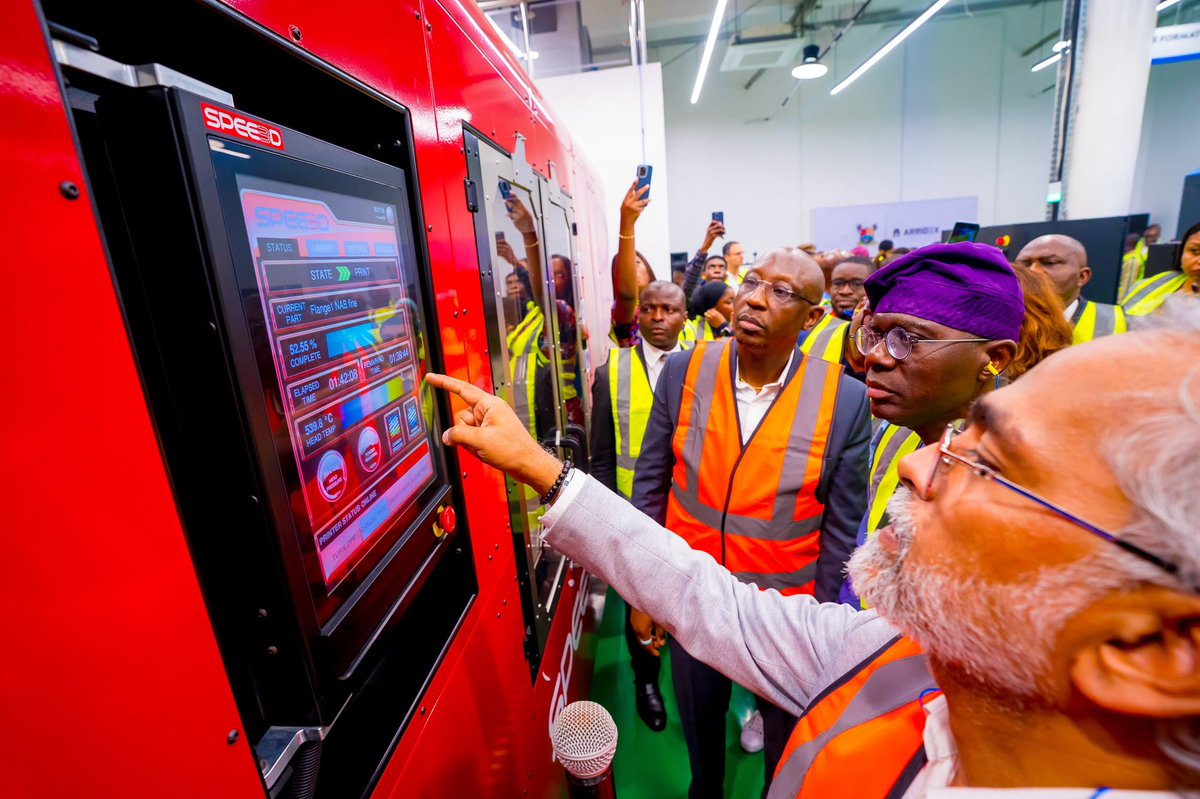
Today, I opened West Africa’s first multi-technology industrial additive manufacturing facility in Lagos.
By producing industrial components and spare parts here in Lagos, Arridex is helping to reduce our dependence on imports, strengthen critical industries and support economic growth.
I commend the Arridex team for their vision and commitment to building solutions that serve not only Nigeria but the wider African continent.
Lagos will continue to support investments that create opportunities, grow local capacity and position our state as a hub for innovation and industry.
I really thank God that I am Yoruba
and I really thank God that my Yoruba mother didn’t marry a man from another tribe but married a Yoruba man, modupe lowo ori mi 😭👏🧎🙏😭
I challenge anybody in this FCT who can come out to say "we don't have the impact; we don't feel the presence of government."
- Nyesom Wike, FCT Minister, speaking during the FCTA official commissioning of Arterial Road N5.
I warmly congratulate Prime Minister Narendra Modi @narendramodi on the historic milestone of becoming India’s longest-serving elected Prime Minister.
This remarkable achievement reflects the enduring confidence and trust the people of India have reposed in his leadership over three consecutive mandates. His dedication to public service, commitment to national development, and influential leadership on the global stage continue to inspire millions worldwide.
Beyond being a great friend of Nigeria, Prime Minister Modi is a personal friend and trusted ally whom I can always count on. Over the years, I have come to deeply admire his wisdom, courage, and commitment to the progress and prosperity of his nation.
As a distinguished recipient of Nigeria’s national honour, the Grand Commander of the Order of the Niger (GCON), he has also contributed immensely to strengthening the bonds of friendship and cooperation between our two countries.
On behalf of the Government and people of Nigeria, I wish Prime Minister Modi continued good health, wisdom, and success as he leads India to even greater heights.
— Bola Ahmed Tinubu, GCFR
President, Federal Republic of Nigeria
Presidential Villa, Abuja
June 9, 2026
@dammiedammie35 90% of the rats are Obidiots. 98% of that 90% are yibos/IPOB. They are using each other. The day VDM mistakenly drags their Agulu fraud Obi is the day he will realize he has no real followers. Just a mob that will turn on him instantly. He already knows that