Research Scientist at @MegagonLabs, working on NLP/ML || PhD from UCI, and former research intern at @MSFTResearch, @Apple, @allen_ai, and @FujitsuAmerica
How confident can we be that an LLM agent actually completed its task?
Long trajectories, multiple sources of uncertainty, and limited model access make this hard.
Our new work, CRGs, uses evidence-grounded reasoning for better-calibrated, interpretable confidence estimates.
👇
📢 New preprint from @MegagonLabs 🧵
Confidence estimation for LLM agents is hard: evidence of success spans tool calls, observations, reasoning, and memory. When model internals are inaccessible, reruns are expensive, and training data is scarce, how can we reliably assess whether an agent succeeded and how much to trust its output?
Meet 𝗖𝗼𝗻𝗳𝗶𝗱𝗲𝗻𝗰𝗲 𝗥𝗲𝗮𝘀𝗼𝗻𝗶𝗻𝗴 𝗚𝗿𝗮𝗽𝗵𝘀 (𝗖𝗥𝗚): a training-free, black-box method that turns a single execution trajectory into a structured, evidence-grounded argument for success and an auditable confidence estimate.
Paper: https://t.co/Judq4upTAS
Code: https://t.co/tJJwBUbL8V
Happy to share that our paper has been accepted to EMNLP2026 main 🎉🎉
Huge kudos to co-authors!! Moin, @PPezeshkpour@estevamhruschka
Link: https://t.co/shBQoA2E07
The quick summary is ↓↓↓
Can LLMs automate prompt engineering?
RPT says: Apparently yes—by turning prompt tuning into a function-calling workflow: evaluate, diagnose recurring failures, use memory, and revise.
The result: stronger prompts on reasoning tasks and better-calibrated confidence.
📢 New Preprint
Prompting is a flexible way to adapt LLMs, but prompt engineering is still manual and hard to scale. Can function-calling LLMs act like prompt engineers: inspect failures, diagnose patterns, and revise prompts?
Meet Reflective Prompt Tuning (RPT): a diagnosis-driven framework for iterative prompt tuning with function-calling LLMs.
Paper: https://t.co/wNczUx32KM
@MegagonLabs
1/n
Our paper got accepted to ICML as a Spotlight!🎉
Most decoding methods ask only: “which token is most likely?”
But tokens are not just probabilities. They live in geometry.
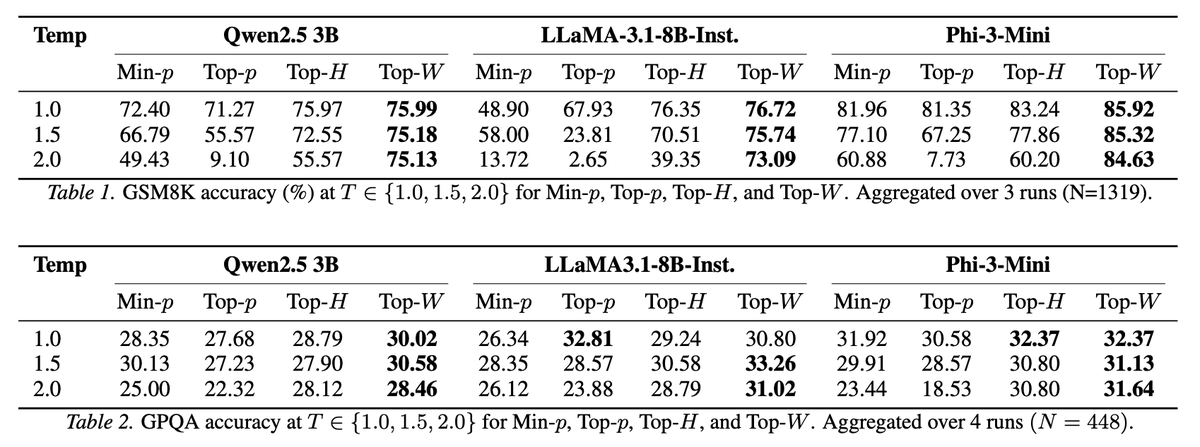
We introduce Top-W decoding: geometry-aware sampling for LLMs.
https://t.co/NYgi8j8f7A 1/n
Across GSM8K, GPQA, AlpacaEval, MT-Bench, and creative writing, Top-W consistently outperforms or matches strong decoding baselines.
The main takeaway:
Better decoding can come from respecting the geometry of the token space. 4/n
@neil_croy Good point. Inspectability is an important factor, though I’d also emphasize controllability and executability. The bigger goal is to make verification logic explicit and reusable, instead of leaving it implicit inside an LLM judge.
📢New Preprint📢
LLMs can solve many tasks. But who verifies an answer when the judge is also an LLM?
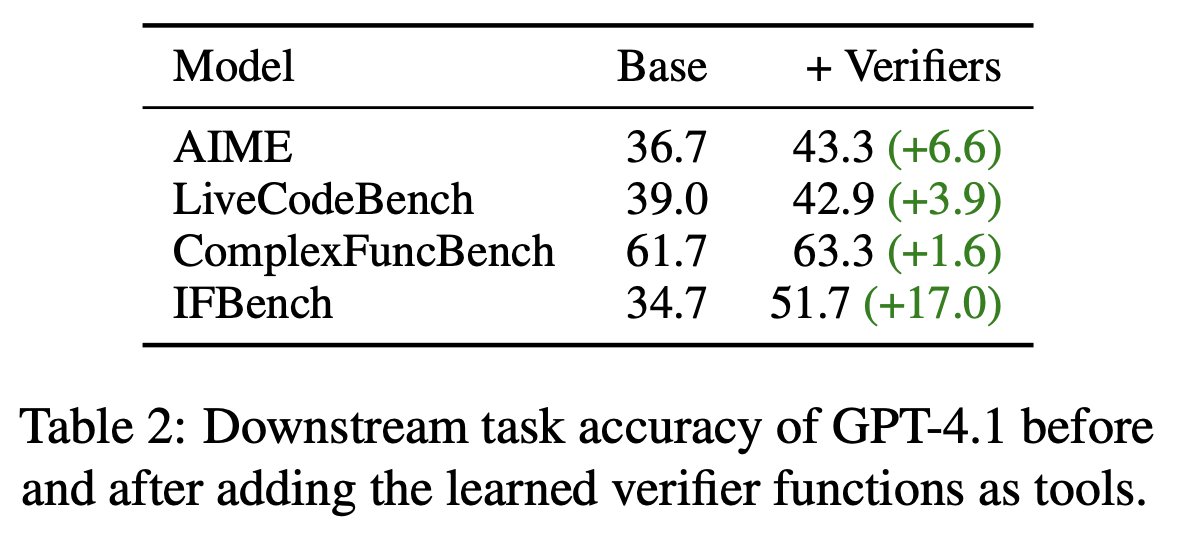
We introduce AutoPyVerifier: learning compact Python verifier sets from labeled LLM outputs, improving objective prediction by up to +55 F1.
Paper: https://t.co/VwJKCHR81u 1/n
@_Suresh2 Nice observation, but +55 F1 is vs. the initial LLM-generated verifier sets, so error simplicity is should be controlled for. We also see similar gains across all the benchmarks, and OOD transfer. That said, dataset difficulty definitely affect the impact of our method.
The learned verifiers are useful beyond evaluation.
When exposed back to GPT-4.1 as tools, the learned verifiers improve downstream accuracy on all four benchmarks by up to +17.0 points by helping the model revise or confirm its own answers. 7/n
📢New Preprint📢
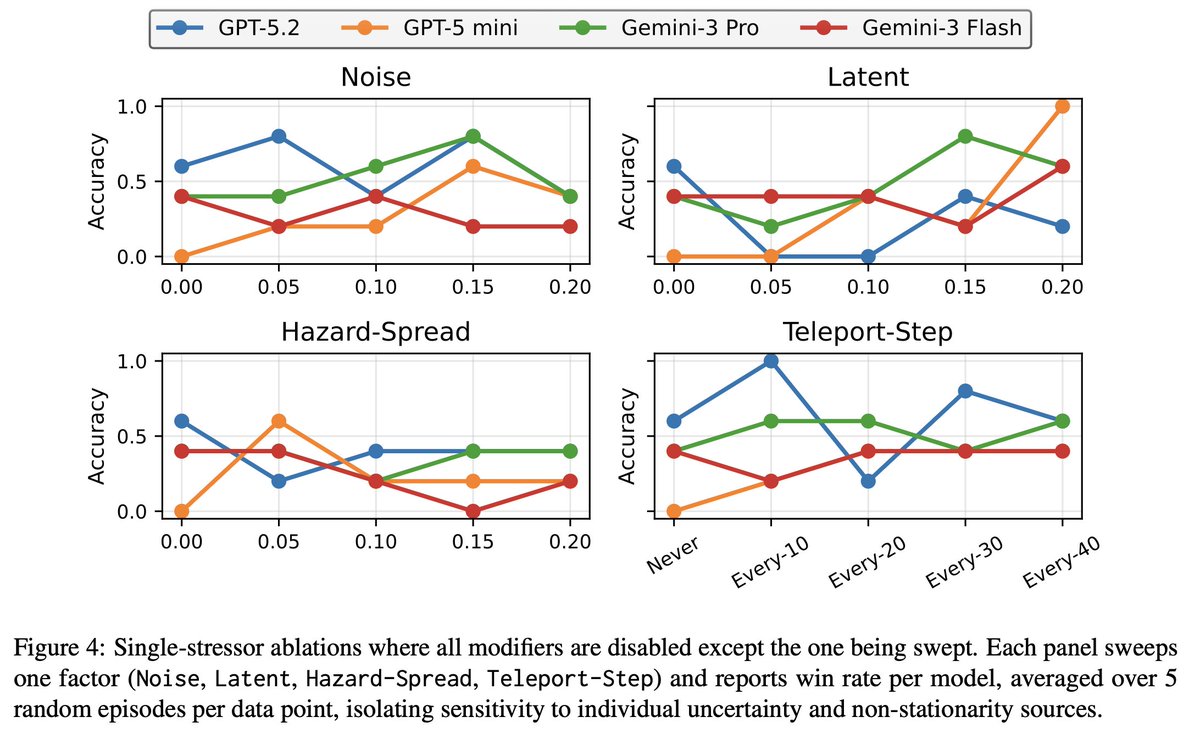
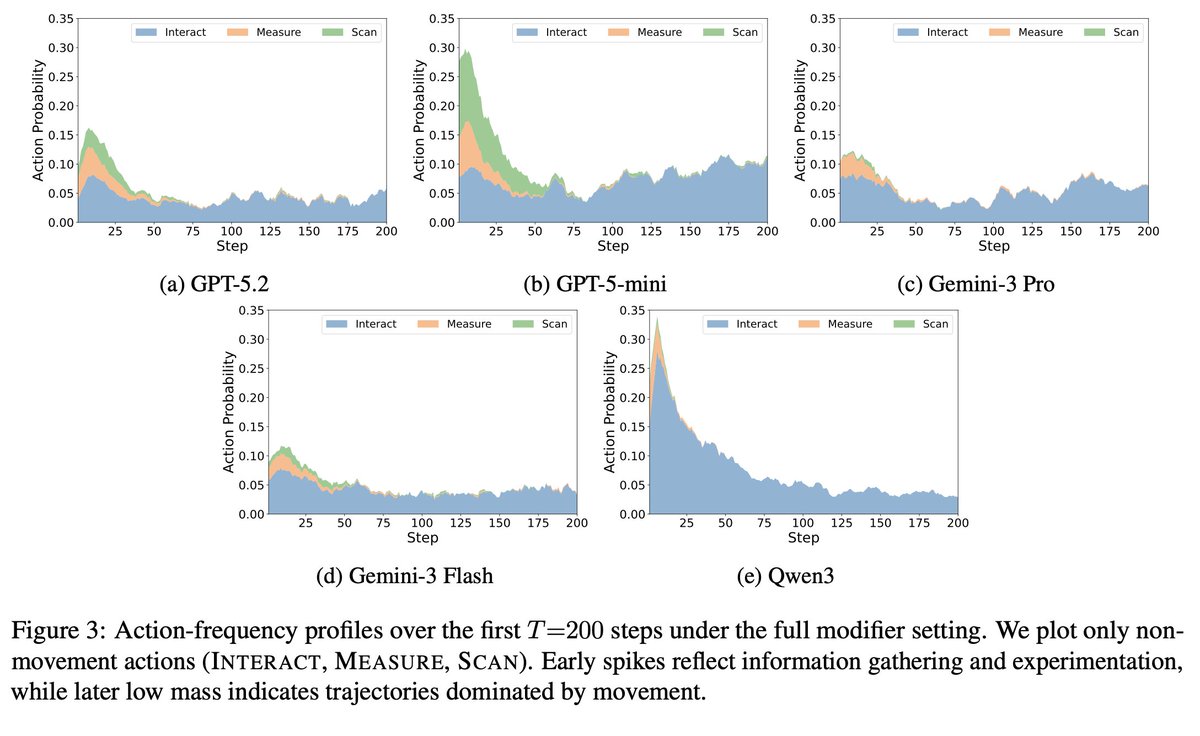
Are LLM agents ready for real-world adoption? We evaluate LLM agents in a controllable interactive game with real-world stressors and find a consistent robustness gap: success drops, LLMs ranking flip, and agents show distinct strategies:
https://t.co/sDdrpgtjMY
Agents trade off completion, efficiency, and penalties—suggesting partial objective inference. Ablations reveal failures: overconfident early hypotheses, miscalibrated info gathering, and weak post-shift recalibration—though extra verification can trade completion for efficiency.