If I had 6 months to become a Backend Engineer in the AI era.
I’d do this.
Stage 1: Core Languages and Concurrency
- Learn: Go, Rust or advanced Python. Goroutines, async/await, memory management, thread safety.
- Practice: Build a high-throughput HTTP server from scratch handling 10k+ concurrent connections.
- Why: AI generates code but you must architect the concurrency models that don't crash under load.
Stage 2: Modern Databases and Vector Stores
- Learn: PostgreSQL (deeply), pgvector, ClickHouse for analytics, Redis for caching, partitioning, indexing strategies.
- Practice: Build a multi-tenant database with Row-Level Security (RLS) and hybrid search (BM25 + vector).
- Why: Structured data and semantic embeddings now live in the same query engine.
Stage 3: Event-Driven Architecture
- Learn: Kafka, NATS or RabbitMQ. Pub/Sub patterns, event sourcing, dead-letter queues, exactly-once processing.
- Practice: Build an order-processing pipeline where every state change is an immutable event.
- Why: AI workloads are slow and asynchronous. You cannot block the main thread waiting for an LLM.
Stage 4: Durable Execution and Workflows
- Learn: Temporal or Inngest. State machines, saga patterns, infinite retries, checkpointing.
- Practice: Build a 3-day automated onboarding workflow that survives server restarts and API timeouts.
- Why: Background jobs are for emails. Durable execution is for multi-step AI agents.
Stage 5: AI Gateways and Semantic Caching
- Learn: API rate limiting, token budgeting, semantic caching (embedding similarity), fallback routing.
- Practice: Build a proxy that caches identical LLM prompts and automatically fails over to a cheaper model if the primary API 503s.
- Why: LLM APIs are expensive and flaky. The gateway protects your margins and your uptime.
Stage 6: Identity, Security and Zero Trust
- Learn: OAuth2, OIDC, JWTs, PII redaction, agent sandboxing, least-privilege access.
- Practice: Build an auth middleware that masks PII before it hits your logs and restricts AI agents to read-only DB roles.
- Why: When AI agents can write to your database, a bad prompt injection is a data breach.
Stage 7: Streaming and Real-Time Protocols
- Learn: Server-Sent Events (SSE), WebSockets, gRPC streams, WebRTC, backpressure handling.
- Practice: Build a real-time collaborative dashboard that streams LLM token generation and database updates simultaneously.
- Why: Time-To-First-Token (TTFT) and perceived latency are the new UX standards.
Stage 8: Full-Stack Observability
- Learn: OpenTelemetry, Prometheus, Grafana, Langfuse. Distributed tracing, custom metrics, log aggregation.
- Practice: Build a tracing pipeline that correlates a user's HTTP request with the exact LLM prompt and database query it triggered.
- Why: You cannot debug an AI hallucination if you can't replay the exact context the model saw.
Stage 9: Infrastructure as Code (IaC) and CI/CD
- Learn: Terraform or Pulumi, Docker, Kubernetes basics, GitHub Actions, ephemeral environments.
- Practice: Write scripts that spin up a complete, isolated staging environment for every pull request automatically.
- Why: Manual deployments are a liability. Infrastructure must be version-controlled and reproducible.
Stage 10: Cloud FinOps and Autoscaling
- Learn: Queue-based autoscaling (KEDA), spot instances, cost allocation tags, resource limits.
- Practice: Build an autoscaler that spins up GPU/CPU nodes based on Kafka queue depth and shuts them down when empty.
- Why: Backend engineers are now responsible for the cloud bill. Idle resources burn runway.
Stage 11: System Design and Resiliency
- Learn: Circuit breakers, bulkheads, rate limiting, chaos engineering, CAP theorem, distributed locks.
- Practice: Design a globally distributed rate-limiter using Redis that handles network partitions gracefully.
- Why: Systems fail. Your architecture must degrade gracefully not cascade into a total outage.
Stage 12: Public Portfolio and Teardowns
- Learn: Writing architecture decision records (ADRs), drawing system diagrams, benchmarking.
- Practice: Publish 3 deep-dive articles on how you scaled a specific bottleneck (e.g., "How I reduced DB latency by 80%").
- Why: Senior engineers are hired for their judgment not just their syntax.
CRUD is dead. AI writes the boilerplate.
The modern backend engineer builds the nervous system for global scale and autonomous agents.
Bookmark and Repost!
July 17, 2022. Greenwood Park Mall, Indiana.
A mass shooter armed with an assault rifle and 100+ rounds opened fire in the food court.
Families dove under tables in terror. Blood on the tile floor.
Across the food court was 22-year-old Elisjsha Dicken.
He had no military background. No law enforcement training.
Just an ordinary American boy who practiced shooting with his grandfather.
He didn't run.
He hid his girlfriend behind a trash can, unholstered his Glock, and moved toward the gunfire.
From forty yards away—an impossible distance for a pistol under combat stress—Eli braced against a pillar.
In FIFTEEN SECONDS, he fired ten rounds.
Eight hit the shooter.
The killer fell dead before police even arrived.
The Police Chief walked up to the cameras:
"Many more people would have died tonight if it weren't for a responsible armed citizen. This young man is a true American hero."
The media tells you guns are the problem.
Elisjsha Dicken proved that a good man with a gun is the solution. 🇺🇸🎯🦅
2026 is the GREATEST time to build a startup in 30 years
I’m 36. I’ve sold 3 startups, helped build companies that raised billions, and backed teams from seed to unicorn.
20 MEGA shifts that make this the BEST time to build in a GENERATION:
1. Hardware got smart. Download open-source AI models from HuggingFace to cheap robots and they're suddenly smart. Opens up tons of use-cases.
2. SaaS is imploding. AI can replicate $500K software for pennies. Enterprise software that took 30 engineers now requires 1 and a Claude Code subscription. Founders will go more niche and more custom and outprice incumbents.
3. Outcome-based pricing is eating subscriptions. With AI agents handling work automatically, founders can guarantee results instead of selling features. This creates a massive arbitrage opportunity to steal market share from rigid subscription models.
4. Vibe marketing is the new marketing. AI agents/tools like Lindy, Gemini and Claude Code Using agents to do personalized outreach, ads and content creation it’s getting good. This is like getting on social in 2005.
5. Social is FYP-ified. Distribution no longer requires massive followings, just content that hits. Founders can build audience from zero without ads and then convert them to owned media channels (text/email).
6. Interfaces are vanishing. Conversations are replacing dashboards across industries. This removes training barriers and means customers can use sophisticated products immediately.
7. Companies are obsessed with efficiency and cutting costs right now. Corporate budgets are getting reallocated to AI. Companies are cutting traditional software spend to make room for AI-powered alternatives. This creates fast-tracked approvals for startups delivering 10x efficiency.
8. 99% of MVPs won't need VC. Low-cost MVPs combined with creator partnerships and AI automation allow bootstrapped scaling. For most software businesses, outside funding is now unnecessary.
9. Global teams. You don’t need to hire in your own city anymore. Opens up tons of arbitrage opportunities and ways to create products unlike before.
10. Millions of creators want to get paid. If you have the right product, the right network of creators, you can hit scale insanely efficiently. Never before did this exist. Next gen founders are building startups community first, software second.
11. Prototyping is nearly instant. With Lovable, Rork etc, you can test ideas in days, not months. MVP speed is basically 1x/week. This creates room for multiple products from small companies (multipreneurship), helps get to PMF faster,
12. LLM APIs create building blocks weekly. I can’t even keep up with how many new APIs/tools coming out from LLMs weekly. Example: Nano Banana pro comes out, probably 1000 ideas built on top of that can be $5M/year businesses.
13. $1m+ revenue per employee. With the leverage of LLMs, community and agents, employees are way more efficient. It won’t be uncommon to generate $1m per employee. This will lead to a rise of "multipreneurship", small teams owning multiple products /businesses. Holding companies will be as common as startups.
14. Superniche is the new niche. Because costs to create software startups is 1/100th, you can service little niches (i call them superniches) and still have a life-changing business.
15. Mobile app ecosystem about to 10X. 2 reasons. First is, adding AI to apps make apps more useful. More useful apps, make more money. Second,
16. Compliance and boring workflows are suddenly buildable. Permits, audits, insurance, payroll edge cases, filings, RFPs. These were “too annoying” for startups before. Agents thrive on rules, checklists, and repetition. The least sexy problems now have the best unit economics.
17. Claude Code killed the “engineering bottleneck.” The constraint is no longer “can we build it,” it’s “do we understand the workflow deeply enough.” The winning founders are ex-operators who encode tribal knowledge into agents. Code is cheap. Taste + domain insight is scarce.
18. The long tail of software is now profitable. Niches that capped at $200k ARR can clear $5M with near-zero marginal cost.
19. Services are quietly becoming software. Manual agencies are one agent away from product margins.
20. if AI can replicate $500K software for $20/month, what’s your moat? distribution, customer service, brand, data etc. REALLY good time to be a world class designer/marketer.
(and even more.... but this is getting long already!)
We've entered the rarest of windows...
when multiple technological shifts collide at once, creating a brief period where small teams can build things that were previously impossible.
THE FUTURE OF BUILDING STARTUPS IS DIFFERENT.
I know this...
This unique moment won't last forever. Markets will adapt. Giants will respond. The window will close.
But right now, a founder with clear vision and bias for action can build more in six months than was previously possible in years.
(note: if you need an idea to get creative juices flowing, grab one at @ideabrowser)
The next generation of great companies is being created right now, many by founders you've never heard of.
Some by people who would never have had a shot in previous cycles.
That's the beauty of these rare windows. The playing field briefly levels, and the future belongs to those who see it clearly and move first.
It's a sacred time, don't bookmark/share this, build something in 2026, will ya?
Happy building, my friends. 2026 is yours.
Am I wrong?
Teen Noah Ney who was convicted to more than 50 years for shooting a 5‑year‑old girl during a gang initiation drive‑by, having guns, drugs, and stealing cars is now seen flashing gang signs, smoking pot, and rapping while in prison.
Backend Skills Ranked by Learning Difficulty
🟢 Node.js Basics — Easy
🟢 Express.js — Easy
🟢 REST API Design — Easy
🟢 SQL Basics — Easy
🟢 Environment Variables/Config — Easy
🔵 Authentication (JWT/Sessions) — Moderate
🔵 MongoDB — Moderate
🔵 PostgreSQL — Moderate
🔵 ORMs (Prisma/Mongoose) — Moderate
🔵 Middleware & Error Handling — Moderate
🟠 Docker — Hard
🟠 Caching (Redis) — Hard
🟠 WebSockets — Hard
🟠 Message Queues (RabbitMQ/Kafka) — Hard
🟠 Rate Limiting & Security Hardening — Hard
🔴 Microservices Architecture — Very Hard
🔴 Distributed Systems — Very Hard
🔴 Database Sharding — Very Hard
🔴 CI/CD Pipeline Design — Very Hard
���� System Design at Scale — Very Hard
Which one should be on the list? 👀
Don't ship your app until you check this.
- Secure your API keys.
- Hide all .env files.
- Never hardcode secrets.
- Add authentication.
- Verify permissions server-side.
- Don't trust frontend user IDs.
- Isolate user data.
- Lock down your database.
- Secure Firebase, Supabase, and storage.
- Protect admin routes.
- Disable production debug mode.
- Hide detailed errors.
- Validate inputs server-side.
- Sanitize user content.
- Secure file uploads.
- Prevent SQL and NoSQL injection.
- Rate-limit login and signup.
- Check Git history for secrets.
- Add security headers and restrict CORS.
- Test as an untrusted user.
Most leaks come from skipping one of these. Fix them before you go live.
Scammers found a way to make people drain their own wallets without sending them a phishing link.
They uploaded YouTube tutorials showing people how to build an AI crypto trading bot with Claude.
People followed the tutorial themselves.
Copied the code.
Deployed the smart contract themselves.
Funded it from their own wallets.
And approved every transaction themselves.
Except the “trading bot” had no trading logic.
It was built to send their ETH straight to the scammers.
224 wallets lost 274.6 ETH, worth about $517,000 when it was stolen.
The median victim lost 1 ETH.
Some victims even got an error after getting drained telling them to deposit another 50% to fix the bot.
They literally got people to build, fund and approve their own wallet drainer.
You've got to be very careful this days
I spent $30k on iPhones so that your agents can finally rent them out for going viral on TikTok & Instagram.
No joke, you can turn your Claude/Codex/GrokBot into Mr Beast with this; we've generated over 500M views with this setup.
Here are 5 things you can tell your agents to do today using this MCP server:
1) Create a bunch of TikTok & Instagram accounts (with real US phone numbers & emails)
2) Warm accounts exactly how you like for your niche
3) Capture video ideas from the FYP to understand what's going viral for your competitors
4) Post videos to all of your accounts at once
5) Monitor all of the activity on the phone including screenshots of every action down to the minute
You can literally create 50 TikTok & Instagram accounts in the next 30 minutes and start posting. Nothing gets pre-created or is managed by a human. It's all automated.
We do not share the iPhones with anyone else, they are completely dedicated to you. Every phone has its own unique SIM card, phone number, and never connects to any proxies or wifi.
All of our iPhones are here in San Francisco. Every operation happens through the apps on the phones; we don’t use any external APIs.
Check it out at https://t.co/CFAg7oySdD or just give that link to your Claude/Codex.
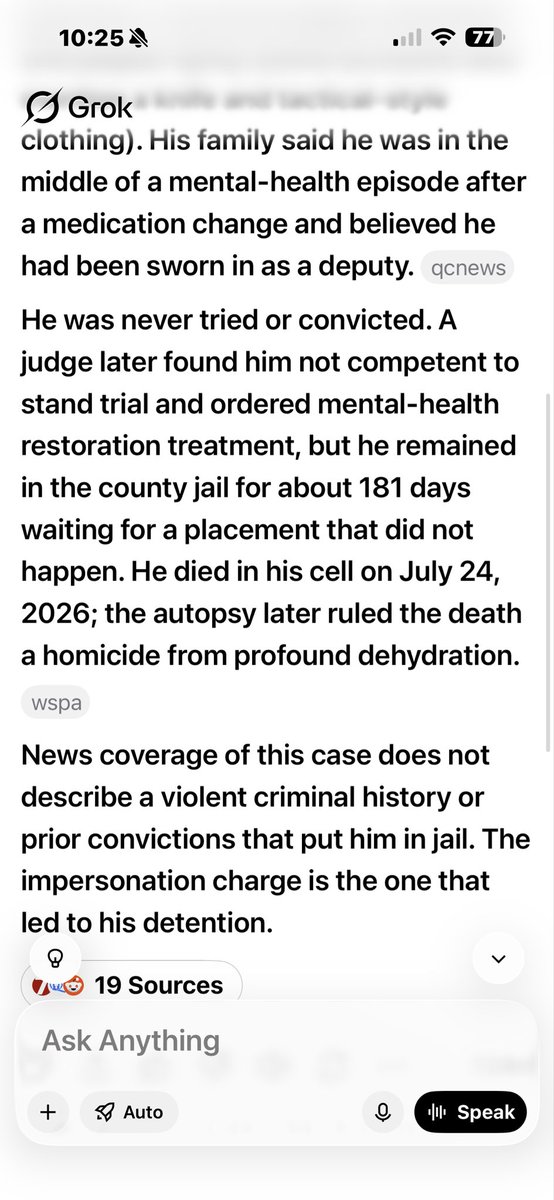
@mattvanswol@SaltyGoat17 I started to wonder if he was in jail for something like “pedo” etc…and maybe it was jailhouse retaliation. No. He was arrested for impersonating a deputy after a change of medication appeared to trigger a mental-health episode. It didn’t appear he was violent.
They actually put their mugshots on their own website for us. Chesterfield County Sheriff's Office 203 Watson Street Chesterfield SC, 29709 (843)623-2101 office
@CivilRights
America is so done with garbage law enforcement. Imagine being this guy. Jail Admin #TroyEllerbe #CamboStreater Sheriff
🚨 Former Kenbridge officer Charles Stokes was recently hit with four new indictments for the Feb. 8 shooting of his former partner—including malicious shooting and child abuse.
This is what happens when police protect their own.
@hollybear0406@AntiCommieBecca@JaimeeUSA Hey dude I think youre over stepping. I get what you mean, but low-key, Austin had that shit coming but he didn't deserve to get stabbed.
I can sympathize with standing up to bullies, and I do believe karmelo had his 6th ammendment violated.
But not all siding w him cuz he ⚫