Lovely read. The older I get, the more I realize that understanding people matters as much as understanding strategy. Fiction has a way of teaching both.
Any suggestions on good coffee capsules beyond Nespresso?
Got a Nespresso machine few months back and its great! However, tried many varieties of Pods - Davidoff, Blue Tokai, Barista and some local brands - but none have come close to original Nespresso ones.
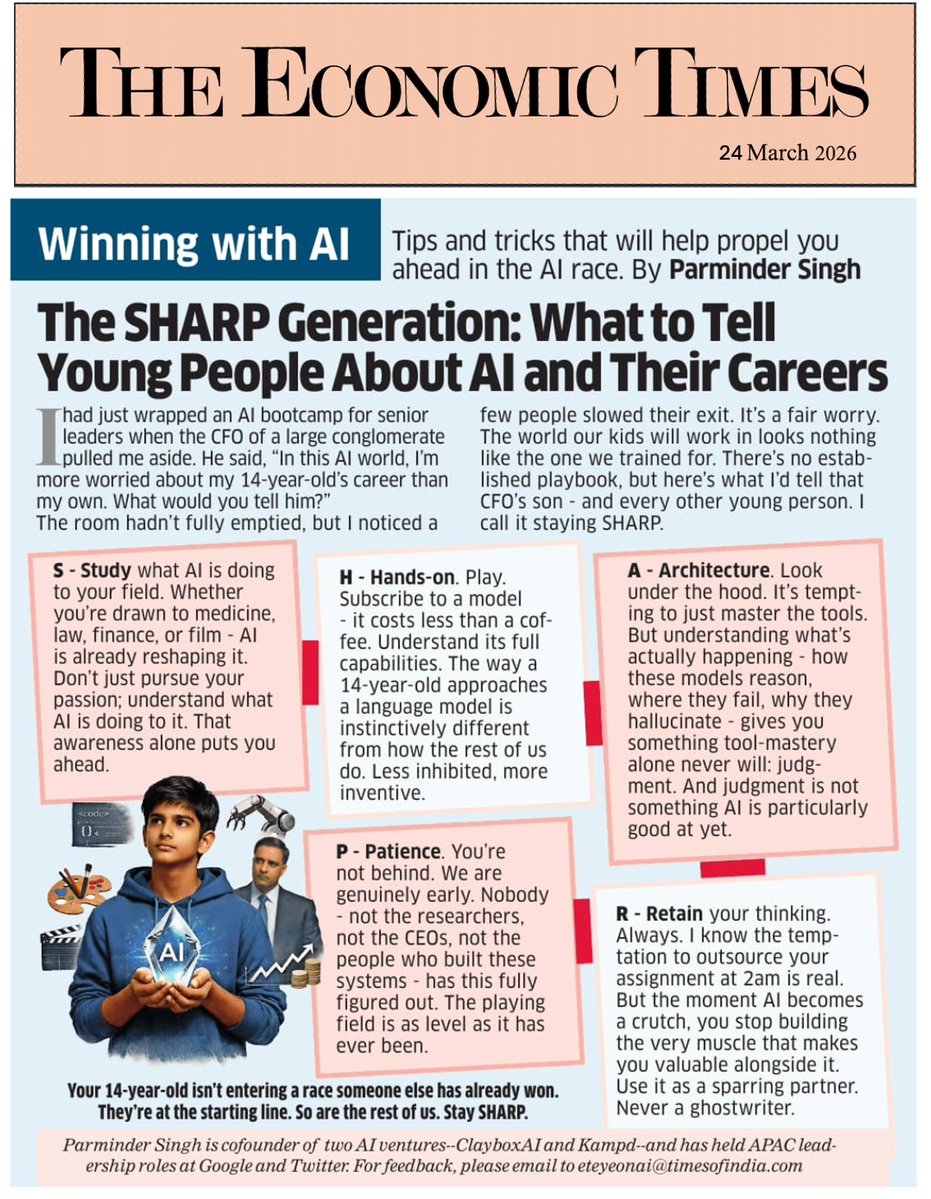
"What do I tell my 14-year-old about AI and his career?" - a CFO asked me this question that’s probably on every parent’s mind today.
The honest answer is - we don’t have a playbook.
But we do have a way to think about it. I call it staying SHARP.
I share it in today's ET.
"CAN DEVELOPING COUNTRIES LIKE INDIA WIN THE AI RACE?"
This question comes up a lot in our AI sessions.
The hard truth? Right now, the US and China are way ahead. Progress in AI needs massive scale - and most other countries are lacking (not just developing countries). But 'lacking' doesn't mean 'lost'.
Instead of complaining, I've identified 6 areas where other countries are behind - and action items where young builders can make their mark. Please add and share if you know interesting developments in these areas.
1. THE LANGUAGE PENALTY
Your AI assistant understands 'Hello' better than 'नमस्ते' - not because Hindi is inferior, but because of how AI 'reads' languages.
English uses ~50,000 tokens to express ideas. Hindi needs 3-5x more. This means:
Slower processing
Higher costs
Less efficient AI
Think of it like this: If English explains a concept in 1 page, Hindi needs 3-5 pages for the same thing. Every chat, every search, every AI interaction costs more.
--> ACTION: Fund open-source local language models. Governments need to sponsor research into efficient tokenization for non-English languages at scale.
2. THE INFRASTRUCTURE BOTTLENECK
Most global data centers are 'greenfield' - built from scratch with AI in mind (cooling, power, speed).
Developing countries mostly have 'brownfield' facilities - retrofitted older infrastructure. Like trying to run a Ferrari on roads built for bullock carts.
Result? Higher latency, higher costs, less competitive AI services.
--> ACTION: Fast-track approvals and power subsidies for AI-ready data centers. Treat them like critical infrastructure, not optional tech.
3. THE MESSY DATA CRISIS
AI needs clean, structured data. But visit any small business in these markets:
Bills in notebooks, not software
Inventory in WhatsApp messages
Customer records don't exist
You can't train AI on chaos. Smart systems need foundations that don't exist yet.
--> ACTION: Launch national 'Digital Ledger' programs - free/subsidized SaaS tools for SMEs to digitize basic operations. Make it as simple as mobile payments.
4. THE DIGITAL LEAPFROG TRAP
Developing countries brilliantly leapfrogged landlines → went straight to mobile.
But AI is different. You can't skip steps.
AI needs:
Digital workflows (most businesses are still analog)
Cloud infrastructure (most use local servers or paper)
Clean databases (most have none)
It's like trying to build the penthouse without the lower floors.
-->ACTION: Create tax incentives for businesses that digitize core operations. Make cloud adoption financially irresistible for the next 3 years.
5. THE TALENT DRAIN PARADOX
These countries produce world-class AI engineers.
But they build AI for:
Google, OpenAI, Anthropic.
Meanwhile, local startups can't afford them. Nations export brainpower while importing AI tools.
Value is created for others, then bought back at premium prices.
--> ACTION: Offer equity tax breaks and housing subsidies for AI researchers who build products domestically. Make staying home economically compelling.
THE BOTTOM LINE:
The window is closing fast. Those who don't innovate, build or adapt now will end up relying on global models as consumers. Once you cede authority and start dependence you become captive forever, simply because your data and workflow become dependent.
If you're in a developing country and want to build something that matters - these are your 5 battlegrounds. Pick one. 👇
Deeply touched by this lovely gesture by Sir Ratan Tata @RNTata2000. Had the privilege of staying as his neighbour during our vacation, and sent a little greeting to him. To our amazement, he signed it and sent it back - lifelong treasure! Big THANK YOU!
True leadership is about quietly making a difference. Things that I had read about Sir Tata, I now feel firsthand, and my admiration has only deepened. Thank you, Sir Ratan Tata, for all that you’ve done for the nation and for being an inspiration.
I did manage to catch glimpses of his calm demeanor and smiling face—and it was a typical fanboy moment every time. What stood out for me was not the celebrity status, but rather the absence of it and amazement at his humbleness and unassuming nature.
So many youngsters voluntarily turning up and waiting for hours for their turn to donate blood for the injured in the train accident.
Long Live Humanity 🙏
Pics from eenadu
@myntra@myntra - Wait is one aspect, but more important is to improve your processes. Asking customers to seek approval for return of incorrect products just doesn't make sense. Also, penalizing delivery folks for incorrect deliveries makes even lesser sense.
@myntra@myntra - if there is a mistake then you should better own it and not shy away. Everyone’s time js precious so one should take back the product and then do due dilligence. Really bad customer centricity.
@myntra@myntra - This is what you call QA of products. Lats time it was a different product that was sent and this time look at the state of box that is supposedly QA’d.
@myntra@myntra - and while its understandable that mistakes happen, but the appalling thing is that the customer has to waste time in seeking approval as the courier people refuse to take it without the same, citing that Myntra charges them for the same. Which is very unfair.