As of now, nothing actually is optimized or opinionated to have custom built AI/ML driven solution for the problem you are trying to solve.
There are tons of opportunities to refactor and enhance the speed of development.
business and desing docs +
source code +
build +
tests +
LLM +
LLM inference engine +
coding agent +
work machine
All of the above presents the great gap to fill in. Most people are just using very generic approach towards everything and specially the integration between them
People do not realize just how much they are putting at risk when they don't accept what life presents them with, the questions and tasks that life sets them. When they resolve to spare themselves the pain and suffering, they owe to their nature.
In doing so, they refuse to pay life's dues and for this very reason, life then often leads them astray.
If we don't accept our own destiny, a different kind of suffering takes its place:
a neurosis develops, and I believe that that life which we have to live is not as bad as a neurosis. If I have to suffer, then let it be from my reality. A neurosis is a much greater curse!
In general, a neurosis is a replacement for an evasion, an unconscious desire to cheat life, to
avoid something. One cannot do more than live what one really is. And we are all made up of opposites and conflicting tendencies.
After much reflection, I have come to the conclusion that it is better to live what one really is and accept the difficulties that arise as a result-because avoidance is much worse.
Today I can say: I have been true to myself I have done what I could to the best of my knowledge and conscience. Whether it was right or not, I cannot say. Suffering was inevitable in any case. But I want to suffer for those things which really belong to me.
Being “smart” and behaving reasonably are not enough to get you through life. You may well spare yourself some trouble, but you cut yourself off from your own life in the process.
- Carl Jung
Storing vectors is easy. Retrieving the right evidence is harder.
Introducing searchgres.js: BM25, semantic + hybrid search in Postgres, with hierarchy, metadata, regex + time filters.
Filtering belongs inside retrieval.
https://t.co/ZxJMUeyT70
🚀 Introducing DeepInfer, our in-house inference framework, now fully open source!
Powering DeepSeek-V4.1-Flash at scale with high throughput and low latency. We’re sharing our production stack to help the community lower compute costs, reduce energy use, and make AI more affordable.
🔗 https://t.co/JGAik1kgk0
1/4
It is difficult to get a man to understand something,
when his salary depends on his not understanding it.
- Upton Sinclair ( I, Candidate for Governor: And How I Got Licked )
A lot of shit we are dealing with in the modern computer systems is an adversarial complexity that serves no purpose except making things harder for the benefit of the system's owners. The main problem is that lot of people believe this complexity is necessary.
Today we're open-sourcing pg_vectorsearch, a new vector search extension for PostgreSQL.
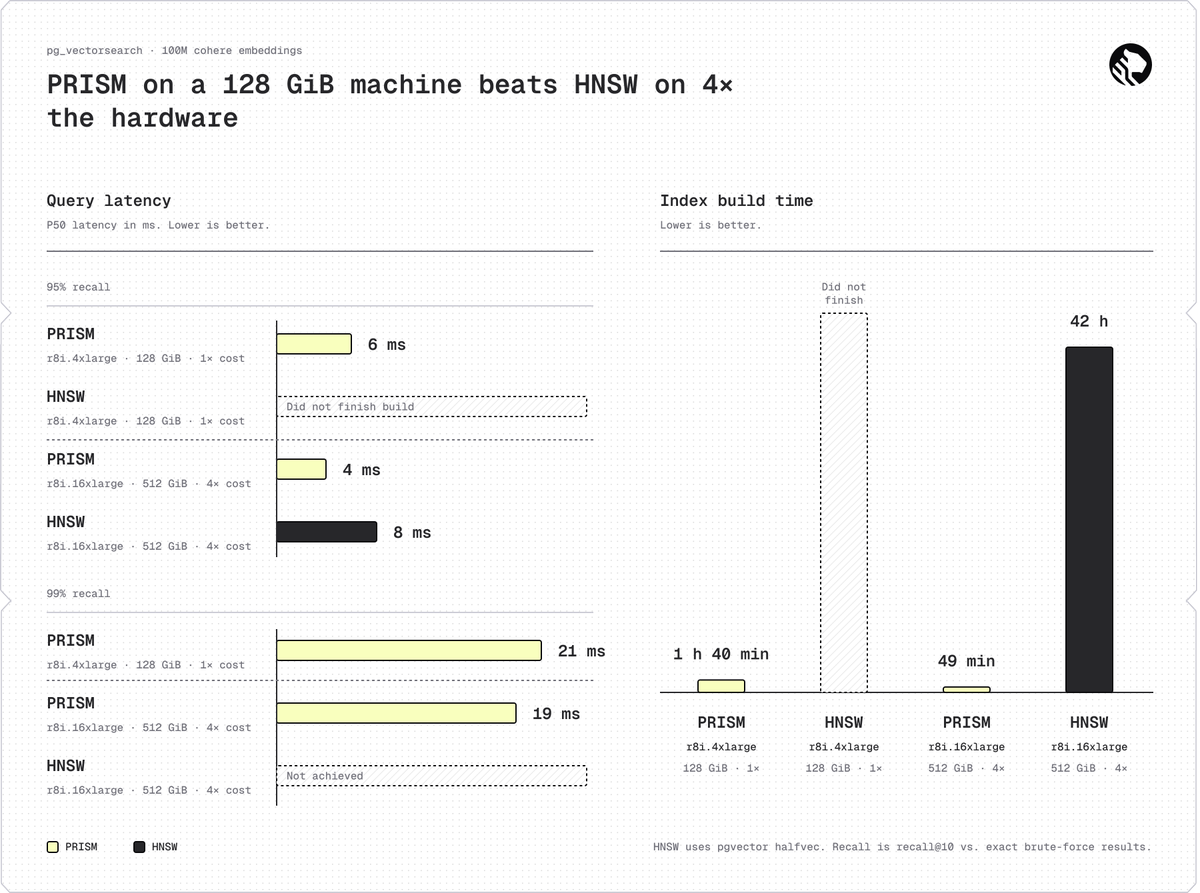
The performance improvements over HNSW are pretty remarkable. At 100 million vectors:
◆︎ Faster queries, 4× less RAM: 6 ms vs. 8 ms at 95% recall, using 128 GB vs. 512 GB RAM. HNSW couldn't even build on 128 GB.
◆︎ 7× smaller indexes: 25 GB vs. 180 GB at 100M vectors.
◆︎ 50× faster index builds: 49 minutes vs. 42 hours on identical hardware.
And at 1 million vectors, PRISM delivers 15 ms queries at 99% recall on just 2 GB RAM, versus HNSW's 392 ms on 4 GB.
What leads to these improvements? Rather than traversing an HNSW graph with random memory accesses, our new PRISM index partitions vectors based on distance, compresses them using RaBitQ, and scans them efficiently using SIMD vectorization techniques. This takes better advantage of modern CPUs and memory locality.
This is actually our second open-source vector index. We learned a lot from building DiskANN-based pgvectorscale, including some important limitations of graph-based approaches. Those lessons convinced us there was a better architectural foundation, so we started over.
pg_vectorsearch is still in alpha, with more engineering ahead. But we believe fast, scalable vector search should live alongside your relational data, without requiring a separate vector database.
Released under the permissive PostgreSQL License, just like our pg_textsearch extension for BM25 keyword search. Together, they provide the building blocks for hybrid vector + keyword search in PostgreSQL.
Feedback and contributions welcome!
Code and blog post below.
⚡️⚡️⚡️
TensorFold 1.0.7 has landed with a major overhaul to Living Weights.
• Each fact you teach through /learn becomes about ten new neurons inside the model's own weights, learned about 4x faster, with a live 3D view of what it has learned. Macs and DGX Spark.
• Structured output and required tool calls on the native server, with drafting still on.
• Qwen3.8-27B serves concurrent requests, and sampled replies draft too: 125 tok/s vs 20 on code on an M3 Ultra.
• RTX 50-series and RTX PRO 6000 Blackwell support, NVFP4 Nemotron on DGX Spark, and faster GLM-5.3-Flash on two Macs.
• Various other bugs and issues squashed
I would like to thank the people who reached out to me and gave me access to their hardware to speed up testing. 🫶🏼
Thank you to everyone who sent PRs, reports and receipts, and to everyone using it: BobClawblaw BlivionIaG jschmied ZackSample ThinkOffApp jayleaton chaog992 Nipale-ai
@volatilemarkts@MiaAI_lab@petruspennanen@plotarmordev
https://t.co/AnMyw323Xe
We are currently working on Qwen3.8-27B-Coder390-EfficientThink-Opus5.5-GPT6Astra-Grok4.7-DSV4Pro-K3-SFT-RLOO-MTP-DFlash2, the model with the longest name. We only need to ablate 5 weights (i.e., 3 layers) to achieve the ablation effect... We’re still testing to see if it can be made even smaller.
You’ve mostly got it right, with some caveats.
Most memory tools keep notes outside the model. RAG, vector databases and memory files store text, search it when you ask something, and paste what they find into the prompt. The model itself never changes. It rereads its notes every time, and if the search misses, it doesn’t know.
Living Weights changes the model. When you tell it “I like blue”, it writes its own questions about the fact and trains a small change into its weights until it can answer them. Then it saves that change into the model’s files. It adds nothing to the prompt and looks nothing up.
Restart it, and it still knows.
Editing facts into weights isn’t new in research. ROME and MEMIT are the best-known papers. What Living Weights adds is doing it live on your own machine, with checks before anything is kept.
Training facts into a model usually bleeds into other answers, and that’s where most of the work goes. Before it keeps a lesson, it checks that ordinary answers haven’t changed and that the fact hasn’t leaked onto similar ones. In one test it refused “my dog is called Ginger” because it had started answering “what’s my cat’s name?” with Ginger.
Today it handles short personal facts, one at a time. Each one takes 2 to 4 minutes on an M3 Ultra and about 22 GB of memory while it learns. With thinking on, the model can still reason its way back to “I don’t know you”, and we’re fixing that now. A saved fact is hard to remove. It also doesn’t learn from conversations by itself yet. You tell it what to learn with the /learn command.
So the coworker comparison works for things it should always know about you. Notes still win for documents and anything that changes often at the moment, but I am solving that.
Jarvis on a Spark is where this is heading. A Spark can already serve a model that learned on a Mac, and I’m building learning on the Spark itself as we speak.
TensorFold 1.0.3 lands with a few cool things.
- Living Weights (beta with Nemotron on Metal) and coming to CUDA in 1.0.4
- Nvidia Ampere (beta) for Nemotron, and native Qwen3.8-27B with DFlash2
- Conversation prefix caching
- Various bugs fixed and improvements
Twelve contributor PRs helped make this happen, so a massive thank you to @niklaslenz_ai and GitHub contributors akol1, jschmied, chaog992, AdrianBinDC and BobClawblaw, and everyone testing, reporting bugs and helping us improve TensorFold.
FYI, Living Weights is in very early beta and has sharp edges, but I think I’m on to something.
I’d love community feedback to make it better: https://t.co/pcq8P57cvo
@plotarmordev@petruspennanen@MiaAI_lab@volatilemarkts
https://t.co/H2dBxCSaUV
Opus 5.5 has one very serious, catastrophic problem that nobody is talking about: it's unfit for code review. It's been made so "safe" and so restricted that, out of a hundred confirmed critical issues, it will flag two at most. Opus 5.5 writes completely insecure software that can't be shipped to production
I'm convinced Anthropic has gone overboard with restrictions and safety. This needs to be fixed urgently
Keep this in mind!
@thdxr Of course guys who build interpreter by themselves tend to have much more EEEGO 😉
Still recommend to have look at this
This is deeply modified QuickJS to ok mprove CPU and memory stats plus lots of extensions
https://t.co/cYzBPpsDfU
You can now train your own Decision model with our free notebook! 💡
Qwen3.5-4B will generate decisions instead of text on just 8GB VRAM locally.
Learn to data prep (state, questions, gold answers), train, serve.
Notebook: https://t.co/avk6G2zyob
Guide: https://t.co/eNy4Ue0btG
Goose: my latest programming language. Safer, faster and less memory than Rust/C++ for algorithms where tightly packed, flat data structures matter.
It can represent more kinds of data structures as flat, pointer-free bytes than any language I know.
https://t.co/qqC3RFD0BS
1/