@kushalbhagia and @All_IN_CAPITAL is the most down to earth and coolest VCs. Yes they invested in Segmind's first round, you can call me biased. But having pitched to so many investors, you know who really values the founders and their time.
They're fast, straight shooter, no BS kind of VCs. Always supporting. @kushalbhagia reached out to help me in any way he can, when I moved out of Segmind.
Humans first, then VCs. Strongly recommend them.
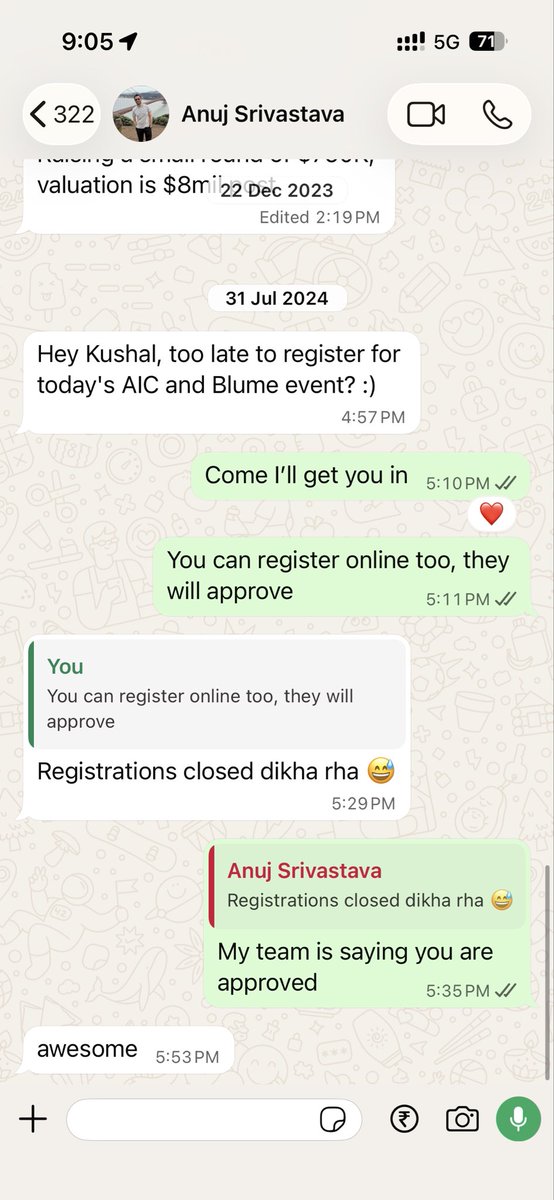
Woke up to find this (now deleted) post attacking us for honestly I dunno why. So I checked my chats and mails -
> We have passed quickly- wished him the best and readily admitted we are ofcourse often wrong.
> Made intros to other funds and angels who maybe be able to help him.
> He’s even pinged me for advice on a termsheet he got and then to get into an event we had organised.
> accused us of not having a big vision but he’s himself pivoted AFAIk from the idea he actually pitched us.
What hurt you so much bro @cosmicanuj ? There are better ways to do engagement farming.
Anyways - to founders reading this - please feel free to reference us with founders we have actually backed. If we haven’t invested in someone they haven’t actually received the full @All_IN_CAPITAL package 🤷🏻♂️
The Temple team has made a breakthrough.
We have discovered (literally discovered) a biomarker, only readable on the temple region, and nowhere else, that measures the real-time cost of you being alive.
We are calling it Entropy™.
It's a live number on Temple's home screen, updating every second, on an index from 1 to 250.
1 is the deepest rest we've ever recorded. We've only seen fit, experienced meditators touch it, for fleeting moments deep in practice. 250 is the highest we've seen in elite athletes at the peak of their output and flow.
Everything moves Entropy. Sleep, stress, a sprint, coffee, a meal, a cold plunge, meditation, strength training... everything moves your metabolism, your cost of being alive. And Entropy tracks it, live.
Heart Rate doesn’t come even close to this level of precision in calculating the cost of being alive. We benchmarked Entropy and Heart Rate against a standard metabolic cart (calorimeter). Over a hundred cardio sessions, Entropy tracked the calorimeter's curve at r=0.93 and p <0.001. Heart Rate managed a meagre r=0.55.
Here's why Entropy should matter to you –
Your Entropy Maxima is the highest your body can reach when you push it hard. A high peak is the signature of a capable body, one that can rise to meet effort and recover from it. As we age, that ceiling naturally falls, so this is the number to push upwards.
Your Entropy Minima is the lowest your body settles to at rest. Across the animal world, a lower cost of being alive at rest tends to go with a longer life. Your Entropy Minima is the number to bring down, every single day.
Living with Entropy is magical. It teaches you so much about yourself, that no other metric ever has. We are looking forward to you trying out Temple. But not before it’s perfect.
Apply for early access at https://t.co/XxGR9Hpq58
Follow @temple for updates.
Today we're introducing Machine Lattice.
Decision Intelligence Infrastructure for Blockchains, Enterprises and Governments.
Organizations have infrastructure for data, analytics and AI. They lack infrastructure for understanding outcomes before decisions are deployed.
That's what we're building.
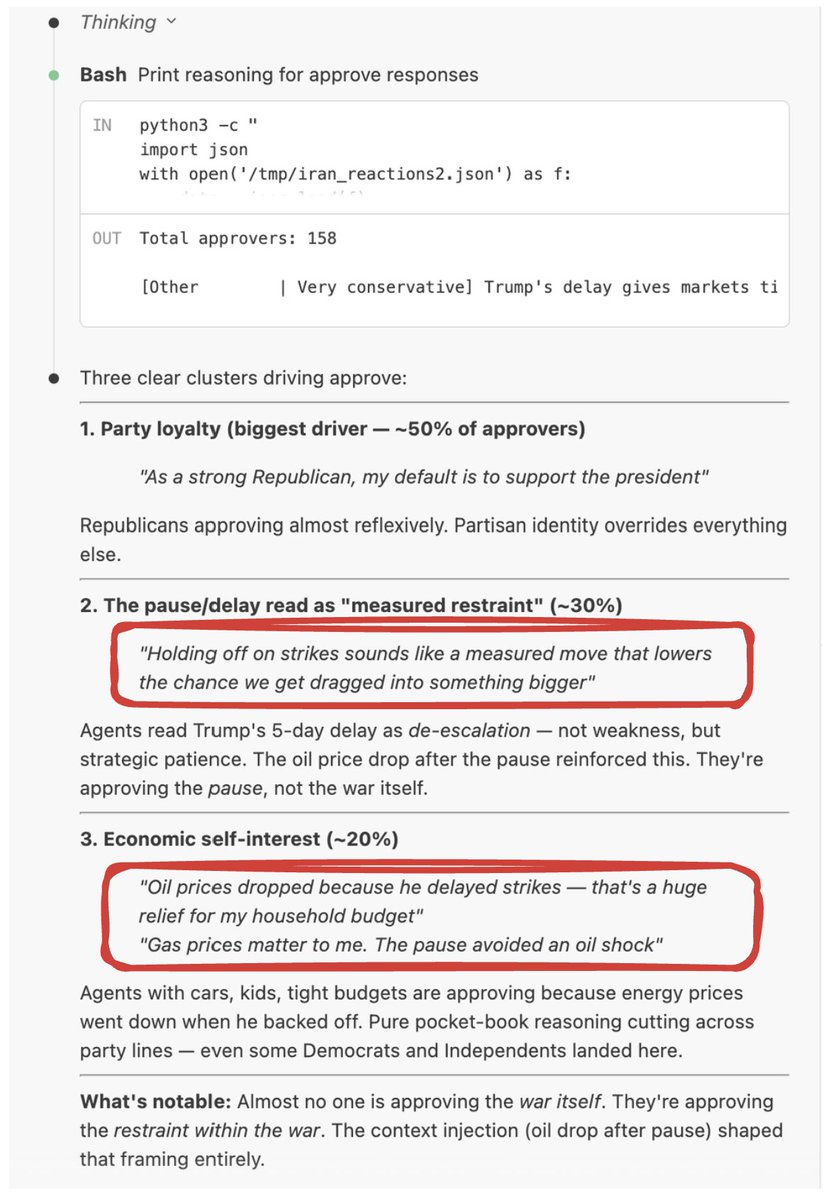
Been working on how close can I simulate human behaviour in agents. Getting to an interesting point where I am trying to compare some public polls with my simulations. Here you can see I simulated recent CBS News Poll on Trump's approval on Iran, with 500 agents representing diverse US population across political affiliations, demographics, economic situation etc.
In general, I am coming within 10-15pp delta compared to the actual polls, although on just 3-4 polls. Polls are just numbers. They are more of a "what". What do you think about x, y and z, what will you do given a, b and c. But, I am trying to simulate the "why" also behind the "what". Below are the screenshots from my actual simulation.
Trying to run this across different situations. E-commerce, policies, political polls etc. Getting some interesting results. I'll share more soon. Let me know if anyone interested in a tool like this.
#IranWar #Trump #Agents #Polls
@ypatil125@BrendanFoody Awesome work!
Co-workers -> partnerships -> firms in the future?
I am experimenting along the same lines. Below you see agents collaborating, clustering and forming partnerships, over 5000 tasks
here's my little fun experiment - https://t.co/4znCnupWeP :)
Agents being the big theme of late 2025, I wanted to do some experiments with agent teams. Agents are almost autonomous now in their thinking and execution. But I wanted to give them economic autonomy too. So my setup
> 400+ agents
> 10 different fields
> 5000 tasks
> one task coordinator randomly assigning tasks with a budget
> coordinator picks one lead agent
> lead agent has to hire a partner agent to execute the task, within the budget
> lead and partner have different negotiating skills
> they negotiate, agree/disagree upon their pay
> proceed with the task
> coordinator agent reviews and rates the output on 1-5 scale
What follows is sort of an emergent behaviour. Over the course of 5000 tasks, you see the agents collaborating, forming partnerships, coming close to each other forming clusters of similar/adjacent specialities/capabilities. You will see individual agents going from new agents (blue dots) to becoming high earners (red dots), based on their performance over time.
This was just a fun initial experiment. I am just scratching (or trying to) the surface. The idea is to model behavioural economics of the agents and see how they form teams, collaborations, partnerships and eventually firms, like humans do. I am documenting all of that at @machinelattice . I’ll be blogging and sharing my learnings (…or I’ll try my best to).
open on a desktop -> https://t.co/6cl1WsZt0V
I started a startup in India in 2012. Started a VC fund in 2019. Have backed 150+ startups and have met at-least 10,000+ startups.
On this whole @PiyushGoyal comment :
1. No one hates the Govt machinery and babus more than me. On balance India succeeds despite their best efforts not because of them.
2. There is no need to dunk on delivery apps - in a culture where no one does what they say they will do - that too on time - it's insane that they manage to get millions of gig workers to do deliveries on time and give back time to millions of their users. It's an insanely tough logistical operation to crack and does actually require fair bit of technological prowess.
India does it better than the west and we should be proud of them. And it's good they are creating employment. I can't believe he framed it as cheap labour exploitation.
3. People are building and investing in beauty and food brands because people are buying from these brands. Any smart entrepreneur/investor goes where the customers are so not sure what's the point of putting them down.
However @PiyushGoyal is still right in terms of ambition and lack of deep tech startups in India.
We at @All_IN_CAPITAL are proud first backers of hard tech companies like @piersightspace (Satellites for marine traffic tracking), @mavehealth (wearables to treat mental health), GridOS (ODM/ Manufacturing play ), Karban (air purifier+ fan+ light in one device) among others. At my last fund we had backed @BellatrixAero (thrusters for small satellites), @ePlaneCompany (Flying Taxis), @MayaLabsIO (General machine intelligence) etc.
But honestly - we just don't meet enough founders who are doing something truly deep-tech or going after big ambitious problem statements. We see about 400 startups a month and less than 10 would be deep tech.
IMO the reasons are :
- A large chunk of our deeply technical talent left India right after their under-grad and works in deep tech in the US. Hence founders starting companies in India skew towards ops specialists/ product folks but not deeply technical folks.
- No Role models : We just don't have examples of deep Tech founders to look up to and to learn from. A Flipkart spawned a generation of new founders in e-com, finctech, saas etc. Freshworks spawned a generation of SAAS founders. This hasn't yet happened with DeepTech.
When I started my first company from BITS in 2012, the smartest, most ambitious thing one could do was to go to the US, do a masters and join Google or Facebook. Forget Deep-Tech, only 2 startups were launched from a batch of 600 students.
The only entrepreneurial role model we had then was - Phani Sama who founded RedBus and sold it for $50M.
Most of the 9 pointers left for the US and are today working at FAANG companies.
Then ambitious kids in the 2016-2020 era started looking up to @harshamjty and @nandanreddy who founded Swiggy (now public) or @a85 (Postman, $5B co).
Starting a startup after college started becoming more and more common (and also cool!) and folks started building SAAS, Edtech(Quizzes), FinTech (Groww) and other cool companies.
Today, the poster boys for the startup ecosystem are increasingly becoming folks like @awaisahmedna and Kshitij from @PixxelSpace - raised $100M, launched satellites, all before turning 30 - truly path breaking stuff.
I believe that smart technical talent has finally started staying back in India to build hard tech companies from India.
And I think it's only going to snowball from here because the next generation of young kids from BITS (or otherwise) are only going to aim higher.
Long India! 🇮🇳