Google.
OpenAI.
Anthropic.
They're all working on the same problem for agents.
How to let agents control the UI layer at runtime, rather than just output text.
That's Generative UI, and it's built on three parts:
Anthropic's MCP Apps + Google's A2UI + CopilotKit's AG-UI
These are the building blocks that power Generative UI behind agentic apps like Claude.
Until now, bringing them into your app has been complex, with no clear resources to follow.
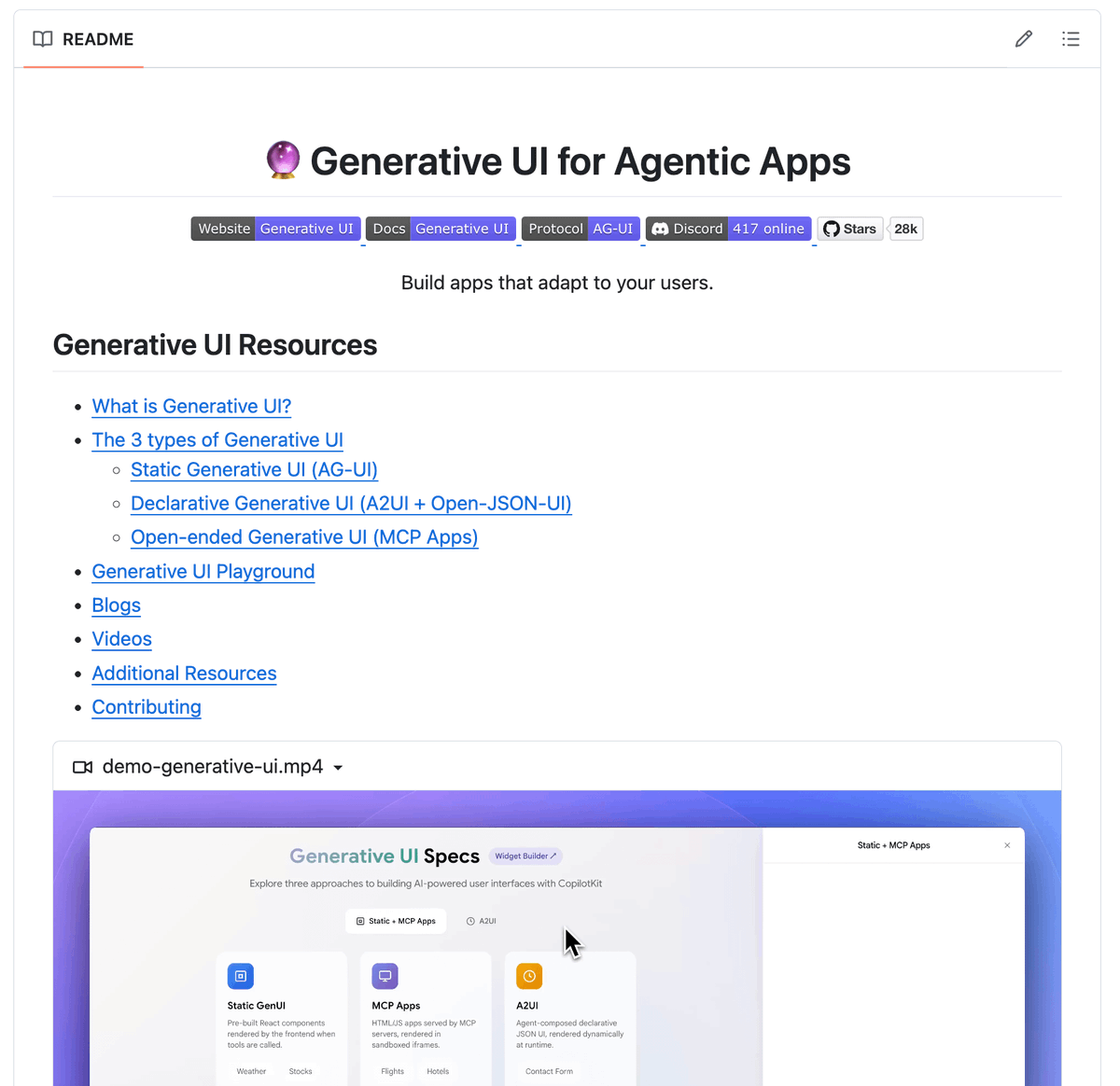
But I found 2 resources that cover everything you need to get started.
Here's what they cover:
→ what GenUI actually means (beyond buzzwords)
→ how it works via agentic UI specs (A2UI, MCP Apps...)
→ the three practical patterns
→ complete integration flow (with code)
→ how agent state, tools, and UI stay in sync (AG-UI protocol)
One is a detailed blog that goes deep into the concepts and the "why" behind the code. The other is a GitHub repo (400+ stars) that maps the patterns with examples you can run right away.
These are the best starter guides for building Generative UI into your full-stack apps.
I have shared the two resources in the replies!
Marc Andreessen: AI isn’t just about job losses or job gains. At the individual level, it turns people who are good at something into people who are very good—and the best into something else entirely. This is the real shift parents should be thinking about.
We have a 10-year-old, we homeschool, and we think about this a lot. AI is a tool that raises the average for everyone—but it also creates the super-empowered individual who can go far beyond average.
If you’re already good at writing, coding, designing, or creating—and you use AI—you don’t get a little better. You get dramatically better. The gap between “good” and “great” is about to explode.
What we’re seeing right now in coding is wild. Really great coders aren’t twice as productive anymore—they’re saying they’re 10x better than they used to be. That’s AI as leverage.
At the N=1 level—the individual kid—the goal isn’t chasing “safe careers.” It’s creating a super-empowered person who can use AI to amplify their talent beyond anything we’ve seen before.
Marc Andreessen: AI coding doesn’t eliminate programmers — it redefines them. The job is no longer typing code line by line, it’s orchestrating 10 coding bots in parallel, arguing with them, debugging their output, changing the spec, and pushing them toward the right result. But here’s the catch: if you don’t understand how to write code yourself, you can’t evaluate what the AI gives you.
The next layer of programming isn’t writing scripts — it’s supervising AI that writes them. Today’s best programmers spend their day jumping between terminals, managing multiple coding bots, fixing mistakes, and refining instructions. The irony? You still need deep fundamentals, because without them, you won’t know when the AI is wrong.
The job of the programmer has changed. Now it’s about arguing with coding bots, debugging AI-generated code, and understanding why something doesn’t work or isn’t fast enough. AI abstracts the work — but only people who truly understand code can tell if the abstraction is doing the right thing.
Programmers aren’t going away — they’re becoming 10x, 100x, even 1,000x more productive. Tasks are changing, the job is changing, but humans are still overseeing the process, evaluating results, fixing errors, and making judgment calls. AI changes how we code, not who is responsible.
The future programmer isn’t replaced by AI — they’re upgraded by it. You still need to learn how to write and understand code, because when the AI gets it wrong, humans are the ones who have to know why. That up-leveling of capability is the real revolution.
I DON'T BUY STOCKS UNDER THESE CONDITIONS:
Don’t buy when the overall market trend is bearish.
Even the best stocks struggle in a weak market.
Don’t buy stocks that belong to weak industry groups.
Strong stocks come from strong sectors.
Don’t buy stocks below their 50-week moving average.
If price is under this level, the long-term trend is weak.
Don’t buy stocks that are declining below their 30-week moving average, even if they look cheap.
No matter how bullish a stock looks, never buy if it breaks below a key buy point.
Broken support is a warning, not an opportunity.
Don’t buy stocks with poor volume on breakouts.
Real breakouts need strong volume. Weak volume = fake move.
If a stock breaks out and then quickly falls back below the buy point, sell it immediately.
No hope, no excuses.
Don’t buy stocks showing weak relative strength.
Leaders lead. Weak stocks lag.
Don’t buy stocks that fail to hold above resistance.
If it can’t stay above resistance, it’s not ready.
Never buy a stock just because it looks cheap after a big drop.
Bargains can turn into disasters.
Instead, buy stocks that break out above resistance with strength and volume.
Discipline protects capital.
Patience builds wealth.
@arpit_bhayani Spot on! Most dev’s find working on maintenance tickets to be boring. I learned about business flow in my projects only through working on production ticket from business users. One good production ticket will teach more than few hours pouring through docs.
No company can give you the most exciting, challenging, and impactful project around the year, so the ups and downs in the kind of work you'd get are expected.
On average, you would get 4 months of high-impact work, 4 months of moderate work, and 4 months of mundane work in a year. Instead of feeling bad about it, leverage the time and energy to advance your career and secure more impactful projects in the future.
Remember, the most important and impactful project is not given to the smartest engineer, but it is given to the one holding the track record of getting things done well and on time. The trust you instill by doing grunt work or maintenance would and should put you in a position to get the most impactful project.
Given that the maintenance work does not eat up a lot of your mental bandwidth, use this breathing room to identify more significant problems within your organization. Spend time digging deeper into systemic issues, find a solution, create a project plan, and present it to the leadership. This showcases your initiative and capacity for impactful contributions.
When I was given some mundane work, I used the additional time to figure out the root cause of recurring outages and proposed an architecture change to solve it once and for all. Because I was thorough with my homework, it became a no-brainer for leadership to approve.
You can also use this time to enhance your visibility and influence within your organization. The easiest of all is to use this time to hold tech talks and mentor early engineers. These interactions will make it more likely that you'll be top of mind when exciting projects are conceived.
To be honest, this is what I did at all of my stints across all the companies I have worked at. I gave talks on some of the lessons learned from past projects, new industry trends, or introductions to new technologies. This helped me establish a good reputation within the org.
Remember, every phase cannot be exciting, but it is important to know how to leverage it well. Impactful projects will not be served to you on a silver platter; you need to earn them.
@ElieJarrougeMD It’s the Algos. Posts don’t get eyeballs if users just read but don’t engage. Please keep posting. You can use hashtags to see if it helps