A number worth watching: ₹23,544 crore.
That’s how much FPIs have invested in Indian equities in August so far.
But there’s a catch.
India has seen more than ₹1 lakh crore of FPI selling in 2026 overall.
So I wouldn’t call this a full FPI comeback yet.
My view: August buying is encouraging, but the real signal will be whether foreign investors continue buying through September and beyond.
One month is a flow.
Consistent buying is a trend.
One number is quietly changing the Indian market story: ₹6,535 crore.
That’s how much foreign investors put into Indian financial stocks in the first half of August, after selling ₹2,669 crore in the last two weeks of July.
That is a ₹9,204 crore swing in a matter of weeks.
Why financials?
Banks remain closely linked to India’s domestic growth and credit cycle, so foreign investors may be seeing better risk-reward in the sector.
But I wouldn’t call this a full FII comeback yet.
A change in flows is interesting.
A sustained change in flows is a trend.
The market is telling us something interesting about earnings.
India’s NSE 500 companies reported ~21% profit growth in Q1 FY27, according to recent market analysis. But the recovery isn’t broad-based it is concentrated mainly in Metals, BFSI and IT.
That distinction matters.
A 21% profit-growth headline sounds great.
But if only a few sectors are driving it, the market still needs wider earnings participation to make the rally stronger.
My view:
The next phase of the Indian market may depend less on whether earnings are growing and more on how widely that growth spreads across sectors.
Strong earnings from a few pockets can lift an index.
Broad-based earnings growth can sustain a market.
That’s the trend I’ll be watching.
India’s growth story may be stronger than the headline forecast suggests.
RBI Deputy Governor Poonam Gupta said India’s growth could be closer to 7%, above the RBI’s current 6.7% forecast, despite higher oil prices, US tariffs and global uncertainty.
My view:
The interesting part isn’t just the GDP number.
If growth stays near 7% while inflation remains manageable, it could support earnings growth, credit demand and domestic consumption.
But the key risk is the word “if.”
Higher oil prices and global shocks can quickly change the equation.
So rather than asking “Will Nifty go up or down?”, I’d watch one thing:
Can India maintain strong domestic growth despite a tougher global environment?
That may matter more for Indian equities over the next few quarters than short-term market noise.
The AI chip war just got more interesting.
Nvidia’s H200 chips are reportedly starting to reach China in small quantities after months of restrictions. ByteDance and Tencent have reportedly received around 10,000 chips each.
Why does this matter?
China wants more AI computing power.
The US wants to control access to the most advanced chips.
And Nvidia wants access to one of the world’s biggest technology markets.
My view:
This isn’t just a chip story. It’s becoming a race between technology, business and geopolitics.
China will keep building its own AI-chip ecosystem, while Nvidia still has a huge advantage in AI hardware and software.
The interesting question is:
Who benefits more in the long run Nvidia from China access, or China from becoming less dependent on Nvidia?
The interesting market story today isn’t the Nifty. It’s the bond market.
US 30-year Treasury yields have moved above 5.3%.
At the same time, Brent crude is above $90 a barrel.
Why does this combination matter?
Higher oil can keep inflation under pressure.
Higher inflation can keep interest rates higher for longer.
And higher long-term bond yields make borrowing more expensive across the economy.
That creates pressure on global equities — especially expensive, rate-sensitive stocks.
For India, there’s another link:
Oil ↑ → import bill ↑ → rupee pressure → inflation risk
So today’s market weakness isn’t just about stocks falling.
It’s about the cost of money and the cost of energy rising together.
That’s the macro story I’d be watching.
The most expensive mistake in investing isn’t buying the wrong asset.
It’s buying a good asset at a price that leaves no room for error.
A great company at a crazy valuation can disappoint.
A mediocre company at a sensible valuation can surprise.
Returns are not just about what you buy.
They’re also about what you pay.
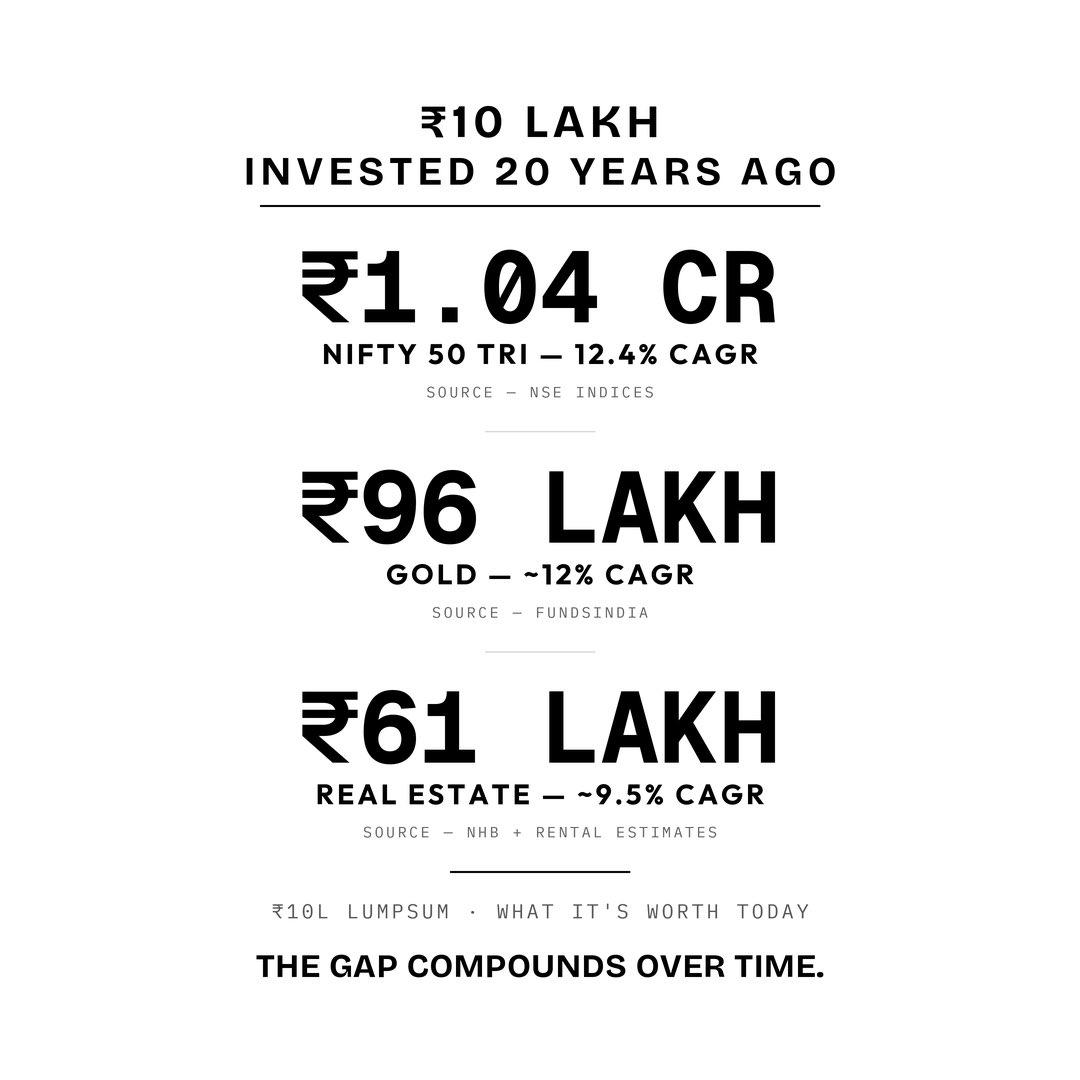
Equity vs Real Estate vs Gold: What do 20 years of data actually show?
For years, Indians have heard one simple idea:
“Buy a house. It’s the safest investment.”
But when you actually look at the numbers, the story becomes more interesting.
India | ~20-year CAGR
Nifty 50 TRI: ~12.4% (NSE Indices)
Gold: ~11–13% (FundsIndia)
Residential real estate: ~7.7% (NHB RESIDEX)
Add roughly 2–3% rental yield, and residential property comes to around 9–10% total (NHB + rental yield estimates).
So, on long-term compounding, equity has done better.
But returns aren’t the only thing that matters.
Imagine you suddenly need ₹5 lakh.
With equity, you can sell a portion of your portfolio.
With a house, you can’t sell 10% of your flat.
You need a buyer, negotiation, documentation and time.
And if you need the money urgently, you may have to accept a discount.
That’s where liquidity becomes part of the investment story.
And real estate isn’t risk-free either.
Japan is a reminder: after its 1991 property bubble, land prices fell roughly 70% by 2002. (Japan land-price data)
India is different, but the lesson is universal:
Physical assets can fall too.
A house can provide shelter, stability and utility.
But if the goal is pure long-term wealth creation, the numbers deserve a closer look.
Real estate can be valuable without being the best compounding asset.
Would you still call property the “safest investment” after looking at the numbers?
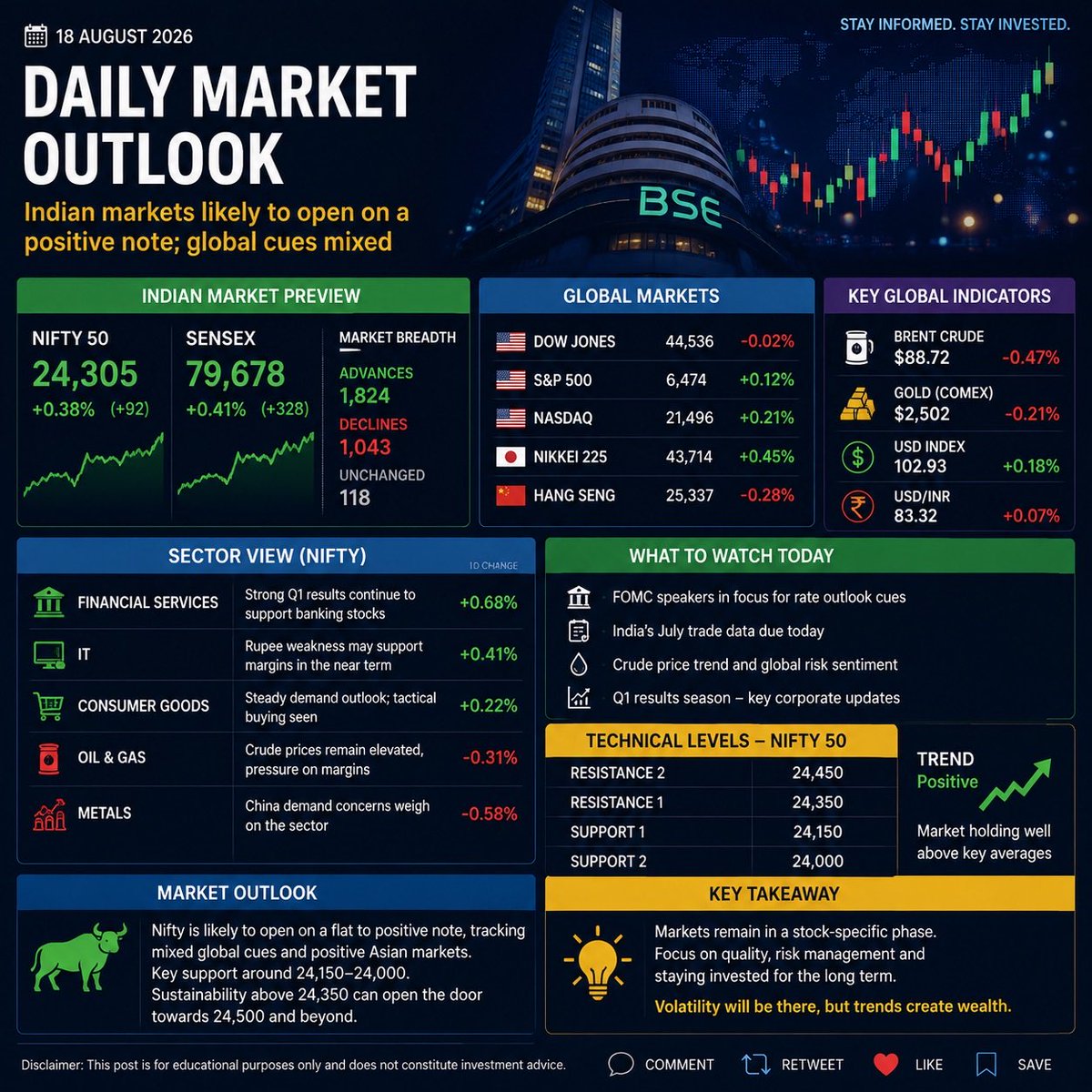
Institutions have pumped in more than 20000 Crores in August.
Still markets keep falling.
What can make this market to move higher?
Note: No political comments please.