Kuthampully was indeed a revelation. You hardly know anything about your own neighborhood.
Village on the banks of the Bharathappuzha, synonymous with traditional handloom industry.
Thrissur Dt, but very Palakkadan vibes.
https://t.co/1UtVT91JuB
This is quite a bit of overselling. These side channels are well known in hardware and low level security circuits. Even many more than these.
Similarly someone else posted "look models are communicating through images here" while all they were doing was using more code or binary in the images. Techniques that were used a long time ago or in movies.
Agents aren't discovering any new things here. They are using well known ways to communicate.
It is important to understand that all these decades of security research is indeed something to pay attention to and fix in the light of AI.
But it is irresponsible to put them forward in a way that induces panic by anthropomorphizing models/agents or by implying that they are doing something completely unknown to humans.
Wild story: the Python semantics Anthropic used was defined at Brown by @JoePolitz and students from a *MOOC*. Summary here, which also explains what Anthropic depends on:
https://t.co/Uszobto20P
Funnily, the last sentence says, "Once again, machines may put people out of work".
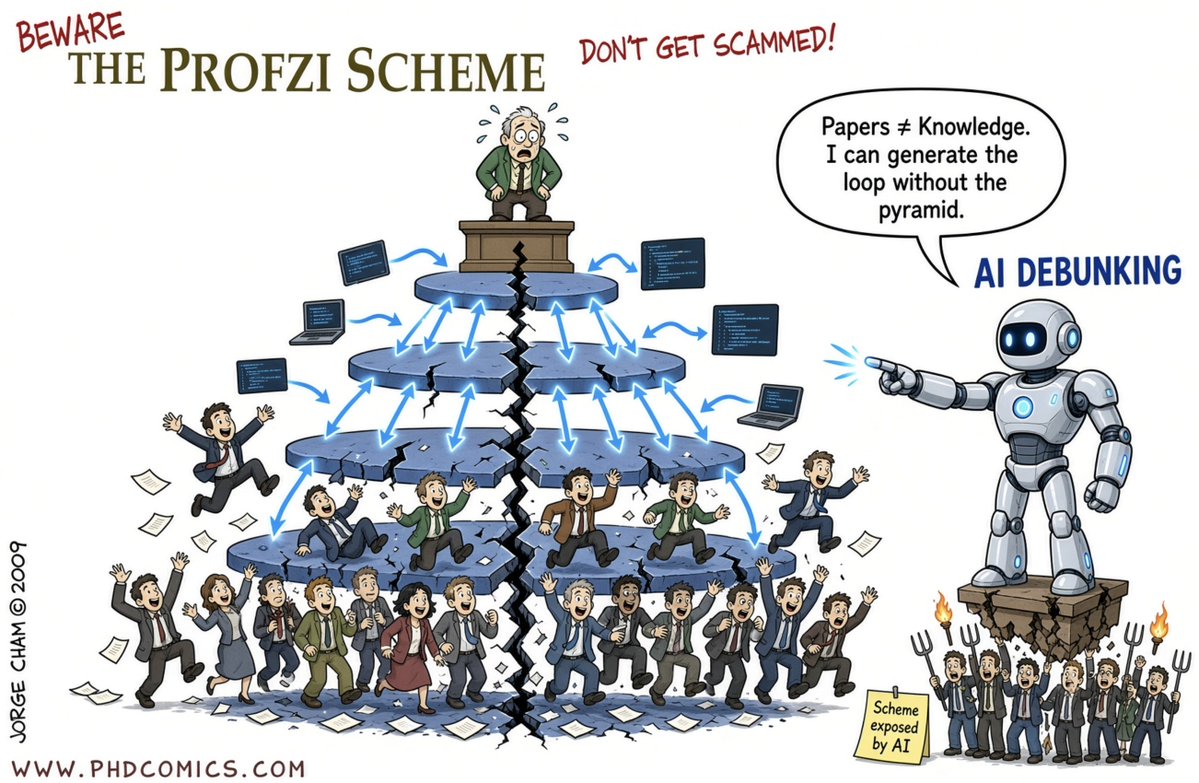
The profzi scheme is a famous comic from Jorge Cham. It compares academia to a Ponzi scheme: many students work for a professor to produce more papers. The professor takes credit for all the paper, but few of the advisee will have a great academic career because... the whole thing is pyramidal... the numbers don't add up.
The whole operation is largely sterile and only works due to the pretence that producing peer reviewed research papers is equivalent (synonymous) to producing new, valuable, knowledge.
What happens if AI can produce the papers?
The scheme is exposed.
We see it in mathematics right now. The AIs sidestep the entire peer-review process... and provide correct proofs to what was considered by the math establishment as the important problems.
These people are very angry.
It is the great AI debunking.
So what is the solution? Go back to what should always have been. The purpose of research should never have been to produce peer-reviewed papers. This was always a perversion. (For people who do not read me regularly, the peer-review model became dominant in the 1970, it is a recent addition.)
The purpose, of course, is to solve problems that people care about. That's much more difficult than producing papers... so it puts the bar much higher for scientists and researchers. But the bar should never have been lowered in the first place.
What happens to the 'profzi scheme'? I predict, I hope, that it will fall. Not all of a sudden, but once the system come to the realization that the production of papers is a solved problem, AI can do it better than us... then it won't be decades before students start worrying about where the train is headed.
(The comic attached is AI generated. Obviously.)
I've received a lot of encouraging feedback on my book on virtual memory from engineers and students.
But this morning, I was pleasantly surprised to see a 5-star rating from Prof. Nectarios Koziris of the National Technical University of Athens, who has spent decades researching and teaching computer architecture and high-performance computing.
It feels very rewarding to receive appreciation from someone with deep expertise in the field.
My advice to juniors is simple:
Dont be a prompt engineer, it takes no skill.
Do:
- learn math
- learn to code
- build from first principles
Go as far as you can with math.
Learn to code well. Start with the @handmade_net crowd.
Build whatever interests you from scratch: llms, game engines, compilers, etc.
They key here is building systems you understand inside out. Just reading about it isnt good enough, let alone letting ai do it for you.
You have to put the reps in.
There is a tidal wave of slop being built by many who have never done the above, and someone will have to fix all that down the road.
Be that someone.
There's something particularly boneheaded and perverse about doing demoscene-related things with AI.
The entire field is about acquired personal skill and the respect that is derived from that. Demoscene slop is not just made wrongly but fully discredits the poster.
@copyninja_ Just that the usual concerns of most FOSS projects (which are not corporate-funded to the extend the kernel project is) regarding LLM usage do not apply to the kernel project.
More than 80% of Linux kernel development is done by professionals employed at companies like Intel, Google, IBM etc (looks like this has been the case for a long time).
The kernel is basically a corporate project.
As long as these companies want to keep the kernel around, everything will be fine; nothing else really matters.
Linus's strongly pro-AI stance should be seen in this context.
omg this sh*t is ableist as hell
Just wait until nobody cares to send patches to your stupid mailing lists. In a few years, it will cease to be a way to prove a person's competence. Everyone will have their own kernel fork instead. You guys can just entertain yourselves.
One of Budget 2026-27’s good proposal - 5 university townships envisaged as integrated academic zones built beside major industrial and logistics corridors. 🎓
Five states are in contention
Coimbatore, Tamil Nadu
Jagiroad, Assam
Dholera, Gujarat
Amaravati, Andhra Pradesh
Odisha (Bhubaneswar, Sambalpur or Koraput)
The states must compete for a township through a challenge-based process
The idea is based on South Korea’s Daedeok Innopolis turned research into tech companies, and China’s Guangzhou Higher Education Mega Center clustered whole campuses into one hub. via @bsindia
I am so much more exhausted when I program with AI than without it. I reflected a bit, and I think I know why.
First, I think about how to solve a problem. This step is the same with and without AI. Then, with AI I have to write a prompt with a decent bit of precision and somewhat more long-term than if I just jumped into straight implementing it and figuring out the details as I go.
Then you start up the agent, and you immediately have some other work to do and you jump to another prompt for another task, where you also think really hard and try to formulate what you want quite well.
By the time you're done, first agent has some code for you to review, and you can't slack - you need to actually review it and be diligent about it. And when you're done - second task is there for your review. So really there's not time to rest.
When I program manually, I can decompress while typing the code in, I can rely on my muscle memory for typing and navigating the codebase, so there's periods of deep think and some relaxation. With AI, there's only deep think. And as soon as you try to think less - you open the doors for slop.
It's so tiring.