Associate Professor @ Ritsumeikan University. Mostly working on Labor, Development, Econ History, and Political Economy. Opinions not endorsement. Also ଓଡିଆ.
@soumitrashukla9 I so agree. I have used it a lot for my slides in the EEA-ESEM presentation in Dublin last week!
Once I picked the style, Codex/ChatGPT delivered strongly.
📢 Call for Papers: The Society of Labor Economists’ 30th Annual Meeting will be held April 30–May 1, 2027, at the Hyatt Regency Baltimore.
Submit complete papers for full or poster sessions via MiraSmart. Submissions open August 31. https://t.co/iNxwNRpUW3
Sharing a pre-doc opportunity at Microsoft Research, Bengaluru, with Gareth Nellis + co. On AI, public health + education. Details: https://t.co/p4wKI3TZcL.
The economic consequences of Mr. Modi
By most measures, India has grown rapidly under Modi. But less so than its peers and past trajectory would have predicted, per @rgrier88 & @ez_angus.
https://t.co/AybNNps081
Every district in India and the schools its children actually go to (on a single map).
I built a small, free portal from public UDISE data. Click any district to see its class sizes and whether its schools have basic facilities...
https://t.co/wCAi3bZpTg
Very excited to see our paper forthcoming in the QJE!
Our publicly available database on hours worked, disaggregated by age, gender, and other socioeconomic characteristics, can be found here:
https://t.co/KHp1VxdTuI
Now forthcoming in @JEEA_News - "Going Viral" (with @dyanagizawa, @brunocaprettini, @mcaesmann). We use ultra-granular data on local polling boths and marching routes to show that in 1932 Hamburg, people who saw a Nazi march *massively* swung to the party. Black line= march.
I stumbled across a version of this during the sampling process for my job-market paper in Malawi. One sampled “village” was really an incredibly dense peri-urban slum. The census counts were off by a factor of 5. They just skipped tons of people.
I’m really excited about this paper! Some of my work has pointed out problems in empirical work, but this one is all about new 🔧s.
If you (or your referees) want to know about the mechanisms by which a treatment affects an outcome, you may be interested. A 🧵.
1/ Economists: I’ve launched a small project to make AI coding tools actually useful for your day‑to‑day work.
Awesome Econ AI Stuff – a growing collection of reusable AI “skills” for Claude Code, Cursor and Gemini CLI, tailored to empirical + theoretical economics. https://t.co/IdLIprWnr9
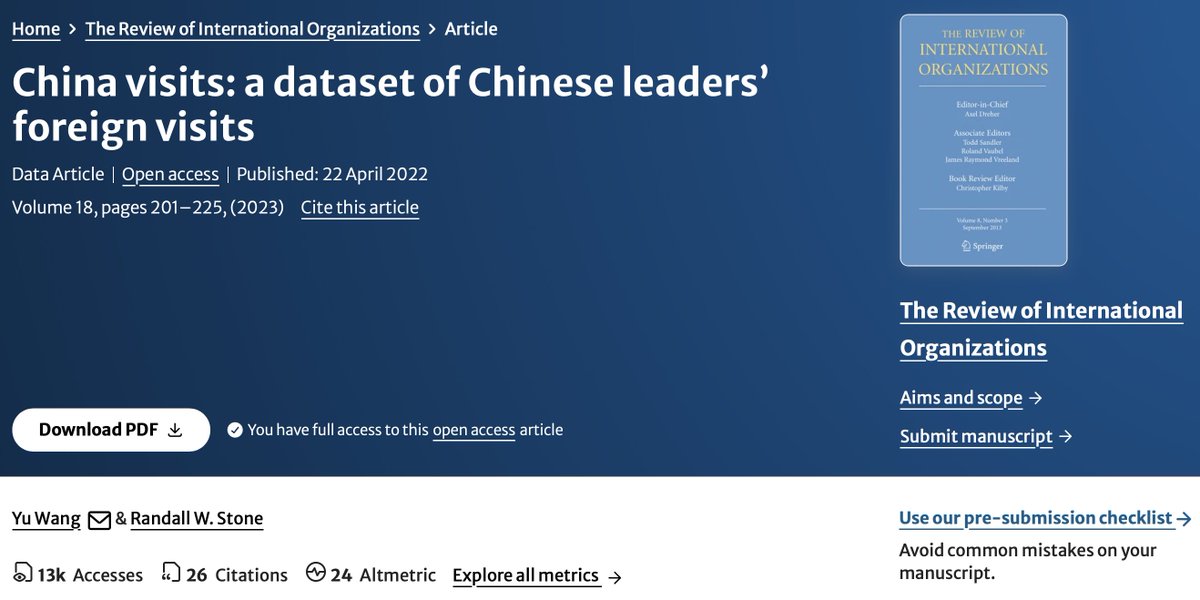
We are releasing the 2024 version of our dataset in "China Visits: a Dataset of Chinese Leaders' Foreign Visits"
@The_PEIO .
The dataset should be useful to scholars in #InternationalRelations#InternationalPoliticalEconomy
Harvard Dataverse: https://t.co/jd75DffOuG
📊 Are you looking to expand your data analysis and presentation skills? It starts with a strong foundation in probability and statistics—join our free online course, Data Analysis for Social Scientists, taught by Nobel Prize-winner Esther Duflo and fellow MIT economist Sara Fisher Ellison. It starts *tomorrow* !
Enroll now: https://t.co/gO2ASpJphl