Built an AI team that ships products.
PM, dev, code reviewer, QA. All agents.
I only talk to the PM.
Live teardown tomorrow at our Noida office. 20 seats.
https://t.co/9f4yHcYTCZ
VIDEO | Global Fintech Fest: Reeju Datta, Co-Founder, Cashfree Payments, says, “Cashfree is a payment aggregator, so we work largely with startups as well as large enterprises. We help them come online and start selling globally and within India using all the payment methods. I think this is a great opportunity for us to meet our existing partners, existing banking partners, existing network partners, and existing merchants, as well as make new connections, find new merchants and new partners. As you can see, there has been a steady stream of people visiting, and that's the beauty of GFF.”
(Full video available on PTI Videos - https://t.co/bIyFWTfmBd)
India’s neobank wave looked promising. But what did Better Capital learn from backing the sector early?
In his guest post, founder @vaibhavbetter reflects on the banking licence challenge, early fintech bets and how Slice’s full-stack approach changed the game.
https://t.co/eEJ4nqXzbS
We just launched ARBR on Product Hunt. It’s an open-source project we have been building to help teams manage and route requests across multiple AI models.
Do check it out and upvote.
https://t.co/pfiar74tjA
Home cooking can change your life. And there is very little doubt about it.
But there is also little doubt that the vast majority of households in India simply do not have the time for home cooked meals, even after understanding that it is likely the best thing they can do for themselves.
That is why we are building Tossit - a simple experience for you to enjoy home cooked meals in the comfort of your home, as per your nuanced preferences and at the hygiene bar of your kitchen (and even better!).
Open Tossit. Choose what you'd like to eat (this is increasingly personalised based on your usage). And a Tossit Cook trained in that specific recipe will be in your kitchen in 30 minutes cooking it up - your choice, your kitchen, your preferences, your home.
We believe this is the largest opportunity that has not been delivered the right way yet and the full stack of tech and services are not ready to make it happen.
So go ahead and @Tossit_now - Snehith and team are at your service in HSR, Harlur and Bellandur in Bangalore.
Please chime in with all your comments and feedback. 🙏
Want to work with me and other brilliant engineers at @SarvamAI shipping #KMP and #AI to billions of Indians?
You'll work on both mobile and desktop targets with #CMP / #KMP#Kotlin
Apply here: https://t.co/II590u2N2F
🚩 Same quote. Same price. Different specifications.
That’s where construction costs can quietly hide.
Before you compare the number, compare what’s actually specified. https://t.co/2idFiq9BPy
Today we're launching Arbr.
Every team building with AI right now is quietly giving up control. Over which models they run. Over their data. Over what happens when a provider changes a price, deprecates a model, or ships an update that breaks production.
Arbr is about taking that back. We're calling it what it is: independence.
Independence from model lock-in. Route every call across any provider. Switch models without rewriting your stack.
Independence from vendor lock-in. Self-hosted, MIT licensed. Runs on your own infra, not a SaaS you rent.
Independence from model churn. New models ship every week. Shadow test and adopt them safely, on your terms, without betting production on a version bump.
Independence from flying blind. See every call. Score quality on live traffic. Turn what you learn into training data you own.
Arbr is the open control plane for AI workloads. Route, govern, observe, evaluate, capture, deploy. All self-hosted, all open source.
The closed stack was never going to give you independence. So we built the open one.
This is year one. Go try it, star it if it resonates, and tell us what breaks.
LINK IN THE FIRST COMMENT.
What this country needs is more businesses that try to do more than just business, businesses that give back to the communities and ecosystems they depend on.
In that sense, we need more businesses that don’t just take value from the system, but actively put value back into it.
@akshayakalpa is one of them, and that’s one of the reasons we invested.
@thiruka and the team are building a business for profit, of course, but profit isn’t the only motivation. There’s also a genuine desire to improve the lives of the communities around them and build in a way that can sustain itself over the long term. That mindset is still relatively rare.
You can see it in the way they work with farmers, helping new farmers get started, helping existing farmers improve their incomes and farming practices, and investing in ways that can create new livelihoods in rural communities.
We’ve been working on something new called Rainmatter Originals. The idea is simple: to tell stories about entrepreneurs who are trying unusual things and building businesses differently.
And we couldn’t think of a better story to begin with than Shashi and Akshayakalpa.
A lot of sweat and tears went into making this video. No blood, thankfully. 🙂
If you’ve ever wondered whether there are different ways to build a business from much of what we see around us today, I think you’ll find their story interesting.
Watch it and let us know what you think of our first Rainmatter Original. Full episode link in comments.
Met an Indian startup last week that built a high end ICU ventilator in just 84 days. The founders are 30yo engineers with no prior medical device experience. Today, 260 of their ventilators are being used by hospitals across India. The company has a team of 50+ people, is profitable and is competing head-on with global brands like Philips. India’s healthcare problems are massive, but they are not unsolvable. The more healthcare startups I meet, the more optimistic I feel about the future of Indian healthcare.
Hundreds of determined engineers and doctors are working together to build a healthcare system that will look radically different a decade from now.
A casual visit to our senior propulsion scientist, Mr. Gnanagandhi’s home, became one of the most memorable moments after Vikram-1.
To my surprise, hundreds of children and families from his apartment community had gathered with endless questions about rockets, propulsion, and space.
It felt especially meaningful because Mr. Gnanagandhi has been a pillar of Skyroot’s journey and one of the key contributors to Vikram-1. Seeing the community celebrate him and the mission was truly heartwarming.
The true impact of a launch isn’t just reaching orbit—it’s inspiring young minds to dream bigger. 🚀
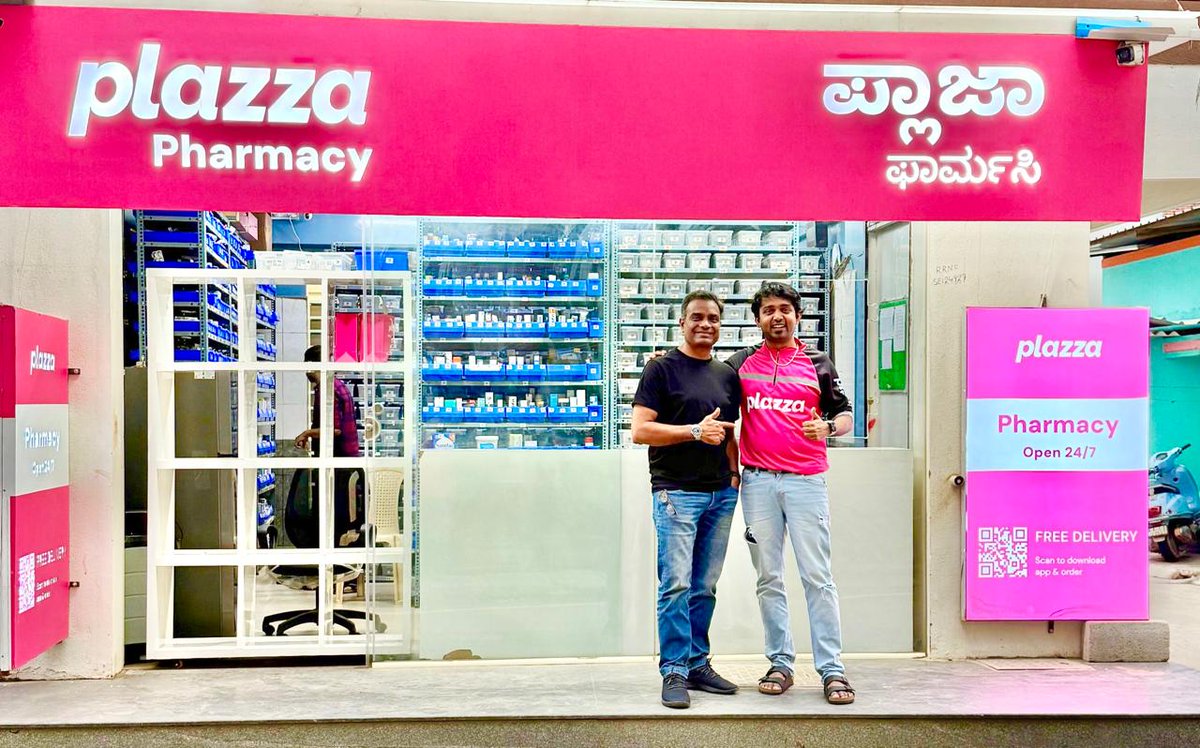
We have invested heavily in our "Quick India Movement" thesis since 2023/2204 so when Plazza came along it was a no-brainer because we were already clear on how broken the customer experience was and Aman Priyadarshi had THE clearest articulation of the entire problem AND the solution.
This was a one call commit for us - my long zoom call with Aman ended with a clear and firm commitment to invest right there with no qualifications whatsoever...Aman was THAT good on that call. He took the call from the Plazza store, his store members were moving around in the background, he was wearing the Plazza gear (which is the only thing he always wears) and appeared like he had just come back from delivering an order (which might have been the case) and during our discussion he would walk towards the shelf behind him to grab a medicine to show me the QR code he was adding to them to explain how to use them etc. It was a like a pitch and a live demo all in one right from the store. I had never seen anything like that.
Over the next several months, I saw Aman and team execute every piece of the puzzle brick by brick to create a machine like nothing else.
We are have along way to go but I am amazed how far we have come in such a short time, how many pitfalls and mountains we have tackled and excited to be a tiny part of this mission.
Super grateful to all friends and co-investors in this round - $15M Series A led by Accel, Nexus Venture Partners and Elevation Capital - as well as the founding stage one, All In Capital. They say it takes a village and this is one incredible village assembling around Aman and Plazza.
Kudos team, and thank you for bringing us along for the ride!
For decades, India imported critical minerals
(And China dominated the supply chain)
But now, this Indian startup is trying to rewrite this equation.
With 47 global patents and world-leading recycling tech, they claim India can meet up to 75% of rare earth demand domestically through recycling.
This is not waste management any more.
It is strategic independence!
You can make India Atmanirbhar!
(By not throwing away your phone)
Believe us when we say that your old electronics may be more strategic than oil.
Today, India imports almost every major critical mineral while running a massive trade deficit with China.
Now deeptech recycling startups believe India can recover 30–75% of its metal needs domestically.
Waste is slowly becoming national infrastructure. 👇
Why does India need deep-tech recycling?
Because a discarded phone once meant toxic pollution, billions in economic losses and workers with an average lifespan of just 27 years.
This company formalized the supply chain, reduced hazardous work and transformed waste into strategic value for the nation.
Watch the complete episode to know more!
He didn't wait for the ecosystem to exist !
(Instead he chose to build it from scratch)
In 2008, there was no supply chain, no regulation and no market for e-waste deeptech in India.
So they built AI-powered platforms, organized the industry and created the infrastructure from scratch which is now powering this Rs.1000 crore revenue giant called Attero.
He left US to build in India !
(For deeptech nation-building)
This is the story of an IIT Delhi engineer returning home to solve one of India’s hardest problems: critical minerals and recycling.
A decision taken 18 years back is now turning out to be a key geopolitical leverage for India.
Akshayakalpa has 13 years of data showing that simply introducing bee boxes increases the average coconut yield per farm by 20%. It’s such a massive win-win that they’ve now integrated 7,500 bee boxes across all their farms.
Shashi from @akshayakalpa recently brought over two bee boxes for my home to get us started with beekeeping. In this clip (full video in comments), he walks through how incredibly simple it is to set up a bee home, even in smaller or semi-urban spaces.
The bigger takeaway here is about how we view sustainability. We often look for grand, complex technological solutions to environmental issues. But the reality is that our survival is deeply tied to basic, interconnected ecosystems.
Without pollinators, our food systems collapse; roughly a third of what we eat depends entirely on them. Taking care of them isn't just a good deed; it's an absolute necessity for our own survival. And I think education is the key, which maybe the bee boxes in urban spaces can do.
Can’t be prouder of everything that the Akshayakalpa team is doing for improving the quality of life of farmers, their economics, their cows, and everything else.