NDA'S UPI CLARIFICATION: 6 KEY POINTS
1. 0.4% MDR ABOVE Rs 2,000
UPI merchant payments above Rs 2,000 will attract a nominal 0.4% MDR, shared across the payment ecosystem.
2. Rs 300 MAXIMUM ON BIG PAYMENTS
For UPI payments of Rs 75,000 and above, MDR will be capped at Rs 300 per transaction.
3. Rs 5 FLAT FEE FOR ESSENTIAL SERVICES
Railways, telecom, insurance, fuel, agriculture inputs and other essential sectors will pay just Rs 5 MDR per transaction above Rs 2,000.
4. CAPITAL MARKET PAYMENTS: JUST 0.02%
UPI payments to mutual funds, stock brokers, securities and dealers will attract 0.02% MDR, capped at Rs 300.
5. SMALL VENDORS: ZERO MDR
Small merchants receiving up to Rs 1 lakh a month through UPI QR will continue to pay zero MDR under the P2PM framework.
6. SMALL PAYMENTS PROTECTED
The framework keeps everyday small UPI payments free, while introducing nominal charges on selected higher-value merchant transactions.
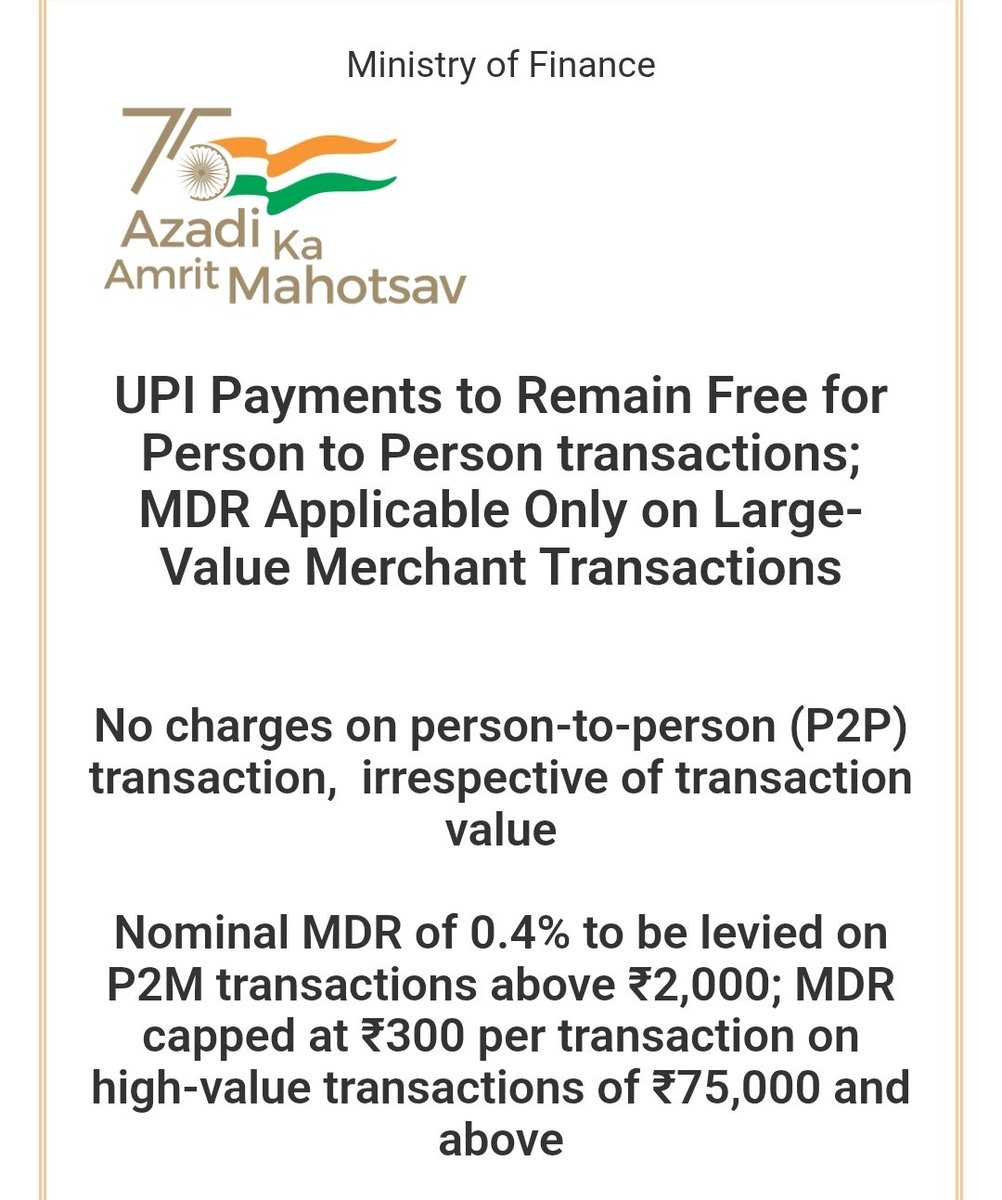
Ministry of Finance says, "UPI Payments to Remain Free for Person to Person transactions; MDR Applicable Only on Large-Value Merchant Transactions
No charges on person-to-person (P2P) transaction, irrespective of transaction value
Nominal MDR of 0.4% to be levied on P2M transactions above Rs 2,000; MDR capped at Rs 300 per transaction on high-value transactions of Rs 75,000 and above."
Shocking news coming out of Mumbai. Two Income Tax officials, including an IT Inspector, have been arrested by the Andheri police for conspiring with impersonators to stage a fake tax raid and attempt a ₹1 crore extortion scheme targeting a local businessman.
What made this case so egregious was the high-handed response when the taxpayer stood his ground—demanding a formal statutory notice and offering to pay dues directly to the department instead of handing over cash. In response, the perpetrators threatened him with arrest and inflated penalties.
Key takeaways for taxpayers and businesses:
Insist on Formal Notices: Never settle demands in cash or yield to verbal threats. Always demand official written notices/orders via official communication channels.
Verify Official Credentials: Verify DIN (Document Identification Number) on official communications and cross-check the credentials of visiting officials through statutory portals.
Stand Your Ground: Courage and adherence to legal protocol are the strongest defenses against extortion and administrative abuse.
A strong reminder that compliance transparency works both ways—and remaining vigilant about statutory due process protects your business.
To be alive in India:
1) Even if you aren’t wrong, say sorry and move on. Don’t get into arguments on the road with anyone. Control your anger and move on. Nothing is worth risking your life over.
2) Live in a good gated community that matches your social wavelength. Not saying this because I’m in this business. It genuinely saves you from a lot of unnecessary problems.
3) Buy a car as soon as you can. Even if you’re a safe two wheeler rider, Indian roads can disappoint you and sometimes, the consequences can cost your family a lot.
4) Don’t drive fast just because the road is empty. You can control your driving. You can’t control the idiot coming from the opposite direction.
5) Don’t pick fights with strangers. You have no idea who they are, what they are capable of, or what they are carrying. Walk away.
6)If you’re travelling late at night, use the safest option available. Saving ₹500 is not worth putting yourself in a situation you can’t control. Skip night drives > 30 km post 11 PM as much as possible.
7)Avoid roadside food as much as possible. It may look tempting and harmless, but hygiene, water quality, oil quality and food storage are things you simply cannot control.
The Centre for Audit Quality Committee of ICAI has developed an ICAI MSME Verification Tool to assist auditors in examining the MSME status of suppliers.
It is in the form of an executable (.exe) file which can fetch and compile data from the Udyam portal.
Smart features of the tool:
•Fast & accurate verification
•Easy data upload (CSV/Excel or manual)
•Real-time dashboard with clear status updates
•Distinguishes Micro, Small and Medium enterprises
•Identifies activities as Trading, Service and Manufacturing
•Indicates whether the MSME registration is currently active or not
Download the Tool using the Link: https://t.co/D0NTemk9ss
5% is the number deciding if your tax audit limit is Rs 1 crore or Rs 10 crore.
Most business owners have no idea this number even exists.
Here is the full tax audit rule for AY 2026-27 👇
*No Rs 75,000 Fee for Tax Audit Delay in AY 2026-27 - New Fee Structure Applicable Only From Next Year*
*Complete Clarification:*
Tax Audit season for AY 2026-27 is starting tomorrow and many professional groups are panicking about Rs 75,000 Late Fee for Tax Audit Report delays.
Please Do Not Panic. The Rs 75,000 fee is NOT applicable for AY 2026-27.
*What is the new provision?*
The proposed provision in Income Tax Act, 2025 under Section 428(c) provides:
- Delay up to 1 month in filing Tax Audit Report u/s 63: Fee of Rs 75,000
- Delay beyond 1 month: Fee of Rs 1,50,000
Even a one-day delay will fall under the Rs 75,000 slab. The fee is mandatory and fixed.
This is a major change from the existing law where penalty u/s 271B was 0.5% of turnover, subject to maximum Rs 1,50,000 and was discretionary. The penalty could be waived u/s 273B if reasonable cause was proved.
*Why it is NOT applicable now?*
As per Budget 2026 and Finance Bill 2026, this new fee structure will be effective from 1st April 2026 and will apply to Tax Year 2026-27 onwards, which means Assessment Year 2027-28 onwards.
There is no amendment in Section 271B of the Income-tax Act, 1961 for the current tax audit cycle.
*For AY 2026-27:*
- Due date for Tax Audit Report is 30th September 2026
- Existing penalty provisions of Section 271B will continue - 0.5% of turnover, max Rs 1,50,000, with relief for reasonable cause.
- No Rs 75,000 fixed fee for a one-day delay under the existing rules.
So for AY 2026-27 Tax Audit Reports, relax.
📌 GST Alert
SCN u/s 74 for FY 20-21 is time-barred as of 31.08.2026.
✅ Check your GST portal:
• SCN issued? → Comply within time
• No SCN? → FY 20-21 is effectively closed for adjudication u/s 74
⏳ Next Time-Barring Date:
SCN u/s 73 for FY 2022-23 → 30.09.26
What is going on, @GST_Council@cbic_india?
Why are taxpayers being unnecessarily harassed?
It feels as though officers have been given revenue targets, leading to notices being issued on every possible pretext just to meet those numbers.
Tax administration should be about fairness, clarity and compliance, not creating unnecessary litigation and harassment.
Please take note and put an end to this.
🚨 GST Department is now issuing notices on unpaid sundry creditors using invoice ageing. They start from creditors appearing in your Balance Sheet / financial statements / GSTR-9C, compare them with invoices older than 180 days, and raise demands for ITC reversal plus interest.
GST NOTICE OF THE DAY
Have you ever seen GST levied on “Sundry Creditors”? 😐
Apparently, there seems to be a new GST calculation methodology:
Step 1: Look at the Balance Sheet.
Step 2: Find “Sundry Creditors.”
Step 3: Assume every creditor has remained unpaid for more than 180 days.
Step 4: Take the entire closing balance of creditors.
Step 5: Apply 18% GST.
Step 6: Issue a notice. ✅
The reasoning?
“Payment has not been made within 180 days. Therefore, the entire ITC relating to sundry creditors has to be reversed and GST is payable.”
And the most interesting part?
The SCN itself says that once the taxpayer furnishes the creditor-wise details, the department will modify the figures.
So, what exactly is the approach here?
No detailed analysis.
No transaction-wise verification.
No attempt to understand the nature of the creditors.
Just pick a figure from the Balance Sheet, create a tax demand on the basis of assumptions, add a reason somehow, and issue a notice.
And if the taxpayer later provides the actual details, the figures can be modified.
Is this really how GST scrutiny is supposed to work? 🤔
Ram Bajaj
8696424223
For Regular GST Updates, Join this Group
https://t.co/H9LDAtzEua
A 1% GST rate sounds amazing.
So why doesn’t every small business choose Composition?
Because the lower rate is only one part of the equation.
Here’s the simple breakdown 👇
GST Notices:
Know the Form Before You Respond!
GST compliance is not just about filing returns it’s also about responding correctly to notices within the prescribed timeline.
From GSTR-3A, REG-03 & REG-17 to ASMT, DRC and Anti-Profiteering Notices, each notice has a specific purpose, response requirement and consequence if ignored.
⚠️ Ignoring a GST notice can lead to assessment, demand, penalty, cancellation, recovery proceedings or even prosecution.
Save this GST Notice Quick Reference for future use and share it with fellow professionals & taxpayers.
Follow the Tax Talk with CA Nitin Chawla A.C.C.A channel on WhatsApp: 👇 https://t.co/7KtKmuv6rW
#GST #GSTNotice #GSTCompliance #GSTUpdates #GSTPractitioner #Taxation #IndirectTax #CA #CharteredAccountant #ICAI #TaxProfessionals #GSTIndia #Finance #TaxTips
MASTER CHART ON CAPITAL GAIN -
This is probably the most-used Reference table in our office during tax season from the book ITRR 5.0 — whenever we need to decide the taxability of different asset classes, especially shares & securities.
Our most detailed one-page Capital Gain Master Chart, combining the period of holding and applicable tax rates.
And this is just one of the 100+ such insights, master charts and tabular references included in ITRR-5 for easy reference throughout the tax & audit season FOR YOU AND YOUR TEAM.
📘 ITRR–5 -35 Income Tax topics | 163 pages | Updated with Finance Act 2026 amendments
Here is Link for subscription & start reading instantly (₹175)
Link: https://t.co/HUBDGbxhJ4
CA HARSHIL SHETH
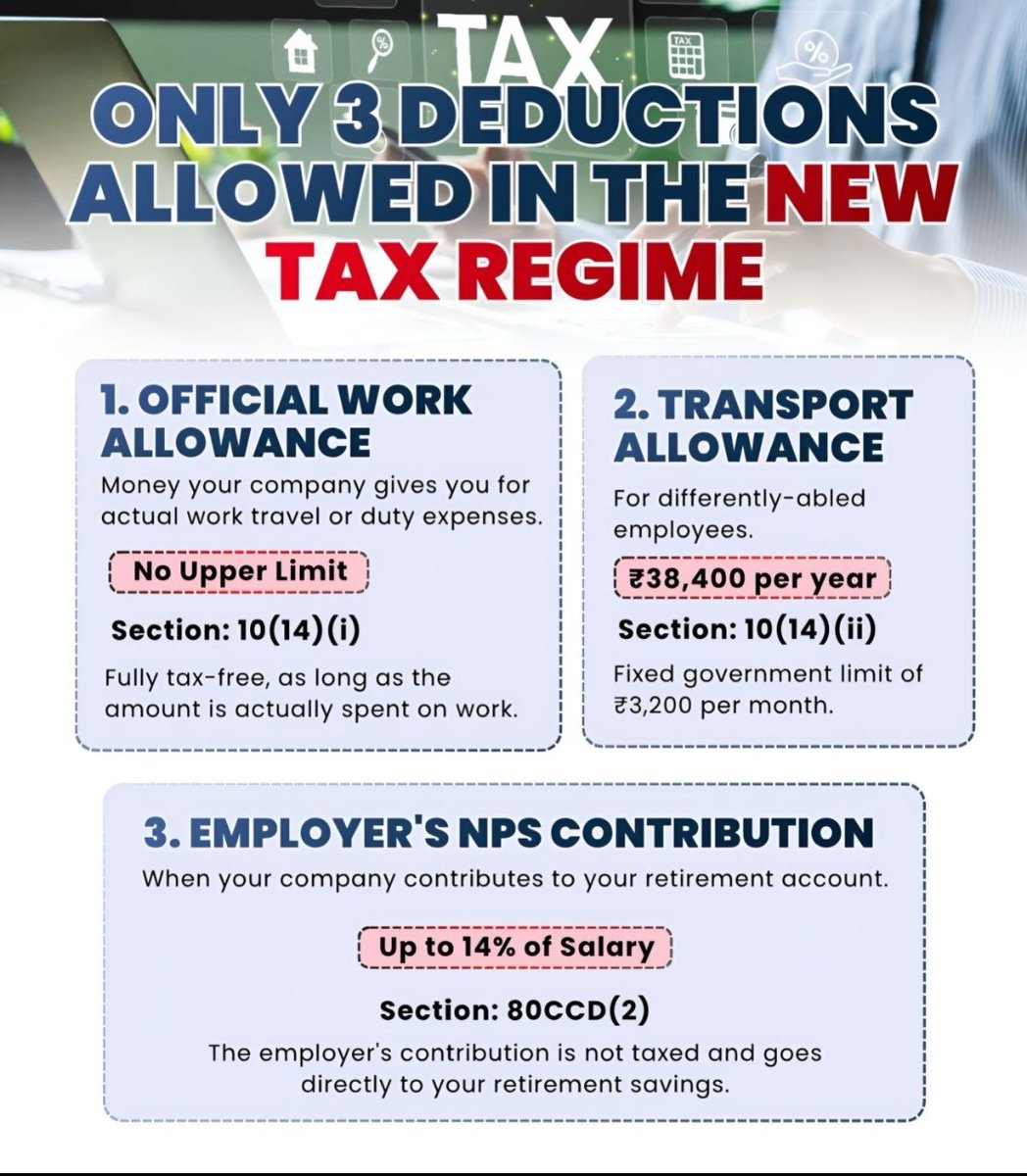
Think the New Tax Regime has no deductions? Think again! ✅
You can still claim several deductions and exemptions, including the ₹75,000 Standard Deduction, Employer's NPS contribution, and more.
Know what you're eligible for before filing your ITR.
Income up to ₹4 lakh is completely tax-free under the new tax regime.
If your total income is up to ₹12 lakh, you can claim rebate under Section 87A.
However, if your income is between ₹4 lakh and ₹12 lakh and includes capital gains or other special rate income, you may still have to pay tax on that portion of income.