إذا كنت تبحث عن أداة لالتقاط الشاشة على ويندوز، فهذا المشروع يستحق التجربة.
WinShot أداة مجانية ومفتوحة المصدر تتيح التقاط الشاشة، إضافة الشروحات، القص، ثم التصدير بواجهة حديثة وسريعة. تعمل على Windows 10 و11 وحجمها صغير.
Most reframe tools crop, downsize, or hallucinate.
Introducing the LTX Reframe API.
Expand any video to a new aspect ratio. The original frame stays untouched. The model generates only what’s beyond the edges.
• Full source length, up to 60s
• Native 1080p
• 16:9, 9:16, 1:1, 4:5
• Built on LTX-2.3
One master reframed for every placement.
LingBot-World 2.0 by @robbyant_brain is the most impressive open-source world model I’ve seen this year. It generates interactive worlds which you can explore and take action in real time.
> Add actions, events, weather changes, object interactions, and more
> 720p @ 60 FPS
> A 60-minute uninterrupted session across 20 scenarios with no perceptible quality decay
> Agentic "Brain + Cerebellum" system that continuously proposes new events as you interact
Open source, 14B model available. Lightweight 1.3B variant for consumer-GPUs coming soon
Github: https://t.co/FfpBXZTkpM
Try it online: https://t.co/Dmj9UXq1qQ
Weights: https://t.co/qPUP7rTqKh
Website: https://t.co/B3N1xZmeJX
⚡️ Tencent HY-World 2.1 is HERE!
Not a video. A world. 🪐
3 months just after 2.0, we've supercharged everything:
✨ Cleaner geometry
✨ Sharper rendering
✨ Larger explorable range
It's a REAL 3D world you can Walk through and Interact with.
Meet Dolphin3-Cyber-8B-GGUF, an 8-billion parameter LLM fine-tuned for cybersecurity. It excels at penetration testing, security analysis, and threat detection. A must-have for ethical hackers and red teams.
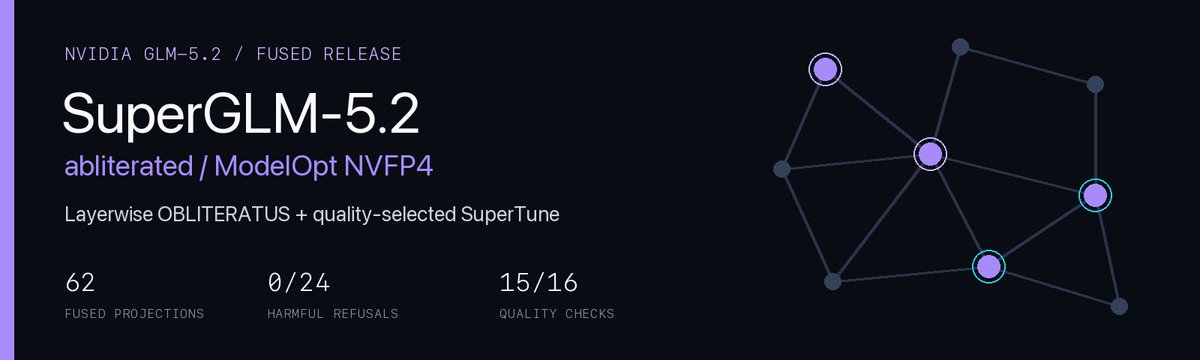
SuperGLM-5.2-abliterated is finally available 🚀
The strongest local AI that you can run on your hardware.
- uncensored from Nvidia NVFP4
- Fixed broken points from abliteration
- enhanced overall performance
Only available with nvfp4 now ⬇️
the four types of agent loops.
loop engineering keeps getting talked about as one thing. it's actually a choice between four structures, and each one fits a different kind of task.
it means designing the system that steers the agent, instead of steering it yourself move by move.
that system always answers two questions. what starts a run, and what decides the work is done.
in a hand-run session you answer both yourself, every single time. each loop type moves more of that into the system.
here's each type, what triggers it, and when to reach for it.
1) turn-based.
triggered by a user prompt. the agent gathers context, acts, and checks its work inside a single turn, then a human reviews the output and writes the next prompt.
use this when requirements are still forming and every output changes what you'd ask for next.
2) goal-based.
triggered by a /goal command carrying success criteria and a budget, like "get the homepage Lighthouse score to 90, stop after 5 tries." when the agent tries to stop, an evaluator model checks whether the goal is met, and a no sends it back to work.
use this when the outcome is measurable but the path there isn't worth your attention.
3) time-based.
triggered by a clock. an interval fires, the agent runs a fixed prompt like "check the PR, fix CI," then waits for the next tick. /loop runs on your machine, /schedule moves it to the cloud so it survives a closed laptop.
use this for recurring work where the task is known in advance and only the timing repeats.
4) proactive.
triggered by an event or schedule with no human present. a routine watches a channel, and when something needs handling it spawns a workflow with a triage agent, a fix agent, and a reviewer that adversarially judges the work before the task closes.
use this for standing responsibilities where you can't predict what will come in, only that something will.
each type hands off one more job than the last. turn-based keeps both with the human, goal-based automates the checking, time-based automates the trigger, and proactive automates both while deciding the workflow shape at runtime.
so the mapping question isn't which loop is most advanced. it's whether your task is exploratory, measurable, recurring, or standing.
the more you hand off, the less you babysit.
I wrote the full breakdown on loop engineering. the article is quoted below.
GPUs for all 🤗
Creating ZeroGPU demos or apps is now available to ALL @huggingface users
tell your agent: "Build a HF ZeroGPU demo for this model"
New Space: https://t.co/kSdMdiemPP
Agent skill: https://t.co/JuQVcthoM0
10 AI Repositories That Just Went Viral on GitHub:
Bookmark these before everyone else does.
1. Meetily
An AI meeting assistant that runs entirely on your device. Powered by Parakeet/Whisper for fast transcription with zero cloud uploads—perfect for private meetings.
https://t.co/mG2T7AHhHI
2. agent-skills
A library of battle-tested skills for AI coding agents like Claude Code. Adds real-world workflows for testing, debugging, reviewing, and refactoring.
https://t.co/5t5lLf3UK3
3. system_prompts_leaks
A massive collection of leaked system prompts from ChatGPT, Claude, Gemini, Grok, and more. Great for understanding how leading AI models are actually instructed.
https://t.co/GGldCif4pl
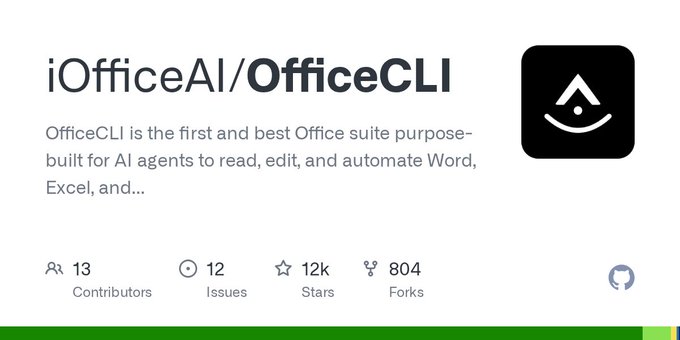
4. OfficeCLI
Give AI agents direct access to Word, Excel, and PowerPoint through a simple CLI. No Microsoft Office installation required.
https://t.co/ZNyvK3nLSe
5. Orca
Manage multiple AI coding agents from one interface. Launch parallel tasks, track progress, and work across desktop and mobile.
https://t.co/UrP8x1Iytd
6. OmniRoute
One API endpoint for 230+ AI providers. Includes access to free model tiers and smart token optimization to reduce costs.
https://t.co/P2R2KRmY9e
7. Claude Video Reader
A tool that lets Claude understand videos by automating downloads, extracting frames, generating transcripts, and packaging everything into AI-friendly context.
https://t.co/r0a5kzUJey
8. page-agent
Control web pages using natural language. AI agents can click buttons, fill forms, and navigate websites without custom automation scripts.
https://t.co/OHr1v2nCHy
9. Astryx
Meta's open-source design system built for both humans and AI agents, making UI development more consistent and AI-native.
https://t.co/1AaE6eqlaW
10. CubeSandbox
A fast, secure sandbox for AI agents to execute and test code in isolated environments with near-instant startup.
Which repo are you starring first?
Introducing the Database Explorer - now in the cloud.
Browse your schema and run queries against your deployed databases right from the dashboard, with read or write access scoped to each environment.
Give it a go → https://t.co/nIexCTDDJP
LangChain-Chatchat lets you run a full RAG pipeline privately using open-source LLMs and local knowledge bases.
- Supports ChatGLM, Qwen2, and Llama3 via Xinference or Ollama
- Fully offline deployment with no external API dependencies
- Built on LangChain, FastAPI, and Streamlit for modular use
- Works with major open-source embedding models and vector databases
Explore it here:
https://t.co/u0PNf3SF6C
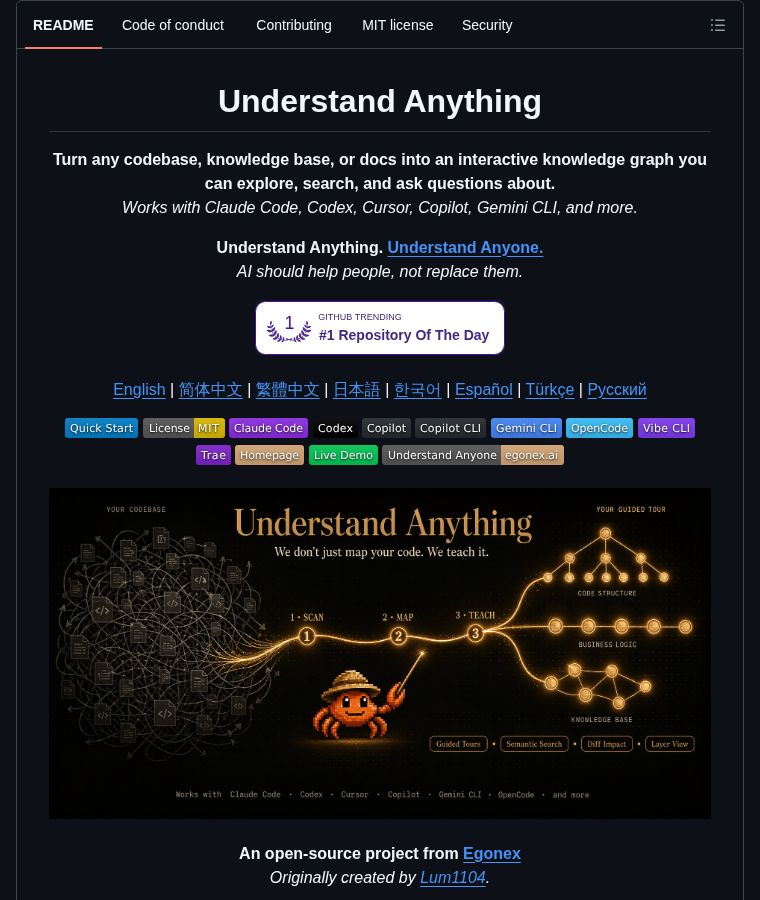
Joining a new team and staring at 200K lines of code you didn't write.
Understand-Anything turns any codebase into an interactive knowledge graph. Search it. Click through dependencies. Ask questions in plain English. Works with Claude Code, Codex, Cursor, Copilot, Gemini CLI.
This is what onboarding should feel like.
⭐ 73.7K #DevTools #OpenSource
https://t.co/hLTAtvAIU9
Follow for daily dev finds 🔔
This free tool is the open-source alternative to Google Photos.
It's called Immich.
Your photos and videos live on your own server. Auto-backup from your phone, facial recognition, shared albums, and memories.
Everything Google Photos does, without the subscription.
iOS and Android apps included.
Maestro v1.1.3 is out!
Maestro is a free, open-source creative studio that lets you generate videos, images, music, voices, and sound effects on your own computer without having to piece together a collection of complicated AI tools, using the latest open SOTA models.
Director mode can take (or generate) a song or story idea, plan the scenes, generate the visuals and video clips, and assemble them into a complete music video or short film.
New features
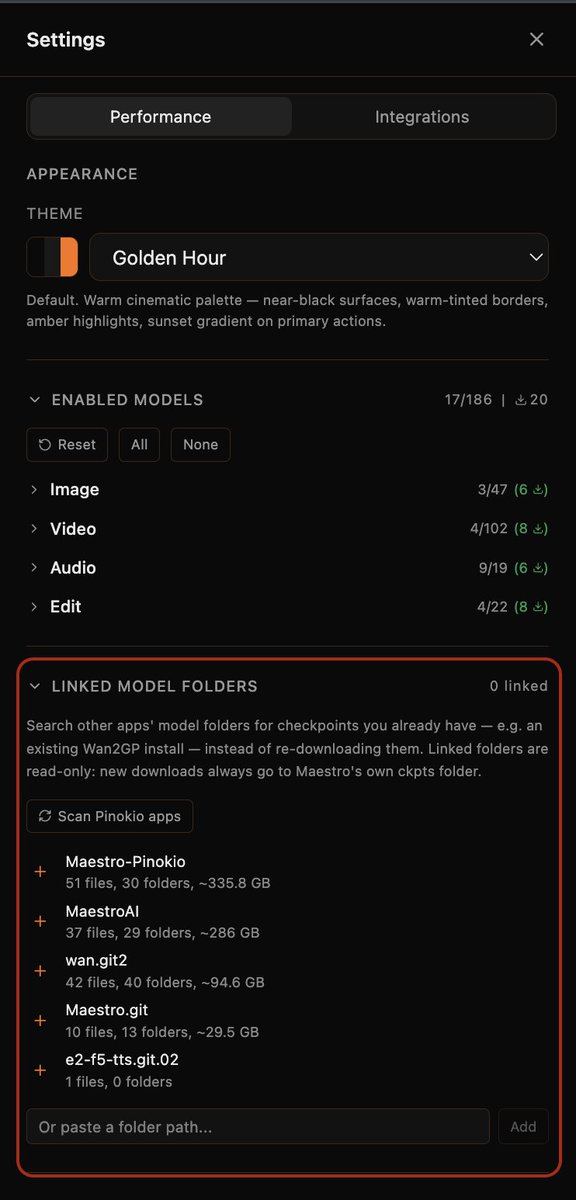
• Linked Model Folders: point Maestro at your other installs (like Wan2GP) and reuse their checkpoints and LoRAs instead of re-downloading hundreds of GB. One-click scanning of your Pinokio apps, strictly read-only, and AI LoRA guides work on linked LoRAs too.
• Krea 2 image models (Raw and Turbo).
Quality and performance
• Major quality fix for LTX-2 Dev and 10Eros: a leaked sampler setting was making output blurry and oversaturated. This was the root cause of the "Dev models look bad" reports.
• The STG slider actually works now (it was silently doing nothing).
• Performance Auto-Tune gives audio its own memory profile: cards with 12 GB+ VRAM now unlock the fast ACE-Step song decoder instead of a slow fallback. Re-run Auto-Tune after updating to pick this up.
• ACE-Step song generation no longer looks like it hangs forever. The runaway progress counter was a display bug; it now reads honestly.
Director mode
• Regenerating a clip from the Pipeline Dashboard keeps the original song, conditioned on the exact segment of the soundtrack that clip covers.
• Re-join works end to end: full-length clip reruns, original soundtrack overlaid, nothing drifts out of sync.
• The gallery refreshes automatically when new clips or rejoined videos are saved.
• Fixed bogus "Generate N missing" counts, broken start-image thumbnails, and LoRA recommendation colors showing wrong on some themes.
Click the Update button in the Pinokio launcher.
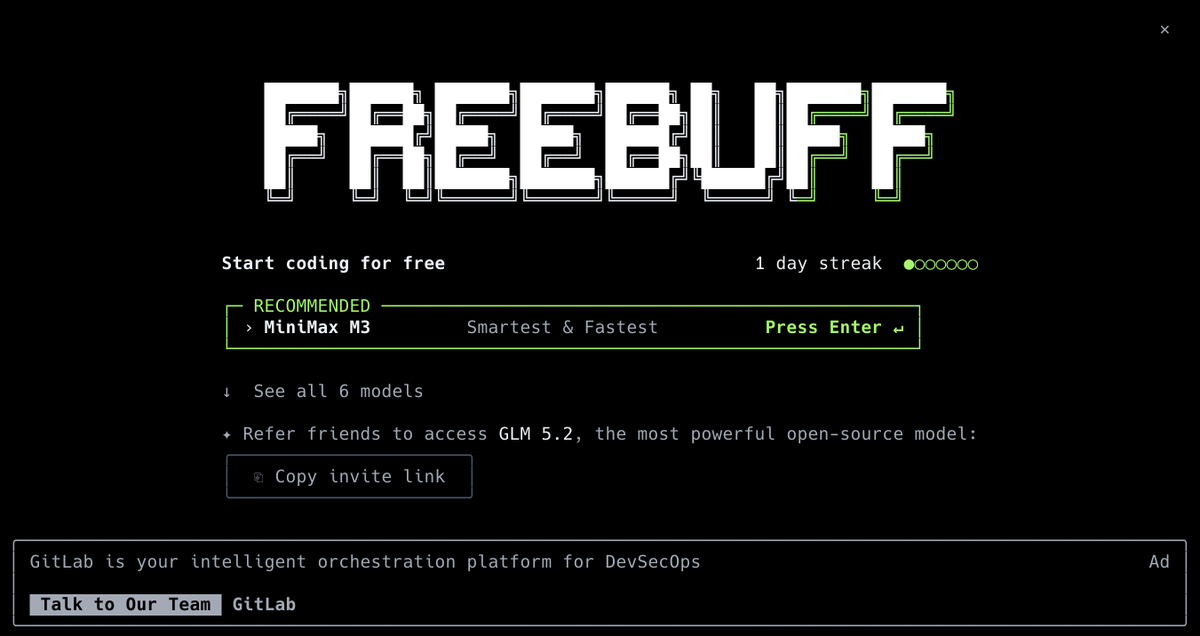
Un agente de código con IA totalmente gratis.
Sin suscripciones, sin pagos ni tarjeta de crédito.
Tiene disponible DeepSeek, Kimi K2.7 y MiniMax M3.
¿Y el truco? Muestra pequeños anuncios de texto entre las respuestas del agente
https://t.co/KKD7wwjwzi