🚨 Nightmare day for cybersecurity
Multiple major security incidents, active exploits, supply chain compromises...
If you run production systems, start patching NOW.
PHP: Two critical unauthenticated RCEs. Attackers already exploiting them. Patch NOW
LiteLLM: v1.107.0 on PyPI and Docker is BACKDOORED. Steals cloud, SSH, and AI credentials. Pin 1.106.2. Rotate secrets.
eMudhra: A certificate authority's keys were crackable. Update your browsers, systems, and trust stores.
Node.js / Next.js / React: Security releases for Brotli RCE, TLS bypasses, and TWO critical Next.js RCEs.
TiDB Cloud: PingCAP breached through stolen credentials. Customer information and other sensitive data exfiltrated. Read the attacker's release, fun stuff.
Plex2Shell: Weaponized within HOURS of the PoC. Attackers already deploying cryptominers and proxy backdoors.
BeyondTrust / Ivanti: Actively exploited zero-days added to CISA's KEV catalog. BeyondTrust attacks linked to a China-nexus campaign.
And that's not even the full list.
Patch. Audit. Rotate. NOW.
One of the rarest sights in Indian Railways: an electric locomotive-hauled train running without overhead electric wires!
This unusual operation is currently seen on two routes in India, the Ramanathapuram–Rameshwaram section in Tamil Nadu and the Mysuru–Chamarajanagar section in Karnataka.
But why is a small portion of these otherwise electrified routes still without overhead wires, while electric locomotives continue to operate on them? The core reason is airports and aviation operations.
On the Ramanathapuram–Rameshwaram route, the railway line passes close to a Naval air base, while on the Mysuru–Chamarajanagar route, it runs near Mysuru Airport. During electrification, concerns were raised about overhead equipment in the vicinity of active runways and its potential impact on flight operations.
As a result, while most of both routes were electrified, these small sections were left without overhead electric supply.
But Indian Railways still wanted to operate electric locomotives on the routes. So, a rather unusual solution is used: trains accelerate to their permissible speed before entering the non-electrified section and then roll through it using their momentum before reaching the electrified section again.
It sounds like a hack, but this is an actual operational practice, making it one of the most unusual electric-train operations you can spot in Indian Railways.
And yes, there have even been instances on these sections where a train reportedly got stuck after losing momentum in the non-electrified zone! :)
Stop doomscrolling.
10 Long-Form Reads Every Software Engineer Should Bookmark 📗
1. Learn in Public — swyx
https://t.co/VaQQJOV9hK
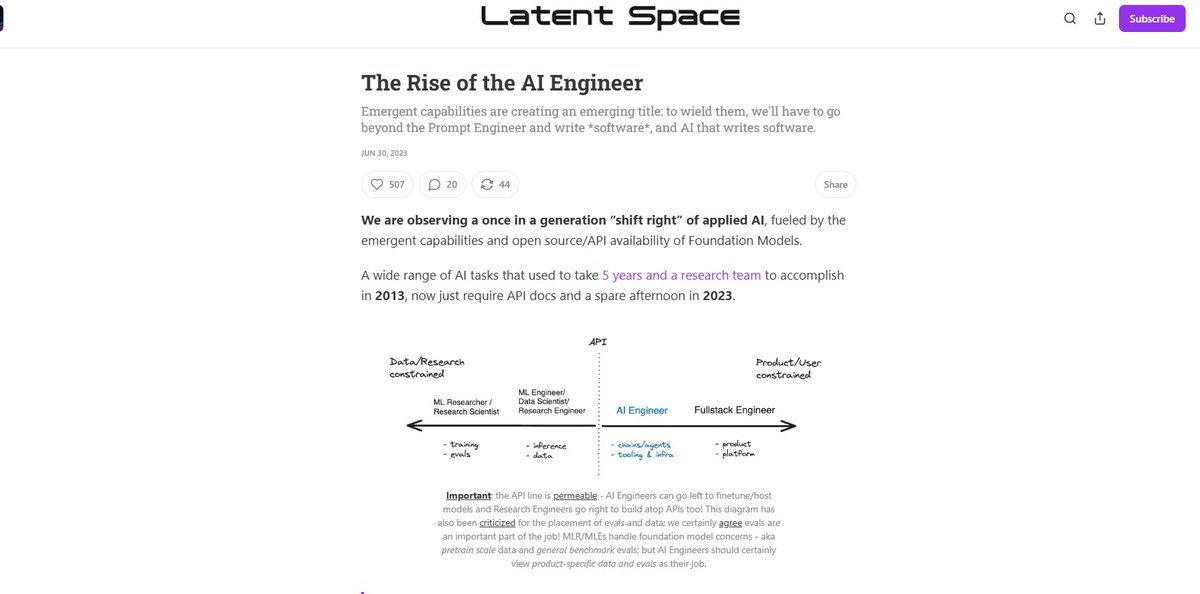
2. The Rise of the AI Engineer — swyx
https://t.co/98clCgWFKH
3. Coding Interview University
https://t.co/8bSlB344ob
4. Tech Interview Handbook
https://t.co/llozpr7nHc
5. System Design Primer
https://t.co/kj8QBHCZvh
6. Simon Willison's AI Blog
https://t.co/tUj3TXpSU9
7. Andrej Karpathy's Blog
https://t.co/DdCuNAEsCY
8. Gergely Orosz (The Pragmatic Engineer)
https://t.co/HUeKoEAIRr
9. Addy Osmani's Blog
https://t.co/tf3cDsvirK
10. Martin Fowler
https://t.co/sbPUyAts0Q
Better than another hour of scrolling.
Bookmark this. 📌