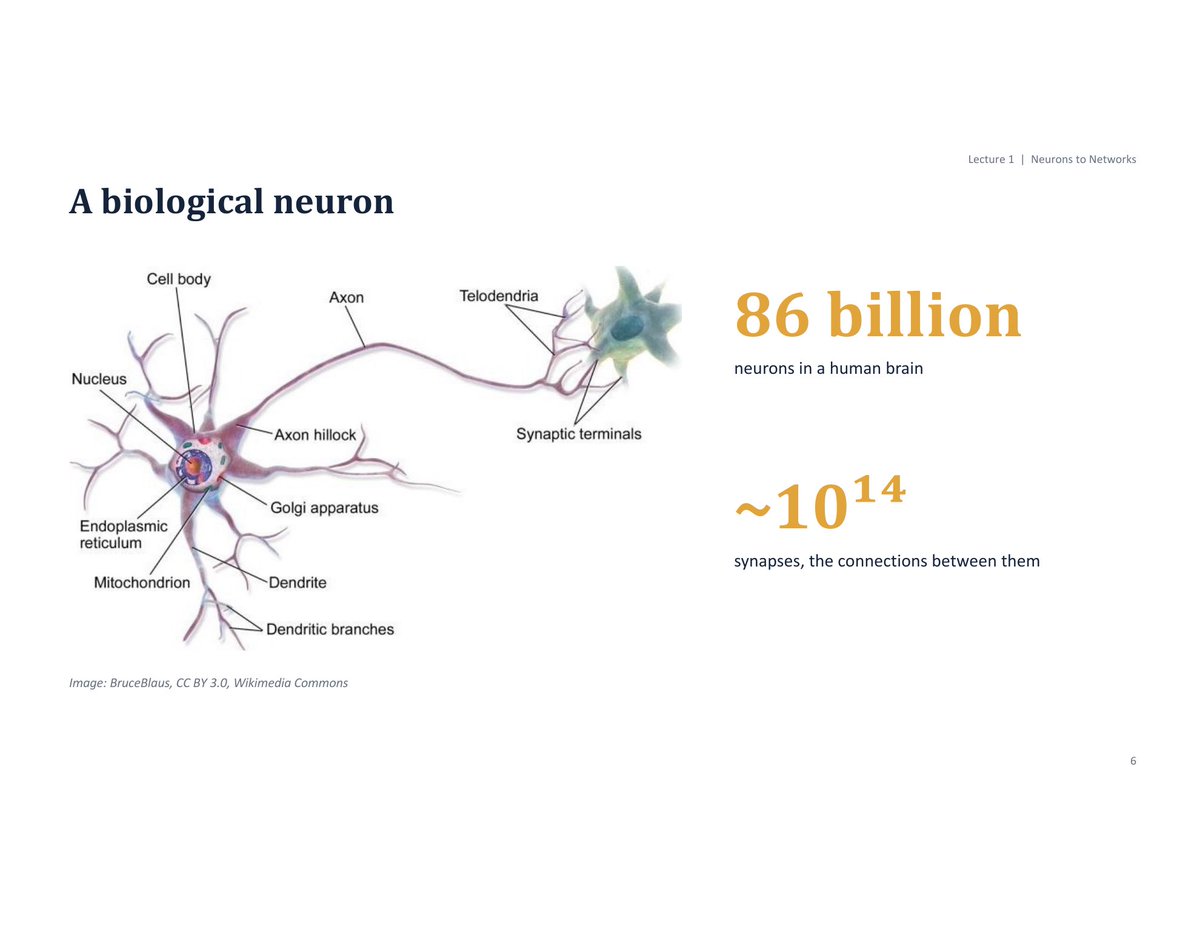
1/ These slides are from AI in Context, a course I helped design and co-teach. My module (From NN to LLM: Rise of the Machines) starts with biological neurons and follows the abstraction all the way to modern LLMs. I’m a little allergic to “brains are literally neural networks.”
Ben Affleck (Hollywood star & Artists Equity CEO) talks about how he fine-tunes open video models by unfreezing weights and trained only the last cinematic layer so a film crew can hit real production standards.
for context, Ben Affleck founded InterPositive in 2022, a 16-person AI shop for film post and Netflix bought it in March 2026 for $587 mn in cash.
He needed that model because public video models were trained on his peers' films, and he did not think that was a real business. So InterPositive raised money, shot its own dataset for 8 months on a controlled stage, and used it only as late-stage training.
Each new film then trains a private model on its own dailies, so the production keeps the footage and the learning. That is the product Netflix paid $587 million for.
----
From "Bloomberg Live" YouTube channel, (link in comment)
@waiting4_asi Finetuning and RL makes smaller models for many use cases significantly cheaper at comparible quality. Boris is incentivized to sell Claude and "general" models.
Any one who is privileged therefore owes it to the world to work on the most obnoxiously hard problems, not just build a life for themselves, but uplift people by building great companies and employing as many people as they can.
The privileged must risk it all, over and over again, until they are tortured to greatness.
This is my version of socialism, re- distribute risk. The rich have a moral imperative to embrace more risk.
New blog post with @perryadong on what we need for robots to be broadly useful in the real world.
https://t.co/jxsNeMUhFg
Reliability is the one of the biggest open challenges in AI right now. Current models work out okay if a person will be reviewing the outputs (eg drafting code), but it will become more of a bottleneck as we want systems to act with more autonomy and more trust.
After 2+ years in the robotics data space, we are shutting @Eidon_AI down.
The thesis was right. But the business is brutally hard.
We close this chapter by open-sourcing everything we built and sharing lessons for anyone venturing into the space. https://t.co/pyL9IkjQPT
Long range career advice. (Won't help you get a job tomorrow, this is a ~10-20 year thing)
You want to run two processes. Your main loop:
1. Knock on doors, many outside your league, and get yourself in a room with the most competent people who will have you.
2. Work your ass off to be reliably useful to them. Like, really, _really_ hard. However hard you think you're working to be reliably useful, work ten times harder. Also, be cheerful.
3. Every once in a while pop your head out and go to step 1.
Your background loop: look around for weird asymmetric opportunities. A startup to found/join, a project to hack on, an angel investment into a friend's company, whatever. When your heart sings, jump on it. (You will fail a lot but that's fine so long as you handle failure well, I'll cover that in another post)
In exchange for working really hard you get two things. First, knowledge/experience-- you learn a ton. Second, relationships-- ppl will remember how great it was to work with you. Knowledge and relationships with competent ppl create crazy asymmetric opportunities. You then jump on those. (There is a lot of twitter slop about compounding, well this is what career compounding looks like.)
---
Now some failure modes. Do _not_ do this:
"I deserve much better than this company/role, I'm just going to begrudgingly collect a paycheck" --> first, you deserve what the market clears and that's that. Second, if you act this way you'll only hurt yourself. Your colleagues will remember you as a grouch and it will wreck the compounding loop. Third, it's a very unpleasant state to be in, and you should choose not to be in it.
"But I work at Home Depot, what's there to compound?" --> that's extremely shortsighted. Maybe you do a super good job helping a customer who then has an open spot and remembers you. Maybe your store manager becomes a regional manager and calls you. Maybe years down the line your quiet peer is looking for a partner to start their own store. Maybe none of this happens, but it doesn't matter because empirically ppl who try hard to be useful wherever they are tend to do great, and people who don't, don't. (Home Depot is a metaphor, obviously)
"I hate this place, I quit! And anyway they're a faceless corporation that will lay me off any time." --> don't do that. The company may be a faceless corporation, but your colleagues are not faceless. They bet on you, hopefully you did a great job, and now they depend on you. Leaving is never easy, but do it in a way that respects the trust ppl put in you.
"Everyone around me is an idiot, I hate this!" --> maybe they are, or maybe you're not ready and some day will discover you were wrong about this. In any case you can learn from everyone and everything. So do that and be useful, don't break the compounding loop because opportunities will surprise you and things are often not what they seem.
“_I_ should have been promoted not that other guy/why is my manager layering me, screw this!” --> every time that happened i eventually understood I deserved it, you probably do too. Don’t hold grudges, do your best to figure out how to learn from this and move on, it will make sense eventually.
P.S. it helps if you’re a little talented.
Started avoiding AI for any first draft (tech design, requirements and so on) and noticing a big boost in productivity and clarity of thought! Thanks to Deep work by Cal Newport for the suggestion. I'm trying to get back to pen and paper for the initial draft - highly recommend :)