@bphillipsonMP The Gestapo were a police organisation not a military one, they did not march anyone anywhere, dragged would be a more apt word. Thank god you are not Education Secretary with a lack of such basic knowledge . . . . . . . . . . . oh!
Shabana Mahmood has CONDEMNED the Henry Nowak protests in Southampton, saying those responsible will be arrested.
Meanwhile, here she is on a pro-Palestine protest which turned violent and forced a supermarket to close.
She has since deleted this video. Please don't RT it.
'I don't think you have Mate', should go down in history as the line that inspired huge change within British policing, but it won't, because most senior officers are DEI and other woke nonsense obsessed tossers.
@PoliceChiefs@CollegeofPolice
@Keir_Starmer Did the Speaker of the House order you to make this pathetic post as he ordered your government to respond to the House of Commons today? Despicable, truly despicable.
Sky news are warning not to turn Henry Kowaks murder into a political football...
Said the Org who turned George Floyd's death into a political football
Fuck off Sky
Dear @Keir_Starmer
People can’t afford another £200 energy bill increase.
If you really wanted to make a change, you’d sack this lunatic before he bankrupts the country.
@InsideLucysHead The council replied they would be happy to do so but there was the matter of the fine of 1 shilling for every Sunday and holy day of missed archery practice since his 8th birthday. When he paid the fine which with interest was well over £2000 butts would be erected.
No reply.
@InsideLucysHead A similar story from Chester in the 1960s when a retired gentleman wrote to the council demanding they put archery butts on the Roodee (Chester races course) every Sunday so he could practice archery as every was supposed to do. 1/2
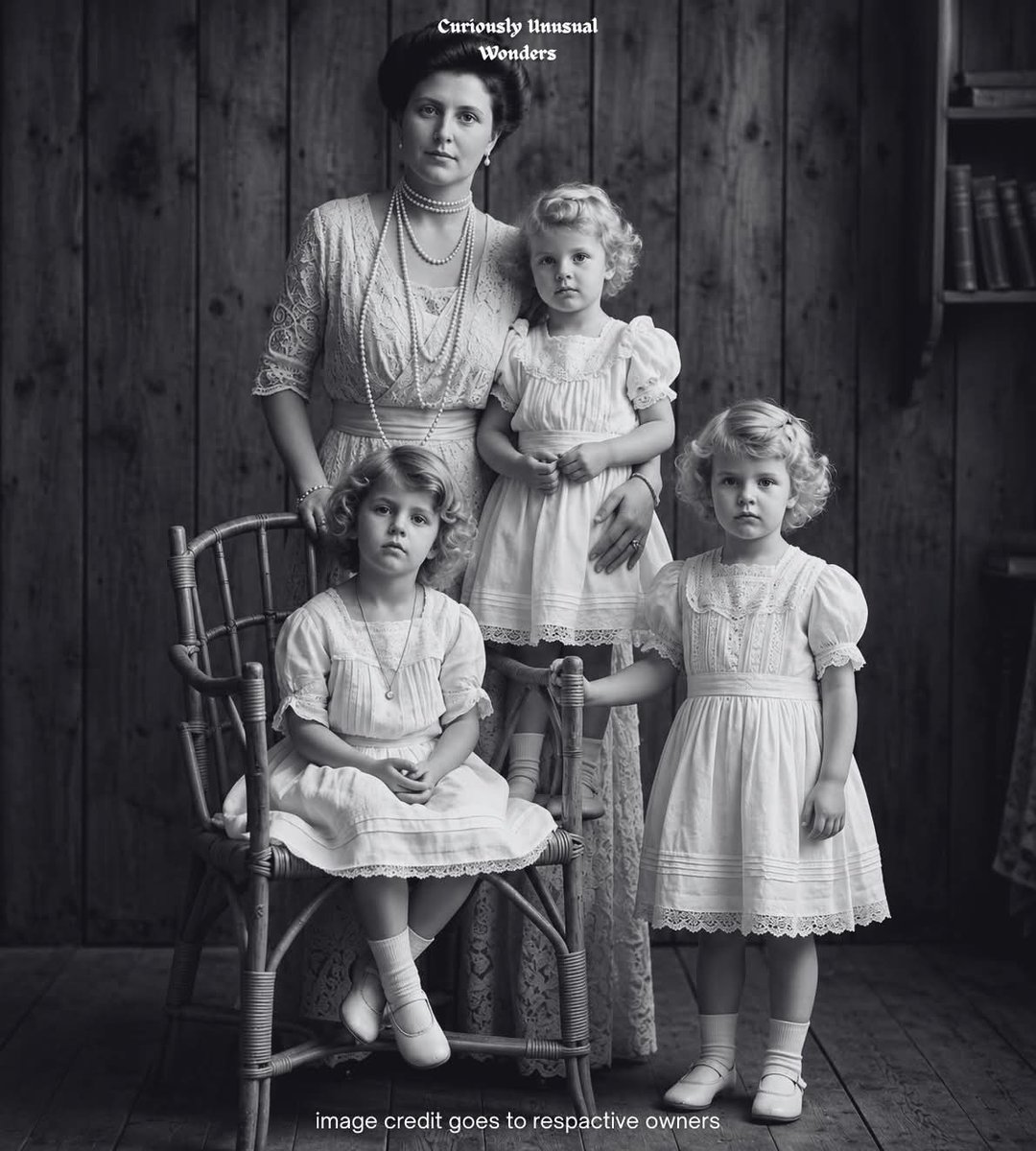
Princess Alice opened her front door to find the Gestapo waiting.
It was October 1943 in Athens, Greece. The Nazis controlled the city and were actively rounding up Jewish citizens, sending them to Auschwitz.
The officer asked her sharp questions about who lived in her house and about the persistent rumors that she was hiding people. Princess Alice was 58 years old—a British royal living in Greece, and a mother of five. She was also completely deaf.
She simply smiled, pointed to her ears, and made hand gestures.
The officer raised his voice. She raised her hands in return, pretending she couldn't read his lips. Eventually, he gave up and walked away.
Up on the third floor of her house, a Jewish widow and her children sat perfectly still, listening through the floorboards. They would stay hidden there for another full year.
Here is how she got to that moment.
She was born on February 25, 1885, at Windsor Castle in England. Her great-grandmother, Queen Victoria, was present at her birth. Alice was born deaf, but her mother patiently taught her to read lips in English, German, and French.
In 1903, she married Prince Andrew of Greece and moved to Athens. They had four daughters, followed by a son in 1921 whom they named Philip.
Then, Greece fell apart. The royal family was overthrown in 1922, her husband was nearly executed, and the family fled into exile.
By 1930, Alice suffered a complete mental breakdown. She began hearing religious voices and believed Christ was speaking to her. Her panicked family sent her to a clinic in Switzerland, where Sigmund Freud examined her and diagnosed her with schizophrenia.
Doctors subjected her to experimental treatments, including X-rays aimed at suppressing her hormones, mistakenly believing her religious visions stemmed from sexual frustration. She was locked away in institutions for two years.
During this time, her husband moved to France with his mistress, her four daughters married, and her nine-year-old son, Philip, was sent away to a boarding school in Britain. Alice didn't see her son for years.
She left the institution in 1932 and eventually moved back to Athens to start rebuilding her life. Then, the war arrived.
In 1941, the Germans invaded Greece, and by 1943, they occupied Athens. Alice’s life was deeply complicated. Her son, Philip, was fighting the Germans in the British Royal Navy. Meanwhile, two of her four daughters had married German princes, and some of her grandsons were serving in the Wehrmacht. Her own family was split on both sides of the war.
Alice chose to stay in Athens. She worked tirelessly with the Red Cross, ran soup kitchens, and set up shelters for orphaned children.
Then, the deportations of Greek Jews began. The Nazis sent 60,000 Greek Jews to Auschwitz—nearly 80 percent of the country's Jewish population. In Athens, the roundups started in September 1943.
That was when the Cohen family reached out to her. Haimaki Cohen had been a Greek member of parliament and a close friend of the royal family for decades. He had passed away earlier that year, leaving his widow, Rachel, alone with their four sons and a young daughter. The Gestapo was hunting them.
The four sons planned to escape to Egypt to join the Greek resistance, but Rachel and her young daughter, Tilde, couldn't make the perilous journey. When Alice heard about their plight, she sent a simple message: Come to me. I'll hide you.
Rachel and Tilde moved into the third floor of Alice's house, hidden away from the world. Later, when one of the sons was unable to escape to Egypt and returned to Athens, Alice took him in as well.
For over a year, she hid them. She knew perfectly well that if the Gestapo found out, she would be executed. She did it anyway.
She brought them food, kept her staff quiet, and visited Rachel every day. She sat with her, talked to her in Greek, and held her hand when she cried. And when the Gestapo came knocking, she used her deafness as a shield, pretending she couldn't understand a word they said until they finally left.
The Cohens remained hidden until December 1944, three weeks after Athens was liberated. When they finally came down from that third floor, they were alive. All of them.
Afterward, Alice told absolutely no one what she had done. Not her son Philip, not her daughters, and not her friends. The story stayed hidden for almost fifty years.
What makes her story so poignant is what followed. After the war, Alice’s life took another unique turn. She founded a religious order of Greek Orthodox nursing nuns, selling her own jewelry to fund it. She put on a nun's habit and lived as a nun for the rest of her life.
In 1947, her son Philip married Princess Elizabeth, the future Queen of England. Alice attended the ceremony at Westminster Abbey in her simple nun's habit—the only nun at one of the most famous royal weddings in history.
In 1967, following a military coup in Greece, Queen Elizabeth sent for Alice and brought her to live at Buckingham Palace. She spent the last two years of her life there—a nun-princess living in the heart of the British monarchy. She told her son Philip that she wished to be buried in Jerusalem, beside her aunt who rested there.
She passed away on December 5, 1969, at the age of 84. Initially, her remains were placed in the Royal Crypt at Windsor. But nineteen years later, in 1988, Prince Philip finally honored her last request, and her remains were moved to the Mount of Olives in Jerusalem.
In the early 1990s, the story finally came to light. Michel Cohen, one of Rachel's sons, was 78 years old when he decided to share what had happened. He went to Yad Vashem and told them about Princess Alice—how she had hidden his family for over a year and risked her life every single day.
In March 1993, Yad Vashem posthumously named her "Righteous Among the Nations," Israel's highest honor for non-Jews who saved Jewish lives during the Holocaust. She had been gone for 24 years.
In October 1994, Prince Philip flew to Jerusalem for the ceremony at Yad Vashem. It marked the first time a member of the British royal family had officially traveled to Israel.
During his speech, Philip noted, "We did not know, and as far as we know, she never mentioned to anyone, that she had given refuge to the Cohen family." He added, "I suspect it never occurred to her that her action was in any way special. She would have considered it a perfectly natural human reaction to fellow beings in distress."
The surviving members of the Cohen family traveled from France to attend, publicly thanking Prince Philip for his mother's incredible bravery.
Princess Alice. Born deaf, diagnosed with schizophrenia, locked away by her family, left by her husband, and separated from her young son. Yet, she saved a Jewish family from the Holocaust and never breathed a word about it for the rest of her life.
Her legacy lives on in a grave on the Mount of Olives, a dedicated tree at Yad Vashem, a grandson who became King, and a Jewish family whose grandchildren still light candles for her every single year.
She believed that saving lives was simply what it meant to be human. That is what makes her remarkable. And she was absolutely right.
Share this story. She deserves to be remembered.
The Soldier Who Found a Baby on the Battlefield and Carried Her for 40 Miles
The American Soldier Who Found an Abandoned Baby on the Italian Battlefield and Carried Her 40 Miles to Safety — Then Spent 60 Years Wondering If She Survived, Italy, 1944.
January 1944. Anzio, Italy.
The Anzio beachhead was a particular kind of hell — a narrow strip of Italian coastline held by Allied forces under constant German bombardment, no room to advance, no room to retreat, just the grinding daily mathematics of holding ground under fire.
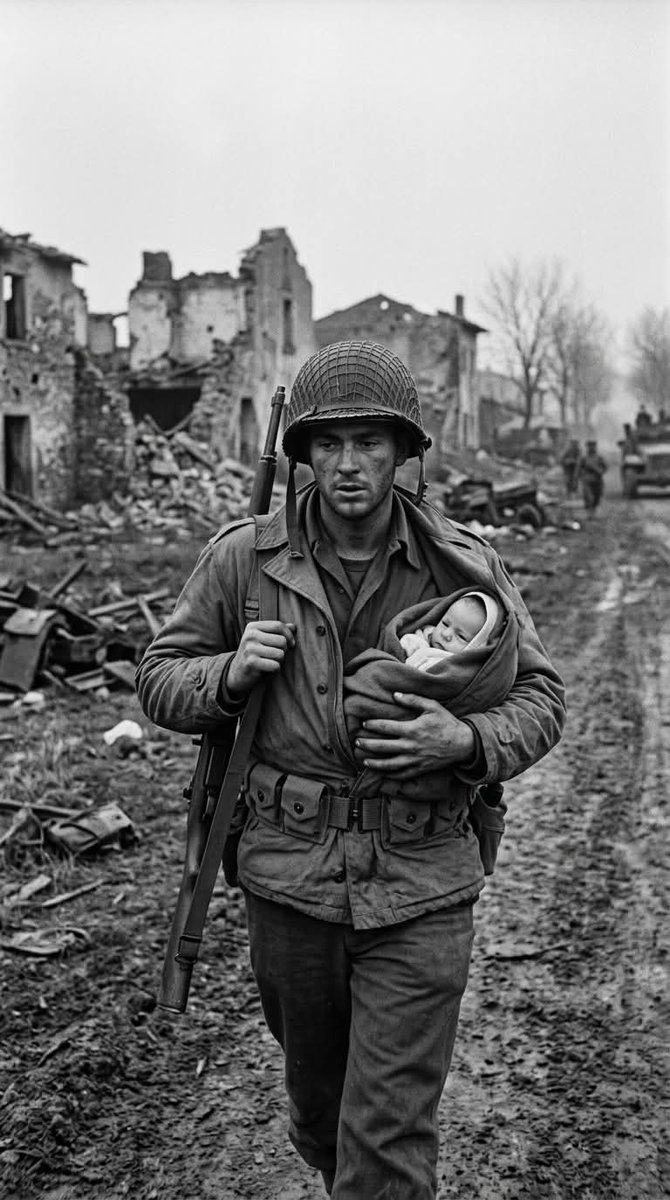
Corporal James Whitaker, 24, Georgia, was moving through a bombed farmhouse on a patrol assignment when he heard it.
Not crying — past crying.
The sound an infant makes when it has cried beyond what crying can accomplish and has gone to a place beyond it, a thin persistent sound like a mechanical thing running down.
He found her in the farmhouse cellar. An infant girl. Eight months old at the most. Alone in a wooden crate lined with a woman's wool coat. Alive, barely, from cold and dehydration.
No one else in the farmhouse. No one else anywhere visible.
He picked her up.
The Problem
James Whitaker was on a combat patrol in an active battle zone carrying an infant who would die if he put her down and who he had no ability to help if he kept her.
He had no formula, no milk, no baby supplies of any kind.
He had his canteen, a chocolate bar, and forty miles between his position and the field hospital at the rear.
He started walking.
The Forty Miles
He carried her inside his field jacket, against his chest, where the body heat kept her warm.
He gave her water from his canteen, dripped slowly from his finger to her lips the way he had seen his mother water young animals — a memory that surfaced from childhood without warning and turned out to be exactly applicable.
He broke small pieces of chocolate and let her suck the sweetness from his finger.
He moved at night when he could, staying off roads, moving through terrain that was simultaneously trying to kill him from German positions and from Italian winter.
He talked to her. Quietly, constantly, in the specific soft register humans use with infants regardless of whether the infant understands. He told her about Georgia. About his mother's cooking. About the farm where he grew up. He told her it was going to be fine, which he was not certain was true but which he had decided to commit to regardless.
She was alive when he reached the field hospital at dawn on the second day.
A nurse took her from his arms.
He sat down on the ground outside the hospital tent and did not get up for an hour.
The Handoff
The field hospital logged the infant as a found civilian, turned her over to an Italian Red Cross representative, and that was the last official record that connected her to James Whitaker.
He asked about her before he went back to his unit. They told him she was stable, that she would be placed with a relief organization, that she would be taken care of.
He went back to his unit.
He went back to the war.
The Sixty Years
James Whitaker came home to Georgia in 1945. He married. He had three children. He farmed and then he worked in hardware and then he retired.
He thought about the baby for sixty years.
Not obsessively — he was a practical man, not given to obsession. But consistently. On certain mornings. On certain nights. A presence in the back of his mind, an open question he had never been able to close.
She would be in her sixties now, he would calculate. He did not know her name. He did not know if she had survived the war, the occupation, the chaos of postwar Italy. He did not know if she had a family, children, a life.
He knew only that he had carried her forty miles and handed her to a nurse and never found out what happened next.
In 2004, his granddaughter Sarah — seventeen years old, working on a school project about WWII — asked him if he had any war stories.
He told her one.
Sarah put it on the internet.
The Finding
Three months later, a woman in Bologna, Italy, contacted Sarah's email address.
Her name was Maria Conti. She was sixty years old. She had been told, by the Italian family who had raised her, that she had been found as an infant during the Anzio campaign by an American soldier who carried her to safety.
She had been looking for that soldier for forty years.
James Whitaker was eighty-four years old when Sarah showed him the email.
He read it twice.
He looked up at his granddaughter.
"She's alive," he said.
"She wants to talk to you," Sarah said.
They spoke by telephone first — Sarah translating between English and Italian. Then by letter. Then, in 2005, Maria Conti flew to Georgia.
She was sixty-one years old. She was a schoolteacher. She had three children and five grandchildren.
She walked into James Whitaker's living room and he stood up — slowly, at eighty-five, he stood up — and they looked at each other.
Maria crossed the room. She took both his hands. She said something in Italian.
Sarah translated: "She says she has wanted to say thank you her whole life. She says she is sorry it took sixty years."
James Whitaker held her hands.
He said: "Tell her sixty years is nothing. Tell her I just needed to know she made it."
🚨 This footage of Andy Burnham being absolutely hounded by furious families at a public meeting should be required viewing for every voter in Britain — because this is the man quietly being lined up as Keir Starmer’s replacement.
Watch the raw anger. Mothers and fathers screaming from the public gallery, demanding answers about the systematic rape of hundreds of vulnerable British girls in Oldham and Greater Manchester. Burnham — the so-called “King of the North” — stonewalls them, shuts down calls for a proper public inquiry, and prioritises “community relations” over the broken bodies and shattered lives of working-class white girls targeted by grooming gangs.
Greater Manchester Police failed these victims catastrophically. Files ignored. Girls dismissed as “troubled” or “consenting.” Fathers arrested for trying to rescue their own daughters while the predators — overwhelmingly Pakistani-heritage men — operated with impunity for years. Burnham didn’t just turn a blind eye. He actively blocked full accountability. His toothless “Assurance Review” was a whitewash designed to bury the truth rather than expose it. He spent years defending it, denying a cover-up, only conceding the obvious when the scandal went national and international.
This isn’t ancient history. This is the same Andy Burnham who, as Mayor, refused to discipline senior officers who looked the other way. The same man who watched grooming gangs destroy lives and chose political correctness and bloc votes over the safety of our children. The same Labour careerist now being floated as the next Prime Minister — the antidote to Starmer’s collapsing regime.
Let that sink in.
In two-tier Britain, the feelings and electoral clout of certain communities matter more than the innocence of British girls. From Rotherham to Rochdale to Oldham to Manchester — the pattern is identical, and the cover-up machine is still running under Labour. Burnham isn’t the solution. He’s the continuation of the same rotten project that sacrificed our daughters for “diversity” optics and cheap votes.
The silent majority has had enough.
We demand:
✅ A full, fearless national inquiry into grooming gangs with no limits, no sacred cows, and real criminal consequences for every police chief, councillor, social worker and politician who looked the other way.
✅ Life sentences that actually mean life for the rapists — no more soft-touch sentencing.
✅ Burnham held to account publicly and barred from ever holding high office again. No “King of the North.” No return to Westminster. No path to No. 10.
✅ An end to the two-tier protection racket that puts imported communities above native British children.
Patrick Christys is right to keep showing this. The British people remember every girl failed. Every father arrested. Every inquiry blocked. And we will not let the grooming-gang apologists rewrite history or slither into power.
This is why Reform is rising. This is why the silent majority is awake.
Protect our children.
Demand real justice.
No more cover-ups.
No more Burnham.