Remain bless here is my winnings from game only God can reward you thanks @Smartfixed9
_
_
_
Peter Obi/Graham/Valentin Barco/Repentant/Nigeria for the FIRST TIME/Olise/Nollywood/#altın/Molineux/Benue/Ademola Lookman
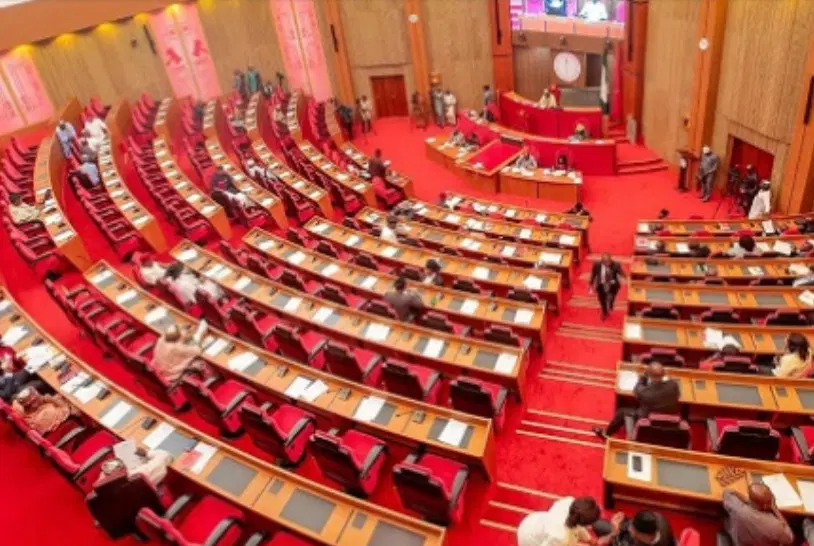
Details of constitutional amendments to provide an additional 12 women senators, 37 women representatives, and 3 women per state house via the Electoral College
Senate (Alteration of Section 48)
Original provision: The Senate consists of three Senators from each of the 36 States + one from the Federal Capital Territory, Abuja (total 109).
New provision (substituted Section 48):
• (a) Retains the original 3 Senators per State + 1 from FCT.
• (b) Adds two additional Senators from each of the six geo-political zones, who must be women and elected in accordance with the new Section 77A (via Electoral College, with rotation among States in the zone as prescribed by an Act of the National Assembly).
Key details:
• Total additional seats: 2 × 6 zones = 12 additional women Senators.
• Rotation of the extra seats among States within each geo-political zone (order, pairing, transition, etc.) to be prescribed by an Act of the National Assembly.
• The extra seats are treated as special senatorial seats for geo-political zones (delimitation rules for ordinary seats do not apply).
• Provisions take effect at the first general election after commencement and are reviewed after 16 years.
House of Representatives (Alteration of Section 49)
Original provision: 360 members representing Federal constituencies of nearly equal population (no constituency spans more than one State).
New provision (substituted Section 49):
• (a) Retains the original 360 constituency-based members.
• (b) Adds one additional member for each State and the Federal Capital Territory, who must be a woman and elected in accordance with the new Section 77A (via Electoral College).
Key details:
• Total additional seats: 36 States + 1 FCT = 37 additional women Representatives.
• The extra seats are treated as special Federal constituencies for the States/FCT (ordinary delimitation rules do not apply).
• Provisions take effect at the first general election after commencement and are reviewed after 16 years.
State Houses of Assembly (Alteration of Section 91)
Original provision: A State House of Assembly consists of 3 or 4 times the number of Federal constituencies in the State (minimum 24, maximum 40 members), divided to reflect nearly equal population as far as possible.
New provision (new subsections (2)–(4) inserted after subsection (1)):
• (a) Retains the original constituency-based members.
• (b) Adds three additional members per State, being one woman elected from each of the three Senatorial districts in the State, in accordance with the new Section 117A (via Electoral College).
Key details:
• Total additional seats: 3 women per State House of Assembly (one per Senatorial district).
• These are treated as additional special State constituencies (ordinary delimitation/size rules do not apply).
• Provisions take effect at the first general election after commencement and are reviewed after 16 years.
Common Provisions for All Special Seats (Senate, House of Reps, State Assemblies)
• Election method: Indirect election by Electoral College (not direct constituency election). INEC conducts and supervises all such elections.
• For Senate & House of Representatives (new Section 77A): A State Electoral College per State (or FCT Electoral College). Composition:
• All elected LGA Chairpersons & Vice-Chairpersons.
• All elected LGA Councillors.
• All members of the State House of Assembly.
• All House of Representatives members from the State.
• All Senators from the State.
• (FCT version uses Area Councils instead of LGAs.)
• For State Houses of Assembly (new Section 117A): Identical State Electoral College composition per State.
• Candidates: Must be women, sponsored by registered political parties. Must meet the usual qualification/disqualification rules (Sections 65/66 for National Assembly; 106/107 for State Assemblies).
• Voting: One vote per Electoral College member; secret ballot.
• Detailed rules: An Act of the National Assembly will prescribe procedures (accreditation, quorum, voting, collation, results declaration, tie-breaking, vacancies, by-elections, substitution, withdrawal, campaign finance, election petitions, transparent party nomination processes, rotation for Senate seats, etc.). The Act cannot alter the Electoral College composition set in the Constitution.
• Status of elected women: Same tenure, rights, privileges, immunities, and obligations as members elected to ordinary seats.
• Vacancies: Filled as prescribed by an Act of the National Assembly.
• Recall: Special procedure via the relevant Electoral College (petition by at least half its members → INEC verification → approval by at least two-thirds of members via secret ballot). Ordinary recall rules do not apply.
• Other consequential changes: Updates to Sections 69 (recall), 71/72 (Senatorial districts/Federal constituencies), 76/116 (election timing), 112/113 (State constituencies), 285 (pre-election matters/election petitions — “election” now includes these indirect elections), 318 (new definitions for “additional special seat”, “electoral college”, “geo-political zone”), First Schedule (new Part IA listing the six geo-political zones and their States), and Third Schedule (INEC powers now explicitly cover these special seats via Electoral College).
Explanatory Memorandum summary: The bill introduces these additional special seats for women as a temporary special measure to promote women’s representation in the legislature and strengthen inclusive governance.
JUST IN: Nigeria 🇳🇬 Senate today passed the second reading of the bill to amend the Federal High Court Act, which seeks to increase the number of federal high court judges from 70 to 90.
Constitution Amendment Bill Seeks Creation Of 12 New Seats In Senate, 37 In Reps, 108 In State Assemblies Exclusively For Women | Sahara Reporters https://t.co/owosowFSYA
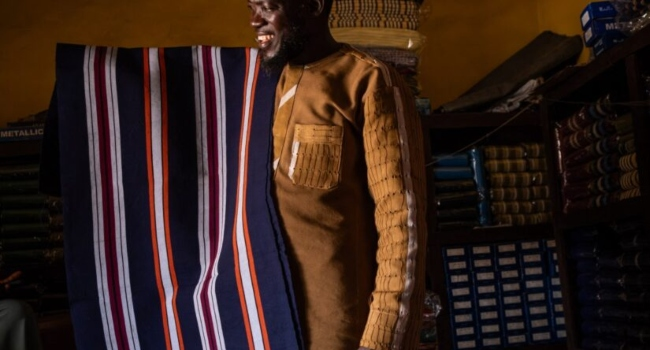
MAN Seeks Stakeholder Engagement Over Senate’s Proposal To Ban Textile Import
On Tuesday, the Senate asked the Federal Government to ban the importation of textile materials in a bid to boost local production and revive the country’s struggling textile industry.
https://t.co/ufNY5rk5bW
Senators Avert Fire Outbreak At National Assembly
The incident occurred in the kitchen compartment of Hearing Room 107 shortly after the Senate Committee on NDDC concluded the screening of Dr. Zainab Marwa, the nominee representing the North-East on the commission’s board.
https://t.co/vdZFJrsZIj
The Senate has passed for second reading two bills seeking to expand the number of judges in the nation’s superior courts as part of efforts to decongest the judiciary and accelerate the dispensation of justice across the country.
The proposed legislation seeks to increase the number of judges of the Federal High Court from 70 to 90 while also raising the number of justices of the Court of Appeal from 70 to 110.
https://t.co/MlVvlywe69
Last night, I had an interview with Arise TV, where I sympathised with our aspirants over some noticeable irregularities in our just-concluded primaries.
I noted that, while not claiming that the exercise was perfect, I urged all of them to bear with the party in view of the circumstances we are managing, which have overwhelmed even bigger parties. This includes parties with a sitting President, 33 Governors, and control of political structures in most states, in the case of the APC, and even the ADC, which is over two years old.
I made the case that we are just four months old and have been thrown into the middle of a very tight electoral timeframe, within which we had to carry out membership registration, congresses up to the national convention, primaries up to the national convention, appeal processes, and now the reconciliation phase.
I identified the root cause of these challenges, my views on the Electoral Act have been clear: the APC-led majority were wrong in foisting compulsory direct primaries on political parties and the country. Complaints about irregularities in direct primaries are pervasive across all parties and are not peculiar to the NDC.
As a matter of fact, considering the age of the NDC and the teeming number of aspirants we have had to manage, we have done quite well. For months since the formation of the NDC, I have been building confidence and receiving respected politicians into its fold. Since the primaries I have been attending to people and managing disagreements across the country on a daily basis.
The NDC is on the ascendancy, and I thank Nigerians for their trust and confidence in our party. Even these challenges, which are not peculiar to us, will pass.
I also noted that no party has announced any set of winners from its primaries, and neither has the NDC. The public should disregard any such claims in circulation, especially on social media, and await the party's formal submissions through the appropriate channels. The results of party primaries are not announced like school results; they are communicated through formal channels.
I thank all our members for their abiding support. In anticipation of these challenges, the 2nd NEC meeting, held a few days ago, approved the composition of a Reconciliation Committee to work with state caucus leaders and other stakeholders in managing grievances.
As I have stated before, this is our first set of primaries, and it will also be the last to be conducted manually. The next primaries will be technologically driven and will have none of these issues.
I thank all supporters of our party, which has no government officials and is entirely self-funded. I appreciate their donations, contributions, and sacrifices made on behalf of the party. They remain valuable members of our party regardless of the outcome of the primaries.
We are in this together, and we are all committed to ensuring the success of our party and our presidential team, their Excellencies Peter Obi and Senator Rabiu Musa Kwankwaso, who are my colleagues in this project.
This success must be managed carefully, with everyone working together. I advise all members and supporters to avoid meaningless quarrels and infighting. Everyone should support our candidates, from the Presidency down to the least elective office.
I urge all the stakeholders, caucus leaders and other leaders in various states who coordinated the primaries to take responsibility and step up their game in terms of coordiating the reconciliation process. Most of the candidates are persons backed and recommended by them, and not me nor the national leadership of the party. It is not a time to shift blames or dodge responsibilities. Since they midwifed and managed the process of the primaries, they should equally help in supporting the party in coordinating the reconciliation process, of which they have the support of the party.
~HSD
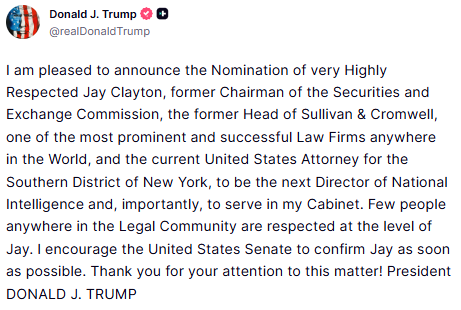
🚨 JUST IN! TRUMP NAMES JAY CLAYTON AS NEXT DIRECTOR OF NATIONAL INTELLIGENCE
President Trump just announced the nomination of Jay Clayton, former SEC Chairman, top attorney at Sullivan & Cromwell, and current U.S. Attorney for the Southern District of New York, to lead National Intelligence and serve in his Cabinet.
A heavyweight legal mind with massive respect across the board. Smart pick.
Senate needs to confirm him ASAP. America First team getting stronger.