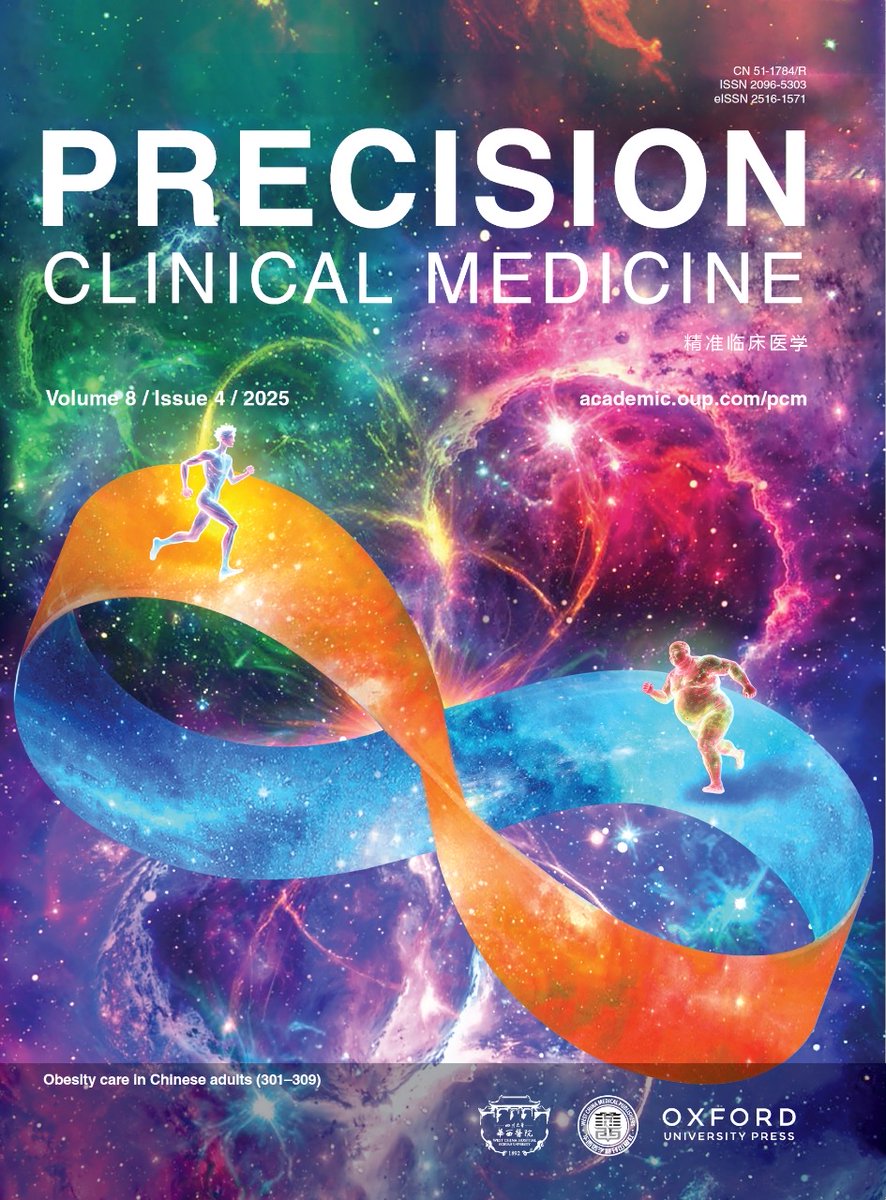
PCM is an international, peer-reviewed, open access journal that publishes original research articles, case reports, reviews, editorials and perspectives.
Out now: The December issue of Precision Clinical Medicine (Vol 8, Issue 4) is live! 🔬
This issue explores: 📉 New guidelines for obesity management 🤖 AI’s impact on the future of endocrinology 🧬 CRISPR-based prime editing 🎗️ HER2-ultralow breast cancer research
Full issue here: https://t.co/rhWfYUYBTn
Liquid biopsies offer a minimally invasive way to monitor minimal residual disease and track tumor evolution. This technology is vital for precision oncology and improving long-term patient survival.
https://t.co/aB51TnpA0A
Early detection is key for gastric cancer survival. This AI-based system uses CNN architecture to identify lesions with high precision, matching expert performance to improve patient outcomes. https://t.co/wILQJAciDD
Precision medicine transforms HNSCC care. Targeted therapies like cetuximab and immunotherapies like pembrolizumab offer personalized oncology approaches based on genomic profiling of mutations like TP53 and PIK3CA. https://t.co/JkXZnqgoxz
A systematic review confirms PD-1/PD-L1 inhibitors plus chemotherapy as a powerful first-line treatment for advanced ESCC. The combo therapy improved objective response rates and overall survival across multiple clinical trials. https://t.co/Xdo2b2Ki4H
Digital pathology and multi-omics are being transformed by machine learning. AI-driven insights enable more accurate cancer screening and tailored drug discovery for better patient care.
https://t.co/n8uC0bZOQ9
Thyroglossal Duct Cyst
A congenital midline neck mass originating from thyroglossal duct remnants during embryonic thyroid descent. It presents as a painless swelling that characteristically moves upward during swallowing or tongue protrusion due to its attachment to the hyoid bone. Common symptoms include a visible lump and occasionally difficulty swallowing.
Source: @NIH
B. Warfarin and C. Heparin
Deep vein thrombosis (DVT) is a blood clot in a deep vein, typically causing leg swelling and pain. Anticoagulation therapy with rapid-acting Heparin and maintenance-dose Warfarin prevents the clot from growing or breaking off to cause a life-threatening pulmonary embolism. Patients should watch for increased bleeding or bruising.
Source: @MayoClinic
Automated tools using deep learning are vital for managing COVID-19 surges. By leveraging public datasets and pre-trained models, AI can accurately classify infections and segment lesions in medical imaging.
https://t.co/xY8cG5NBNV
C. Vitamin D deficiency rickets.
Vitamin D deficiency rickets is a bone-softening condition in children caused by inadequate mineralization. Frontal bossing involves a prominent forehead due to excess uncalcified osteoid tissue, while weight-bearing on soft bones leads to bowed legs (genu varum). Other signs include widened wrists, ankles, and delayed fontanelle closure.
Source: @medlineplus
Immunotherapy and new biomarkers like Claudin 18.2 are reshaping gastric cancer treatment. ICIs like nivolumab offer significant benefits for PD-L1 high or MSI-H subgroups, improving survival outcomes. https://t.co/C0o9R1Qs4f
Pharmacogenomics is transforming how we manage drug-induced liver injury (DILI). Research highlights HLA and non-HLA genetic variants as key risk factors. Personalized medicine aims to prevent DILI and improve patient safety. https://t.co/x2NQxpk2YV
Caregivers of NSCLC patients face significant mental health challenges and activity impairment. Effective cancer management should encompass screening for caregiver distress and providing resources to support the patient-caregiver unit. https://t.co/vQlorqaE8L
Advancing heart health through precision: Polygenic risk scores and AI-driven diagnostics enable earlier CVD intervention and more accurate risk prediction. https://t.co/BD1BcJjz1r
Drug repurposing offers hope for cancer patients lacking actionable mutations. This systematic framework uses NGS and functional validation to identify high-level evidence opportunities, improving outcomes for advanced refractory cases. https://t.co/IRflpomJKq
From accelerating drug discovery to refining radiotherapy planning, artificial intelligence is transforming oncology. This review highlights AI’s potential to improve patient outcomes through precision medicine. https://t.co/OvyWNaVgjP
Mpox
Mpox is a viral zoonotic infection caused by the Mpox virus. It presents as firm, deep-seated, dome-shaped papules and pustules, typically featuring central umbilication. Key symptoms include fever and lymphadenopathy, followed by a rash that evolves across multiple stages over several weeks. Transmission occurs through close contact.
Source: @CDCgov
Tooth Enamel
Enamel is the thin, protective outer layer of the tooth crown. Composed of 96% hydroxyapatite, it is the body's hardest substance, protecting teeth from the mechanical stress of chewing. Erosion or loss of this mineralized tissue leads to symptoms like dental sensitivity, pain, and increased susceptibility to cavities.
Source: @MayoClinic
Regular physical activity reduces the risk of breast (12-21%) and colorectal (19-27%) cancers by improving metabolic regulation and reducing inflammation. Aim for 150 minutes of moderate activity weekly to lower risk.
https://t.co/LGxTBz5KES
AI-driven spatial transcriptomics is transforming precision oncology and neuroscience. By mapping gene expression in context, researchers can better predict immunotherapy responses and understand neurodegeneration. https://t.co/Pe241btZqA
Croup (Laryngotracheobronchitis)
Croup is a viral respiratory infection causing inflammation and subglottic narrowing of the trachea, visualized as a steeple sign on imaging. Pathophysiology involves mucosal edema in the subglottic space, resulting in a characteristic barking cough, hoarseness, and inspiratory stridor. This condition primarily affects pediatric patients and can lead to significant respiratory distress.
Source: @Radiopaedia