What is Prelisted? 📡
Prelisted tracks on-chain activity around exchange staging and listing preparation.
We monitor patterns like:
• exchange wallet flows
• deposit activation
• staging behavior
• repeated signal clusters
Goal: detect signals before official listing announcements.
Examples caught so far:
• HTX (~21h lead)
• MEXC (~1.9h lead)
• KuCoin (~64d lead)
• Bitget (~61d lead)
Some signals are noisy.
Some arrive very early.
Some become listings.
Building in public ↓
Quiet week here — spent it on the unglamorous work of cleaning how we attribute tokens across chains and exchanges.
There are far more ticker collisions than anyone wants to admit.
Side effect: surfaced an industrial-scale scam factory on #Avalanche, deploying thousands of impersonator contracts of popular tokens, all from a single coordinated operator.
Catching the real signals means clearing the fake ones first.
#AVAX #CryptoSecurity #OnChain
🔍 Watching: APXCOIN ( $APX )
Recent exchange-linked activity detected across:
• #Binance
• #Gemini
No #CoinGecko identity yet.
No confirmed listings.
Currently classified as:
high-noise / low-confidence staging.
One of the more difficult parts of exchange intel is distinguishing:
• real pre-listing prep
vs
• ticker collisions
• metadata drift
• copycat contracts
Monitoring for follow-up activity.
#crypto #onchain #cryptoalpha
$ZIK is showing one of the more interesting early-stage patterns we’ve seen lately.
Not “confirmed listing” activity.
But possible infrastructure prep.
Over the last few days, wallets tagged to:
#Binance, #OKX, #KuCoin, #Kraken, #Coinbase, #HTX, #Bitfinex and others
have all interacted with the token in small repeated transactions.
Most transfers are tiny “dust” amounts — which is exactly what often appears during:
• address testing
• routing validation
• MM prep
• exchange compatibility checks
Important:
This does NOT mean a listing is confirmed.
But multi-exchange wallet touching in a compressed timeframe is not typical random retail behavior either.
Right now this looks more like:
Stage 1–2 wallet staging
than actual exchange deployment.
Watching for:
• repeated reuse of the same exchange wallets
• larger follow-up transfers
• liquidity expansion
• market maker overlap
That’s where signal quality increases dramatically.
#crypto #cryptoalpha #onchain
Update:
Since initial confirmation $CTR got listed on:
🟢 #Coinbase → ~24.7d lead
🟢 #Kraken → ~15.0d lead
🟢 #HTX → ~35.3h lead
Initial staging activity was appearing across these venues before the first public listing landed.
Interesting footprint 👀
#crypto#onchain #cryptoalpha
🚨 CONFIRMATION: $CTR → #MEXC
Interesting one:
Initial staging footprint wasn’t on MEXC.
Detected activity was appearing across:
• #Coinbase
• #Kraken
• #HTX
MEXC ended up confirming first.
This is why the footprint is more important than the specific venue — exchange prep often spreads before the first public listing lands 👀
#crypto #cryptoalpha #onchain
Interesting edge case surfaced this week:
Three completely different tokens sharing the same ticker: $SLX
• Slimex - BNB Chain (SLIMEX/USDT on MEXC)
• Solstice - Solana (listed on MEXC as SLX/USDT)
• A BNB copycat (0x70db0c…) with no CoinGecko identity
What happened:
When #MEXC listed Solstice, our confirmation pipeline matched the event against previously detected on-chain activity.
Problem: those signals actually belonged to the BNB copycat.
Subscribers briefly received an incorrect confirmation (~2d lead, 5 signals caught).
Root cause - ticker collisions.
Contract-level attribution was always preferred, but reliable exchange-side contract data wasn’t consistently available in the pipeline.
Today I patched pulling network contract mappings directly from exchange metadata across multiple venues, which allowed replacing ticker-first matching with contract-first resolution.
Fix shipped.
Incorrect confirmation removed from audit history and a correction sent to subscribers.
Reminder:
Names can collide. Contracts generally don’t.
#crypto #onchain #web3
🚨 CONFIRMATION: $UNITED → #Bitget
Signal detected: Apr 1
Lead time: 54 days
Signal footprint: 6 on-chain signals
Initial activity wasn’t isolated:
After the original detection, $UNITED later listed across multiple venues:
• #MEXC (May 10)
• #HTX (May 10–12)
• #Gateio (May 10–12)
• #KuCoin (later delisted May 22)
• #Bitget confirmed today
Sometimes the signal resolves as one listing.
Sometimes it turns into an exchange trail.
#crypto #onchain #cryptoalpha
🚨 CONFIRMATION: $CTR → #MEXC
Interesting one:
Initial staging footprint wasn’t on MEXC.
Detected activity was appearing across:
• #Coinbase
• #Kraken
• #HTX
MEXC ended up confirming first.
This is why the footprint is more important than the specific venue — exchange prep often spreads before the first public listing lands 👀
#crypto #cryptoalpha #onchain
Interesting discussion here 👇
Execution matters, but this is the pattern I noticed while reviewing catches:
The strongest moves often happen when it’s either:
• first-ever exchange exposure
• or major exchange events (#Binance / #Coinbase / #OKX etc.)
Been tracking post-listing behavior on recent detections, small sample below👀
#crypto #onchain
🔄 RETROSPECTIVE: $TRAC → #Upbit
Detected: Apr 1
Confirmed: May 18
Lead time: 46.3 days 🛰️
Signal footprint:
• 9 on-chain signals
• repeated activity over ~3 weeks
• eventual Upbit routing
48h after listing:
📈 +110%
Interesting part:
This wasn’t a single wallet move.
The pattern formed gradually before resolving into a real listing.
#onchain #crypto #prelisting
✅ CONFIRMATION: $GENIUS listed on #Binance
📡 Detection lead: 41.1d
🛰️ 1 on-chain signal
Interesting part:
The original signal wasn’t obvious.
Small exchange wallet activity across multiple venues, limited public information, moderate risk score.
Not every signal starts loud.
Some begin as weak patterns — then resolve later.
Proof below ↓
#onchain #crypto #prelisting #cryptoalpha
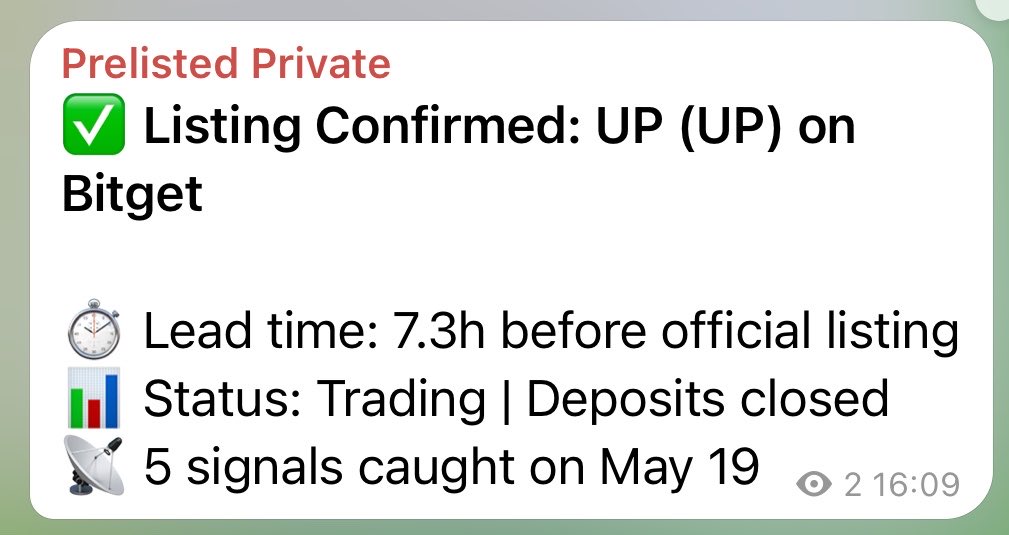
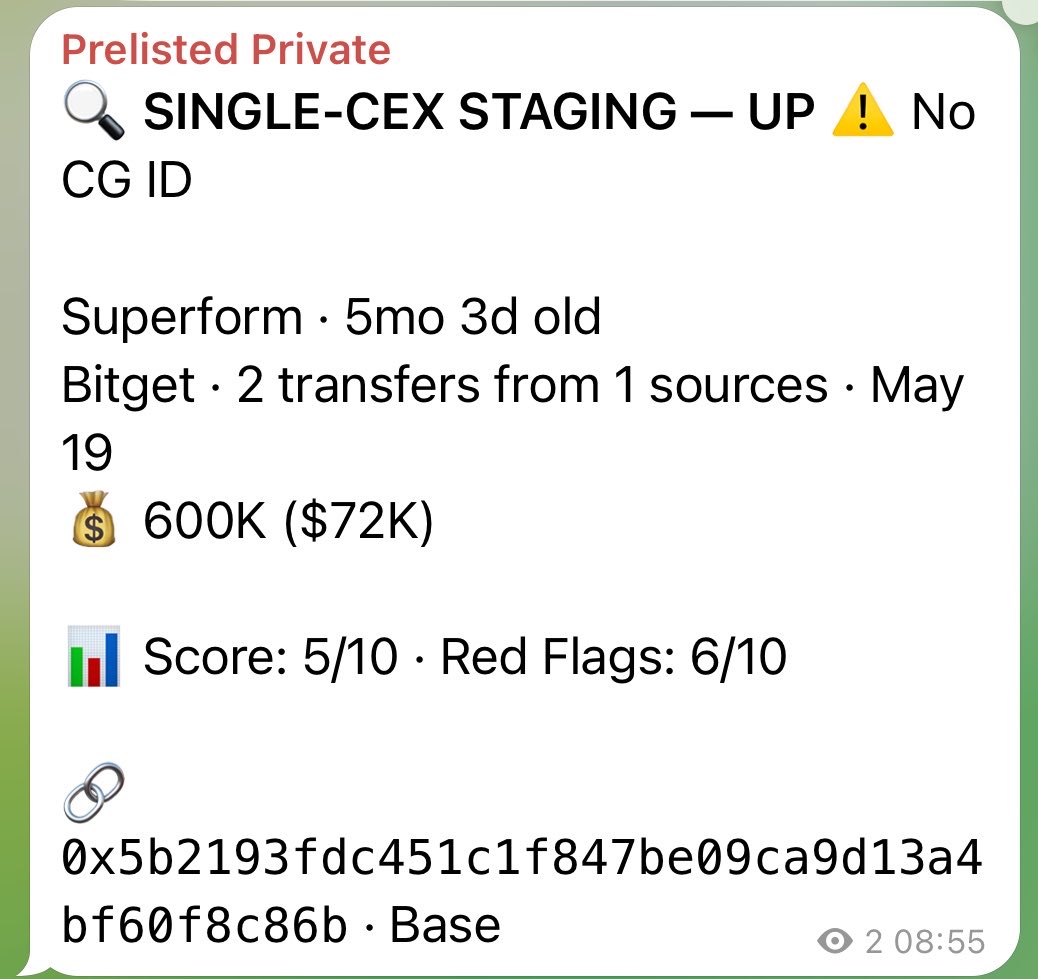
✅ PUBLIC CONFIRMATION: $UP (Superform) listed on #Bitget
📡 Detection lead: 7.3h
🛰️ 5 on-chain signals
⚠️ No CoinGecko ID at detection
Early signals don’t always arrive with perfect metadata.
Sometimes the strongest clue is simply repeated exchange flow behavior.
Proof below ↓
#crypto #cryptoalpha #onchain #web3